A few tips and label basics

By Brad Berkman & Louis J. Terminello of Greenspoon Marder LLP
Virtually every wine that it makes to the shelf of a US wine shop has had its label reviewed by the Alcohol and Tax and Trade Bureau (TTB) of the U.S. Government. After a review and compliance is found, a Certificate of Label Approval is issued, commonly known by its acronym, COLA (Wines below 7% a/b/v do not need label approval, but the labels must comply with FDA requirements).
COLAs do not grant the holder any legal ownership rights but rather indicate that the wine meets all federal labeling regulations with the ultimate goals of ensuring that labels do not contain any misleading, deceptive or inaccurate statements, they properly identify product identity. and contain the ubiquitous “health warning” statement a/k/a the “GOVERNMENT WARNING.” Importantly, COLA’s travel under the permittee, not by brand. This means that each producer or importer must hold the COLA under its TTB permit, regardless of whether the product was previously issued a COLA.
Label Basics
Labels must have certain required information under the law. This is referred to as “mandatory” information. All other information, absent a mandated exclusion, is generally referred to as voluntary information, which the producer may wish to include on its label.
Mandatory Information-Required Information:
The following must be placed on the label(s):
• Brand name and class/type designation.
• Alcohol content.
• Net contents statement
• Producer’s name and address.
• Government health warnings.
• Country of origin (for imports).
• Sulfite declaration (for most wines).
• Appellation of Origin
An appellation of origin is not always needed on all wine labels, but it must be stated when the following is on the label:
• A vintage date
• A varietal designation.
• A type designation of a varietal.
• A semi-generic designation.
• An “estate-bottled” claim.
It should also be noted that each piece of information be placed on the appropriate label as required by the law. Some information is placed on the back label, while other information may be on the brand label.
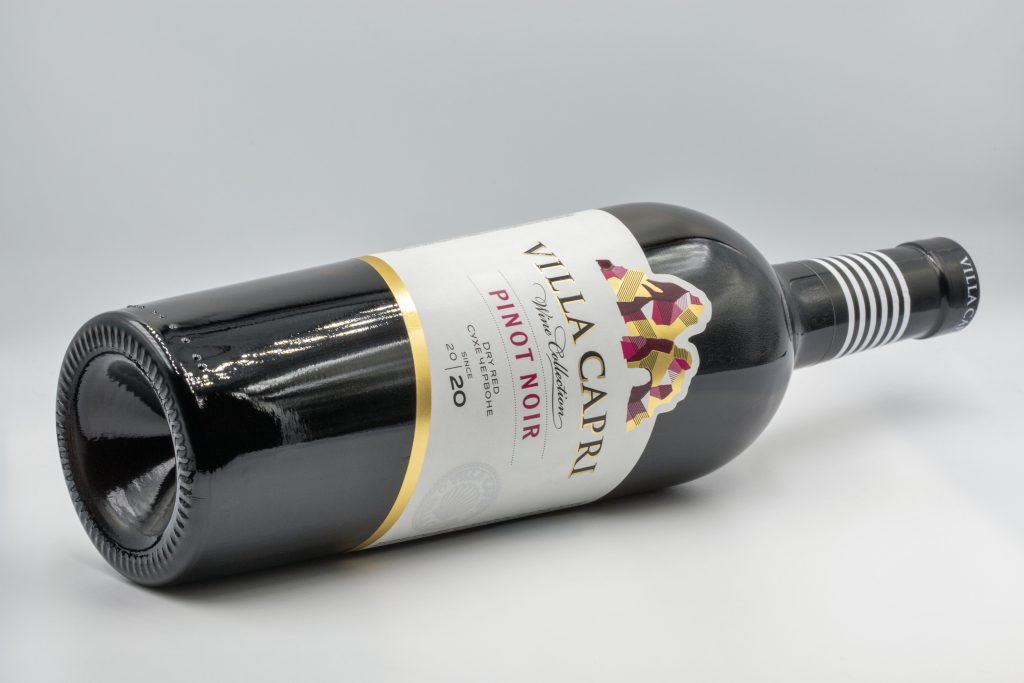
Notes on Stating Varietal:
Only grape varietals approved by TTB can be used. The list of grape variety names and their synonyms, approved for use, can be found in subpart J in 27 CFR 4 (Code of Federal Regulations).
Another important point worth noting is the 75% rule. If the varietal is stated on the label, with certain exceptions, 75 percent or more of the wine must be made from the named grape variety. Also, the entire 75 percent of the grape variety must have been grown in the labeled appellation of origin.
Producers and importers may use multiple grape varietal names on the label. When this is the case, all the grapes used to make the wine must be on the label, and the percentage of the wine derived from each grape is shown on the label as well, with certain tolerances permitted (2%).
Nutritional Information-Is it Required? For now, nutrient information may be placed on a wine label, but it is not mandatory. The reader should be aware that there are two TTB proposed rules open for public comment. One rule requires the disclosure of per-serving alcohol, calorie, and nutrient content information in an “Alcohol Facts” statement on all alcohol beverage labels. The other requires a labeling disclosure of all major food allergens used in the production of alcoholic beverages, such as milk, eggs, fish, crustaceans’ shellfish, tree nuts, wheat, peanuts, soybeans, and sesame, as well as ingredients that contain protein derived from the aforementioned foods.
If nutrient information is voluntarily placed on the label (as well as advertising materials), specific requirements apply. Only calories, fat, carbohydrates, and protein may be included, and according to a TTB webpage, they must be stated in the following manner:
• Calories: A statement of the caloric content per serving must be expressed to the nearest calorie, except that amounts less than 5 calories may be stated as zero.
• Fat: A statement of the number of grams of total fat in a serving must be expressed to the nearest 0.5 (1/2) gram increment below 5 grams and to the nearest gram increment above 5 grams. If the serving contains less than 0.5 grams, the content may be expressed as zero.
• Carbohydrates: A statement of the number of grams of total carbohydrates in a serving must be expressed to the nearest tenth of a gram, except that if a serving contains less than 1 gram, the statement “Contains less than 1 gram” or “less than 1 gram” may be used as an alternative, or if the serving contains less than 0.5 gram, the content may be expressed as zero.
• Protein: A statement of the number of grams of protein in a serving must be expressed to the nearest tenth of a gram, except that if a serving contains less than 1 gram, the statement “Contains less than 1 gram” or “less than 1 gram” may be used as an alternative, and if the serving contains less than 0.5 gram, the content may be expressed as zero.
According to TTB ruling 2013-2, Serving Facts statement appearing on a label or an advertisement may be stated per container size if the container is equal to or less than a single serving size. Serving Facts statement may be presented in dual-column format, which provides information both per serving size and per container size. The per serving size requirement is- a single serving is 12 fl. oz. for malt beverages; 5 fl. oz. for wine; and 1.5 fl. oz. for distilled spirits.
The European
Approach-Mandatory Since 2023
As a point of comparison, wines sold in the European Union, since 2023, must provide consumers with detailed nutritional and ingredient information.
The stated goal is to offer consumers clear information regarding the wine they are consuming. Interestingly, the regulations allow for QR codes to be placed on wine labels that take the consumer to a website where all the nutritional values can be found. Alcohol content, allergens, and nutritional values must be placed on the label.

