Disease-tolerant grapes have been enthusiastically embraced by Texas wineries

By Danny Hillin, Justin Scheiner, Ph.D., and Michael Cook
Texas A&M AgriLife Extension Service
It’s not often that a new grape variety is developed, and it’s even rarer that a new grape becomes widely adopted in the wine industry. In order for a new grape variety to succeed, it must first prove to be durable and productive in the vineyard, qualities that are absolutely essential for growers. Equally important, the grape must produce wine of acceptable, and ideally exceptional, quality. Yet, even if a grape excels in both these areas, the largest hurdle is consumer acceptance and market demand. In Texas, however, Blanc Du Bois has managed to overcome these obstacles, establishing itself as a stand-out example of a success story of a relatively new hybrid grape.
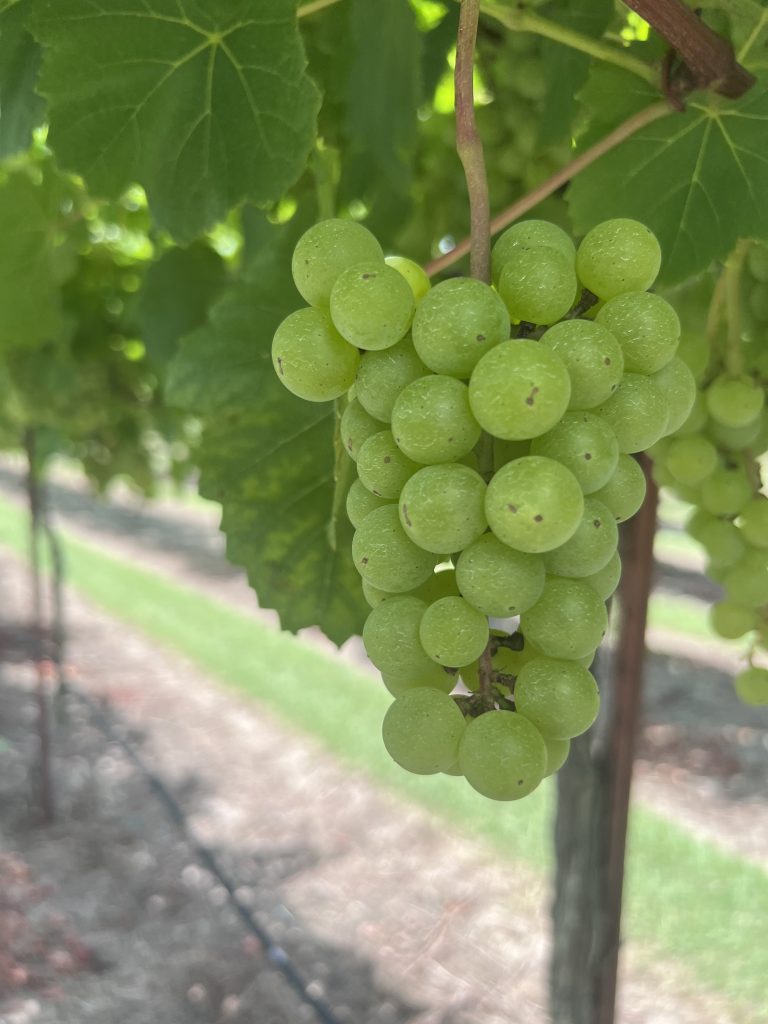
For those unfamiliar, Blanc Du Bois is an interspecific hybrid white wine grape whose most important characteristic is its tolerance to Pierce’s Disease. Blanc Du Bois was developed by the University of Florida grape breeder, Dr. John Mortenson, specifically as a Pierce’s Disease-tolerant wine grape capable of thriving in Florida’s humid and disease-prone climate. Interestingly, Blanc Du Bois has proven to be even better suited to the Texas Gulf Coast, where the humidity and rainfall are typically more moderate than in Florida, creating an ideal environment for this resilient grape.
Where Blanc Du Bois truly shines among Pierce’s Disease-tolerant grapes is in wine quality, a key reason it has been enthusiastically embraced by a growing number of Texas wineries. Blanc Du Bois wines have aromatic flavors characterized by citrus, grapefruit, floral, and spicy notes. The ripe grapes also offer a pleasantly flavorful snack for harvest crews. While most wineries use Blanc Du Bois to produce table wines, sparkling wines made from Blanc Du Bois have surged in recent years. The grape’s relatively low soluble solids at ripeness (usually 16–21%) make it particularly well-suited for sparkling wines as well as lower-alcohol still wines. One of the most celebrated Blanc Du Bois wines is Haak Winery’s Blanc Du Bois Madeira, which has garnered just about every award out there.
Blanc Du Bois is impressively versatile in the winery, and recent research at Texas A&M University suggests that Blanc Du Bois wines can have a very high antioxidant capacity. This may help explain why its aromatics can remain vibrant in the bottle for several years. Another clear marker of Blanc Du Bois’s rise in reputation is the increasing number of wineries now producing and labeling varietal Blanc Du Bois wines, reflecting industry-wide recognition of its quality.
In the vineyard, Blanc Du Bois is certainly not without challenges, but ongoing research and grower experience in Texas have paved the way for continued improvements in production. The most persistent issues faced by Texas producers are downy mildew (Plasmopara viticola) and bunch rots. Although Blanc Du Bois is also susceptible to several other fungal diseases, these two are especially troublesome in wetter regions or during particularly rainy years. Along the Texas Gulf Coast, this typically translates into eight to twelve protectant spray applications per season, with higher numbers required in areas with more rainfall and longer frost-free periods.
Blanc Du Bois ripens as early as late May in the southernmost reaches of Texas, up to July in the northern Gulf Coast and North Texas, approximately 115–125 days from bud break to harvest. This gives vineyards in far south Texas a longer post-harvest season than the pre-harvest growth period. At Texas A&M, researchers have successfully double-cropped Blanc Du Bois on an experimental basis in this region suggesting a potential to produce two crops each year there. Although Blanc Du Bois tends to break bud early, making it vulnerable to late spring frosts, it fortunately produces relatively fruitful secondary buds.
Managing the high vigor of Blanc Du Bois has led to innovative solutions in Texas. The Watson Training System, developed by Jerry Watson, the state’s longest-standing Blanc Du Bois grower, is a high-wire, horizontally divided canopy system featuring 48-inch cross arms and two pairs of rake wires to keep shoots in position. Although this system demands extensive canopy management, the payoff can be worthwhile for small vineyards: higher yields and better air circulation within the fruiting zone compared to single-canopy systems. Several publications from Texas A&M University and the University of Georgia describe this system and provide comparative data for its performance.
Blanc Du Bois is most often grown as own-rooted or ungrafted vines, but when soil pH is above 7.0, alkaline tolerant rootstocks are generally recommended to mitigate nutrient deficiencies. This represents many areas of Texas and fortunately grafted vines are available from several nurseries.
With good vineyard management Blanc Du Bois routinely yields around two to five tons per acre. However, growers in Texas commonly report poor fruit set, although the cause remains unclear. The Texas A&M AgriLife Extension Service has tested various canopy management strategies and prebloom zinc applications to improve fruit set, though results have been mixed. It is possible that observed fruit set issues are related to virus infections and excessive vine vigor, both of which commonly occur. Fortunately, Foundation Plant Services at UC Davis maintains clean Blanc Du Bois plant material to supply nurseries.
Over the past four decades since Blanc Du Bois was released, Texas grape growers and winemakers have built up a wealth of knowledge and practical experience with this variety. Fortunately, that expertise has been captured in a comprehensive new book scheduled for publication later this year: A Compendium of the Blanc Du Bois Grape, from Texas A&M University Press. The authors, Fran Pontasch, Justin Scheiner, and Russ Kane have chronicled the extensive experiences of Texas Blanc Du Bois growers and winemakers, along with numerous applied research studies focused on improving Blanc Du Bois production. Fran Pontasch, the principal author, and co-author Dr. Justin Scheiner are viticulturists with a combined 27 years of hands-on experience in Texas vineyards. Dr. Russ Kane is a technical researcher and writer, author of The Wineslinger Chronicles: Texas on the Vine and Texas Hill Country Wineries. He also pens the long-running wine blog VintageTexas.com and recently launched BlancDuBois.com, further connecting Blanc Du Bois enthusiasts.
The success of Blanc Du Bois in Texas represents the combined work and dedication of grape and wine producers and as the industry continues to expand and diversify, it will remain as an important testament of success for the Gulf Coast.
