Keep it Moving

Fast & Efficient Ways to Help Material Handling
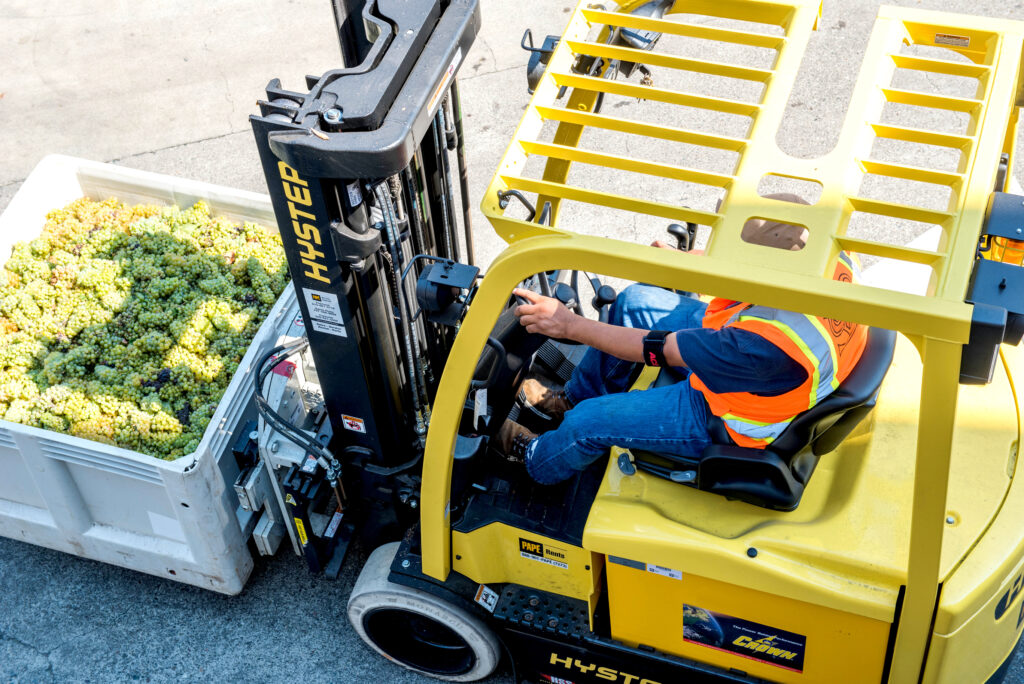
man moving crops using a forklift

By: Cheryl Gray

Before wine is bottled, labeled and ready to ship, wineries and vineyards have to shift large quantities of materials from one place to the next.

  The movement, storage and protection of these assets form an entire industry known as material handling. This industry sector performs a major role in ensuring the smooth operational flow of goods throughout wineries and vineyards. Its evolution includes automation and technology designed to prevent injuries, cut costs and boost productivity.

  Fortunately, there are companies, large and small, that can handle these critical tasks. Among them is Bishamon Industries Corporation, founded in 1986 to serve as the United States production arm for its parent company, Sugiyasu International Corporation.

  Bishamon works with wineries and vineyards of all sizes, from small boutique operations to large commercial establishments. It touts a line-up of products and options designed to offer solutions that meet clients’ specific needs, regardless of scale.

  It all happens at Bishamon’s 78,000-square-foot manufacturing plant in Ontario, California, with a rooftop solar system generating more than 80 percent of the facility’s energy needs. In its early years, the company produced automotive lifts and imported material-handling equipment from Sugiyasu. By the 1990s, Bishamon introduced the Bishamon EZ Loader®, which the company says revolutionized the manual palletizing industry, winning awards such as Plant Engineering Product of the Year. The product is patented worldwide and has been awarded CE certification.

  Following the success of its EZ Loader®, Bishamon launched additional material handling products, including the UniLift, which the company describes as the only product of its kind to lift and transport a standard pallet without straddling it. There is also the  EZ X Loader®, which offers a new design that targets cost savings and greater flexibility in performance. Another product, the Lift Pilot®, is described as a one-of-a-kind floor-level pallet positioner. Brian Dedmon is the director of sales for the company.

“Bishamon can address the specific needs of wineries and vineyards by offering a range of equipment designed to improve efficiency, safety and productivity in the winemaking process,” Dedmon said. “Solutions include hydraulic lift tables, mobile lifters and pallet positioners. To help wineries and vineyards select the right equipment for their unique requirements, our team takes a consultative approach by assessing the customer’s needs and offering recommendations, training and support. By offering a diverse range of equipment and providing personalized support, Bishamon strives to be a trusted partner for wineries and vineyards, helping them optimize their material handling processes and achieve greater efficiency and success in their operations.”  

  Dedmon points to some key Bishamon products that wineries and vineyards can add to optimize production, reduce costs and enhance their products.

  “Three products wineries and vineyards can benefit immediately from are the implementation of hydraulic lift tables, mobile lifters and pallet positions in their work processes,” he said. “Bishamon’s hydraulic lift tables are ideal for lifting and positioning heavy wine barrels, crates and equipment. These versatile tools come in various sizes and weight capacities to suit different tasks in the winery, ensuring smooth and ergonomic material handling for easy maneuverability. Bishamon mobile lifters are perfect for moving materials within the winery or vineyard premises. They can assist with transporting grapes, bottles, and other items efficiently, minimizing the need for manual labor and reducing the risk of injuries. Bishamon’s pallet positioners enable winery workers to load and unload materials from pallets at comfortable heights, promoting efficient workflow and reducing strain on the worker.”

  Dedmon talks about some of the company’s most widely purchased products.

  “Our most popular products are the UniLift and the EZ Loader,” he said. “The Bishamon UniLift is the only two-in-one pallet positioner/lift on the market that works with closed-bottom pallets and skids. This unit utilizes a retractable outrigger operation that allows the user to pick up closed bottom pallets without the use of a straddle stacker. This allows the unit to be used in small areas where you need more maneuverability and versatility for pallet options. Our EZ Loader is one of the best self-leveling pallet positioners on the market. It utilizes a self-contained air system with an adjustable knob to allow the user to adjust the system without resetting the air pressure or the hassle of replacing springs like other brands. The EZ Loader will raise or lower as the user adds or takes off the product, keeping the working height at an ergonomic position.”

  Dedmon adds that the company has introduced an upgraded option to its UniLift product.

  “The UniLift is an all-in-one pallet transporter and positioner designed for transporting and lifting pallets,” he said. “It also serves as a dual-purpose tool by eliminating the need for a forklift or lift table in certain applications. Now, the customer may add a Power Assist Drive System that will significantly improve the ease of maneuverability and reduce operator fatigue.”

  It is possible to reduce fatigue through innovative solutions grounded in artificial intelligence. That is the mission ofAugean Robotics. The company has invented a robot platform it callsBurro, showcasing what the robot can do through collaborations designed to give grape-growers a peek at what autonomous farming can achieve. Augean Robotics has created a team of robotics experts with vast computer knowledge and seasoned entrepreneurs with years of experience selling high-tech farming machinery to build and market Burro.

  Burro deploys A.I. in vineyards to help grape growers maximize harvests. The robots act as carrying devices or can assist with harvesting fruit. According to the company, a Burro robot is typically paired with a team of six to eight workers and can help increase productivity anywhere from 10 to 50 percent, depending upon the vineyard layout, fruit volume and other variables. Burro can also assist in patrolling, scouting and capturing data. It can serve as a platform for tasks such as UV lighting to combat powdery mildew that can wreak havoc on vineyard crops. Augean Robotics can provide a CAD file to prospective clients to outline Burro’s shape and enable a potential buyer to model items and technologies that will customize a purchase.

  When wineries and vineyards need to transport products, Magline, Inc. can help. Based in Standish, Michigan, the company has been in business for over 75 years. It manufactures various material handling products, including its recently launched Magliner Powered Lifting Hand Truck. According to Magline, the product allows its users to lift easily and lower heavy loads of up to 200 pounds, which helps to prevent injuries. When used as a traditional hand truck, Magline says that its Powered Lifting Hand Truck provides a 500-pound overall load capacity with a design featuring many of the same components as other Magliner lightweight, aluminum hand trucks. The company adds that in some instances, one person using the product can do a job that would normally take two people.

  Another popular product series from Magline is the company’s line-up of LiftPlus® powered stackers. This product features user-friendly, one-hand controls and combines the functions of a walk-behind pallet jack with those of a lift truck. It is used to handle bulk materials in manufacturing, distribution, warehousing and other areas where large material handling is  required. Unlike forklifts, no operating license is needed, and the machinery helps to reduce injuries since it is powered to carry large loads.

  Experts agree that investment in proper material handling equipment pays off in real-time by helping to prevent on-the-job injuries, smoothing the transport of critical materials and automating processes that reduce labor costs. 

Malic Acid & Chromatography

box of grapes

By: Tom Payette – Winemaking Consultant 

Malic acid is one of the major acids in grapes used to make wine.  In most cases it is secondary only to tartaric acid in quantity and then followed by succinic, citric, fumaric and other small quantity acids all contributing to a total acid or titratable acidity. 

  Every variety of grapes has a potential difference in the amount of malic acid that may proportionately exist in the grapes at harvest and much of this is predicated by the growing season, amount of rainfall, overall heat summation temperatures and night time temperatures.  Cool climates often have grapes higher in malic acid and warmer climates often have lower quantities of malic acid in the fruit.  Riper fruit generally has less malic than under ripe and so on; yet, winemakers should be cautioned not to try and use a measurement of malic acid as a sole predictor to grape ripeness for winemaking.  Further note fruits other than grapes such as cherries and apples have wide ranges of malic contents.  Cherry’s and apple’s principal acid is malic.

  In some traditional roles of winemaking such as wines made from the Bordeaux varieties, Burgundy varieties and Rhone varieties a decision by the winemaker may need to be made as to whether or not to perform a malo-lactic fermentation on those wines.  In making that decision, many factors come into consideration:  How much malic is present?  What is the pH now?  What will the pH be after alcoholic fermentation?  What is the predicted pH to be after malo-lactic conversion?

Malo-lactic Fermentation

  Unlike what the term indicates, this is not a fermentation done by yeast.  This process of converting the harsher malic acid, the acid dominant in most apples, to lactic acid, the softer acid dominant in most milk and cheeses is done by malo-lactic bacteria. This small bacterium is a Leuconostoc

oenos  and predominantly responsible for the “sterile filtration” standards of 0.45 absolute microns used as a wine industry standard today.  These small bacteria, often rampant in nature, can cause serious issues to any wine in the bottle or cellar that may undesirably undergo a potentially unwanted, uncontrolled wild fermentation.

  Many winemakers today control the malo-lactic fermentation process through cleanliness, pH, sulfur dioxide, temperature and controlled conditions to support or suppress the bacterial growth. Outside of these conditions, winemakers often select a desired malo-lactic bacterium to perform the desired job, giving a wine a desirable flavor and aroma attribute, while eliminating malic acid from the wine, or less likely, the must/juice.

Supporting the Growth

  Malo-lactic bacterial fermentations can be a challenge to any cellar.  Humorously, in some cases a winemaker who wants to suppress a malo-lactic will find one starting spontaneously and one that wants to encourage a malo-lactic will find the microbe to be stubborn.  The author has seen a huge correlation toward the microbes’ growth in relationship to the pH, temperature of the wine at inoculation and the temperature during microbe growth, sulfur dioxide use and timing of encouraging the process.  The pH of wine should be in certain recommended ranges hopefully above 3.10. 

  If below this pH, the microbe may be in serious jeopardy of surviving to do its functions of converting malic acid.  The temperature of the wine for a successful Malo-lactic should be slightly above 70 degrees F if possible.  This temperature (72 degrees F) will allow the microbe to perform rapidly and with success.  T he malo-lactic bacterial fermentation should be complete in twenty days or less on the average.  The sulfur dioxide of most wines must be relatively low from near zero ppm to about 15 or 20 ppm at a maximum.  Levels above 15 or 20 ppm may show signs of no to sluggish or incomplete activity.  The timing of a malo-lcatic is often best just after alcoholic fermentation has taken place.  This often turbid, nutrient and yeast rich solute can be a healthy environment for the microbe to grow and succeed consuming malic acid.

Suppressing Malic Bacteria Growth

  Referencing the above paragraph, many readers can draw their own conclusions on how to suppress the malo-lactic fermentation.  Colder temperatures especially below 50 degrees F will help slow or stop the bacteria, a free sulfur dioxide of 35 parts per million (PPM) or higher may help suppress the microbe and lower pH’s offer a more hostile environment to the microbe.  Most winemakers use temperature and sulfur dioxide adjustments to suppress a spontaneous malo-lactic before resorting toward potentially undesired pH adjustments in a must or wine.

PH Shifts During Malo-lactic

  The shift of a wine’s pH after a successful malo-lactic fermentation is difficult to predict.  Many times a wine pH may go up by 0.1 or even as high as 0.20 pH units or more.  This is dependent on the amount of malic acid content in the wine and how much was converted during the malo-lactic fermentation.  One must recognize at this time also that there are two different configurations of malic acid.  One is consumable by the malo-lactic microbe and one is not.  Therefore, some winemakers that have performed what they believe to be a successful complete malo-lactic fermentation process may, after performing a quantifiable test on the malic acid content, find some malic acid is indeed left of over.  This can be in the range of 22-30 milligrams per liter.  Each winemaker is left to his or her own decision as to what is an acceptable level and risk.

Filtration

  Winemakers that know their wines have come into contact with the malo-lactic bacteria often elect to filter those wines to a pore size of 0.45 microns.  We often show these wines as ML positive on our cellar inventories.  Other winemakers often assume, wisely so, that any wine in their wine cellar with malic acid is considered ML positive to be on the safe side.  With these assumptions, all the wines that have any malic acid in them should be filtered to a 0.45 micron level – just to be certain.

Paper Chromatography

  A non-quantifiable inexpensive process to measure malic content in wine, must and juices is the use of paper chromatography.  Winemakers are urged to use this crude, easy process in their cellars to measure their progress of a malo-lactic fermentation.  After using this “in house” testing technique winemakers are best served to measure the amount of malic acid in their wines in some quantifiable way to get an exact number to understand how much malic is still present in a wine or not.  Well-funded internal winery labs may have the tools in their own lab to measure this acid.  Others may find it cost effective to ship a small sample to an outside lab and have it measured at an external laboratory. 

Process

  The process of paper chromatography is very simple and very affordable.  Acids are carried, by way of a solvent, up the paper a distance related to each acid and or it’s standard.  After the paper dries one may look at the “developed picture” to understand what wine may contain what types of acid.  This is non-quantifiable as previously mentioned.

Tools and Chemicals

•    Chromatography paper

•    Chromatography solvent solution

•    Hematicrit tubes  0.05 (AKA Capillary tubes)

•    Malic acid standard

•    Lactic acid standard (Note I am leaving

      tartaric out)

•    Sharp #2 pencil

•    Straightedge or ruler

•    Paper towels

•    Well ventilated work area

•    Wines to be tested ;   10 milliliters or more.

•    Standard lab safety gear

  Some winemaking supply stores have affordable pre-assembled chromatography kits with instructions.

Procedure

1.   Clear and clean a space in the laboratory to be your workspace.

2.   Make sure the area is well ventilated since the solvent for the paper chromatography is very pungent and possibly harmful over a large period of time.

3.   Wash your hands thoroughly, twice, before handling the paper used with the paper chromatography.  This will remove any grease or dirt that may interfere with the results and action of the chromatography process.

4.   Place several pieces of clean dry paper towel on the countertop area to be the workspace.  This will be another layer of protection.

5.   Retrieve a piece of the chromatography paper from its container being very careful to handle it by the edges only.

6.   Place the chromatography paper on the paper towel work area.  Place the days date at the paper at the top of the paper.

7.   Using the straight edge and pencil, draw a straight line about one inch above the bottom of the chromatography paper.

8.   With the pencil, make small dots about 1.25 – 1.50 inches apart across the page along the freshly drawn straight line at the bottom of the paper.

9.   Under each dot make a code to reference the intended product or standard so one will be able to know what was placed at each dot.  Eg:  M= Malic   L= Lactic   Mer= Merlot   PN= Pinot noir and so on.

10. Retrieve from the cellar representative samples of each wine desired to be tested.  Only small quantities are needed.  Less than 40 milliliters.

11. Line each standard and wine sample up in front of the chromatography paper work space from left to right to equate what was drawn on the paper.

12. Take a hematicrit tube for each wine out of the hematicrit tube storage container for these.  Handle them only by the end that will not be in contact with the chromatography paper.

13. Holding the hematicret tube by the top end, quickly dip the receiving end into the acid standard or wine sample desired to be tested for each mark on the chromatography paper.

14. Once a small amount of the acid standard or wine is inside the hematicrit tube quickly touch the pencil spot made that is labeled for that standard or wine.  Be very careful to keep this organized and that each spot is exactly what it is labeled.  If in doubt – re-sample and start over.

15. Rotate left to right until all of the spots have their corresponding liquid on them.  (Do your best to make these spots very small with hopes they do not grow any larger than the size of a pencil eraser head.  Just a quick touch to the paper is plenty.

16. Wait about 4 minutes for each spot to dry and the reapply with the same appropriate hematicrit at each spot a second small spot of resultant correspondent liquid.

17. Allow these spots try roughly 10-15 minutes.

18. Prepare the solvent holding vessel with about one half to five eighths an inch of chromatography solvent.  (This solvent may remain in this vessel for subsequent uses and it should remain fresh for about 8 months)

19. Gently lower the chromatography paper with the wine and standard sample on it into the solvent.  Make sure the paper is level so the solvent will travel equally, and at the same speed, up the paper.  This takes about three to five hours.

20. Replace the lid on the container and set the apparatus where it will not be disturbed, moved or knocked accidentally.  One may check this container from time to time in order to estimate when to remove the paper.

21. After the solvent has visibly moved 95% of the way up the paper, one may remove the paper from the chromatography solvent vessel.

22. Replace the lid to the chromatography vessel.

23. Hang the freshly solvented paper in a well ventilated area to dry.  Make sure the drying process takes place away from any sulfur dioxide, bleach or other similar chemicals.  This paper should dry 10 hours or more and most winemakers allow it to dry overnight.

24. Read the chart the next day by looking at it.  Resist the temptation to look at it up close.  The author prefers to look at it about 5-7 feet away to get a true picture of what is happening.  The results will not be well defined and often ghostly or blurred.  This is normal.

25. Relate the distance the standards traveled to the distance the acids in the wine spots travel.  Try to ignore any colors from the wine such as potential red stains, etc.

26. Remember while reading this “film” that this is only used to get an idea of whether some malic acid is left in certain wines or not.  Some wines will have a more defined spot and others may be less easy to read. 

Calculation

  There is no real mathematical calculation as one can see.  One should relate where the malic and lactic acid standard spots are on the chromatography after the drying time and look horizontal to see if resulting spots exist in the same horizontal area above the wine spots.  This is an indication there is some of the same acid in the wine.

Mixing and Standardizing Chemicals

  Due to the difficulty of making these chemicals and the reasonable cost of the chemicals, it is recommended to order the chemicals from an outside lab.  Making the solvent is especially cumbersome with separation flasks and other tedious time consuming issues.

Other Helpful Tips

  Plastic gloves and goggles may be worthwhile to use if one finds they cannot handle the paper without getting skin oils and other contaminants on the chromatography paper, etc.

  NOTE: Always perform this test in a well ventilated area – the solvent is odorous and unpleasant.

References

Amerine, M.A., Berg, H.W., Cruess,W.V. 1972. The Technology of Wine Making

Zoecklein, B.W., Fugelsang, K.C., Gump, B.H., and Nury, F.S. 1999. Wine Analysis and Production

Verbal discussion with:  Mr. Jacques Boissenot, Mr. Chris Johnson, Mr. Joachim Hollerith and Mr. Jacques Recht.

Grapevine Leafroll & Red Blotch Virus Disease Management and Control

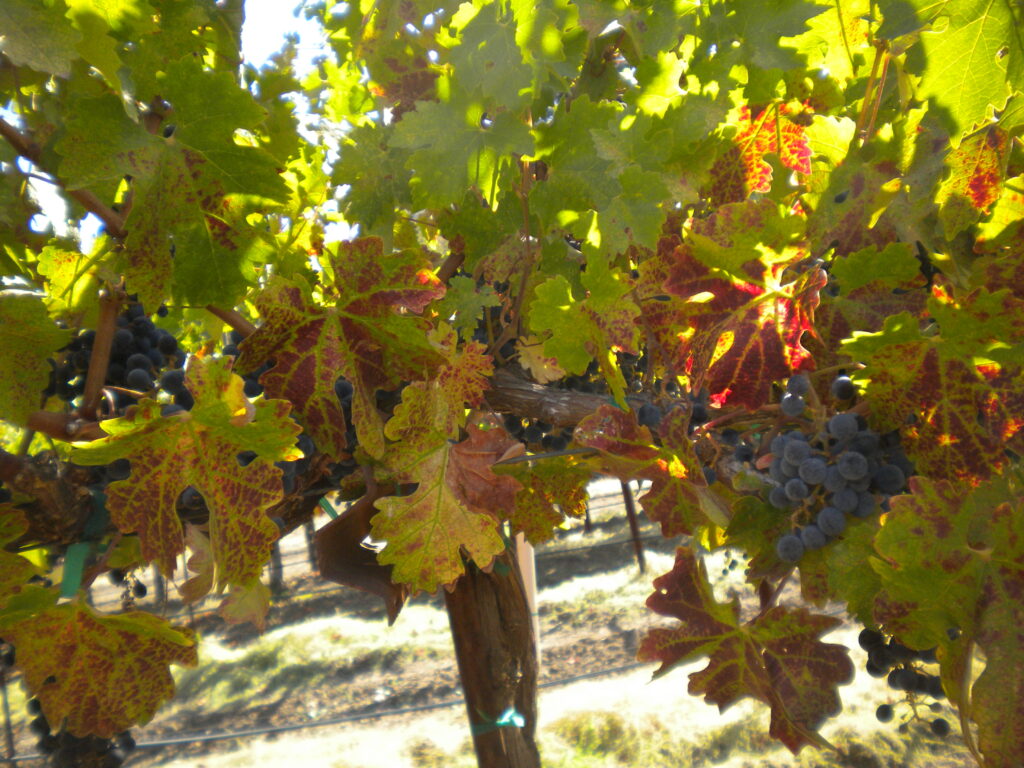
close-up of grape trees

By:  Judit Monis, Ph.D. – Vineyard and Plant Health Consultant

As the fall season approaches, symptoms of virus infection become more pronounced in the vineyards.  Leafroll and red blotch are the most important viral diseases that manifest in late summer and the fall season.  Often, it is difficult to distinguish leafroll from red blotch disease symptoms in the vineyard.  This is especially true on red-fruited grapevine varieties.  In this article I will summarize and update information on the biology, symptoms, transmission, and management of the viruses responsible for these important diseases.  

The Viruses responsible for Leafroll and Red blotch Diseases

  There are four different viral species associated with grapevine leafroll disease.   The viruses belong to the Closteroviridae family and are named Grapevine leafroll associated virus followed by a number (GLRaV-1 to -4).  Except for Grapevine fanleaf and red blotch, Koch’s postulates have not been completed with most of the disease-causing grapevine viruses.   The postulates state that a pathogen must be isolated in pure form from a diseased plant, later the pathogen (virus in this case) is introduced to a healthy plant, and the newly infected plant must show the same symptoms as the original infected one.  Clearly Koch’s postulates are important because they prove the cause and effect of a pathogen causing disease.  Because it has not been possible to complete Koch’s postulates with GLRaVs, the word “associated” is added to the virus name.  As I will describe below, researchers can tweak the definition of Koch’s postulates to prove that a virus causes a specific disease and drop the word “associated” from a particular virus name.   Within the Closteroviridae family, species of GLRaV are classified in three genera, Ampelovirus, Closterovirus, and Velarivirus. Grapevine leafroll associated virus -1, GLRaV-3, and GLRaV-4 belong to the Ampelovirus genus.  Grapevine leafroll associated virus -2 is a Closterovirus and GLRaV-7 is a member of the Velarivirus genus.  Some researchers claim that GLRaV-7 should not be considered a leafroll virus.   Recent research has shown that GLRaV-7 was isolated from a mixed leafroll infected vine and symptoms may have been due to the other leafroll virus present in the vine.  When found in single infections, GLRaV-7 does not appear to show typical leafroll symptoms.

  Grapevine red blotch virus (GRBV) is the second DNA virus species discovered in grapevines (its genetic material is DNA rather than RNA).  Both its molecular and structural characterization has placed GRBV in a new genus (Grablovirus) within the Geminiviridae family.   As stated above, it has been difficult to demonstrate Koch’s postulates, with grapevine-infecting viruses. There are many reasons for this.  Mainly, there are not many alternative hosts that are susceptible to most grapevine infecting viruses.  But most importantly, grapevine viruses cannot be mechanically transmitted onto grapevines.  These viruses need to be introduced to a vine by an insect vector or via grafting (graft-transmission).   Dr. Marc Fuchs team at Cornell University was able to demonstrate that GRBV genetic material is responsible for red blotch foliar symptoms in red fruited grapevine varieties.  The work was done using sophisticated recombinant DNA technology to introduce the virus genetic material into tissue cultured grapevine plants.   Time will tell, after the plants grow, if the infected vines also display the detrimental effect of the virus in organoleptic qualities of the fruit (i.e., reduction of sugar).

  Leafroll and Red Blotch Symptoms are Similar

  Vines infected with leafroll viruses produce smaller grape clusters that ripen unevenly with lower sugar content. Foliar symptoms include downward rolling, reddening, or yellowing of leaves depending on the grapevine variety. Other foliar colors associated with leafroll virus infection include pink, purple, and orange speckles. The leaf veins may remain green or take many other colors (yellow, purple, or red).  

  Grapevine red blotch virus infection displays different leaf discoloration which usually appear spotty or blotchy.  However, these symptoms are indistinguishable from leafroll, especially when rolling of leaves are absent in GLRaV- infected vines.  In red fruited varieties, GRBV infected vines can display red veins, but red veins have also been observed in non-infected vines, and many red-blotch infected vines do not display red veins.   In my opinion, red vein symptoms cannot be used as a diagnostic tool.   In white-fruited varieties red blotch disease displays yellow blotchy discoloration in leaves. While the symptoms of leafroll and red blotch can be confused, these diseases are caused by different viruses. As described above.  Further, visual diagnostics is complicated by the fact that grapevines often carry mixed infections of viruses and other pathogens.  Although, the change in colors of the leaves in the fall is a tale-tell of virus infection, the most important negative effect of both GLRaV and GRBV infection is the reduction of sugar in fruit resulting in lower Brix values and delayed fruit maturity.

  Some GLRaVs and their strains are more aggressive than others.  Researchers have described the Alfie (Australia and New Zealand), BD (Italy), and Red Globe (U.S.A) strains of GLRaV-2. These strains are molecularly similar and have been associated with graft incompatibility, vine decline and death.  Some researchers report that GLRaV-1 and -3 induce more severe symptoms than GLRaV-4.  However, symptoms vary depending on the grape variety, rootstock, and climatic conditions.  Now, two different genetic groups (clades) of GRBV have been reported but no differences in their biology or effect on symptoms in the vineyards have been described.  Just as seen with leafroll, the symptom expression of GRBV infected vines is affected by climatic conditions and the author has noted differences in the effect on sugar reduction in sunnier and warmer areas (i.e., California coastal areas with more fog and lower sunshine yield fruit with lower sugar concentration than the same grape clones grown inland with more sun/heat exposure).

Transmission and Spread of the Viruses

  Ampeloviruses (GLRaV-1, -3 and -4) are transmitted by mealybugs and soft scale insects in a non-specific manner.  This means, different mealybug and soft scale insect species can transmit any leafroll virus in the Ampelovirus genus.  Research has shown that the citrus (Planococcus citri), grape (Pseudococcus maritimus), long-tailed (Pseudococcus longispinus), obscure (Pseudococcus viburni) and vine (Planococcus ficus) mealybugs as well as the soft scale insects Pulvinaria vitis and Ceroplastes rusci are able to transmit GLRaVs. Mealybugs and soft scale insects feed on the vine’s sap by inserting their sucking mouthparts into the plant’s vascular system (phloem). The honeydew excreted during the feeding process attracts ants that nurse and aid mealybugs to be transported to different positions of the vine or a different vine in the row.  Mealybugs may be difficult to observe as they may hide beneath the bark.  However, the presence of sooty mold (a fungus) and ant activity can be a good indication that mealybug are present in the vineyard.  No insects able to transmit GLRaV-2 or GLRaV -7 have been reported to date and the propagation of these viruses is performed by humans who produce, graft, and distribute cuttings from infected vines.  

  Work by researchers at Cornell University and the University of California reported that the three-cornered alfalfa hopper (Spissistilus festinus) can transmit the GRBV in greenhouse and laboratory conditions.  Although, the three-cornered alfalfa hopper has been found in vineyard blocks where red blotch disease has spread, transmission experiments in the field have not been completed to date.   It is interesting that grapevine is not the preferred host for Spissistilus festinus that prefers to feed on legumes, grasses, and shrubs.  Furthermore, the insect is not able to complete its reproductive cycle in grapevines.  While research continues to determine if other vectors are capable of transmitting GRBV it is clear that the rapid expansion of this virus in vineyards was due to propagation and grafting of cuttings from infected vines.  This also explains the arrival of GRBV to many countries in Asia, Europe, and South America where GRBV had not been previously reported.   In summary, both, GLRaVs and GRBV are graft transmissible and predominantly propagated by producing cuttings of infected rootstock and scion material. 

Diagnosis and Disease Management

  The distribution and concentration (titer) of leafroll and red blotch viruses is different in infected plant material.  While leafroll detection appears to be seasonal (best detected late in the growing season), detection of red blotch virus can be performed any time of the year.   Further, work performed in my lab showed that red blotch virus can be detected in high titers in any part of the vine.  The work showed that red blotch virus can be detected in any tissue tested, new or mature leaves, petioles, green or lignified canes, as well as cordons and trunks.  In contrast, leafroll viruses are generally found in low concentrations and are best detected in mature leaves, canes, cordon, and trunk.  If a vine has been infected through cuttings, the older the plant material is, the easier it is to detect GLRaVs. 

  Keeping both leafroll and red blotch viruses out of the productive vineyards relies on clean planting stock programs.  Because both viruses are graft transmitted (and some also have biological vectors) it is important to implement a monitoring and sampling program at the nursery and production vineyards.  Vines that are symptomatic or that test positive must be removed from the vineyard to avoid spread (especially if one of the Ampiloviruses or GRBV are detected and the vector is present in the vineyard.  Depending on the disease incidence (I have developed a statistical sampling formula to calculate and help make decisions), the removal of a few vines or the whole vineyard is recommended. Different chemical and biological control strategies are available for the control of mealybugs that transmit leafroll viruses.  The use of chemical control, although might be used to control GRBV vector is not presently recommended.

Conclusions

  This author has been involved in applied research with the goal to determine the ideal process to protect clean planting grapevine stock and newly planted vineyards from infection of viruses and fungal pathogens.  Presently, information on what is the distance needed at the foundation and nursery blocks to avoid infection from diseased blocks is lacking. The results of the research will develop the best strategy to isolate and monitor clean planting stock.  Until we have this information my recommendation is that nurseries and growers determine the health status of grapevine stock prior to planting to avoid the propagation and/or introduction diseased vines to the vineyard.  Yet, it is imperative to isolate and monitor newly planted vineyards to avoid the introduction of disease via insect vectors.  It is important to remember that lack of symptoms does not always correlate with a healthy diagnostic result (rootstock varieties as well as non-grafted vines are usually asymptomatic), so it is best to test a statistical sample of the nursery propagated material to be sure of its health status.

  Judit Monis, Ph.D. provides specialized services to help growers, vineyard managers, and nursery personnel avoid the propagation and transmission of disease caused by bacteria, fungi, and viruses in the vineyard.   Judit (based in California) is fluent in Spanish and is available to consult in all wine grape growing regions of the word.  Please visit juditmonis.com for information or contact juditmonis@yahoo.com to request a consulting session at your vineyard.

The #1 Pruning Tool Your Vineyard Needs Right Now

Picture of hand holding INFACO_sécateur_F3020 pruner in vineyard

By: Alyssa L. Ochs

Here at The Grapevine Magazine, we have covered many pruning-related topics for vineyards in past issues, such as pruning techniques, best practices and seasonal tips. But if your vineyard is looking to really improve your pruning practices this year, you may benefit from specific product recommendations from industry experts that can make your life easier by saving you time and money while keeping employees safe.

  For example, a pruning shear called the Infaco F3020 is one of the best products available on the market today for vineyard pruning to consider buying for your wine grape maintenance and upkeep. Two industry experts told The Grapevine about this tool and what vineyard owners should know before buying it. 

Pruning Tools and Techniques

  Pruning may seem simple enough on the surface, but the tools you use and how you train your staff really go a long way in a vineyard. While removing unwanted fruit and foliage, you are also helping to control vine damage, prevent disease and improve your chances for a successful yield.

  The most common vineyard tools used for pruning are hand and lopping shears, but you may also need saws and larger tools for challenging jobs.  

  Safety must always be the top priority while using sharp tools among the rows of grapevines, so it is helpful to be well-stocked with gloves and accessories that make the job easier and more efficient. Meanwhile, properly training your staff members to use these tools can prevent many common pruning-related injuries, such as hand lacerations, strained shoulders and aching neck and back muscles.

  The pruning process is relatively straightforward: remove the canes first, remove the spurs second and ensure all old growth is out of the way of new fruiting canes and renewal spurs. Yet recent innovations in pruning tools make this tedious but necessary maintenance task more productive than ever. 

Infaco F3020 Professional Battery-Powered Pruning Shear

  While researching the latest and greatest pruning tools for vineyards, Infaco’s brand-new F3030 electric pruning shear stood out. After over six years of research, tests and fine-tuning, Infaco released this new and improved version as a follow-up to its F3015 model. The new F3020 builds upon the F3015’s technical base and adds numerous improvements to improve cutting speed and work comfort. It is ideal for vine pruning and is lighter, more compact and easier to handle than the previous versions of the tool.

  Infaco-USA, Inc. carries on the legacy of M. Daniel Delmas, who invented the world’s first electric pruning shear in 1984. The company has designed, produced and sold over 350,000 pruning shears in more than 45 countries.

  “Our founder invented the world’s first-ever electric pruner in response to friends he had in Southern France with vineyards,” Ananda Van Hoorn, operations manager for Infaco-USA, told The Grapevine Magazine. “At the time, they had an incredible labor shortage, and back in the 1980s, pruning was the single biggest labor expense for vineyards, just as it is today. So, the shear he invented was designed to work with all kinds of vineyards – cane pruned, cordons, goblet and so on.”

  Van Hoorn said that the F3020 electric pruning shear increases productivity by an average of 30 percent in a vineyard since users can keep making the same number of cuts per hour all day long.

  “So, vineyards that switch to our shear will find that they don’t need to purchase one shear per worker,” she said. “Instead, some of the workers who were previously pruning will be reassigned to cleaning up canes or other vineyard tasks.”

  Van Hoorn explained how this shear has a built-in safety system, so her top safety tip is simple: use the F3020, and you’ll never have to worry about losing a finger again!

  “The trigger on the new F3020 is metallic and connects to your entire body’s electric system through your trigger finger,” she said. “This means that when you touch the metal blade of the shear to your skin, the circuit is grounded out.”

  She also said that maintenance of the tool is easy and only involves greasing the tool once per day and sharpening it twice daily with the included grease and sharpening stone.

  Among the various pruners and canopy products offered by BDi Machinery, Paul J. Licata, the owner and president of this company, says that the best and most commonly purchased pruner is the battery-powered Infaco F3020. BDi Machinery Sales, Inc. is a complete source for innovative, specialty agricultural machinery and offers everything from pruners to sprayers, hedgers, leaf-removers, shredders, cultivators, mowers, row-mulchers and more. BDi Machinery is an authorized Infaco provider for routine and annual service programs. Licata spoke to this pruner’s cutting speeds, work comfort, compact design and ease of handling. The F3020 is used for pruning during the dormant and growing season. 

  “Loaded with technological advances, the pruning shear can now be ‘connected’ using an optional Bluetooth box,” Licata said. “This new system makes it possible to report highly relevant data in order to achieve ever more effective pruning work.”

  Licata also said that this connectivity option, combined with the Infaco application, can make many adjustments directly from a smartphone, such as adjustable blade opening management, blade crossing and new “soft mode” speed configuration. Additionally, it offers advanced reading and analysis of the data collected during the device’s use.

  “A technology differentiator is the Infaco electronic safety system (DSES) – Wireless DSES/hard-wired DSES,” Licata said. “Infaco has always considered safety to be essential. A true pioneer in the 1990s, it has never stopped investing in cut-prevention solution research for its user clients. The new safety system comprises a conductive trigger that connects the user’s body and the shears’ electronic system, Infaco patents. As soon as the cutting head touches the opposite hand, bare or wearing a glove, the pruning shear instantly opens to prevent injury.”

Pruning-Related Parts and Accessories

  When discussing additional parts and accessories that vineyards may need for their pruning tools, the suggestion of additional head sizes arose. Infaco’s shear is the only electric shear in the world that features interchangeable heads, so the most common accessories that Infaco’s clients buy are additional head sizes to increase their cutting capacity up to 55 millimeters or 2.17 inches.“

  This lets vineyards use the same tool for cane pruning as they do for Eutypa surgery without having to invest in a whole new set; just buy the head!” said Van Hoorn. “We also find some vineyards using our electric shear with the medium head 100 percent of the time. This is because with manual pruning, some vineyards have workers carrying around two different tools that they have to switch between when they identify a larger cut to make. Buying the F3020 with medium head gives workers a 1.75-inch cutting capacity, and they can easily flip between a customized smaller opening and the full capacity. This means that this one tool replaces carrying around a set of pruning shears and a pair of loppers or saw and cuts down on wasted time switching back and forth between tools.”

  BDi Machinery’s Paul Licata pointed out that you can carry the Infaco F3020’s battery in four different ways: on a vest with straps, on the belt without the removable straps, using the trouser belt clip or directly in a pocket thanks to its small format. He also said a new shear holder with a minimal size is secure and easy to use because the cutting head is protected and stored in its sheath with just two steps.

The tool’s main asset is its versatility, thanks to the medium and maxi kits,” Licata said. “It only takes five minutes to easily transform your shears for other occasional or permanent pruning applications. The Infaco design office engineers have completely revolutionized the pole system to propose an innovative and ergonomic solution. Simply clip the F3020 pruning shear to the end of the pole and the battery to the other end: that’s it, the tool is ready for use. Forget the previous cables, and operate your tool using a wireless Bluetooth trigger system. Also, you can keep the blade profile sharp easily and in record time using the Infaco electric sharpener.”

Innovations and Considerations

  Van Hoorn from Infaco-USA told The Grapevine Magazine how you’ll see many things her company offers that the competition can’t match because Infaco has been perfecting its shear for nearly 40 years. This includes the built-in safety system, more accessories to increase the tool’s versatility and the absolute lightest battery on the market that will power a shear for an entire workday.

  “Quality and reliability have always been core concerns to Infaco,” said Licata from BDi Machinery. “From design, through production, then in the after-sales department, it offers users excellent products and services that fulfill the company’s strong values.”

  Looking ahead, Van Hoorn from Infaco shared with us something new that will be coming from the brand in the months ahead.

  “Infaco will be announcing a brand-new tying tool that works with the same battery as our F3020 shear for this spring,” Van Hoorn said. “The new AT1000 electric tying machine is designed specifically for cane-tied vineyards and will be an absolute game-changer!”

What is a Website Template & Ten Reasons You Want One

By: Susan DeMatei, Founder of WineGlass Marketing

In today’s fast-changing landscape, web experts agree that we should redesign our websites every three years. Don’t get us wrong, that doesn’t mean touch your website every three years. You should constantly update and keep your website current, but we’re talking about a complete reboot every three years. This refresh is necessary because our content and feature-needs change, and our consumer eCommerce and browsing habits are constantly changing. Look at the wine business in the past four years and how much has changed since pre-COVID. In addition to the obvious design revitalization, we should also be re-evaluating our website goals and needs on this three-year frequency.

Image showing 75% of consumers will judge a brand's credibility based on their website design source Stanford Web Credibility Research

  When facing a redesign, the first question that crosses the minds of most is, “Should I use a template or have this custom-built?” If you have done a big website from scratch. before, you hired a designer and then a developer, and they walked you through Photoshop comps and wireframes. It worked back then, but that long and expensive process is no longer the only way to build websites. In the final months of 2023, the vast majority of the websites on the internet are built with a template or theme. For most of our clients, a template is the best place to start unless you are a complex corporate entity with multiple brand or feature needs (and even in that case, you might want to start on a template.) But we’re getting ahead of ourselves. Let’s define a template and then break down some pros and cons of using a template.

What is a template?

I am currently car shopping, so I have automobiles on the brain. I let my lease go during COVID and for a time my husband and I have survived on one car, but it’s getting to be logistically difficult. For the past few weeks, I have been comparing features and reading reviews and am no closer to making a decision than I was when I started. Is it wrong to want heated seats in Northern California? Will I really use the Navigation system if I can plug in my iPhone? What the heck is torque, anyway? If anyone has an SUV suggestion. I’m all ears. So, forgive all the car analogies and puns when discussing websites, but that’s what’s racing out of me at this moment. (See what I did there?)

There are Three Parts to a Website

1.  The base structure is like a chassis of a car. Your base will include basic feature choices like a type of Navigation menu, the ability to incorporate eCommerce, mobile optimization, a photo carousel, or slider. It will also suggest plugins options like a recipe section, a mailing list signup, or a blog page. A good base with have pre-built areas for what you need and easily be able to incorporate additional special touches you want.

  This base is a template (or theme or stencil) and is a blank slate that can host very different websites. If the template is the chassis in our car analogy, it is mostly unseen as what you put on top of it defines the car. This is why a Toyota 4Runner, an SUV, can have the same chassis as the Toyota Tacoma, a pickup truck. (Ok, I’ve read entirely too much Car & Driver lately.)

2.  Your website content is the shell, or car, that is put on the chassis. This is the second part of the website and contains your copy and images. These areas flesh out details of your website like a wine club membership section, an events schedule, or that wedding venue picture gallery. On top of the template, your content provides the site’s function as well as content specific to your winery.

3.  But the third part is where most people think about – the design. The design of your website are fonts and colors added on top of everything with a style sheet. This is the trim of your car. It dictates what color it is, if it has the sports or the luxury package, or if the interior is cloth or leather. (Um, with four dogs, leather. Definitely leather). The designer crafts these tweaks to make your site look like your winery and nobody else and puts thought into how your content is best displayed.

  So don’t feel like a template will be cookie-cutter. A template should be the basis for the content and styling that will make your site your own. A template is not an excuse not to customize everything. Sure, you bought it with some fonts and colors but you should absolutely customize it.

Image says it takes .05 seconds for visitors to form an opinion about a website source  behaviour & information technn\ology

10 Reason’s To Choose a Template over a Custom Build

  Have you ever tried to configure a car at a dealer? It’s nearly impossible. They don’t like it and quickly try to sell you a configuration already on the lot. If you resist and genuinely want your custom car, you have to wait, sometimes for months. Having your dream car is pretty sweet but time-consuming, costly, and requires a hefty dose of patience. 

  On the other hand, using a template is like buying a car on the lot. It might not match your dream features perfectly, but it’s close, quick and convenient, you still get that new car smell, and it’s much easier on your wallet.

  But sometimes, the heart wants what it wants. Both options have their merits, and the choice largely depends on your unique needs and circumstances. But, for those who appreciate a straightforward, no-nonsense approach, there’s something inherently attractive about going the template route.

Here’s are ten reasons why you might lean towards a template for your website:

1. Time-Efficiency:  Templates are like website-building cheat codes. They come pre-designed with layouts, color schemes, and content placeholders. You can go from a blank screen to a functioning website in days, not months. Templates get you online faster, which can be a game-changer in the digital world and allow your team to focus on sales versus infrastructure.

2. Cost-Effectiveness:  Custom builds can be expensive. You’ll need to hire web designers and developers, and the bill can quickly spiral out of control. Templates are often affordable, making them a budget-friendly option. You can save your development dollars when you start with a template.

3. Beginner-Friendly:  Not everyone is a web development guru. With templates, you don’t need to be. They are designed with the average Joe in mind, so you can create a professional-looking website even if you’ve never coded a line. While I recommend getting a designer to design your template initially, you should be able to maintain it independently. Templates always come with a CMS, and if you’re using something like WordPress, once you learn the basics, all those skills are transferable throughout your career. You don’t need to be a coding wizard to use templates. On the other hand, custom builds require extensive technical knowledge or the hiring of a developer, which can be a headache if you’re not tech-savvy.

4. Built-In Features:  Many templates come with handy features like responsive design (your site looks good on any device), SEO optimization (helps your site rank higher on Google), and e-commerce functionality (perfect for online stores). Why reinvent the wheel when it’s already rolling your way?

5. Stability and Maintenance:  Technology is like a never-ending racetrack with new updates and emerging trends constantly rounding the corner. With templates, you can breathe easily. Templates typically receive updates from their creators. This means you don’t need to worry about your site becoming outdated or vulnerable to security breaches. It’s like having a virtual mechanic on standby. Also, this template has been used repeatedly, so all the issues have been worked out. With a custom site or something only your winery uses, you and you alone are the guinea pig. With templates, you’re minimizing the risk of major technical issues.

6. They Are Highly Customizable To Your Brand:

  As discussed, the template is just the base. (The most popular WordPress theme, DIVI, has been downloaded over 800,000 times. And all these websites look very different from each other.) The point is to make it your own with customization. It is recommended that you initially get a designer to customize your template for you, but with some reading and trial you can likely do it yourself.

7. They Are Developed To Change:  We started this blog by saying the web is dynamic and constantly changing. One of the cool things about templates is that they are built to be changed. Don’t design your website and then walk away from it. Design it, then watch customer activity. Track your sales conversions, track your visitors, and then try different landing pages, sliders, or content. Templates are made to be modular and editable, so take full advantage of that. This allows you to experiment with different layouts, content, and features to optimize your site’s performance and user experience. Custom builds require additional development to implement such testing capabilities.

8. SEO Friendliness:  Templates often come with built-in or the ability to add SEO features or plugins that make optimizing your website for search engines easier. Custom builds may require additional development to implement these features, adding to your time and costs.

9. Mobile Matters:  In today’s mobile-first world, having a responsive website that looks great on smartphones and tablets is crucial. Most templates are designed with mobile responsiveness in mind, saving you the headache of ensuring your custom site is mobile-friendly.

10. Future-Proofing:  Website templates are built to adapt to changing technologies and trends. As design and functionality evolve, templates evolve with them. Custom-built sites can become outdated quickly, requiring more significant investments in development to keep up with the times.

When asked what visual elements they value on a company website 40% of consumers said images 39% of consumers said website color scheme and 21% of consumers said video source top design firms

  Ultimately, the content of your website matters most. Whether you choose a template or a custom build, what you say and how you say it will be the driving force behind your online success. A beautiful custom design won’t save poor content, just as a template won’t hinder great content from shining.

  So, why choose a template over a custom build for your website? Because sometimes, speed, affordability, and ease of use trump the pursuit of perfection. Templates offer a fast track to getting your online presence up and running without draining your bank account or sanity. For most small to medium-sized businesses and personal projects, templates offer a hassle-free and efficient way to get your online presence up and running.

  In the end, the choice between a template and a custom build is a profoundly personal one. It’s like choosing between that dream car and one off the lot. Both have their merits; it just depends on what drives you (Sorry, I can’t help it).

  So, get out there, explore the world of website templates, and remember that the web is an open road. Whether you go with a template or a custom build, the most important thing is to get your voice, brand, and ideas out there for the world to see.

  Susan DeMatei founded WineGlass Marketing; the largest full-service, award-winning marketing firm focused on the wine industry. She is a certified Sommelier and Specialist in Wine, with degrees in Viticulture and Communications, an instructor at Napa Valley Community College, and is currently collaborating on two textbooks. Now in its 11th year, her agency offers domestic and international wineries assistance with all areas of strategy and execution. WineGlass Marketing is located in Napa, California, and can be reached at 707-927-3334 or wineglassmarketing.com.

New Grapevine Crop Insurance Coverage Now Available

stormy dark skies over a vineyard

By: Trevor Troyer – Vice President at Agricultural Risk Management, LLC

The USDA Risk Management Agency has just released the new Grapevine crop insurance plan.  This has been something that vineyard owners across the US have wanted for years.  Coverage is now available starting for the 2024 crop year. The sign-up deadline is November 1st in all states where it is available.

  The states where you can obtain this new coverage are: California, Idaho, Michigan, New York, Ohio, Oregon, Pennsylvania, Texas and Washington.  It is not available in all counties though.  The counties that are listed in the actuarial documents are not the same as the Grape crop insurance program.  This new program is available for grafted grapevines only in 91 counties.

  What is covered with this new insurance product?  The Causes of Loss that are listed in the Grapevine Crop Provisions are below:

      11. Causes of Loss

      (a) In accordance with the provisions of section 12 of the Basic Provisions, insurance is provided only against the following causes of loss that occur within the insurance period:

(1) Freeze;

(2) Hail;

(3) Flood;

(4) Fire, unless weeds and other forms of undergrowth have not been controlled or pruning debris has not been removed from the vineyard;

(5) Insects, diseases, and other pathogens if allowed in the Special Provisions; and

(6) Failure of the irrigation water supply if caused by an unavoidable, naturally occurring event that occurs during the insurance period.

      (b) In addition to the causes of loss excluded in section 12 of the Basic Provisions, we will not insure against damage other than actual damage to the vine from an insurable cause specified in this section

  The vine needs to be completely destroyed, or is damaged to the extent that it will not recover in the 12-month insurance period from November 30th.

  Any damage other than damage to the grapevine from an insured cause is not covered.  For example, chemical drift, terrorism etc. are not covered.  Failure to follow good farming practices or the breakdown of irrigation equipment are also not covered.

  For the grapevines to be insurable they must be adapted to the area they are being grown in.  They must be being grown and sold for fruit, wine or juice for human consumption.  The vines must be grafted to be insurable as well.  The Crop Year begins December 1 and extends through to November 30 of the following year. You must have a minimum of 600 vines per acre to be insurable also.

  Vines are classified into 3 stages of growth for the policy.  Here are the exact definitions:

      (a) Stage I, from when the vines are set out through 12 months after set out;

      (b) Stage II, vines that are 13 through 48 months old after set out; and

      (c) Stage III, vines that are more than 48 months old after set out.

  Values are determined by the Stage (age) of the vine and the county they are located in.  Obviously Stage III vines are worth more than Stage I vines.  These prices are set by the USDA Risk Management Agency.

  Vines are insured in four different categories; Group A, Group B, Group C and Group D.  Without listing all the varieties in each group, which would take up a lot of space, suffice to say that any variety can be insured.  Group A for example has Concord, Niagra and other natives and some hybrids.  Group B has mostly hybrids such as Chardonnel, Diamond, Elvira, Vidal Blanc but does have some Vitis vinifera like Reisling.  Group C has the most European grapes, Cabernet Sauvignon, Chardonnay, Gamay and others but does have hybrids as well.  The catch all is Group D which has “All Other Varieties”.  You can select a different coverage level for each Group.  You could have 60% coverage on your Group A and 75% coverage on your Group C vines. Depending on which vines you think are more at risk.   If you choose Catastrophic Risk Protection (CAT) level for any vine type then CAT will be applicable for all of your insured vines in that county.

  You can choose coverage levels for your Grapevine insurance from CAT (Catastrophic) to 75%.  CAT insurance is 50% coverage but you only get 55% of that 50% value per vine. Coverage increments are 5%, so you have 50%, 55%, 60%, 65%, 70% and 75%.   There is a sort of a double deductible with Grapevine insurance.  You have a damage deductible and a value/price deductible.  For example, if you choose 75% coverage you would have a 25% damage deductible.  That means that the first 25% of damage is not payable.  So, if you had 30% of your vines killed because of a freeze you would have a payable claim of 5% (30% minus 25% deductible).  There is also a value deductible as well. Again, if you have 75% coverage you would have a grapevine value deductible of 25%. For example, if the grapevine is Stage III in California in Napa County it would be worth $39.  At the 75% coverage level the dollar amount for that vine would be $29.25.

  There is an optional endorsement that changes the damage deductible.  This endorsement does cost a little more but is worth it, in my opinion.  This is called the Occurrence Loss Option or OLO for short.  It changes the damage deductible to a 5% damage trigger.  If your loss is 5% or more of the total value of the vines in a unit you would have a payable loss.  Plus, you are paid on the full value percentage of the loss.  So, if you had a 30% loss, you would get paid on the full 30%.  This does not change the value percentage of the coverage level, if you choose 50% you get that amount.  You cannot exceed the total insured value, Liability, of the vines in any case. 

  OLO has been available for other types of insurance like citrus trees, avocado trees etc.  To keep premiums down growers often elect lower coverage levels with OLO.  That way you are likely to get a claim paid but the premium is not too high, you just get a little less per vine.

  Once you sign up and complete all the forms with your agent, they are then submitted to the underwriter.  The underwriter will open an inspection and an adjuster will come and take a look at your vineyard.  The adjuster will determine if the grapevines in your vineyard are insurable.  The vines could be uninsurable for any of the following reasons.  The vines are unsound, diseased or in someway unhealthy.  They could have been grafted within a 12-month period before the beginning of the insurance period. Or they could have been damaged prior to the beginning of the insurance period.  Once the adjuster has completed the inspection, it is sent to the underwriter and then on to the USDA Risk Management Agency for final approval. 

  If you have damage from an insured Cause of Loss, you should contact your agent to get a claim opened.  It is always best to get a claim opened up sooner rather than later.  48 – 72 hours after discovering damage is best.  I know that a lot of growers want to wait and see how much damage there is before they do anything.  It is always better to get a claim opened up rather than wait and see.  If there is not enough damage then you just let the adjuster know.  After you open up a claim an adjuster should be out within 10 days to inspect the vineyard.  Do not remove any damaged vines until it has been inspected!

  This is a good program, and it will provide protection to vineyards that need to mitigate losses from Freeze, Hail, Flood, Fire etc.  But you will have to determine, with your agent, whether or not it is a good fit for your vineyard.  Some growers and locations have less risk than others.  While some areas are constantly pummeled by the elements and other factors.

The 21st Amendment Enforcement Act & Retail Sales in Interstate Commerce

man holding gavel

By:  Brad Berkman and Louis Terminello, Greenspoon Marder

Direct to consumer (“DTC”) sales of wine and other beverage alcohol from out of state shippers is presumably here to stay, at least from the perspective of retail shippers. The Granholm decisions, as most readers are familiar with, burst open the door to DTC sales by suppliers and in particular winemakers. Wineries, with and without distribution in the various states, took advantage of the new opportunity and began shipping direct to consumers outside the sacrosanct three tier system.  In addition to winemakers, other business types began to sell their beverage alcohol wares in interstate commerce, directly to consumers in states other than their home markets. Retailers, in particular, have grown substantial sales revenue streams from selling to consumers outside of their home markets via the internet. Of course, third party e-commerce platforms have turned the three-tier system and interstate sales on its head through highly creative and not always beverage law compliant sales strategies often at the disdain of state regulators. Recently, some states have turned to legislation passed in October of 2000 to bring enforcement actions against out-of-state entities that seemingly violate their laws on the importation and shipment of beverage alcohol across their borders. The purpose of this article is to introduce the reader to this twenty-three-year-old piece of legislation known as the 21st Amendment Enforcement Act, some of its key provisions and its recent use by certain states.

The Act-What is it?

  The 21st Amendment Enforcement Act, (the “Act”), became law in 2000 and effectively amended the Webb Kenyon Act of 1913. The act allows for states attorneys general to bring civil actions in federal court against parties that import or transport beverage alcohol into a state in violation of the Act and the states laws.  Certain provisions of the law are printed below that are worth looking at, however, it is not necessary to reprint the full Act to understand its effect and implications, In a nutshell, the Act permits a state’s attorney general, to move for an injunction against the offending party to force cessation of the activity complained of that is in violation of a state’s beverage law. It is worth noting that relief in federal court takes the form of injunctive relief. The Act, as drafted, does not allow for states to bring actions, or impose monetary fines for violations brought under it. Further, nothing in the Act prevents states from bringing actions in state courts for violations of its beverage laws.

Certain Provisions of the Act Are:

      SEC. 2004. TWENTY-FIRST AMENDMENT ENFORCEMENT.

      (a) SHIPMENT OF INTOXICATING LIQUOR IN VIOLATION OF STATE LAW.—The Act entitled ‘‘An Act divesting intoxicating liquors of their interstate character in certain cases”, approved March 1, 1913 (commonly known as the ‘‘Webb-Kenyon Act”) (27 U.S.C. 122) is amended by adding at the end the following:

      SEC. 2. INJUNCTIVE RELIEF IN FEDERAL DISTRICT COURT.

(a) DEFINITIONS.—In this section

(1) the term ‘attorney general’ means the attorney general or other chief law enforcement officer of a State or the designee thereof;

(2) the term ‘intoxicating liquor’ means any spirituous, vinous, malted, fermented, or other intoxicating liquor of any kind;

(3) the term ‘person’ means any individual and any partnership, corporation, company, firm, society, association, joint stock company, trust, or other entity capable of holding a legal or beneficial interest in property, but does not include a State or agency thereof; and

(4) the term ‘State’ means any State of the United States, the District of Columbia, the Commonwealth of Puerto Rico, or any territory or possession of the United States.

(b) ACTION BY STATE ATTORNEY GENERAL.—If the attorney general has reasonable cause to believe that a person is engaged in, or has engaged in, any act that would constitute a violation of a State law regulating the importation or transportation of any intoxicating liquor, the attorney general may bring a civil action in accordance with this section for injunctive relief (including a preliminary or permanent injunction) against the person, as the attorney general determines to be necessary to—

(1) restrain the person from engaging, or continuing to engage, in the violation; and

(2) enforce compliance with the State law.

(c) FEDERAL JURISDICTION.

(1) IN GENERAL.—The district courts of the United States shall have jurisdiction over any action brought under this section by an attorney general against any person, except one licensed or otherwise authorized to produce, sell, or store intoxicating liquor in such State.

(2) VENUE.—An action under this section may be brought only in accordance with section 1391 of title 28, United States Code, or in the district in which the recipient of the intoxicating liquor resides or is found.

(3) FORM OF RELIEF.—An action under this section is limited to actions seeking injunctive relief (a preliminary and/ or permanent injunction).

(4) NO RIGHT TO JURY TRIAL.—An action under this section shall be tried before the court.

(d) REQUIREMENTS FOR INJUNCTIONS AND ORDERS.

(1) IN GENERAL.—In any action brought under this section, upon a proper showing by the attorney general of the State, the court may issue a preliminary or permanent injunction to restrain a violation of this section. A proper showing under this paragraph shall require that a State prove by a preponderance of the evidence that a violation of State law as described in subsection (b) has taken place or is taking place.

  Over the past few years some states have brought actions under the Act aimed at perceived violators. It is indeed worth taking note of these actions and to bring them to the attention of readers who may be sending alcohol beverage products into these states. Emphasis should be added that states have not often relied on the Act to enforce its laws against allegedly illegal transport and shipment of beverage alcohol but we are likely to see more actions by states brought under it.

Tennessee and Ohio

  This past July, Tennessee’s Attorney General brought an action for an injunction in federal court against six out of state retailers. These retailers were shipping distilled spirits, not wine, to Tennessee consumers in violation of that state’s beverage laws. It should be noted that those sued were out-of-state internet retailers, that allegedly sold distilled spirits without a license and were untaxed by the state. The retailers included Bottle Buzz, Cask Cartel, and others.

Ohio

  Ohio was the first state to make use of the Act. Its Attorney General filed a complaint and motion for a preliminary injunction in federal court in the Southern District of Ohio against several out-of-state retailers including Wine.com and Ace Spirits. The attorney general argued that the illegal shipment by out of state retailers takes business aways from licensed Ohio retailers and the alcoholic beverage were not properly taxed. Though, as noted above, the Act did not include monetary fines, the action against Ace Spirits ended with a consent order that called for financial penalties of $150.00 per violation should the activity complained of continue.

  As noted, the 21st Amendment Enforcement Act has not been often used. It is clear that the Act provides an additional tool for the states to use to enforce its beverage laws. Retailers that engage in interstate sales to consumers should carefully review state laws prior to shipping to remain in compliance. This caveat holds true for e-commerce sellers of alcohol that act under an agent for consumer model. E-commerce sales of alcohol have led to creative routes to market for brand owners as well. As we move forward, state laws may indeed carve out certain exceptions from their legislative floors. For the time being, state and federal courts will remain the arbiter of disputes of this sort. Consumer demands and technology are changing the face of alcohol sales. Until exceptions are carved out at the state level, retailers are well advised to remain in compliance with the beverage laws of receiving states shipping laws.

The Right Blend of AI Can Keep Customers from Withering on the Vine

robot holding tray with full wine glass and woman holding full wine glass

By:  David Wachs, CEO of Handwrytten

Changing U.S. consumer drinking habits have been troublesome for the domestic wine industry. Younger generations including Millennials and Gen Z are more likely to purchase ready-to-drink cocktails, seltzers, or mocktails than wine, a shift from previous generations. It was noted in Rob McMillan’s annual State of the Industry report earlier this year that wineries need to do a better job of marketing to younger generations because currently the only growth being seen is among the Baby Boomer demographic. Otherwise, wine sales are falling, and less wine was sold in 2022 than in 2021. One reported suggestion was to launch a multi-winery campaign like what the dairy industry has done for milk or the cattle industry for beef. But those efforts failed. Perhaps now is the time to call on the robots for their assistance?

  It might seem like social media is the best way to reach younger generations, since a 2022 survey by Morning Consult found that 54% of Gen Zers said they spend at least four hours daily on social media, and 38% spend even more time than that. But an avatar on TikTok or Instagram enjoying a glass of merlot on a beach or in the back of a camper van overlooking a breathtaking vista is not the right robot to help the wine industry breakthrough to younger generations. Especially when the industry is competing against a movement of influencers promoting sober living as the latest wellness trend that followers should aspire too.

  So, if not social media, then what? Does the wine industry need to go head-to-head with politicians and launch an invasive television advertising campaign that floods screens across the country with bottles of chardonnay and cabernet playing the starring roles in every type of social gathering possible? Do wine tastings at grocery stores and other brick-and-mortar retail locations need to occur on a daily basis to infuse wine purchasing as a more regular habit when picking up items for meals for the week? None of these are bad ideas, but the reality is AI isn’t all that great at creating television ads, yet, and a robot pouring wine at the local grocery store would require investing in technology that is cost prohibitive and impractical.

  The most effective and unique way that wineries can connect with younger consumers is through a traditional advertising method with a high-tech, modern twist. A survey, conducted by Full Spectrum Insights on behalf of Handwritten, found that emails and text messages are, unsurprisingly, the most common way for businesses to communicate with customers but that 45% of customers would feel more valued and be more likely to make repeat purchases if they received a handwritten note. 30% of customers said handwritten notes are the most meaningful way a company could communicate with them and the least annoying, compared with the annoyance of receiving a phone call, email, or text.

  Nothing says “pay attention” like a personalized handwritten note. No one flips past or does not see a handwritten envelope in their mailbox. These stand out from everything else that was delivered. Recipients wonder what could be inside and while envelopes that look like bills or advertisements are set to the side, handwritten envelopes are usually opened immediately. The attention-grabbing nature of a handwritten envelope provides an instant advantage that even the biggest and most prevalent direct mail marketers cannot compete with. Handwritten envelopes have been found to have a 300% greater open rate than standard envelopes. And handwritten marketing has response rates 7-21x greater than printed mail, with a return on investment 3-7x greater than print. Some companies have even found that retention rates are 50% higher for customers who receive a handwritten thank you note.

  Rather than tasking an employee to sit at a desk with a stack of cards and envelopes and bucket of ice to alleviate hand cramps, the task of penning handwritten notes to customers can be outsourced to robots that are capable of using real pens to craft notes that are nearly indistinguishable from ones written by an actual human hand. There are also a variety of AI services available own that can help everyone from a marketing novice to a pro discover the right words to include in the message. From there, it’s about ensuring wineries are using the right direct mailing strategy to maximize ROI.

Spend Time On Your Call to Action

  Your call to action (CTA) may be the most important part of your direct mail campaign. This statement tells your recipients how you want them to respond and encourages them to do it. A strong CTA can boost your response rate substantially while a weak one can jeopardize your entire campaign. Every communication piece you send your customers should have a purpose. Identify it and your CTA will come naturally.

  Compelling CTAs are clear and concise. They contain actionable verbs which are impossible to misinterpret. When people read your direct mail letter, they should know what you want them to do. You can ask people outside your marketing department to read your letter and determine whether they understand what’s expected of them.

  Procrastination prevents action. Limit procrastination by adding a sense of urgency to your CTA. Asking your recipients to call today or claim a free sample by a specific deadline is more powerful than making similar statements without referencing time. The way you present your CTA can make it more compelling. White space draws the eye. Separating your CTA from the body of your letter prevents someone from overlooking it. Using a different color or font size can also help your call to action stand out.

Use Personal Text and Images

  Savvy consumers will see through a handwritten form letter. Make sure you include personal details to strengthen your bond with your recipients. Using names rather than “To whom it may concern” is an important start. But you should look for other opportunities for personalization, too. Mentioning customers’ locations, past purchases, and pop culture references that people of their ages will probably appreciate are other ways you can show your recipients you’re speaking to them.

  While the text matters, using appropriate imagery can also reinforce your words. For example, targeting a millennial or Gen Z household with a note that features a retired couple enjoying a glass of wine with dinner, probably a messaging failure.

Tempt Your Recipients With Great Deals

  The most compelling direct mail campaigns contain offers people can’t refuse. Brainstorm strategies to tempt your recipients with your direct mail campaigns.

People love feeling they’re receiving something others don’t get. They’ll struggle to resist signing up for your mailing list if you say they’ll receive exclusive members-only coupons. Ordering a product becomes much more enticing if you’ve waiving shipping costs or reducing the price for a limited time.

Get the Timing Right

  As with all marketing campaigns, the timing of your direct mail campaigns plays a key part in their success or failure. Your direct mail will ideally reach your recipients when they’re receptive to the messages inside them.

  Getting the timing right isn’t a precise science, but you’ll do best if you put yourself in your customers’ shoes. The members of your mailing list will probably be receptive to a card promoting a great sale sent in the lead-up to Christmas when they’re searching for gift ideas and planning to spend money. Sales announcements can also be received favorably in April when your customers may have extra money from refunds on their tax returns. Your sales efforts are likely to be less effective in January when customers may suffer from a Christmas credit card hangove

  Sending direct mail cards through your customers’ journey with your organization is also a great way to engage them and make them feel special. However, timing matters here, too. Send a card saying you have missed a customer’s business too soon and you’ll seem too insincere. However, with the right timing, this type of card can re-engage a lapsed customer and encourage a purchase. On the flip side, a letter thanking a customer for the individual’s business or referring a customer should be sent promptly. If you let too much time elapse, the thank you will seem unnatural.

Think Outside the Box

  Since households don’t receive many letters, your direct mail is already likely to be more memorable than a marketing email. However, you can increase the chances your recipients will recall your direct mail with a novelty. Think outside the box to create a direct mail campaign that makes a real impression.

  Knorr used leuco dye on a direct mail campaign for a new line of frozen food. The cheeky mailing read “Unlike any F****N dinner you’ve ever tried.” Recipients were encouraged to put the mail in the freezer. The extreme cold triggered a new message reading “FROZEN meals can be this delicious.” The quirky campaign, which had a 10.2 percent response rate, prompted 17,000 purchases. This campaign was so successful that half of the mail was delayed to help supermarkets manage the increased demand for the company’s products.

The great part about all of these direct mail ideas is that they stay in the minds of recipients long after they open the mail. Even if your recipients don’t take action now, they’re more likely to think about your business when they need your products or services in the future. Brainstorm relevant ways you can also enhance your direct mail materials and make them distinctive.

An Overview of Washington State’s Vineyards & Wineries

Picture of rose of grape vineyards mountain and blue sky

By: Becky Garrison  

Since the first planting of wine grapes in Fort Vancouver, Washington in 1825, Washington State has risen to become the second-largest producer of wine, with an annual production of approximately 17.7 million cases and a total annual in-state economic impact of $8.4 billion. Currently, the state has 1,070 wineries, with over 400 grape growers and over 60,000 acres of grapevines planted, which produce over 80 varieties of grapes. Of these wineries, 90 percent would be classified as boutique wineries, producing less than 5,000 cases annually.        

Tour of Washington State’s AVAs

  Established in 1983, the Yakima Valley AVA is the state’s oldest AVA, with 708,710 total acres, of which 18,580 are planted acres. This area’s diverse growing region, with an annual rainfall of eight inches, allows for a wide range of wine varieties and styles. Approximately a quarter of the grapes grown in this AVA are chardonnay, with riesling, merlot, cabernet sauvignon and syrah among this region’s other most popular grapes.

  The Columbia Valley AVA was founded the following year and consists of 11,308,636 total acres, 8,748,949 of which are in Washington State. Cabernet sauvignon, chardonnay, riesling, merlot and syrah represent the most popular varieties planted in this area. This region is home to 99 percent of Washington’s total wine grape acreage, with the vast majority of Washington State’s 20 AVAs located within the Columbia Valley.  

  Four of Washington State’s AVAs are cross-border appellations. Columbia Valley, Columbia Gorge and Walla Walla Valley are shared with Oregon. Lewis-Clark Valley is shared with Idaho. 

  The Columbia Gorge represents the state’s westernmost appellation east of the Cascade Mountains. Founded in 2004, this AVA is noted for the diversity that produces a greater variety of wines than other AVAs. This AVA consists of 186,610 total acres, 66,604 of which are in Washington State, with 381 planted acres in this state. Rachel Horn, winemaker at Aniche Cellars in Underwood, Washington, states how the western end of the Columbia Gorge AVA is similar in many ways to her favorite cooler climate growing regions in Europe, including Alsace and the Wachau. She observes, “I find that many of the white varieties so seldom grown in the U.S. can thrive here.” Unlike most farms in eastern Washington, they can dry-farm, as the slopes and cooler nights on Underwood Mountain provide enough rain that, according to Horn, can make some gorgeous ripeness in phenolics without becoming jammy or too high in alcohol. “We can focus on elegance and finesse without huge extraction and muscle in our wines,” she said.

Growth of Seattle Urban Wineries

  When Tim Bates, Andy Shepherd and Frank Michels of Eight Bells Winery and Lacey and Charlie Lybecker of Cairdeas Winery launched their respective wineries in 2009, they were among the first winemakers to set up shop inside Seattle’s city limits. Bates reflects on how consumers had a hard time understanding how they could have a winery in the city. “Everyone expected you to be surrounded by vineyards. People are pretty amazed when they come in and see a real winery in action, especially during crush.” Lacey adds, “When we first started making wine, the urban wine scene was concentrated in South Park and Georgetown. It’s now in SODO, West Seattle, Ballard, and beyond. It’s great to see the expansion.”

  As part of this expansion, after the Lybeckers moved their winery from West Seattle to Lake Chelan, they established a second tasting room at SODO Urban Works, a collective of ten of Washington’s finest wine and food crafters situated in one communal space. Nine Hats Winery followed a similar model, with a winery based in Walla Walla and a tasting room at SODO Urban Works. According to Ryan Shoup, who oversees this tasting room, having a presence in this bombing-bustling neighborhood enables them to pivot off this urban energy. “This, in turn, results in a more casual and upbeat feel to their tasting room that attracts a younger audience,” he reflects.

Promoting WA State Wines

  The Washington State Wine Commission designated August as Washington Wine Month (WAugust). During this month, consumers can find special deals and events all month long at wineries, tasting rooms, restaurants, grocery stores and backyards across the state. Also, as part of WAugust, the Washington State Wine Commission partnered with Ste. Michelle Wine Estates in 2022 to bring on Wine Spectator as a national media partner for an expanded Washington Wine Month campaign.

  In addition, 2023 marked the return of Taste Washington in March, which is the nation’s largest single-region wine and food festival. This week is marked with a dinner series, seminars and parties. A key highlight of this week is the Grand Tasting, which includes selections from over 200 wineries alongside more than 50 regional restaurants. This event will return in March 2024, with the Grand Tasting slated for March 16 and 17, 2024.

  Another series of statewide events that have returned post-COVID are those from the Auction of Washington Wines. This nonprofit organization seeks to raise awareness of Washington wine through a series of events benefiting their community. Events happen throughout the year, including an online holiday bottle auction, Wine Country Celebration dinners, and a trade-focused Private Barrel Auction. The largest events happen in August and include TOAST!, an industry-focused recognition dinner; the Winemaker Picnic & Barrel Auction, a casual event featuring wines, food and a consumer barrel auction. Their largest fundraising event of the year, a formal gala, where unique auction lots are available through a live auction and money is raised for Seattle’s Children’s Hospital, Washington State University Viticulture & Enology Department and various industry grants.

  On a more regional level, Walla Walla Wine on Tour allows 45 member wineries to pour to sold-out crowds in Seattle and Portland, as well as reconnect to the wine trade and media. In 2023, they expanded this tour to include Boise, Idaho. In 2024, they will return to Seattle on January 29, Portland on February 26 and Boise, Idaho on March 3-4. In 2023, 60 percent of ticket purchasers were first-time attendees to the Seattle and Portland events.

  Along those lines, Horn points to events like the Blood Of Gods 2023 Annual Merrymaking event held in Walla Walla that work to create space and voice for alternative people in the wine industry, including queer, punk, BIPOC and female voices. She proclaims, “I like that people like us are finding wine and taking some ownership.”

  Renea Roberts, the director of community engagement for the Lake Chelan Wine Alliance, points to the importance of in-person events as an essential part of any local wine community. As she notes,

“They provide an opportunity for wine enthusiasts to gather and share their passion for wine while also promoting local wineries. Being able to host wine events means that the wine community can come together to celebrate their love for wine, learn from each other and support local businesses. It also allows wineries to showcase their products and connect with potential customers.”

  Currently, Washington’s wines can be found all over the state in some unexpected settings. Onboard Amtrak Cascades trains from Eugene, Oregon to Vancouver, British Columbia, travelers can savor Chateau Ste. Michelles’ chardonnay and cabernet sauvignon. Most hotels offer Washington wine to their guests, with the Kimpton Hotels hosting Washington-focused happy hours featuring Washington wines. Other places to find Washington wines include the Seattle Space Needle, Washington State ferries and various performing arts venues, such as the Seattle Art Museum, Seattle Symphony Orchestra and the Fifth Avenue Theatre.

Recent Washington State Winery Trends 

  After Paul Beveridge of Wilridge Vineyard, Winery and Distillery in Yakima led the lobbying effort to permit wineries to hold a distilling license, a select number of wineries have followed suit. Like Beveridge’s winery, most of these other wineries also distill the must from their grapes and other fruits to produce grappa and fruit brandies though a few produce grain spirits. For example, Browne Family Vineyards in Walla Walla established  Browne Family Spirits in Spokane, focusing on locally sourced, limited-edition bourbon and rye whiskeys by Kentucky-native master distiller Aaron Kleinhelter.

  Another growing trend with Washington wineries is offering lodging options onsite. Presently, nine wineries based in either central or eastern Washington offer lodging ranging from guest cottages to yurts, cabins and more palatial offerings.

Challenges

  Moving forward, the biggest challenge for Washington State vineyards remains wildfire smoke, though the 2023 harvest was not impacted as in the case of some previous years. Also, in August, Ste. Michelle Wine Estates announced to its contracted Washington wine grape growers that it’s not taking nearly half of its contracted fruit this fall. The long-term impact of this decision is not known at this writing.

For updates about Washington wine, visit https://www.washingtonwine.org   

Robots in the Vineyard

How AI and Other Technologies Are Changing the Landscape for Vineyards & Wineries Worldwide 

Picture of vineyard tractor bakus enjambeur electrique-L-scaled

By: Cheryl Gray

From grape-picking robots to mechanized pruning machines, just name it, technology has a cutting-edge answer for virtually any vineyard need to reduce dependence upon manual labor.

  Studies show that technology-driven equipment is becoming increasingly used in the viticulture industry. When deployed, those studies show that the results show greater productivity when it comes to caring for and, eventually, harvesting grapes. 

Westside Equipment Company is one of the corporations at the forefront of making this a reality for its clients. A global leader in its field, Westside Equipment is headquartered in  Madera, California in a grape-growing region designated as an American Viticultural Area (AVA) since 1985. The company, which also has three other locations in the Golden State, has been in business for nearly 40 years.

  Westside Equipment Company, which designs and manufactures harvesting equipment at its Madera location, recently acquired VMECH for its portfolio, adding an entire new line of technology-driven vineyard products, including the Chariot Mechanized Vineyard Pruner. Stephanie Hawkins is the marketing and sales coordinator for the company.

“The VMECH Chariot’s dual precision pruner adapts to various trellis types and enables pre-pruning and near finish pruning, covering up to three acres per hour and  saving up to $600 per acre. With a vision-based approach, our AI technology identifies and scans the cordons, adjusting based on the incoming data. The versatile Chariot has multiple attachment options to keep it useful year-round, including shoot thinning and trunk suckering. A single row pruning unit will be available in fall 2023.”

  The Chariot is useful for applications that include work on high wire, VSP and quad trellises. According to Westside, the equipment is built to supplement pruning capacity and comes equipped with individual joysticks for seamless operation. While the machine requires three operators, it promises to save money by pruning two rows at a time and one to three acres an hour, depending on row spacing and length. 

  Another feature of the Chariot is that its pruning heads are efficient, versatile, and can be customized. The heads attach to each of the machine’s booms. In addition to its pruning capabilities, the Chariot can be used to cane-cut vineyards in spring.

  The VMECH Toolbar is another vineyard productivity tool. The unit is designed to be mounted on virtually any tractor, with Westside Equipment providing manufacturing assistance to ensure a proper fit. Customer support, Hawkins says, is important to Westside Equipment.

  “All Westside Equipment Company products are custom built at our manufacturing headquarters in Madera, California and come with 24/7 in-season service and parts (limited to California vineyards) to conveniently serve the wine grape industry,” Hawkins said.

  For companies that take over when the grapes arrive at the winery, Prospero Equipment Corporation considers itself a frontrunner in supplying processing and packaging equipment for wineries of every size. The company, founded in 1972, started as a supplier to home winemakers. 

  In the 1980s, Prospero expanded into commercial wine-making equipment, opening an office in California to begin servicing and distributing products from Italy to West Coast wineries. The product roster includes imported tanks, fillers, labelers, commercial presses, filters and crusher destemmers. The family-owned and operated business now specializes in offering the latest technology to help wineries keep pace in an ever-changing industry.

  Prospero represents SK Tank, which builds wine tanks, wine presses and equipment for other beverage industry sectors. Andy Robinson represents Prospero’s sales division.

  “Working with SK allows Prospero to offer full tank storage capabilities as well as supporting harvest equipment,” Robinson said. “Prospero’s brewhouse division offers the highest quality brewhouses and beer tanks accompanied by full engineered designs and complete turnkey installations.”

  Robinson adds that Prospero has recently launched new products that focus on the use of technology, thanks to a newly formed relationship with GAI Machinery, which Prospero now represents.

  “GAI sets the upper standard of machine manufacturing and offers the highest quality packaging equipment available,” Robinson said. “Prospero now offers a revolutionary new technology with the UNICA filling valve, which is an Electro Pneumatic filling valve capable of filling from 0 – 6 BAR pressure. This has allowed many companies to expand their product lines and be able to package all of them within the same Monoblock. The UNICA filling valve is now also available with a Volumetric Electro Pneumatic filling valve, offering the most precise filling for a wider range of container sizes and formats. Offering still and counterpressure filling in the same filling valve has brought the new technologies to the forefront of packaging for the beverage imdustry. The UNICA filling valve is also offered on the GAI canning Monoblocks. The GAI Monoblock design is engineered so all main gears are interlocking and connect all turrets, thus eliminating any risk in loss of machine timing.”

  Robinson adds that Prospero has multiple ways to help its clients with products and services, identifying the absolute essentials for wineries that want to keep up with the latest technology.

  “Prospero offers sales consulting, engineered drawings, parts departments and a technical team for service, installation and training,” Robinson said. “Having effective product and packaging consultation allows direct discussions for future growth and wiser investment strategies. Providing engineered drawings allows for a seamless installation, parts to be on hand if needed and a direct format for our technical team to follow.”

  Robinson says that planning ahead is the key to keeping up with technology.

  “A company should plan for future development of products and production volumes, this also includes added closures and perhaps canning,” he said. “Investing in high quality equipment helps guarantee longevity, ease in maintenance and the finest quality finished product. Prospero technicians fully train all new equipment owners after installation to guarantee all operators are knowledgeable about the machinery and the supporting equipment. This support is backed up by our service and parts department for maintenance and repairs.”

  Experts say that the cost of labor is the biggest expense grape growers face every season. With the declining number of farm workers available to work the vineyards, those experts say there is a serious labor shortage. The answer for many growers is technology replacing workers to do the tasks of pruning, shoot thinning, shoot posting, fruit thinning, leaf removal and row line cultivation.

  Gearmore, Inc. specializes in implements for those many operations. Gearmore, Inc. has provided quality vineyard implements through servicing tractor dealers for 60 years. To cover all the grower’s requirements, the company has more than 100 different models, with widths and capacities of products for vineyards to handle varying acreage, row widths, terrain, foliage profile and different tractor horsepower.

  Gearmore is headquartered in Chino, California and boasts the largest inventory of implements on the West Coast. Its reach is global and includes sales representatives in charge of territories throughout the southwestern United States, Hawaii and parts of Mexico. Vineyard equipment options include in-row cultivators, air blast sprayers, soil conditioners, air sprayers, boom sprayers, vine trimmers, leaf removers, pre-pruners, compost spreaders, mowers, soil conditioners, mower shredders and more.

  There are other technologies in use by vineyards, such as drones, satellite imagery and GPS. Larger operations use these technologies to monitor vineyard health, and smaller vineyards are following suit. Through satellites and drones, vineyards can easily gather data, including the ripeness of grapes, water shortages and the early signs of vineyard disease. The technology can also help protect the environment because products must only be sprayed for disease and pests when necessary.

  As for wineries, experts say that platforms that merge statistics, such as point of sale, club memberships and e-commerce help streamline sales and improve customer experience.

  In short, technology, including AI, is increasingly becoming the norm rather than an anomaly for vineyards and wineries. Its widespread use is now seen as a way to advance productivity and sales in a highly competitive industry where smart moves driven by technology make money.