By Becky Garrison
As reported earlier in The Grapevine Magazine, 2024 marked the 40th anniversary of the Walla Walla AVA, a wine appellation in Eastern Washington State that includes one nested AVA, the Rocks District of Milton Freewater AVA.
In 1997, Christophe Baron of Cayuse Vineyards planted the first modern day vineyard on the Oregon side of the Walla Walla Valley in a region that was referred to as The Rocks, and later become known as The Rocks District. As per Cayuse Vineyard’s website, “The terroir reminded him of the cobblestones of the southern Rhone valley and Châteauneuf-du-Pape in his native France.”
When Steve Robertson, owner of Delmas/SJR Vineyards and the founder of the Rocks District Winegrowers, first visited this region in 2004 there were only 25 to 30 acres of wine grapes and only a handful of wine producers. “There was not much local support for growing wine grapes in that abundantly rocky soil, and I was not encouraged to purchase land there for that purpose,” he recalls.
But like Baron, Robertson recognized he could produce world-class wines from these basalt cobbles and gravels, the deposition of which reach many feet below the surface. This depth makes for extremely well-drained soils that encourage deep-root penetration in pursuit of water and nutrition.
Typically, wines from this soil series possess an umami character, savory complexities, and a singular minerality. “These wines have very round flavor notes and no hard edges if picked and vinified with respect for those conditions. They’re not necessarily fruit forward, and there exists a saline quality that’s undeniable,” Robertson exclaims.
Robertson and Baron’s vision for The Rocks District attracted others like David Wanek. “With some unique places like the Rocks, you’re transported to these places instantly when you smell and taste the wine produced from this region. The Rocks terroir is new and different and doesn’t exist anywhere else in the world,” Wanek observes.
On a practical level, despite the region’s dry climate, most vineyards have adequate water, as there’s not as much pressure for water due to drought and fire as is the case with some other wine regions in the Pacific Northwest. Also, the price for vineyard land at this time made it easier for Wanek to establish himself as a vintner here as opposed to more established Pacific Northwest regions like Oregon’s Willamette Valley.
Wanek began buying and developing vineyards under his company Walla Walla Land Company with the goal to become a premium grower that will attract those vintners who want Rocks District fruit but don’t want to build out their own vineyard. With Robertson guiding him towards those people he would need to build and maintain his vineyards, Wanek expanded to 220 acres of land spread amongst three vineyards. Even though all his vineyards are within two miles of each other, the same clone of a particular varietal will taste very differently at each vineyard.
In 2021 Wanek partnered with Jeff Bond to make their own estate wine brand using only grapes farmed from their own vineyards. They named their winery Cimento, which is an Italian word for experiment derived from the 17th century Academia del Cimento, which was the first scientific society created by Galileo’s followers who developed the scientific method. “This word kind of fits what we’re doing. We’re trying to grow plants in 300 feet deep of rocks, and we’re experimenting with different training methods, clones, and rootstocks. So, I thought Cimento was kind of an apt name for what we were trying to accomplish.”
The Establishment of the Rocks District of Milton Freewater AVA
Robertson and his wife Mary founded SJR Vineyards in 2007 and established Delmas three years later with the 2010 vintage, where his daughter Brooke Robertson currently serves as the Director of Winegrowing and Winemaker. Also, he joined forces with Dr. Kevin Pogue, a professor of geology at Whitman College in Walla Walla to gain formal recognition for this region by establishing the Rocks District of Milton Freewater AVA. This AVA is only 5.9 square miles (3,767 acres) and has the distinction of being the only AVA in the U.S. whose boundaries (96 percent) have been fixed by a single soil series (Freewater Series) and a single landform (alluvial fan).
In establishing this AVA, Robertson sought to create an appellation that would be respected for its global distinctiveness and appreciated by fine-wine consumers alongside other world-class wine destinations like Hermitage and Côte-Rôtie in France. In addition to Robertson, six other producers helped fund this project, with the TTB approving the Rocks District of Milton Freewater AVA on February 9, 2015. Following this approval, Robertson formed the Rocks District Winegrowers. (Side note: Pogue has since worked on approving nine additional AVAs in the Pacific Northwest.)
The Growth of the Rocks District
Since 2015, the Milton Freewater AVA has grown from 250 to 707 planted acres. While this AVA has more planted acres than either Hermitage or Côte-Rôtie, Ben Kaehler, General Manager of The Walls Vineyards, observes, “Working in The Rocks District still feels like exploring uncharted waters.” Kaehler notes how the grape varieties of the Rhône have become established, particularly Syrah and Grenache, while the Rhône whites are beginning to attract a lot of attention.” In Robertson’s estimation, the appellation is in a particular sweet spot with much more promise ahead. “The Rhône varieties, especially Syrah, reach physical maturity easily in these cobbled soils and dry conditions. In comparison, the Bordeaux varieties are more challenging because they want to be harvested later than our seasonal weather conditions (heat units) can typically deliver on a consistent basis.”
In addition, Cabernet and Bordeaux varieties have a totally different feel when grown in the Rocks District Kaehler opines, “You get soft, fine, tannins comparable to the same varieties grown just outside this AVA, which are more typical of the larger Columbia Valley AVA. Both are of excellent quality, but that’s the opportunity.” Also, while the Tempranillo presents challenges in the cellar, he finds it is an exciting varietal to explore.
Currently their PÁŠXA brand features five wines all sourced from the Rocks District with four Walls wines using fruit from the Rocks District, including a Single Vineyard Series Rockgarden Cabernet Sauvignon. Their grapes are sourced from two estate vineyards: Rockgarden Vineyard (8 acres) planted in 2007 November and Petros Vineyard (12 acres) planted in 2020, along with fruit from River Rock and Stoney Vine Vineyards.
Many of these wineries in The Rocks District like Los Rocosos Vineyards operate like truly a boutique winery with the owners often serving in their tasting room. Headed by Roger Lesmstrom, Los Rocosos Vineyards began in 2016 with a focus on growing for other wineries before producing their own wines. On their eight-acre vineyard that’s drip irrigated and hand harvested they grow Grenache, Mourvèdre, Syrah, Grenache Blanc, Sangiovese, and a little bit of Viognier that Lemstrom uses for blending. Currently, they produce between 400 to 600 cases of wine per year for sale in the tasting room, as well as selling grapes to nine different winemakers. In addition, Lesmstrom buys fruit from growers he trusts.
A number of Walla Walla based wineries such as Echolands Winery feature these wines in their portfolio. Winemaker and General Manager Brian Rudin are drawn to these grapes due to their distinctive aromatic profile. “Wines from The Rocks District just smell different than anything else on this planet with such a cool flavor range. Also, it’s one of the most fun terroir experiments that there is out there to try and harness the right amount of mineral and savory tones to achieve the perfect balance.”
Further, a small but growing number of winemakers in the Willamette Valley have begun to explore making wine using Rocks District fruit with Brian and April Zawada, owners of Violet Vines (Carlton, OR) having the distinction of being the first Willamette Valley winery to own a vineyard within this AVA. In 2019, they purchased five acres in The Rocks District with a focus on growing Syrah, Grenache, and Mourvèdre varieties to produce both single varietal bottlings along with a GSM blend. “I’ve been taking what I’ve learned over the years in terms of making high quality Pinot noir in the Willamette Valley and applying some of those same practices to these wines,” Brian states.
The success of these wines led them to offer both a Willamette Valley and a Rocks District tasting flight in their Carlton tasting room, which they find gives them an opportunity to educate the consumer about the differences between these two wine regions. As a result of the enthusiastic reception to these wines, the Zawadas hope to host events with other Willamette Valley winemakers who are also experimenting with fruit from The Rocks District.
Challenges Growing Grapes in The Rocks
Lemstrom describes operating a vineyard in The Rocks District as akin to “growing grapes on chunks of styrofoam in the heat,” adding that attention to nutrients, available moisture, temperature variations, and wind, are critical for vine growth. In his experience, the greatest threat is weather-related damage. “Imagine having 20% of your crop damaged by hail the size of golf balls or a solid week of 118-degree temperatures turning the top clusters into raisins.”
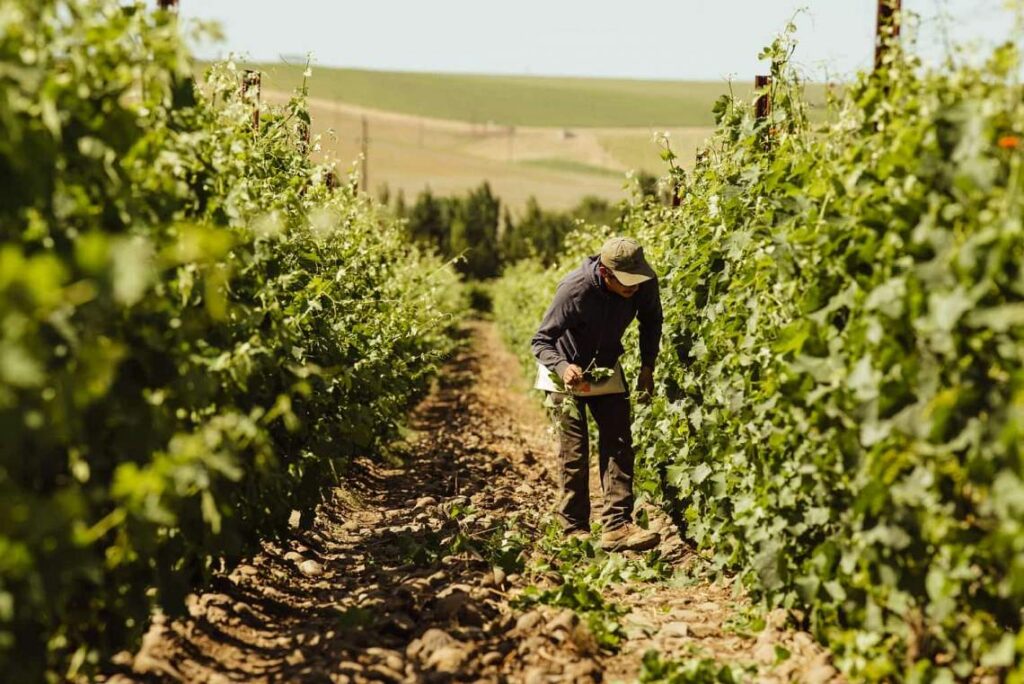
As Wanek declares, “It’s hard enough to walk on those stones, let alone, you know, farm them. You must hand harvest and hand farm basically everything in The Rocks District.” In a similar vein, not using herbicide translates into manual weed control.
Also, chilly air can be a challenge. The Rocks District receives air drainage from both the Blue Mountains and the VanSycle Ridge where cold air can move like a river from those higher elevations to the flat valley floor below. To address these concerns, Kaehler notes how most vineyards utilize wind machines for frost protection in the fall and spring. Additionally, during the extreme cold, many winegrowers will select, lay down and bury canes with soil, or will bury the entire trunk, head and up to three buds on head-trained (MHT) vines (a specialized training form found exclusively within The Rocks District developed by Brooke for vine protection, health and longevity) in the fall, in the event of an extreme hard freeze.
Finally, Robertson believes another key challenge that remains is finding needed talent and expertise on both farming and viticulture fronts as more plantings arrive in the AVA. “It’s difficult to be world-class if you don’t have world-class experienced people to meet the promise of this very distinctive AVA,” he stresses.
Basalt Bash Celebrates the Rocks’ 10th Anniversary
On July 25-26, 2025, The Basalt Bash & Barrel Auction celebrated the 10th anniversary of the founding of The Rocks District of Milton-Freewater AVA. This new event was created and hosted by the Rocks District Winegrowers and connected the winegrowers with the local community: with proceeds going to the Milton Freewater School District in support of mental health services, which local officials identified as the greatest community need. The weekend kicked off at Watermill’s winery with a Rocks District Winegrowers wine and tamale tasting, followed by a downtown Milton-Freewater Fiesta. A golf event as well as a silent barrel tasting and auction at Davis Orchards closed out the first annual Basalt Bash festivities. Event organizers were able to write a $75,000 check to the school district from proceeds. This will be an annual event with the next Basalt Bash slated for July 24-25, 2026.
When reflecting on the future of this burgeoning wine region, Ben Kaehler, General Manager of The Walls Vineyards contemplates, “People may think they know what Rocks District wines are stylistically, but the story is still being written.” With only eighteen percent of this AVA’s land currently being utilized for wine-grape production, there exists tremendous potential for growth. Currently, a hundred additional acres are in development, and the Rocks District Winegrower membership continues to rise each year there for that purpose,” he recalls.

