Rethinking Trellis Viability in the Age of Mechanization

By: Tracey L. Kelley

narrow path of a vineyard

Initially, when conceptualizing this article, we wanted to present the feasibility, maintenance and costs of the Lyre trellising system.

  However, research and interviews revealed that while it was once a viable choice, evolving production practices, reduced labor availability and other factors require growers to think more strategically. For cost-saving efficiency in the fruit zone, vine vigor and development of the finest product, growers need more modern trellis innovation.

  You know something interesting is about to happen when you contact a subject matter expert about a story angle and he or she says, “Um, that simply won’t work. Here’s why.”  Uh oh…

  What first piqued The Grapevine Magazine’s interest in the Lyre system was visiting American-based vineyards and hearing growers share their enthusiasm for it. Developed in the 1980s by Alain Corbonneau in the Bordeaux region of France, the Lyre trellis trains vines to grow up, allowing more wind and sun into the canopy for greater fruit yields and reduced mildew. It first entered into some mainstream vineyards because of a disaster.

  “The 1990s was a period of questioning canopy management and trellising. This was particularly evident in California, where (growers) were replanting after the AxR debacle,” said Richard Smart, author of Sunlight into Wine and world-renowned viticulturist specializing in canopy management, improving vineyard yield and nutrition management. The referenced debacle was AxR#1, or Aramon Rupestris Ganzin No. 1, a French-American cross rootstock devastated by the louse phylloxera.

  “There was a lot of the Lyre trellis installed in the Napa Valley and thereabouts at that time, probably more than anywhere else in the world that I am aware of,” Smart said. At the time, high-yielding growers in California, Oregon and Washington considered it a viable alternative—as did some in Texas and, to a limited extent, Missouri, New York and North Carolina. It’s a less-popular divided canopy choice where cold injury is common because of the extensive cordon development required. However, that’s not the only issue with it.

  “There may be 6–to–12 foliage wires and two fruiting wires. It’s, therefore, one of the more expensive trellis systems to install,” Smart said. “And its popularity soon waned because of problems with mechanization and subsequently, the effects of trunk disease—although this system is less prone than single curtain vertical shoot positioning (VSP). I hear mixed reports on the ease of mechanical harvesting, although it’s relatively easy to mechanically pre-prune.”

  So here’s one point where our story angle turned: how does a single choice of trellis impact all other aspects of production, labor and cost savings?

Labor+Mechanization=Different Trellis Choices

  “The top three trellis issues we’re asked to help with are labor savings, trellis systems that allow for more mechanization and stronger systems to hold the larger crop loads,” Jeff Miller told The Grapevine Magazine. Jeff Miller is COO of JSC Agricultural Supply, a division of Jim’s Supply based in Bakersfield, California. It manufactures trellising supplies, provides a full line of agricultural equipment and consults with growers about trellis systems and installation.

  A term frequently mentioned in the industry now is “no touch”: vineyards managed by mechanization and technology that reduce reliance on human labor. In France, where agricultural labor receives higher wages than in the United States, there’s an intense demand for advanced no-touch technology. Growers in Australia, Italy and Spain are adapting, too. At the 2017 Unified Wine & Grape Symposium, numerous panel experts—including Mark Krstic of the Australian Wine Research Institute, Aaron Lange of Lange Twins Family Winery and Vineyards in California, and Nick Pehle of Stone Hill Winery in Missouri—detailed the hows and whys of no-touch operations for everything from pruning and shoot thinning to leaf removal and harvest.

  “This is the direction the industry is heading,” Miller said. “It has to. With a shrinking workforce, more competition for labor, changing overtime laws and increasing minimum wage, growers are seeking solutions to limit the amount of labor needed in the vineyards.”

  These essential points circled our story angle back to trellis choices. Craig Macmillian is an ag specialist with Gold Ridge Research Conservation District in Sebastopol, California, who works with landowners to conserve, preserve and improve their properties. A former grower and winemaker, he said it’s not easy or inexpensive to convert horizontally-divided systems to vertical systems to allow for greater mechanization.

  “When I have seen people make a change, they were redeveloping the vineyard,” he said. “While horizontal systems like the Lyre are still excellent choices for high-vigor sites, you can’t pre-prune, prune or harvest mechanically. Most machines are designed for vertical trellises.”

  He went on to say that because both sides of the vine established on a horizontal structure require more touches, it takes additional time to work a block. “So with whatever labor you have, it’s very slow to get through a block. Doubling the amount of labor just isn’t practical. Costs are going up, and growers are paying more per hour, but more importantly, there simply aren’t enough people.”

  Here’s where the angle of this particular story could have easily jumped from the Lyre system and trellising in general to necessary mechanization due to immigration and adverse effect wage issues. In the United States, most farm labor comes from Mexico, but fewer people, in general, want to be involved with such hands-on, backbreaking work. So, while that topic is definitely an important feature to present another time, what’s interesting and more on target in this story is how growers, educators and manufacturers are innovating to accommodate where the industry is now and how planning should evolve to address key challenges before they happen.

Consider All Options for Now…and the Future

  To ensure the most healthy and productive canopy, Smart encourages growers to consider their options down the line, taking into consideration the overall operations of the vineyard.

  “My general preference in today’s market of constrained labor availability and cost is to use the vertically-divided Scott Henry system for cane pruned vines, and the Smart-Dyson for spur pruned vines,” Smart said. “The latter can be mechanically pre-pruned, and both machine-harvest well.” Smart partnered with John Dyson, a California and New York grower, to develop a split canopy system to improve yield and wine quality. Industry experts rely on the system to provide better grape-foliage balance.

  Miller added that “as the grower works to reduce their costs in the field, they’re moving towards a single bi-lateral cordon system 60–66 inches high. The system allows for uniformity to help with mechanization.”

  To new vineyard owners, Macmillian recommends installing the most basic trellis system possible at first. “Then put in a line post that has the ability to have retrofits put on it, so you can put on catch wires, additional catch wires, a crossbar, if that’s how you decide to go. Build up to what your needs eventually will be.”

  For ease of mechanized harvest, he referenced a California grower who established a cross arm that was up to about 18” wide. “While not horizontally divided, it was a way to capture the canopy without having to move the wires, which is what a cross arm will enable someone to do. It allows the canopy to be more open than with catch wires, but not flopping completely.”

  Macmillian also suggests people think about mechanization right from the beginning. “I don’t see that there’s going to be more labor in the future. In order to survive, vineyards are going to have to become increasingly mechanized. This applies to small, medium and large producers.”

What about the sense of community pride when people are involved in pruning, harvest and crush? Many vineyard owners rely on this assistance not only to provide a connection to tradition and as great promotion but also to manage costs more effectively.

  “If someone has a small enough vineyard—we’re talking a couple of acres—and they have that kind of community of friends, neighbors and relatives, hand labor is viable,” Macmillian told The Grapevine Magazine. “However, what I’ve found is most folks are excited to work for a couple of hours, then it’s not fun anymore. So there’s not much acreage you can cover that way. Now, in Europe, for example, domains—such as those in Burgundy, which tend to be very small—have folks from the community who come every year who pick at the end of the day, and that’s it. But we don’t have the same kind of tradition as they do there. And even in Europe, [use of] immigrant vineyard labor is increasing.”

  He added that “if you have a high-vigor site, a divided canopy trellis might initially be the right choice, but economically and logistically, it may not be the right choice. Which means you’ll have to deal with that vigor issue another way, and that’s the problem.”

  Miller said JSC tries to develop products to allow for a slight hybridization in operations, recognizing that while complete trellis retrofitting might not be an option for existing growers—especially those of a certain size—adapting technologies might bridge the gap.

  “In early 2018, JSC partnered with ECO Trellis out of New Zealand to add the ECO/ KLIMA suite of products to our product line,” Miller said. “The KLIMA pruning machine is a cane pruning system that reduces costs during the pruning process. We developed a cross arm that can adapt any existing trellis system over to be compatible with the KLIMA pruning machine. In addition, working with a grower on the Central Coast, we developed an extension that can be added in the early years of a high-wire system to help with the spur positions in the initial development of the vineyard.”

  University of Missouri Extension Services offers a comprehensive article that provides great detail in preparing for mechanized viticulture or preparing an existing vineyard for mechanization. It advises producers to first “develop a working knowledge of the abilities, limitations and requirements of currently available equipment.” Also included in this analysis is the importance of site selection, vineyard design, cultivar selection and trellising.

  “At present, single curtain, cordon-trained systems are the most conducive to full vineyard mechanization. Examples include the high bilateral cordon, mid-wire cordon with VSP and the Smart-Dyson and Ballerina systems. Of these, the former two are often preferred for their simplicity in management, and selection of either should be based upon cultivar growth and bearing habit, anticipated vine size and revenues and other site or regionally-specific considerations.”

  Basic touchstones for existing vineyards include close examination of trunks and cordons, as well as the density of canes and spurs; investigating the cost of repairing or retrofitting the trellis; and reasons for sagging between posts, whether it’s due to falling end assemblies, excessive line post spacing or inadequate tension prior to cordon establishment. U of M Extension offers an extensive checklist for established growers considering more mechanized operations.
Exploring the Diverse: Wines Within the Columbia Gorge Wine Region

By: Becky Garrison

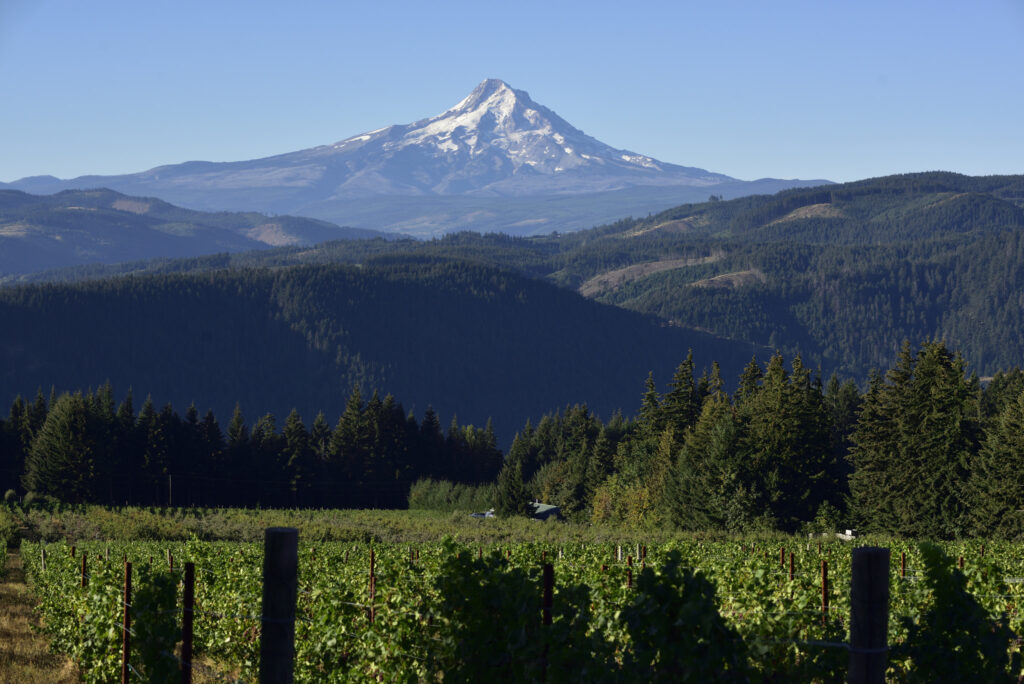
vineyard with an overlooking mountain

The Columbia Gorge Wine Region is defined by the Columbia River that cuts through the Cascade Mountain Range, as well as the Missoula Floods that scoured the region 15,000 years ago. Within this compact 40-mile region that includes Washington State and Oregon, lies the Columbia Gorge American Viticulture Area (AVA), as well as a portion of the Columbia Valley AVA.

  Lewis and Clark first made the Gorge famous during their 1805 passage to the Pacific Ocean, when they found this was the only sea-level passage through the Cascades. However, the first signs of this region’s winemaking potential did not occur until the 1880s when the Jewitt family, founders of the town of White Salmon in Washington State, first planted American vines.

  Soon other pioneer families followed suit with some of their original vines still standing. Case in point, during this time period, Italian stonemason Louis Comini planted Zinfandel wines in a vineyard located in The Dalles, Oregon. In 1982, Lonnie Wright, owner of the Pines 1852 Vineyard and Winery, rediscovered this now abandoned vineyard and nursed the vineyard back to health. He continues to grow grapes used for their Old Vine Zinfandel.

  In the 1970s, other contemporary pioneers began experimenting growing grapes on the south-facing slopes of the Underwood Mountain in Washington State. Over the ensuing two decades, well known wine makers began exploring the grapes of this region, and the Columbia Gorge AVA was established formally in 2004.

A founding member of the Columbia Gorge AVA and co-founder of Syncline Wine Cellars (Lyle, Washington), James Mantone made his first batch of wine in 1999 at Syncline using Pinot Noir grown at Celilo Vineyard, one of the oldest vineyards in Washington State. Early on, Mantone saw the potential of this area for winemaking. He describes his pull to this area. “We were attracted by the tortured topography, the jumbled soils, the varied aspects and elevations of the hills, the influence of the Cascades cooling the nights, the winds shaping vine photosynthesis, the marginal climate. Here was a place that could reward the winemaker with intimate sites that have the potential to produce grapes unique from neighboring sites.”

Rachael Horn, head wine maker and owner of AniChe Cellars in Underwood, Washington, describes the Columbia Gorge AVA as edgy, literally, and fringe in all kinds of ways. “We can grow a variety of fruit in the Gorge, due to a banana belt micro marine-climate while being surrounded by Continental climes.” She adds how these growing conditions produce a high degree of acid in fruit. “This keeps our wines fresh and less concentrated than nearby regions. Our diurnal difference is often 30 degrees or more, which facilitates the retention of native acids.”

  While the Pacific Northwest has become renowned for their juicy red wines, the diverse terroir of this region can produce grapes of almost every varietal. In fact, the Columbia Gorge AVA has the distinction of being one of the few wine growing areas in Washington State where white grape planting exceeds red grape planting with white grapes constituting about 64 percent of the total grape harvest.

  The more western vineyards possess a cool, marine influenced climate ideal for cool-weather loving white varietals such as Pinot Gris, Riesling, Gewürztraminer, and Chardonnay which are known for their crisp acidity. This area also produces bold reds such as Pinot Noir that grow well in this lush environment. Some of these western vineyards such as AniChe Cellars can be dry-farmed, as the soil receives upwards of 40 inches of precipitation annually, and does not require additional irrigation.

  Conversely, eastern vineyards with their continental high desert climate replete with abundant sunshine and just 10 inches of annual rainfall are perfect for growing hot-weather Rhône and Bordeaux along with Italian varietals such as Zinfandel, Syrah, Cabernet Sauvignon, and Barbera.

             Steve Bickford, one of the owners of the family-owned Mt. Hood Winery situated just outside the town of Hood River, observes how the local weather informs the grapes they chose to grow at their vineyard versus those grapes they decide to purchase from other AVAs.

  ”The west end is cooler, wetter and with less overall heat units needed for ripening. So, we grow many white wine grapes on the west end in Hood River, and a few reds; mostly Pinot Noir. The east end of the AVA is drier and hotter, and conducive to the bigger reds, like Merlot, Cabernet Sauvignon, and Syrah, So we buy some grapes from our eastern friends.”

  Even within a single vineyard, one can find a vast array of wines. For example, Nate Ready, Farmer/Winemaker, for Hiyu Wine Farm near Hood River, Oregon, opines how the different kind of microorganisms, plants, animals, and humans living in a symbiotic system allow him to grow 107 grape varietals. He creates 12 complex field blends through practices such as grafting multiple varieties on to one plant. Here Ready is inspired by natural mutations that happen over time with an eye toward history. He notes, “Each planting is a field blend based on a different moment in the European history of the grapevine.”

  Ready chose to situate his 30-acre family farm about 22 miles from the summit of Mt. Hood because he wanted to raise animals and garden in a way that resembles nature more than agriculture. “It works for all kinds of grapes because its a diverse and happy place to be a living, growing, being free of pesticides, herbicides, chemicals, and unnecessary human intervention.”

Graham Markel launched Buona Notte Wines, an Italian leaning winery, after working as an assistant winemaker for Hiyu. While the Gorge is not as diverse as the Italian peninsula, he finds places that grow different Italian varietals. Currently, Markel works with seven different vineyards for the seven different varietals that he makes. “Every vineyard is completely unique and seems to fit that varietal so well. I get Sauvignon Blanc form the cliffs of Underwood and Sangiovese from the rolling wheat fields just east of The Dalles. The two vineyards couldn’t be more different, and are only about 40 miles apart.”

  Luke Bradford, proprietor of Cor Cellars wanted to grow the kinds of grapes that would produce the wines he encountered during his trips to Europe such as the wines of Boudreaux and the Mosel, as well as the wines of central and southern Italy. “We wanted to be located in a cooler climate region while still having access to the warmer climate grapes.” Currently, their white wines are made using grapes grown in the Columbia Gorge while they get the grapes for their red wines from the neighboring Horse Heaven Hills AVA. 

  According to the Columbia Gorge Winegrowers Association, fifty wineries reside in this region with 95% of these boutique wineries producing 5,000 or fewer cases of wine each year. These wineries gatherer their grapes from over ninety vineyards (1,300+ vineyard acres planted) within this wine region, as well as surrounding AVAs with a focus on sustainable and organic farming practices.

  Given this boutique nature of the Columbia Gorge AVA, an event such as the 2017 Eagle Creek Fire had a very detrimental impact on that year’s harvest. In summer of 2019, neighboring Phelps Creek Vineyards,  Mt. Hood Winery and Stave & Stone Wine Estates, launched National Forest Week to help rebuild the hiking trails damaged in this fire. They released 8,376 bottles of three Pinot Noirs made with grapes from this fiery vintage. Each bottle sold generated $3 for the National Forest Foundation’s Eagle Creek Fire Restoration Fund.

  Moving forward, ventures such as the Columbia Gorge Express enable tourists without a car to travel from Portland, Oregon to Hood River to explore the town’s numerous tasting rooms, along with three breweries (Ferment Brewing, Double Mountain Brewery and Pfriem family breweries) and Hood River Distilling, home to brands such as Clear Creek Distilling and McCarthy’s Oregon Single Malt.

  Also, the East Gorge Food Trail worked with the Columbia Gorge Tourism Alliance to develop agrotourism within the region by focusing on local businesses that source ingredients within 150 miles. They chose to focus on the Eastern part of the Gorge this area was not as well developed for tourism as areas such as the towns of Hood River and Cascade Locks and areas like Mt. Hood. They designed a self-guided tour covering Mosier (pop. 433) to The Dalles (pop. 13,631) or The Dalles to Durfur (pop. 638). These tours encompass ten historic orchards and farms, restaurants, and seven wineries (15 Mile Winery, Analemma Wines, Garnier Vineyards, Idiot’s Grace Wines, Moody Tollbridge Winery, Sunshine Mill Winery, and Tierra de Lobos Winery).

  As they are at the beginning stages of this project, they hope to continue knitting together the stories that can connect people to the terroir and tastes of the Columbia Gorge AVA.

Paradisos del Sol: An Organic Vineyard Paradise

By: Nan McCreary, Sr. Staff Writer, The Grapevine Magazine

man posing beside a dog at a vineyard

When Paul Vandenberg was 10-years-old, he would wait eagerly for his mother’s copy of “Organic Gardening and Farming” to arrive so he could read it cover to cover. When he was 13, he made his first wine out of blackberries. It’s no surprise then that Vandenberg, after studying ecology in college, found his life’s work in an organic vineyard in Washington State.

  “I started working in the wine industry in 1983, just as the vineyard explosion was happening in the state,” Vandenberg told The Grapevine Magazine. “I had always been an organic gardener, but everyone thought I was ‘hippy dippy’ at the time.” Yet several years later, Vandenberg was at Badger Mountain Vineyard when the owner, Bill Powers, was having problems with herbicide drift from wheat fields that were 10 to 20 miles away. Out of frustration, Powers implemented organic farming techniques to help mitigate the problem. And that was Vandenberg’s entrée for his true passion: he was with Badger Mountain when it became Washington’s first certified organic vineyard, and later, was winemaker at Worden’s Winery when he produced the first organic wine in the state, which took Worden’s into the worldwide marketplace.

  Fast forward to 2004 and Vandenberg established his own playground, Paradisos del Sol Winery in Zillah, WA, in the Rattlesnake Hills sub-AVA of the Yakima Valley AVA. For the past 20 years, he has taken organic viticulture to new heights by growing grapes in a pesticide-free environment and producing wines that are pure expressions of the earth. In choosing land for his farm, Vandenberg went to great lengths to locate a property that would meet specific farming requirements. “I did not start growing grapes because I owned the land; I found land where I thought I could grow grapes with the least use of pesticides. It’s one of the sweetest spots on the planet. It has a fine, deep loam soil deposited by the great Missoula floods and is on a ridgetop where the leaves are bathed in high intensity sunlight.” It is this sunlight, Vandenberg said, that acts as a natural deterrent to powdery mildew, a potentially devastating grapevine disease.

  To assure ample sunlight in his vineyards, Vandenberg uses a Divided Canopy Quadrilateral Cordon System (Lyre) developed by UC-Davis research viticulturist Mark Kliewer. In this system, instead of using a single wire to support the cordon and maybe one or two wires to support some of the canopy, the grape grower uses a cross arm to create two cordons, separated horizontally by a meter. “The idea is to have two curtains rising from a cordon wire with an open space in between,” Vandenberg explained. “With more openness in the fruit zone, the fruit is well-exposed to light, which adds to color and flavor in the grapes, and deters powdery mildew.”

  Vandenberg describes his trellising system as a “low-vigor canopy,” defined by international viticulturist Richard Smart as a canopy with no more than 15 shoots per meter of cordon and a shoot length no greater than a meter. A low-vigor canopy on a single-wire system will yield a maximum of four tons per acre; by having a double trellis, the yield is double. “The key is balancing the sun and the shade,” Vandenberg said. “Pruning depends on the variety, and the size of its leaves and berries. But essentially all varieties have the same sort of canopy density, the same openness, and the same ability for light to come in for every leaf and every grape.”

  Vandenberg’s pest control strategies in his vineyard are not just in the canopy; they’re also on the vineyard floor. Here on the surface, cover crops grow year ‘round to support a lively complex of predatory insects in the dirt below. For example, dozens of blooming plants provide pollen and nectar for wasps, which prey on leafhoppers. Also, over 16 identified species of mushroom caps on the surface indicates mycelium (the vegetative part of a fungus) web below, which receives sugar from the grapevine roots and in exchange gives nutrients. The objective, said Vandenberg, is to create an environment of well-fed plants so they are able to use their own natural defenses to avoid predators like powdery mildew and leafhoppers. “Biodiversity creates stability and avoids the eruption of populations of pests,” Vandenberg told the Grapevine Magazine. “My soil is not just dirt; it’s a live complex of organisms. That’s what organic gardening is all about.

  The biggest pest problem at Paradisos del Sol, said Vandenberg, is pocket gophers. He is trying to manage this naturally, of course, by building boxes for barn owls, who are the number one predator for gophers. Vandenberg has installed an “owl cam,” so he can watch the owlets grow.

  Like his practices in the vineyard, Vandenberg employs as many natural processes as possible when making wines. “Great wine is grown, not made,” he said. “As a terroirist, I let the wine be what it is. I don’t adjust pH and acidity to some textbook standard.” Paradisos del Sol produces wines from 15 varieties of grapes. Reds include Tempranillo, Sangiovese, Zinfandel, Malbec, Pinot Meunier, Cabernet Sauvignon, Cabernet Franc, and two oddballs: Lemberger, a grape widely grown in Austria and Hungary, and Teroldego, a grape from northwest Italy. White wines include Chenin Blanc, Semillon, Riesling, Orange Muscat, White Muscat, and yet another oddball, Xarel·lo, one of the three grapes used in Cava. Vandenberg is the only person in the U.S. to commercially plant Xarel·lo. “Somebody’s got to plant these things and try them out,” he said.

  While Vandenberg grows multiple varieties of grapes, he releases only two varietal wines: a Sangiovese and a barrel-fermented and barrel-aged Chenin Blanc. He uses his red grapes to produce three wines, including a barrel-fermented and barrel-aged Rosé. He also creates blends with his white wines. Vandenberg eschews the use of new barrels, as he wants no heavy oak influences in his wines. “I grow grapes, not oak trees,” he said. “I believe you can get oak flavors in a 12-year-old barrel; my barrels are over 20 years old.

  Vandenberg does use fining and filtering techniques but puts minimal additives in his wine. Typically, ingredients listed on the label of a white wine are: 100% hand-picked sustainably grown organic grapes, yeast, bentonite clay, minimum effective so2 (potassium metabisulfite). Ingredients listed on the label of a red wine are: 100% hand-picked sustainably grown organic grapes, yeast, malolactic culture, minimum effective so2 (potassium metabisulfite). Vandenberg describes his winemaking practices as “old methods.” The wine goes in the barrel as grape juice, with no racking until it is pulled out of the barrel. “I try to provide the vine a perfect environment so that it is healthy and happy and produces fabulous tasting fruit,” he explained. “I don’t mess with it: I just let it do its thing. A barrel in a cool, dark room is a wonderful place to make wine. That’s why it’s been done that way for 2000 years.”

  Vandenberg describes Paradisos del Sol as a “small family estate winery.” He produces less than 2000 cases per year, and all is sold direct-to-consumer. Wine prices range from $7 to $48. Vandenberg runs the operation with his wife, Barbara Sherman (who manages the office), and only hires part-time employees during harvest and shoot thinning and leaf pulling. The vineyard is Certified Organic by the Washington State Department of Agriculture.

  Compared to other wineries, Paradisos del Sol is also an integrated farm, with chickens, turkeys, cattle, pigs, and sheep, who help mow the vineyard during the winter when grapevines are dormant. The tasting room, with views of Mt. Adams and Mt. Rainier, is open daily, and offers visitors an opportunity to taste not just wine, but food paired with the specific wines. The destination is very popular with families, as children can feed chickens and play with the cats and dogs that live on premises. Paradisos del Sol provides picnic facilities and free overnight camping for tents and self-contained RVs. Horses are welcome, with water available for them.

  Indeed, Vandenberg has created an organic paradise in the heart of the Yakima Valley. There, in this garden in the desert, he offers tours and talks to visitors who want to understand more about how he grows his grapes and produces his wines. “People don’t understand what organic means,” he told The Grapevine Magazine. “Organic means a systemic, all-embracing approach to gardening and farming. It’s about manipulating the environment in a way that is favorable to something we want to do.” As an enologist with over 36 years of experience, Vandenberg’s knowledge is vast, but his mantra is simple: “We are a traditional small wine estate dedicated to growing grapes without the use of pesticides and trying to make the best pure and wholesome wines we can.” For more information on Paradisos del Sol visit their website: https://paradisosdelsol.com/Home.htm

How Vineyards Should Tackle the Task of Dormant Weed Control

bushes vineyard plantation after harvest, autumn landscape

By: Alyssa L. Ochs

Like all plants that are grown commercially or even as backyard hobbies, grapevines are not immune to weeds and the damage they cause. Although your grapevines may not be growing at this time of the year, the weeds around them still are. In fact, the late fall season after harvest time is often considered to be the most important time for weed control. Here is some information about how vineyards can treat their soil for dormant weed control and tips for using herbicides after harvest.

The Importance of Dormant Weed Control

  Weeds can take a lot out of grapevines after harvest, which is why this type of vineyard maintenance is so important to learn about right now. This is an ideal time to get a handle on your vineyard’s weeds while the vines are dormant and have no leaves.

  Dormant weed control helps limit soil moisture loss and prevents more weed seeds from being deposited in the soil. Ultimately, it benefits next year’s crop yield by reducing the spread of disease and reducing competition between weeds and grapevines for both water and nutrients.

  Patrick Clark, the technical marketing manager and research coordinator for BioSafe Systems, LLC, and Taylor Vadon, BioSafe’s technical sales representative, told The Grapevine Magazine how the possibility of crop injury is considerably low during dormancy due to the lack of vegetation. Headquartered in East Hartford, Connecticut but serving customers throughout North and South America, BioSafe is a family-owned manufacturer of biodegradable disease-control products. The risk of crop injury due to herbicide exposure increases when leaves and buds form during the growing season. This is why vineyard managers of conventional, mature vineyards are advised to apply herbicides during the dormancy period.

  “The primary and most effective weed management options during this stage are pre-emergent herbicides used in conjunction with post-emergent systemic chemistries and burndown products,” said Clark and Vadon. “The use of systemic herbicides with a burndown product, such as AXXE, is ideal for removing the weeds from under the vines to ensure a bare soil area. By removing weeds from under the vines, a vineyard manager can maximize radiant heat from the sun to minimize possible frost injury leading up to and during budbreak. The reduction of weeds will also reduce nutrient and water competition when the vines transition from dormancy into the growing season.”

  “Furthermore, having bare soil under the vines is critical in maximizing the efficacy of any pre-emergent herbicides, as it will allow for full coverage of the area,” Clark and Vadon said. “After adequate rainfall or irrigation water moving the pre-emergent herbicide into the soil, the performance of these products will extend well into the spring and summer, which will reduce the competition of weeds during the growing season.”

Types of Weeds in Vineyards

  In many vineyards, you’ll find annual weeds that live less than a year and also perennial weeds that live more than two years. It is crucial that vineyard operators consider both types separately for dormant weed control strategies. Perennial weeds can include poison oak and Canada thistle. Meanwhile, some weeds should be controlled before the vineyard is established, such as bindweed and horse nettle. Weeds are also often classified as summer annuals and winter annuals. Weeds are very regionally specific, so take some time to learn about the weeds common to your area so you can devise a plan to kill them effectively.

  One common mistake that vineyards make with regard to dormant weed control is not applying burndown products and other post-emergent herbicides at the right target plant height. Clark and Vadon from BioSafe recommend treating target weeds at one to three inches maximum height to ensure complete coverage when using a burndown herbicide.

  “When weeds become too large or mature, obtaining adequate coverage by getting product contact throughout the target weeds becomes difficult, thus reducing efficacy,” they said.

  Weather is another persistent concern for vineyards looking to get weeds under control because rainfast timing varies with different herbicides. If you apply the herbicide too early, the product can get washed off the plant’s surface, thereby minimizing the effectiveness of the herbicide’s active ingredient.

  “It is important to note here that a vineyard manager or applicator should consult the product label to be sure of proper rates by plant height and best use recommendations,” said Clark and Vadon. “Understanding the products, proper timing and rates of application, tracking the weather conditions and good planning will ensure your chosen burndown product will be effective.”

Non-Chemical Weed Control Methods

  Weeds can be controlled by both chemical and non-chemical methods, and the choice of method depends on the severity of the weed problem and whether you plan to make organic wine with your grapes. One chemical-free weed control method involves applying a synthetic mulch made of a plastic or geotextile; however, this material can be difficult to keep in place and expensive. You can also apply organic mulch that is several inches deep to reduce weed growth. But be mindful of the fact that organic mulch can offset the nitrogen balance, introduce new seeds from the content of the mulch or create a habitat that rodents love.

  Black plastic and landscape fabrics work well for weed suppression if your vineyard can afford these materials and avoid damaging them during normal vineyard operations. Only the very tiniest vineyards can manage pulling weeds by hand, while machine weeders can assist larger vineyards if they are able to cut close enough to the roots or make multiple trips through the rows. Try planting a cover crop to out-compete weeds in your vineyard but ensure that your chosen cover crop doesn’t compete with the vines. Other organic weed control methods include soil solarization before planting and flaming with propane after planting. Animals, such as geese and sheep, can be used to control weeds without chemicals, as well as organic herbicides made with agricultural vinegar.

Weed Control with Chemical Aids

  If these methods aren’t effective or based upon a vineyard owner’s preference, chemical-based herbicides are commonly used to kill seedings in their earliest stages of formation. Some options are Prowl, Surflan and Diuron, while other herbicides are not used for vineyards because they will harm the vines. Alion is an herbicide that is used in vineyards with grapes that are at least five years old and with root systems that are at least 12 inches deep.

  Roundup PowerMaxx, Rely 280, Shark EW and AXXE are common systemic and burndown herbicides that control many plant species when rotated or tank-mixed. Clark and Vadon of BioSafe mentioned several pre-emergent herbicides for long residual management of tough-to-control weed species, including iChateau SW, Alion, Trellis and Matrix.

  For annual weeds, it is common to use a pre-emergent herbicide to interfere with the weeds’ germination. Glyphosate is often used in pre-plant situations, with multiple applications necessary for perennials that are well-established. Meanwhile, systemic herbicides are most common for perennial weeds, such as poison ivy, poison oak and Canada thistle.

  After harvest, you can apply a pre-emergent herbicide by itself or combined with another herbicide. This is usually done in both the spring and fall or done as a single winter treatment along with a post-emergent herbicide to address weeds that are currently growing in the vineyard. Coarse and sandy soil with little organic matter can use lower rates of herbicides, while silt and clay soil with high organic matter will need more of the product.

  To help vineyards control weeds after harvest, BioSafe offers AXXE, a broad-spectrum herbicide used for non-selective, weed control of grasses and broadleaf weeds for herbicidal burndown applications in established vineyards during dormancy. AXXE provides fast-acting results on many weeds, mosses, lichens and sedges.

  “This product is an herbicidal soap (40% ammonium nonanoate) comprised of a form of ammoniated pelargonic salts that provide rapid burndown of weeds and breaks down quickly leaving no harmful residue,” said Clark and Vadon. “These salts penetrate the cell walls of plants, disrupting the cellular functions of the targeted weeds and killing them within hours of application. AXXE is an American-made herbicide that is ideal as a tank-mix partner for systemic products to provide an innovative mode of action increasing efficacy and resistance management.”

Final Tips About Dormant Weed Control

  Just after Thanksgiving is an ideal time to apply herbicide in many parts of the country before a second application of residual annual grass herbicides in the late spring for late summer control. Regardless of what herbicide you use, always spray it at the weed foliage and soil rather than the vines’ leaves, shoots, or young wood. If weeds are sparse, it may be best to use a visual weed-seeking sprayer to reduce unnecessary spread of the herbicide. It also helps to place a grow tube around the vines to spray for weeds without injuring vines. In addition to deciding on chemical and non-chemical weed control methods, vineyards also need to plan ahead for the equipment required, such as sprayer technology that can fit onto the front of a tractor, a spinning disk under a dome to shield vines from herbicide contact, or a backyard-type sprayer for small vineyards.

  Clark and Vadon of BioSafe’s most important piece of advice about applying herbicide is that worker safety is always paramount. This means that vineyard managers, labor crews, and applicators must be aware of the rules and regulations of herbicide use and read product labels to understand handling and mixing procedures, personal protective equipment needed, and best use recommendations.

  “Regarding weed management in established vineyards during dormancy, we would recommend rotating and/or tank-mixing products from varying modes of action when developing a weed management plan,” said Clark and Vadon. “This will reduce the likelihood of resistant weeds from developing, thus ensuring the industry will have effective products for many seasons to come.”

Post-Harvest Vineyard Maintenance: Tips to Finish the Year Off Right

narrow path of a wine vineyard

By: Alyssa L. Ochs

Although the busy time of harvesting grapes is winding down or has ended for many vineyards, there’s not much time to sit back and relax before more critical work must be done. Many post-harvest vineyard tasks should be on every vineyard’s to-do lists to prepare for next year’s crop and sustain the longevity of the vineyard’s operations.

The Basics of Post-Harvest Vineyard Management

  After the growing season ends and the grapes have been picked, grapevines go dormant and signal that it’s time to start preparing for next year. Some of the vital maintenance tasks to do after harvesting are removing bird netting, analyzing the soil with samples, repairing or replacing trellising and equipment, and planting a cover crop to reduce soil nutrient loss and control erosion. It is also the time of year to be proactive about pest control, consider irrigation strategy, stock up on new vines and put some thought into overall vineyard management strategy.

  As vineyards wrap up harvest operations and prepare for winter, some specialists may be helpful for advice, products and services.

•    Vineyard management companies

•    Pest control companies

•    Irrigation consultants

•    Nurseries

•    Trellising companies

•    Soil companies

Check and Repair Trellising

  Trellising is a big part of post-harvest maintenance, because, in most climates, grapevines need supports to secure the wood and summer shoots within the training system, and ensure proper ventilation and exposure.

  “Furthermore, the trellis helps to improve the implementation of viticulture work and facilitate mechanized procedures, like machine harvesting,” said Oliver Asberger, Vice President of PA Trellising Systems in Charlottesville, Virginia. “If a trellis is not designed right or maintenance is not kept up, it will lead to deficiencies in vineyard performance and higher costs in labor and parts.”

  Asberger told The Grapevine Magazine that two primary signs of a good trellis are tight wires and stable posts. “Each growing season, the trellis experiences pressure on its systems, and that leads to loosening of parts or even breakage,” he said. “To optimize the performance and keep costs down, the trellis is best fixed when the pressure is off and the vine is dormant.”

  PA Trellising Systems is a distribution company, rather than a vineyard management company, but it can offer advice on how to modify and repair existing materials if a vineyard notices a problem with its trellising system.

  “When it comes to new establishments, we guide the buyer to what options are available and optimal for post models, forms of galvanization, size and length, inside or outside hooks, set depth and use of accessories, like cross-arms or wire extenders,” Asberger said. “Also, we are able to customize our posts to offer the best solutions for a unique growing situation.”

  Another company that provides trellising products is Gripple, which offers the Gripple Plus for simple push-fit splicing, locking and tensioning system that is up to five times faster to install than traditional methods for broken trellis wires. Gripple joiners and tensioners have patented ceramic rollers that deliver a better grip and non-corrosive hold on the high tensile wires that are used in vineyards today. They can be used in conjunction with the Gripple Torq Tool or Gripple Contractor Tool to return tension to slacked or broken trellis wires quickly.

  “The Gripple Plus range is perfect for ongoing maintenance and allows for re-tensioning year after year,” said Erik Shortenhaus, Gripple’s Business Development Manager. “Gripple also provides pre-made cable bracing kits designed for the quick and easy repair of end post assemblies. Within our end post cable bracing kits, we offer a range of clips and end-fittings that are designed to quickly and securely attach to any end post material on the market, such as wood, drill pipe and channel steel. Additionally, Gripple offers a range of below-ground, percussion-style anchors that can be instantly load-locked and serve as a dead man anchor point or additional reinforcement for existing anchors. Gripple products make vineyard installation, maintenance and repairs simple and secure.”

  Shortenhaus pointed out that the growing season, crop load, weather, farming practices and harvest activities all contribute to possible wear on a vineyard’s trellis system. He said that the rigors of harvest, especially machine harvest, take a strenuous toll on a vineyard’s trellis structure, making this a prime time to check trellising.

  “Taking account of any damage that has occurred during harvest or over the year, and addressing it prior to next year’s crop, is essential to providing a solid, consistent and hassle-free foundation for your vines,” said Shortenhaus.

Check and Improve Irrigation

  Vineyard managers should remember to check their irrigation systems after harvest since machine harvesting can be rough on the vines and system. Look for physical damage, such as fallen hoses or emitters.

  Brett Curtis and James Bengtson of California’s Bennett Water Systems recommend using the post-harvest time as an “alarm clock” to handle yearly maintenance and “do an eyes-on evaluation with a full system flush and a line treatment to clean the emitters.”

  At the filter station, they recommend inspecting the sand for the sand media filter, working condition of the backwash valves and screen of the screen filter. Other recommendations are to check the pressure gauges to assess the accuracy of the pressure differential and to look for gasket leaks and other visible signs of failure.

  “Post-harvest irrigation is what lets you double-check that all of your fixes were successful before you put the system to sleep for the year,” said Curtis and Bengtson.

  Bennett Water Systems has knowledgeable key-account managers, salesmen and project managers who can perform evaluations, get to the root of the problem, and perform any fix that is required.

  “We have crews with years of experience both in installing drip systems for vineyards and performing repairs and regular maintenance,” said Curtis and Bengtson. “Whether it’s an issue with a pump, filter station or anything downstream of the filter, like pipe, tubing or emitter issues, we have a way to fix it or a solution to prevent it from causing issues in the future.”

Soil Enhancement and Maintenance

  One of the essential tasks to do post-harvest is evaluating the soil for determining nutrient and organic matter needs.

  “The vines utilize nutrients during the growing season, but not all nutrients are absorbed at the same rate,” said Coult Dennis of Superior Soil Supplements in Hanford, California. “The pH level of the soil makes a big difference in the availability of nutrients to the vines. Some nutrients are more readily available at lower pH; others are more available at higher pH. It’s important to look at the pH levels of both the soil and the irrigation water sources in order the make the best possible decisions regarding soil amendments.”

  Founded in 1983, Superior Soil Supplements dedicates themselves to building healthy soil and being California’s largest distributor of bulk agricultural soil amendments and landscape materials. It has facilities in Ivanhoe, El Nido, McFarland, Hanford and Coalinga and believes that balanced soil builds a strong foundation for crops, saving the farmer money on fertilizers and other crop inputs in the future.

  “Making sure your vines are set up for optimal growth in the spring is vital to having flourishing canes and ultimately, a strong and profitable yield,” Dennis said.

Order New Vine Stock if Needed

  After harvest is the ideal time to determine whether the vineyard will need new vine stock for the next growing season.

  “If you are looking to order vines for the spring of 2020, the best time to order vines is from August to December 2019 to ensure that varieties you want are still available,” said Ray Winter of Winterhaven Vineyard and Nursery in Janesville, Minnesota.

  Established in 2001, a year after starting a vineyard of over 14 acres and 6,000 vines, Winterhaven nursery specializes in cold-hardy wine grapes and sells many bare-root grapevines for red, white and table grape varieties. Winter said that the most important things for a vineyard to consider when ordering vines from a nursery should be whether the varietal is hardy to the growing location and if there is a market for them if the vineyard does not plan to use them in their wine.

Final Words of Advice

  In addition to these post-harvest maintenance tasks, vineyards will also want to spend time identifying and removing diseased vines, perhaps with the guidance of a local pest control company that specializes in vineyard pests. It’s also time to check vineyard equipment for routine maintenance or repair needs, as well as to identify which pieces of equipment to replace.

  Take time to reflect on the season and discuss with staff what went well and how to make improvements for the year ahead.

In closing, here are a few final words of advice from our industry experts to guide vineyards across the country through the post-harvest time of year and ensure a successful 2020 season.

For trellis maintenance, Oliver Asberger of PA Trellising Systems advises vineyards to establish a trellis that will last for the lifetime of the vineyard—approximately 25 years— and is mostly maintenance-free.

  “Too often, at the time of establishment, growers choose materials at lower costs or cut corners within the stability performance but later end up with extremely high maintenance and replacement costs,” Asberger said. “Also, in this era of less labor and more mechanization, a grower should consider if the system is set up to use technology in the future, even if the vineyard doesn’t currently own it. A later modification will be costly or not applicable at all.”

  Asberger also said that a trellis is best maintained during the dormant time because, with no canopy present, it’s easy to see loose or missing parts and replace them more cost-effectively.

“Doing this work when the canopy is present will hinder the effectiveness and most definitely will lead to damaging the shoots,” he said.

  Shortenhaus of Gripple also advises vineyards to take a visual inventory of their trellis systems and make any needed repairs or adjustments to give the vineyard a strong foundation for the next growing season.

  “Using Gripple for your trellising repair and maintenance needs couldn’t be simpler or more reliable, and it will effectively reduce your work time,” he said.

  Bennett Water Systems’ most significant piece of advice for irrigation is to remember that the system installed impacts yield directly.

  “The efficiencies of the system all play into it, such as pump efficiency, pressure losses, if supplements are going where you expect and need them and if your water is being evenly distributed throughout the whole field,” said Curtis and Bengtson. “For Bennett Water Systems, it is our goal to design and install a system with the highest distribution uniformity as possible that provides our customers with the tools that they need to produce maximum yields most sustainably.”

  Dennis of Superior Soil Supplements said that the thing his company sees most in California is a lack of organic matter in the soil. He said that organic matter should make up about 5% of soil composition and while this is difficult to achieve, adding any amount of organic matter will help. Organic matter helps retain moisture and nutrients in the soil, promotes beneficial soil flora growth to chelate nutrients, and breaks them down into a structure that can be used by the plant.

  “Compost is the least expensive and easiest way to build up organic matter,” Dennis said. “Compost can be derived from municipal green waste sources, as well as from manure and even processed sewage. Green waste is the most popular choice for vineyard applications. Like any other crop input, organic matter is depleted in the soil through the growing season and needs to be replenished.”

  Dennis recommends compost application as part of a grower’s yearly soil fertility program. “To maximize spreading efficiency, we often blend fertilizers, sulfur, limestone or dolomite with the compost, so the year’s soil needs are addressed with one pass of the spreader,” he said.

  Concerning ordering vines, Winter of Winterhaven Vineyard and Nursery said vines coming from a cold climate nursery tend to grow better than those purchased from warm climate nurseries, even though the genetics are the same.

  “We have had many customers tell us this,” Winter said. “After the fruit comes off our grapevines, we always try to do a fertilizer spray on the leaves to feed the vine and get them ready for the winter.”

Enforcing Your Trademarks: How Far Should You Go?

Legal Protection word cloud concept

By: Brian D. Kaider, Esq.

You’ve secured federal registration for your trademarks and you’ve been building your brand recognition.  Per your trademark attorney’s recommendation, you’ve had quarterly searches conducted to find similar marks.  Lo and behold, a new entry to the market is using your trademark.  Now what?  Stop and take a breath; let the initial surprise or anger settle. There is a lot to consider before taking any action.

Take Stock of the Situation

  First, take a look at your own trademark.  Is it the name of your winery or of one of your products?  Is it a national brand or one that is distributed in a small geographic area?  In what classes of goods and services is it registered (e.g., class 033 for wine, class 040 for “custom production of wine for others,” etc.)?

  Then look at the competitor’s mark.  Is the mark identical to yours or similar?  How similar?  Is it broadly distributed?  Is it used for the same goods and services as your mark?  If not, how similar are the goods and services?  Are your products marketed through the same trade channels?  Are consumers likely to encounter both your products and theirs?  Have they attempted to register their trademark and, if so, where are they in that process?

  No one question will be determinative in any given case, but on balance, they will help develop a sense of how much effort should be expended to enforce your rights.  As discussed below, there are numerous paths, each with its own set of risks and potential rewards.  An international brand that is known throughout the industry, like E. & J. Gallo, must be far more protective of its Gallo® mark than a small winery in Oregon that has a registered trademark for a rosé product only distributed in the Pacific Northwest.

First Contact

  As the owner of a registered trademark, it is your duty to “police” your mark; that is, to monitor unauthorized use of your mark by others and to enforce your right to exclusivity of that mark.  When large corporations learn of potential infringement, their immediate response is generally to have their attorneys send a cease and desist (C&D) letter.  For smaller companies, a personal attempt to contact the owner of the infringing business is often effective.  Sometimes the other party simply did not know about your mark.  If you found their use of the mark before they spent considerable time and money developing it as a brand, they may be willing to simply let it go.

  When making these calls, it is important to maintain a demeanor that is both friendly and firm.  There is no need to accuse the other side of wrong-doing or of violating your trademark knowingly.  However, you should simply let them know that you do have a registration for the mark and that their use is likely to cause confusion in the market as to the source of your respective goods.  If you give them a reasonable amount of time to work through any inventory bearing the infringing mark and to rebrand, this can often be the end of the matter.

Cease and Desist Letter

  If the friendly approach doesn’t work, the next step is generally a cease and desist letter.  This is most effective if drafted and sent by an attorney.  The tone of these letters tends to be more matter-of-fact.  They identify your trademark(s); explain that you have spent a considerable amount of time, effort, and money to build your brand around the mark; identify the other party’s infringing use; state that the use is unauthorized and likely to cause economic harm and loss of goodwill in your brand; and demand that they stop using the mark within a given time frame.

  While these letters can sometimes be effective, especially against smaller companies, they have become so commonplace that often they are simply ignored by more savvy companies who may wait to see if further steps are taken before deciding whether to rebrand.  Accordingly, you should carefully weigh all of your options and decide in advance whether you will escalate the matter if your C&D letter is ignored.

Trademark Opposition

  If the other side has attempted to register their mark, there is a narrow window of opportunity for you to challenge their application before it registers.  If, after conducting a search of other marks, the U.S. Patent and Trademark Office (USPTO) determines that the mark is registerable, it will publish the mark in the Official Gazette.  This publication opens a 30-day window for anyone who believes they will be harmed by registration of the mark to file an opposition to the application.  

  This process should not be entered into lightly.  In some cases, simply filing the opposition will be enough to get the other side to give up its mark.  But, if they choose to fight the opposition, you will find yourself in a litigious process that takes time, effort, and money to complete.  As in civil litigation, the parties to an opposition file motions and briefs, request documents from the other side, take depositions, serve interrogatories that must be answered, and present their evidence to the Trademark Trials and Appeals Board for its consideration. 

  If the opposition goes all the way to the trial stage, it will generally take at least 18 months from when the notice is filed to when the last brief is due and will cost each side in the tens of thousands of dollars.  As with civil litigation, most oppositions do not reach the trial stage, because the parties are able to come to terms and settle the dispute on their own.  But, this often does not occur until sometime in the discovery phase, after both sides have spent a considerable amount on legal fees.

  It is important to note that the object of an opposition proceeding is to prevent registration of the other side’s trademark and, if you are successful, that is your sole remedy.  There are no monetary damages awarded, nor can you recover your legal fees from the other side.  Moreover, while they will lose their ability to register their trademark, it does not necessarily mean the other side will stop using the mark on their goods or services.  In that case, you would have to file a trademark infringement litigation (see below) to get them to stop using the mark, entirely.  In practical terms, succeeding in an opposition will often be enough to get the other side to abandon their mark, because if you were to follow through with a civil litigation, they could be on the hook for treble damages for willful infringement.

Trademark Cancellation

  If you discover the other side’s trademark application after the 30-day opposition window has expired, your only option to challenge the mark at the USPTO is to wait until the trademark actually registers and then to file a trademark cancellation proceeding.  Though there are some differences between cancellation and opposition proceedings, particularly if the challenged mark has been registered for more than five years, they are similar in most procedural respects. 

Trademark Infringement Litigation

  As one might expect, filing a trademark infringement case in federal court is the nuclear option.  Depending upon the jurisdiction, the time frame for completing a litigation may be faster or slower than an opposition or cancellation proceeding at the USPTO.  But, whereas those procedures will likely cost the parties tens of thousands of dollars, a civil litigation will likely reach six figures, or more. 

  The reason for this higher cost is that there are more issues to consider in these cases.  If  your are successful in a civil litigation, you may not only obtain injunctive relief, foreclosing the defendant from all future use of the mark, but also may obtain monetary damages associated with the defendant’s past use of the mark, as well as attorney’s fees expended in the proceeding.  Moreover, if the defendant is found to have willfully infringed your trademark, they may be required to pay treble damages. 

  These issues, which are not even addressed in an opposition/cancellation, add breadth to the scope of discovery taken, which increases the cost.  Further, whereas most opposition/cancellation proceedings are decided without an oral hearing, a civil litigation generally requires live testimony and argument in front of a judge or jury.  These proceedings require a great deal of attorney preparation, dramatically increasing legal fees.

Conclusion

  As the owner of a valid trademark registration, you are obligated to police your mark and failure to do so can result in a dramatic diminishment of your rights or even outright abandonment of your registration.  But, that does not mean you have to file a civil litigation against every minor infringement.  Determining the appropriate path in any given situation requires a careful evaluation of all the circumstances and balancing the risks of action versus inaction.  It is critical to engage a knowledgeable trademark attorney, who will properly assess these risks, your likelihood of success, and the most effective course of action in your case.  

  Brian Kaider is a principal of KaiderLaw, an intellectual property law firm with extensive experience in the craft beverage industry.  He has represented clients from the smallest of start-up breweries to Fortune 500 corporations in the navigation of regulatory requirements, drafting and negotiating contracts, prosecuting trademark and patent applications, and complex commercial litigation. 

bkaider@kaiderlaw.com or call (240) 308-8032

Dealing With Contracts

vineyard workers in the vines

Winery and Vineyard operations are a happy mix of old world charm with agricultural roots, where a neighbors word was as ‘good as gold’ and a handshake was an iron clad agreement, mingled into the modern world with exposures  that are more diversified and with specialized job duties, broader national reach and the increasing litigious environment.

  Contracts can be quite intimidating, confusing and even deceptive at times.

Contract ATips

  Before we get started, as with all editorial information, this should in no way be considered legal advice.  Please contact your attorney for all legal advice specific to your needs or situation.

For simplicity, we will look at two main views; contracts that you create and have others sign and the contracts that you sign as a winery/vineyard operation.

Contracts You Create

  Some of the most common agreements or contracts that a winery and vineyard operation creates can include worker contracts, processing contracts and vendors.

  Depending on the circumstance, contracts for workers need to be clear on employment relationships as an employee, subcontractor or increasingly, a co-employee through a Professional Employer Organization (PEO). 

  The winery industry has a wide breath of operations with the larger accounts that need H-2A seasonal workers contracts to the sole proprietorship where the labor is all family.  A contract should be specific on the conditions and expectations for both parties.

  In processing, there are custom crush operations that handle the complete cycle of wine production from crush to storage, down to a single task process, like using a mobile bottler.  Contracts can relate to a transportation exposures where a hired contractor is used to move the stock between locations or a storage warehouse exposure that needs to address the conditions and the insurance responsibility for the wine value.

  Consider the time element and any penalties associated if an operation under contract fails to meet expectations.

Contracts You Sign

  If you have a contract with a bottle manufacturer, cork maker, label printer, bottle filler and transportation company, do they line up with the timing and expectations to make sure your production is a success? 

  If you are responsible for the production operations, are there service contracts in place for the equipment if a part or service is needed at a crucial time in production? 

  Another common contract to the business is the Lease Agreement.  The basics are familiar to most, with renting a location to run an operation, having a monthly fee and a term agreement are very generic.  The contract can also have specifics as to the type of operations and alterations allowed.  It may be OK to make wine but not allow pressure vessels or brewery operations.  You can have the tenant improvements and betterments with installing a tasting bar, but no authority to add a kitchen space. 

  Contractors and vendors can also require a winery or vineyard to sign a contract.  Examples include a band playing on the stage, craft vendors at the harvest festival or food services.  In the best interest of the winery, the contract should address the insurance aspects of the agreement.  Each of the details in the contract should be viewed through the lens of the risk manager.  A contract should be clear and valid but remember, it is not an insurance solution.  The contract should address the specific insurance requirements needed.

  Insurance policies can also be considered a contract. Verify the language on your insurance policy protects and defends the winery.  The language should be clear to both the scope and the limit of insurance required.  In most cases, providing proof of insurance with the adequate limits is enough justification for the insurance clause.  Taking it one step further, the contract may require the signer to add the winery as an Additional Insured for events that are hosted on the insured property.

  In many cases, having a contract in force can be one of the triggers on many insurance policies that allow for an additional insured status to apply. 

  After the contract is properly executed and additional insured status is secured, the insured should verify that the limits of insurance available are at least equal to the limits under their commercial general liability policy.

  Time to ‘punch down’ and get a little more flavor.  When we switch gears and look at contracts the winery/vineyard operation is being requested to sign, paying close attention to details is paramount.  Signing a contract without understanding the consequence can have huge implications on your business.

  The nature of operations in the industry has many vendor exposures, whether as a festival booth or as a supplier to a restaurant or grocery chain.  Many of these contracts will have a requirement for limits as well as an indemnification clause that requires an additional insured status under the winery/vineyard insurance protection.  The contracts can get detailed with requesting high limits, giving up rights to subrogation of a loss or to ignore negligent acts. 

  One important point in reviewing a contract is to understand from an insurance standpoint, if you agree to a condition in a contract, is it something your insurance policy will cover?  If you sign a contract that is not supported by your insurance policy, you could be responsible for payments in the agreement that are not payable by the insurance carrier.  Failure to satisfy a contract may not be related to a covered cause of loss under the insurance language.

  As a vineyard, do you have a contract to be a supplier to a winery, in which the contract states if you fail to provide a certain volume you would owe a penalty?

  As a custom crush operation, are you under contract agreement to produce a product in a certain timeframe?  Are you contractually obligated to insure the wine stock of others at a certain settlement price?

  As a vendor in a national chain store, are you required to carry higher limits of insurance or coverage lines such as auto and worker compensation?

It may be difficult to do business today without contracts in one aspect of your operation or another.  Having the right contract in place can be a form of risk management, but can also be a source of liability on your operations.

  Not every business is the same and in fact one of the hallmarks of the industry is to celebrate the differences in both product and experience.  This creates a unique situation that should have an equally unique contract for the specific needs.  It is best practice to have professional legal counsel in drawing up any contract in lieu of the generic options.

  Ideally contracts will be written with clear and simple language that will address the relationship and expectations for the situation.

  The subject matter of contracts is complicated and often creates confusion. It is important for operations to begin considering some of the issues BEFORE a loss or conflict occurs.

  The best contract you can enter in, is a high quality insurance policy.  The insurance policy is a contract agreement that is signed by both parties.  Although it can be somewhat complex in the language, the details of the contract indicate the expectations of both parties and what is to happen if certain criteria is met, what coverages are included, what responsibilities are required for the insured and what promises of settlement are made by the carrier.  Insurance can play a major role in working with the various business contracts.

  As contract partners, it is recommended you work with your insurance agent or carrier to review any contract agreement to determine how it will affect your liabilities and to confirm if additional risk management tools may be needed.

Top 3 Tips for Contracts

  • 1. Get it in writing.
  • 2. Keep it simple in language and form.
  • 3. Seek professional advice from your insurance advisor and legal counsel.

For more information, please, contact us Markel Personal Lines or 262-548-9180.

Wine, Widgets & Website Accessibility

Blind person using computer with braille computer display

By: ADA Site Compliance

Like most businesses today, wineries are grappling with making their websites accessible to users with disabilities. Plaintiffs and their attorneys continue to target the wine industry and have now filed dozens of lawsuits alleging that growers, distillers, distributors, and merchants are non-compliant under the Americans with Disabilities Act (ADA). If the current litigation wave follows that of other verticals recently hit – retail apparel, hospitality, restaurants, travel, among others – the trend will likely persist until every player in the space has either revamped its existing website, built an entirely new one, or closed its doors altogether.

  So how have wineries and vineyards fared so far in facing this new risk? While the final chapter in this story has yet to be written, defendants in such suits across similar retail-based industries have found that their outcomes largely depend on the strategy they choose to adopt. There are three basic approaches. One option is to do nothing at all and hope for the best.

  A second option is to take some incremental step or steps toward improving the website. Often, this involves fixing the easy-to-find compliance failures – issues like color contrast violations and missing alterative (“alt”) text on images. The advantages here are convenience and cost; many software tools can assist with this, and for not much money. The primary disadvantage is that the results are mixed, since no technology can catch every failure. In fact, most automated tools only detect about 20-30% of the non-compliant issues. As a result, while software offers a step toward ADA compliance, it will continue to leave website owners exposed and vulnerable. And given that “copycat” suits are now the norm, your odds of escaping further litigation are low.

  The third option is for wineries to make their websites ADA compliant. The only way to do this is through human expert auditing that involves actual people going through the site manually to check for all 78 “success criteria” under the current web content accessibility guidelines (WCAG 2.1). After that, wineries can use the audit reports to remediate their sites and achieve meaningful compliance. While this option costs more, it remains the only reliable way to stop successive suits. It is also the right thing to do.

Widgets: Savior or Snake Oil?

  Many businesses – not just wineries – turn to third-party accessibility “widgets” as an apparent cure-all. These software plugins or overlays go directly on a website and claim to provide disabled visitors with an expanded set of accessibility tools to help them better navigate the site. To the uninitiated, widgets seem to be the long- sought solution: an inexpensive and easy-to-use button that makes fonts bigger, contrasts sharper, and other enhancements. Their simple integration with any website accounts for their widespread adoption.

  Unfortunately, as lots of their former advocates have found, widgets fail to make any website. In fact, there is reason to believe they make sites less compliant than before and more susceptible to litigation. The reason: the features they offer are already available to users via their browsers, their operating systems, or their assistive devices such as electronic screen readers (JAWS and NVDA are the two most popular). Most users who would benefit from a widget’s functionality already have these options available and are using them when needed. So instead of providing new ways to access information, widgets only succeed in further confusing assistive devices, which now have yet another potential barrier on the website to try to “read” and “understand.”

  Some experts have been vocal in their opposition to widgets as a quick-fix tool. Jeanne Spellman, a 19-year veteran of web accessibility, represents the World Wide Web Consortium (W3C), the group that creates the WCAG guidelines. When asked about the rise of widgets, Ms. Spellman referred to them as “snake oil” and noted their likelihood of exacerbating a website’s accessibility hurdles. “Installing plugins that provide text-to- speech or screen magnification,” she writes, “does not help people who are blind or low-vision, because these inferior plugins interfere with real assistive technology the blind or low-vision person already owns and uses.”

  Fair enough. But what about the benefit of widgets as a risk-mitigation tool? Is there not some advantage that website owners derive from prominently displaying this software on their site? To this, Ms. Spellman offers a definitive no: “Plugins do not help you if you are sued. Additionally, installing a custom overlay over your code … requires changing the custom overlay every time you make a change to your site. In the end, you still have an inaccessible site.” In the end, the only use Ms. Spellman sees for widgets is as a temporary patch while business owners fix their sites.

Take Action Now

  In the short term, what should wineries do in order to minimize their risk of costly litigation? Here are some steps that make for a good start:

•   Hire a true expert in website accessibility. There are many new players in the digital accessibility world, many of whom come from other businesses like web design or marketing. They may be experts in their core business, but they’re not web accessibility specialists. Don’t let them learn on your dime.

•   Post an accessibility statement. This can be simple verbiage on your site that lets visitors know you are addressing the issues. It also lists your contact info so that users can reach you if they need help navigating the site. Nearly every lawsuit filed in his space cites the lack of such a statement on the site.

•   Perform human audits. Again, technology does have some benefit for those looking to gauge their general accessibility level. But it will not make your website compliant. If true accessibility is the goal, you must have human beings auditing your website for all instances of all WCAG errors.

•   Commit to ongoing auditing and maintenance. Post-remediation, you’ll need to periodically review your site to make sure it stays compliant. Your content may change, as do laws and regulations, and so a set-it-and-forget-it strategy can land you back in court. Accessibility is a journey, not a destination. 


  Lastly, remember that website accessibility is about more than merely avoiding lawsuits; it’s about doing what is lawful and making your website accessible to all, which ultimately benefits everyone, including your winery. 


  For more information about becoming ADA compliant, please contact Gemma Petrón at ADA Site Compliance at…

(561) 258-9875; gemma@adasitecompliance.com

or find us at… https://adasitecompliance.com

Vineyard Fungal Trunk Diseases: Prevention and Control

leaf infested with fungal infection

By: Judit Monis, Ph.D., Plant Health Consultant

Grapevine trunk diseases occur worldwide and may be caused by bacterial or fungal pathogens, or both. This article will focus on trunk disease caused by fungal pathogens.  It is important to note that the same fungal pathogens that affect grapevine are capable of infecting other fruit crops and landscape trees. It is my intention to provide information on the different species involved in the different diseases and learn how to prevent new infections in the vineyard.

  If you read other articles I wrote or heard me speak, you already know that the only way to avoid diseases in the vineyard is to prevent the introduction of pathogens in the first place.  Once established in the vineyard, there is no cure for graft-transmissible diseases and new infections are difficult to control.     This means that care must be used when selecting planting material prior to developing a new vineyard block. 

  Below I describe the most common grapevine trunk diseases caused by fungi.  As with viruses and bacteria, fungal pathogens can be found in mixed infections with other fungi, as well as with bacteria and viruses.

Petri Disease, Young Vine Decline, Esca

  The disease is caused by Phaeoacremonium and Phaeomoniella species in young vines.  In older vines (defined as older than 10 years), the disease is known as Esca.  Esca disease can be chronic when vines are infected for a long period of time showing gradual decline symptoms or acute when the vines decline and die within a few days (apoplectic stage). It is not uncommon during the apoplectic stage to see dried up canes carrying grape bunches with raisins.

Bot Canker, Eutypa and Phomopsis Die Back, Other Cankers

  Various pathogens can cause canker disease in the vineyard. Bot-canker is caused by different species in the Botryosphaeriaceae family.   Eutypa dieback is caused by different species in the Diatrypaceae family.  The best characterized and known species is Eutypa lata species.  In my lab we characterized Seimatosporium as a canker species, but within the same group others have reported Pestalotipsis and Truncatella to cause cankers in grapevines.  Other canker pathogens include Diaporthe (also known as Phomopsis).  The canker symptoms observed when sectioning the trunk or cordon of a vine can look similar even when caused by unrelated fungal species, however, the life cycles and mode of infection may be different.

Black Foot Disease

  Species of Dactylonectria and Ilyonectria (previously known as Cylindrocarpon spp.) are the causal agents of this complex disease.   These fungi are soil born and most active on compact soils with poor drainage.  Symptoms above ground are indistinguishable from Petri disease and the often the decline symptoms can be confused with Pierce’s disease. 

Other Diseases

  Species of Armillaria mellea (Oak root fungus), Verticillium, Phytophthora, and Fusarium are soil born fungal species capable of causing decline and rots in the vineyard.

  Disease Prevention and Control (Management)

  As mentioned earlier, the best disease control measure is to prevent infection.  Unfortunately, our certification programs do not test or exclude the infection of fungal pathogens in propagation material. The implementation of appropriate sanitation measures at the nursery is needed to produce high quality planting grapevine material.  You probably heard me say that one infected vine can produce at least 100 -200 vines each year, potentially producing a significant number of infected grafted plants. Because fungal pathogens cannot be eliminated in the vineyard once introduced, it is important to inspect nursery material prior to planting.  Since the effect of grapevine fungal pathogens generally will increase with the age of the vineyard growers must adopt management and control measurements as soon as the vines are planted in order to prevent the propagation and the dispersal of pathogens.

  When planting a new vineyard, it is important to inspect the quality of the planting material (graft union integrity, lack of streaking or pitting) and plant in well prepared and drained soil, at the correct season.  It is important to apply best practices in the vineyard (i.e., enough water, nutrients, etc.) as many of the fungal pathogens are endophytic (can live in the vine without causing damage) but can become pathogenic during stress situations.

  Management at the vineyard should include trained personnel for pruning.  In California where the rainy season coincides with the pruning season it is recommended to prune as late as possible.  If the vineyards are large, double pruning is recommended.  In all cases, after pruning, the fresh wound produced should be protected using fungicides or SafeCoat VitiSeal.  The recommendation of pruning as late in the season as possible is related to wound healing (the vine is more active in the spring and will heal faster) as well as most fungal trunk disease pathogens release spores during the rainy season and in the spring time the proportion of spores would have reduced to a minimum.  However, wound protection is still required because fresh wounds are more susceptible to infection and can remain susceptible for long periods of time.   Things to avoid during pruning are: producing large wounds, cutting near the trunk, pruning after long periods of rain, and leaving vine residues in the vineyard floor.

  A more drastic disease management practice includes vine re-training (training a new shoot from the base of the trunk to replace the old decayed vine trunk or cordons).  The technique can help gain some years of production but will not cure the vines from the disease. 

  Economic studies performed by Kendra Baumgartner and colleagues (USDA in UC Davis, California) has shown that preventative methods (late pruning, double pruning, and pruning wound protectants) are sustainable only if applied before symptoms appear in the vineyard.  Adopting these methods in vines that are 10 years old or older will not recover the cost of investment.

  Other methods that have been reported for the management of fungal diseases include mustard greens cover crops and biological control agents such as Trichoderma and Mycorrhizal fungi.

  New and more sensitive pathogen detection methods that apply next generation sequencing are now available for the detection at the species level of microorganisms in plants and soil.  It is my hope that in the near future, these methods will help reduce the infection levels of planting material and consequently will translate into healthier vineyards.

  Judit Monis, Ph.D. is a California-based plant health consultant, provides specialized services to help growers, vineyard managers, and nursery personnel avoid the propagation and transmission of disease caused by bacteria, fungi, and viruses in their vineyard blocks.   Judit is fluent in Spanish and is available to consult in other important wine grape growing regions of the word. 

  Please visit juditmonis.com for information or contact juditmonis@yahoo.com to request a consulting session at your vineyard.

Fruitful Partnerships: Family-Run Vineyards and Wineries

Mercer Family Estate, Horse Heaven Hills, Washington

By: Cheryl Gray

From grapes to glass, teamwork is at the top of the list of requirements for any successful vineyard  or winery.  And what of the extras that come into play if that team happens to be family? 

  Just ask Brenda Mercer of Mercer Family Vineyards, whose family settled in the Prosser, Washington area in 1886, before Washington became a state.  Three Mercer brothers, Don, Bud and Rick, founded  the fifth-generation enterprise right in the heart of what is now the world-renowned, grape-growing Yakima Valley. 

  “They moved out to the Horse Heaven Hills after World War II to run a cattle and sheep operation, initially.  As things progressed and irrigation water became available, the Mercer (Ranches) began growing row crops such as sugar beets and potatoes.  Under the recommendation of Dr. Walter Clore, Don and Linda Mercer planted the very first wine grapes in the HHH in 1972 on what is now known today as Champoux Vineyard.” 

  Mercer adds that the family has incorporated education and technology into the variety of wine grapes they produce, spread across at least a half-dozen vineyards totaling nearly 1,000 acres.  ”There is a great deal of education and training happening in our neck of the woods in the field of agriculture and viticulture.  We are blessed to have the WSU (Washington State University) Wine Science Center in our back yard.  But even with education and outside training, a lot of knowledge is still gained by hands on experience. “

  John Derrick, Vineyard Manager for Mercer Ranches, has been with the family for three generations.  Derrick points out that the success of this family-run business has always included collaborating with educational partners who are in the region. “We are lucky enough to work with WSU, WSU Tri-Cities, Yakima Valley Community College, Walla Walla Community College and LAEP (Latino Agricultural Education Program).  We also work directly with educators and extension in the vineyard doing experiments and collaborating on new ideas and products. Working with the programs above, we have built up a great team here at Mercer Ranches. “

  Derrick adds that Mercer Ranches has recently placed emphasis on expanding its vineyard operations, providing, he says, the perfect opportunity to try new methods and ideas.  “I have always appreciated     the family’s willingness to try something new and I have seen that first hand with three generations now.  Mercer Ranches was well positioned to mechanize the vineyards because of the vision and drive  provided by Rob (Mercer).”

  Brothers Rob and Will Mercer, both of whom attended Washington State University, have been running the family business since 2010.  Rob is in charge of the farming and viticulture operations.  Will serves as General Manager at Mercer Estates.  In fact, many of the Mercer family offspring either currently work or have worked the farm and vineyards    Liz Mercer-Elliott, another WSU graduate who also trained in winemaking at Hogue Cellars, runs the company’s Carma Wine Club out of its Prosser Tasting Room.  Calvin Mercer, another WSU graduate, runs Austin Sharp Vineyard.  Still other family members have worked in many different facets of the company.

  According to Andrew Martinez, Head Winemaker of Martinez Vineyard & Winery, the Mercer family helped to bring to life his own family’s dream of operating a vineyard and winery in Yakima Valley.  Martinez says his immigrant father, Sergio, and mother, Kristy, a Washington native, bought and planted clones from Don and Linda Mercer back in 1981, planting three acres of Cabernet Sauvignon on property the Martinez family bought on Phinny Hill in the Horse Heaven Hills in 1978.  Martinez was born a year and a half after his father planted the family’s first vineyard. 

  “Helping to lay irrigation, plant grapes, sucker, prune, hoe weeds, shoot thin, and harvest are all things that were fairly normal chores in my upbringing. All the hard work that is spent in the vineyard is the reason for realizing the need to go to college for a better life.”  Martinez graduated from Yakima Valley Community College with a degree in Science and attended as many wine-making seminars and other educational outreach programs as he could.  He honed his wine-making skills four days out of the week while working as a dental hygienist part-time.  In the meantime, Martinez says that his wife, Monica,   who also grew up on a farm and whose grandfather, he says, was among the first winemakers in Prosser making wine from Washington grapes, earned her MBA.  The couple’s return on investment in education, Martinez says, has greatly benefitted the family business.  “Needless to say, wine and grape growing runs thick in our blood.  Monica’s MBA and my Science degrees have helped the vineyard and winery be elevated with tools they needed to be more successful.”

  Martinez says the family made the leap from grape growers to wine makers in 2005.   “… I talked my dad into making two barrels of wine for our first 50 cases. For years, we had sold the grapes but now, it was time to start utilizing them ourselves. It was time to show all the hard work and dedication in the vineyard to everyone!  Barrel-aging wines for 24 months, we had time to stockpile vintages and slowly increased amounts until 2007, where we started selling in a corner of a shared room at Winemakers Loft.  In 2009, the facility was sold and new owners wanted to fill actual tasting rooms. So, we were up with a hard decision. Was it time to have an actual tasting room of our own?  Being a microscopic winery, it was either sink or swim and we decided to go for it.  Thirty-eight years after the vineyard was planted, 14 years after our first two barrels of wine made, and 10 years after having the tasting room opened, we are making over 2,000 cases of wine and selling 95% of that through that same door each year.”

  Martinez says the business tasks are now split among the family members.  While he serves as Head Winemaker, Sergio Martinez is Grape Grower, Kristy Martinez is in charge of Tasting Room/Hospitality and Monica Martinez is Business Manager.

  Two Mountain Winery is a fourth generation enterprise headed by brothers Matthew and Patrick Rawn.  Located in Yakima Valley near Zillah, the Rawn brothers oversee 228 acres of wine grapes on seven vineyard sites used not only for their own wine production but also for their winery grape clients.

  Patrick Rawn, who is General Manager and Head of Vineyard Operations, says that once the brothers returned to their family’s land, they focused their interest, passion and skillset(s) on producing grapes for making wine, transforming what was once a family-owned tree fruit farm into a successful vineyard and winery.  They planted the first vineyard in 2000.  “Our production facility and a couple of our vineyards are located on the farm our grandparents started in 1950, near where our grandfather grew up farming… it is very important to us we honor our history and their legacy. “