Maragas Winery: Old World Greece Meets New World Oregon

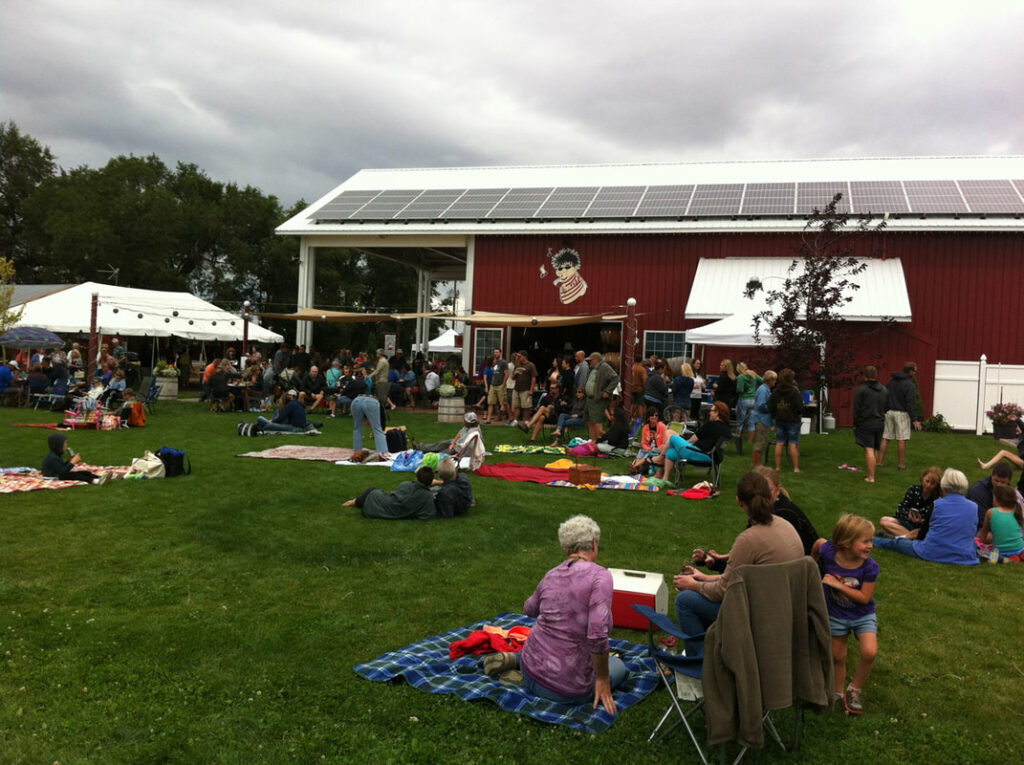
crowd outside a winery

By: Nan McCreary

Deep in the heart of Central Oregon, strategically located between the beautiful rock formations of Smith Rock State park and the majestic peaks of the Cascades, is a gem of a winery that traces its history to the 13th century in Greece.  It’s Maragas Winery, owned and operated by Doug Maragas and his wife, Gina, and, while it sits in a New-World location, it’s wine-making traditions date back to those used by the founders’ family hundreds of years ago.

  The Maragas story began in Crete, when the island was a province of the Roman Empire, and the family started a vineyard to support the growing wine culture.   From this beginning, they farmed grapes, olives and figs for centuries, surviving the invasion of the Ottoman Empire and the occupation of Crete by the Germans in World War II.  The family still owns the vineyard today.

  The family narrative spreads to the U.S. when, in 1941, Doug’s grandparents, George and Anna Maragas, began commercially brokering grapes and making wine out of Lodi, California.  It was Anna and her stories of family history, said Maragas, that led him to winemaking. “My history inspired me, particularly my grandmother, who I was very close to at a young age,” he recalled.  “She was a head of a business, which was unusual in the early 40s.” Maragas remembers spending a lot of time with her, learning about winemaking and the business of owning a vineyard. Essentially, his grandmother was more than a loving family member: she was a mentor.

  With encouragement from Anna, Maragas left his law practice in Ohio and, after searching the country for a viable and affordable place to grow grapes, he settled on Central Oregon.  Not only did the beauty of the area appeal to Maragas, it also reminded him of Crete, with identical soil (volcanic and sandy loam) and a similar Mediterranean climate (warm dry summers and wet winters).  In 1999, he and his wife established Maragas Winery as the founding winery and vineyard of Central Oregon.

  The Maragas vineyard is located near Culver, 25 miles north of Bend.  Conditions are optimum: well-draining soil, a south-facing slope located at 2800 feet and a large diurnal range that promotes seed and berry growth and complex flavors.  After more than a decade of experimenting (with over 48 varietals), and defying naysayers who said it was too cold to grow grapes in the area, Maragas Winery is producing award-winning wines and bringing recognition to Central Oregon as an official wine region.

  Maragas’ grapes are all grown organically, just as they were centuries ago in ancient Greece. This means selecting the right grape variety for the specific region, and excluding the use of artificial fertilizers, pesticides, fungicides and herbicides. Rather, Maragas relies on hand labor to control weeds, and chickens to eat the bugs.  He also has large dogs to keep the deer out, as well as small dogs and feral cats to control the rodents.

  Honoring his Greek heritage and extending his “all natural” philosophy to winemaking, Maragas uses proven Old World techniques that have been handed down from generation to generation. “I don’t put any ‘junk’ in my wine,” Maragas told the Grapevine Magazine.  “I only use four ingredients: bacteria, yeast, grapes and sulfur. There’s a movement to make wine according to the American palate, and to use chemistry if the vintage is not quite right.  I don’t think those chemicals are good for you.”  What makes Maragas’ wines particularly unique is extensive use of barrel aging.  Maragas barrel-ages his red wines anywhere from two to eight years, longer than any known winery in the U.S.  These red wines are all natural, with no filtration or fining.  The result is wines with exceptional Old World flavor and complexity.

  Currently, Maragas is growing 24 grape varieties in his vineyard and at a contract property in Warm Springs, Oregon.  Wines for sale include five barrel-aged red wines:  Malbec, Tempranillo, Zinfandel, Cabernet Franc and a Bordeaux Blend; and three white wines: a Pinot Gris, a barrel-fermented and barrel-aged Chardonnay, and a barrel-fermented and barrel-aged dry white blend, Blanco, that includes Muscat Ottonel, Sauvignon Blanc, Pinot Gris,  Chardonnay and Chenin Blanc. Prices range from $20 to $52.  Because Maragas is a boutique winery with limited production, these wines are only available at nearby limited retail outlets or by ordering direct from the winery.

  Maragas Winery in Oregon, like the winery in Crete, is still a family, hands-on operation. The winery produces 2,000 cases annually, with no more than 400 cases of any varietal.  “This gives me more control, and I love what I do,” Maragas said. All work, from crushing grapes to bottling wines, is completed onsite in the 4,000 square-foot winery. “I manage the vineyard, make the wine, and do maintenance. Our office is in the house and my wife does the books. We do it all.” Maragas employees four additional people who help with everything from pulling weeds to operating the crush pad. “I received a strong work ethic from my Greek heritage,” he added, “and we all work very hard and help with whatever needs to be done.”

  While Maragas takes his winemaking seriously, he has added a little fun to his enterprise with his comic wine bottle labels, which feature artwork from his late mother, Joanne Lattavo. The drawings are caricatures of family members and friends created during the beatnik area of the late 50s and early 60s,’ “I’m trying to be a great winemaker,” Maragas told The Grapevine Magazine, “but I don’t want people to see me as stuffy.  I think the drawings are funny, and if I can make people laugh, they won’t see me as hoity-toity.” As a further tribute to his mother, Maragas is displaying paintings from her former art gallery in Ohio in his Barrel Room at the winery.  The winery’s website notes that this may be the first art gallery in a Barrel Room in the country. 

  As Maragas looks to the future, he is experimenting with many different grapes, including Pinot Noir and Pinot Meunier, as well as Alsatian varieties such as Gewurztraminer, Pinot Blanc and Riesling. He is also growing Nebbiolo, an Italian red wine grape known world-wide for making outstanding Barolo and Barbaresco wines.

  Maragas, in his enthusiasm for Central Oregon, is also working to promote the area as a great grape-growing region. His Estate Vineyard, he notes, sits on the same parameters of famous grape growing from the Burgundy and Alsace regions of France, while the Contract Vineyard is on par with similar growing degree days and average growing temperatures as the Loire Valley. “Just because an area hasn’t been tapped doesn’t mean you can’t make great wines there,” he stated. “After years of experimenting, we now know that Central Oregon, in particular Jefferson County, is a fantastic place to grow traditional wine grapes.”  With global warming, he adds, the prospects are even brighter for the area.  “We have lots of people looking,” he said.  “I’m hoping we can attract winemakers who want to make great wines rather than grow grapes as a hobby or as an asset to increase grounds beauty for resorts.  There is great potential here.”

  In an area dominated by craft breweries, a growing number of wine destinations are already popping up, and, along with Maragas Winery, are part of the new Oregon Wine Trail.  And most recently, the Oregon Wine Brotherhood, an organization dedicated to promoting wines in Oregon and southern Washington, established a Central Oregon chapter, with Doug Maragas as one its supporting members.

  While growth in the area is inevitable, Maragas has no plans to expand his operations.  “We were growing,” he said, “but it took so much time that we decided to wait until our teenage daughter grows up and leaves home.” In the meantime, Maragas is content to focus on making distinctive, hand-crafted wines. He is also committed to sustainability. For example, the “corks” he uses are the first zero carbon footprint “corks” and are actually made of sugar cane.  The company also has a solar array that powers a substantial part of the operation. And finally, he doesn’t use foil around the bottle neck because it has no beneficial effect on the wine and isn’t recyclable.

  Doug Maragas, with his passion for his heritage, has created a taste of ancient Greece in Central Oregon. His tasting room, scenic and family-friendly, is a popular destination for weddings and special events.  One of his premiere events, the annual “Love of the Grape”  Grape Stomp, has become a Central Oregon tradition, a full day festival of food and wine where hundreds of visitors climb into ½ barrels and stomp the grapes with their bare feet, just like they did at the Maragas family vineyard in the 13th century. The crowds at Maragas Winery may be New World, but the traditions are clearly Old World.  And you don’t have to travel to the other side of the world to enjoy them.

For more information on Maragas Winery, visit their website at www.maragaswinery.com

Four Important Ways to Use Software in a Winery

staff placing info at a tablet

By: Alyssa L. Ochs

For hundreds of years, wineries got by with keeping track of their operations with little more than pen and paper. But in today’s competitive wine industry, getting by isn’t good enough, which is why an increasing number of wineries are relying on high-tech solutions that make running a wine business more productive and profitable. Fortunately, there are some excellent software companies that specialize in wine business software to address the common challenges that wineries face.

  With a focus on inventory, fulfillment, compliance, and wine club memberships, here’s how an investment in software can assist modern wineries.

Inventory Software

  Inventory management is a tedious job at a winery, which is why this type of software is in such high demand. Inventory software helps winery owners keep track of how many bottles of wine are available, understand the production history of the bottles, and ensure that each wine batch is traceable. This is a good type of software to invest in because it can ensure fewer counting errors and reduce the amount of time your staff has to spend manually keeping track of wine bottles that are produced, sold, and shipped.

  Fulfillment Software

  Order fulfillment can also be a challenge for wineries because it is a time-consuming and error-prone task. Fulfillment software winery can help winery staff create new orders, search past orders, view inventory details, facilitate returns, and be alerted about inventory shortages. Other fulfillment software features include the ability to view invoices, run reports, and get order status updates.

  It’s important to choose fulfilment software that integrates easily with the current information you are working with and that can provide detailed reports about supply chain issues.

Compliance Software

  Wineries must comply with many rules and regulations, which can be hard to keep track of and put you out of business if guidelines aren’t met. This is why compliance software is a popular choice among wineries to reduce business risks and keep up with important deadlines. Software companies offer solutions that help wineries follow the legal requirements of operating an alcohol-based business in a more accurate and precise way. This is particularly important when your winery begins to sell bottles to new markets outside your home region.

  However, this type of software can be unnecessarily expensive if you have a very low production volume, and you’ll still need a staff member to manage the compliance software system in-house or on an outsource basis.

Wine Club Software

  Wine clubs are great ways to retain loyal customers and stay connected with the wine-loving community. Good wine club software informs consumers how much they will save over time by becoming a member, makes it easy to buy bottles, and simplifies the process of running a wine club. With this type of investment, a winery can create shipments, print shipping labels, report on member statistics, customize shipments, and stay in touch with members more regularly.

Recommended Wine Software Companies

  The wine industry is big business for software companies, but it is a smart idea to choose a company that has specific applications for wineries rather than more general applications that are broad enough for any type of company.

  One company that specializes in the business side of wine is Microworks Technologies in Napa, California. Microworks provides direct consumer sales management software for the wine industry though tasting room, wine club, wine marketing, and winery accounting solutions.

  Scott Meloney, the president and CEO of Microworks Technologies, told The Grapevine Magazine that one thing that sets his company apart from others in the industry is that when you call Microworks, you will reach a real human being.

  “If you need technical support, we encourage you call us by phone, where you will speak to a live person and your question(s) will be answered to closure on the first call 99% of the time,” Meloney said. “Our staff is made up of industry veterans who understand the wineries business and will relate to your questions.”

  Meanwhile, VinNOW LLC is a winery software company that provides customer, wine club, and sales and inventory management all under one roof. This Mesa, Arizona-based company also offers free training and support, extensive reporting real-time wine club management, point of sale, and QuickBooks integration.

  Ted Starr, the CEO of VinNOW LLC, said that what sets his company apart is VinNOW’s extremely reliable customer service.

  “This ranges from customer support when the wineries need it, seven days a week, to the ability to support wineries who can’t rely on their internet connection.”

  Another company that provides a comprehensive software package that integrates numerous aspects of winemaking is The Winemaker’s Database. This Los Gatos, California company has been in the industry since 1983 and assists wineries with everything from tank transactions to barrel tracking, analytical data, customizable reports, 702 generation, and more.

  The Winemaker’s Database’s Vice President, Emily Vahl, told us how her company was originally created by a winemaker and how it still offers winery solutions from a winemaker’s perspective, rather than that of a company or programming team with no winemaking experience.

  “Also, our entire support team consists of former winemakers or winery employees that have worked hands-on with crafting wine,” Vahl added. “When our customers call WMDB, they speak with people who understand their specific needs.”

Considerations and Important Software for Wineries

  There are many considerations to take into account before investing in a new winery software system, and you may want to talk to other wineries in your region about what they use and what works well for them before making any decisions. Compare costs for similar types of software and think about whether you only need a single-service type of software or would benefit more from a comprehensive software program that addresses multiple needs.

  Other considerations include how customizable software is for your winery’s specific needs, the data setup process, and how you will transition from your current system to a new one. You might also think about the ability to use software through a mobile app, how easy to navigate the web interfaces are, and how secure the site is for cloud computing technology and data center privacy. Customer technical support for software purchases and access to future software updates as technology improves are also important considerations.

When asked about the most crucial products that are must-haves for a modern winery, Meloney of Microworks Technologies said, “At the very least, a winery will need a good CRM package with POS, club, ecommerce, inventory, and accounting software so it can leverage sales efficiently with the right tools to promote, track, and measure business goals.”

  Starr of VinNOW pointed out that crucial software needs vary with each winery because some only sell wine online, while others sell through retail, clubs, have tasting rooms, or incorporate a combination of these sales channels.

  But overall, for software or hardware, POS, club, cart, compliance, accounting, communications, and other products, Starr said that wineries “need products that work the way the winery wants to run their business, which are affordable and supported with great service and have the ability to grow with the business as the business grows and changes.”

Vahl of The Winemaker’s Database said that the most important type of software for a winery to have is anything that can help it reduce paperwork and be efficient and organized.

  “Winemaking is an art form, but it is also a craft, meaning the end product needs to be consistent each time,” Vahl said. “Software is an excellent tool because you can click a few buttons and gather the data instantly to view the numerous components of a blend.  Plus, since nobody enjoys paperwork, so it’s pretty handy to let your computer do the leg-work when it comes to providing the required reports to the government.”

How to Avoid Common Software Mistakes

  Meloney from Microworks Technologies said that many businesses make the mistake of not taking the time to learn the full capabilities of their software. This means that you might be missing out on important efficiencies that the software has to offer. Another common mistake he noted was inadequate hardware.

  “Can you image pulling a boat up a hill using a bicycle?” Meloney asked. “Recognizing the impact of outdated computer equipment on the performance and reliability of software can be the difference between success and failure of a software system.”

  To avoid future regrets, Starr of VinNOW emphasized the need for wineries to call multiple references with similar business demands and review the hidden costs and expenses of possible solutions.

  “Ask references about the surprises and difficulties they uncovered during the installation and first six months of using the solutions,” Starr advises. “Also, ask references about any shortcomings and strengths of features and service.”

  Vahl of The Winemaker’s Database said that a common mistake is looking for an entire software package from just one provider. For example, her company has specialized in wine production software for over 35 years and that is its primary area of expertise.

  “Often, wineries approach us looking for a software package from a single company that can do everything from vineyard management to POS,” Vahl explained. The areas of vineyard management, wine production, warehousing, accounting, point of sales, and wine club are vastly different from one another, which is why I am a fan of software interfaces. When companies work together to create interfaces, then they can offer some pretty amazing options to clients because they are each doing what they do best.”

Software Advice for Wineries

  Modern wineries rely on software for accuracy, efficiency, and to be competitive, but a software decision could either help or hurt your business. Therefore, it is advisable to talk to a few software companies to get a sense of how their products can work with your current operations.

  Meloney from Microworks Technologies advises wineries to know their business needs, be thorough, and check with as many references as possible before implementing new software for their operations. 

  “You don’t want to favor one department in the decision when it may cripple another,” Meloney said. “Make sure you are provided an in-depth demo of the features in detail. Know that what you see on the surface does not represent the software’s capabilities. Ask references about the vendor, not just the software, because the quality of your vendor is just as important as the software itself.”

  Starr of VinNOW’s main pieces of advice are to review your winery’s goals, assess the strengths and weaknesses of your team and location, and know what questions you need to ask software companies. He also recommends making sure a company has the features you need and to remained focused.

  “It is so easy to get distracted with features like customer photos in your POS and club, but since most of us don’t have facial recognition features, we end up finding out that a customer is a club member when we speak with them,” Starr said. “And every customer should get excellent customer service, so the feature sounds great but is not highly used.”

  “Then have a hands-on test-drive of the software,” Starr recommended. “If you plan to keep the solution for three to five years, dedicate a few hours per solution to truly see the depth of the solution and avoid picking the wrong solutions. Try adding a sale, changing the order mid-stream, cancelling an order, processing a club release, and managing returned packages and cancelled orders. Take the time to access reports that you need. Some solutions are strong in reporting but need a rocket scientist to use them. Ask how they meet ADA and PCI compliance and how they deal with D2C compliance and all the new tax reporting requirement and permits that are required.”

Finally, Vahl of The Winemaker’s Database advises wineries to start small and not try to resolve all of your issues right away because this is a common way that wineries end up paying too much for way more software than they really need.

  “I always recommend starting with the simplest form of the program and then adding on components as they are required, when users become accustomed to how the software works,” Vahl said. “Modular-based solutions are excellent for keeping costs down and also for helping wineries create a tailored solution for their operations.”

Falconry at Featherstone

woman holding a bird

By: Michael Strickland

For Louise Engel and Dave Johnson, the decision to fly a raptor over their 23-acre vineyard and winery was a no brainer.

  Like so many other fruit growers across North America, the owners of Featherstone Estate Wineries in Ontario’s Niagara Region had waged a frustrating war against starlings. A flock of 5,000 can consume a ton of fruit in just 10 days, though they cause even greater damage by pecking more berries than they eat. The weeping fruit attracts fruit flies, which encourages rot.

  Grapes are often the last crop to be harvested, long after cherries, strawberries and tender fruit have left the field. With less soft fruit to binge on, bugs start to disappear. By October, grapes are one of the last food sources—a juicy-fruity one no less—visible from the sky.

  “When you look at that vineyard, and you’ve looked after and babied these vines along, and it’s now October 10th, and the fruit is loaded and healthy, and you see a flock of starlings—of five, six or ten-thousand—just descend on you, we run out and we’ve got all kinds of cannons and bangers, it is breathtakingly annoying,” says Johnson.  So, when Engel said she thought she had a solution, Johnson says, “it was a no brainer.”

  Engel attended a bird of prey demonstration in October 2003, four years after the couple opened Featherstone. She returned determined to take up falconry, undertook the 15-month certification required in Ontario and purchased a Harris Hawk named Amadeus.

  Today she is president of the 200-member Ontario Falconry Club. While falconry is a common bird abatement technique in the U.S., she’s not aware of anyone else really adopting the practice in Canada.

  “We’re certainly the only winery that has a resident bird of prey, or that does it on a regular basis,” she says.

  While Featherstone continues to use noisemakers and netting against starlings, few things work quite like Amadeus. “The one thing they never get used to is hawk silhouettes,” says Engel. “When you put a bird of prey in the air, everyone leaves, and it becomes very quiet.”

  Only for a little while, however. Like nets and noisemakers, falconry has its limits. Starlings will find holes in the nets, and they’ll return when the noise dies down, or Amadeus leaves the sky.

  “So it’s effective while I fly him, but then I put him away and go do other things, and it ceases to be effective,” says Engel. “So it’s best not to get on too much of a routine, to fly him as periodically as I can.”

A Working Relationship

  After spending one long night looking for Amadeus, Engel no longer flies him without a tracker. He is a bird of prey, she stresses, with no emotional attachments. He can and will leave if and when he wants. She relies on a trust relationship—a rather mercenary one—to bring him back at the end of each flight.

  Amadeus views Engel as a source of hunting opportunities. She regularly provides him with the chance to hunt starlings and, if he catches something, he gets to it eat it. Since he frightens away far more prey than he finds, Engel is also a ready source of food. When he returns empty-handed, she greets him with bits of quail.

  “So there’s a bond there that is predicated on positive reinforcement and hunting.”

  For growers interested in using birds as a pest control method but hoping for a little more control, Harris Hawks are a popular choice for beginners. They are one of the few avian predator species that hunt in castes, a family unit akin to a wolf pack, working collectively in the wild.

  “When I, as a falconer, am in the field with them, that kind of fits in with their paradigm quite naturally,” says Engel. “They’re a little less independent and a little more predisposed to want to work with you to find hunting situations.”

Natural and Eco-friendly

  Adding Amadeus to the mix of pest abatement strategies fits with Engel and Johnson’s eco-friendly approach to viticulture. They live on their 23-acre property, farming 20 acres of it, and have a vested interest in being responsible stewards.

  Featherstone has been insecticide-free since day one and has adopted a range of natural practices to deal with pests that threaten the vines. Methods include using diatomaceous earth (which is abrasive and irritating to insects), bringing in beneficial predatory insects like the ladybug, and using pheromones to disrupt mating cycles. In 2008, they purchased a recycle sprayer to capture and reuse any spray that does not stick to the vines.

  Johnson is mainly focused on natural ways of keeping his soil as healthy as possible. He plants cover crops (25% legumes, 25% daikon radish and 50% ryegrass) between rows of grapes. He’s also determined to fight soil compaction by reducing tractor passes, aiming to reduce the total by one pass each year.

  “The big issue for us, and the thing we’re working on all the time is compaction of the vineyard floor,” says Johnson. “We’re trying to get tractor trips reduced. I think that’s more important than organics, biodynamics or anything else. We need to get the equipment out of there.”

  To that end, Featherstone has adopted “lamb labor” to help keep the vineyards “sheep shape.”

  Johnson first learned of the practice in 2007, when he spent time in New Zealand as a guest Pinot Noir specialist at the Sileni Estates Winery and Cellar Door. He’d noticed that the leaf pulling was flawless—the low fruit zone was cleared, allowing sunlight and air to reach the grapes, while the upper canopy looked unmolested—and wondered how that was accomplished.

  At the time, Featherstone was paying migrant workers $200 to clear each acre. Sileni were letting sheep do it for free.

  “They can’t afford to irrigate a pasture for sheep,” says Johnson, “and the vineyards are all fenced to keep the sheep out. Then, at a certain time of year, they open the gates, and they allow the lambs to flood into the vineyards. They strip out the grass, then pick their heads up and start eating those lowest leaves.”

  Featherstone has been using lamb labor ever since. Each February, they purchase 25 or more baby sheep and begin confining them to one-hectare areas as soon as the first varietals, the Pinot and Chardonnay grapes, need leaf clearing. That seems the perfect number to entirely clear a hectare in roughly 10 days, after which he moves the flock to the next area. By the fall, they’re clearing the Cabernet Franc.

  Sheep are perfect because they eat only leaves. Goats, Johnson points out, would eat everything and likely destroy the vineyards. Lambs, it turns out, are also the perfect size.

  “What we worked out here is that they need to be no more than 22 inches high at the shoulder. Otherwise,” he says, “they reach too high and are stripping too many leaves. So we have set the vineyard and pruned it particularly so that the fruit zone is sitting at 22 to 32 inches above the ground. That is the reaching height of a lamb.”

  For Engel and Johnson, these eco-friendly practices are about living a more natural life, a life where all aspects are as fully integrated with nature as possible.

  “We’re interested in complete integration, in being integrated with all aspects of the property, and capitalizing on natural relationships where possible,” Engel says. “Whether its natural predator-prey relationships, or it’s help that just naturally grazes in the vineyards and then helps you with leaf removal, those kinds of integrations appeal to us on a number of levels.”

  The approach seems to be producing one key result: great wines. Featherstone turns 20 this year and was just named Winemaker of the Year at the Ontario Wine Awards. The judges recognized Featherstone’s consistent quality across the portfolio, successes in wine awards and overall contributions to the industry.

  Engel and Johnson realize that their approach is not for everyone. For one thing, it reflects their personal beliefs. They also acknowledge economics and other factors would make all of these practices more challenging if Featherstone were larger, or more commercial than craft.

  “We’re still classified as a small winery, at the larger end of small, but a nice size for us, given our tank capacity, the size of our press and all that,” says Engel. “Were we to get bigger, we’d need to get a lot bigger, and we’re pretty happy at this size. It lets us keep our fingerprints all over everything, and stay craft or artisanal.”

Needs of the Animals

  There’s also the added responsibility of owning livestock, which includes letting it out to pasture each morning, rounding it up each night, and maintaining fences. Ontario has problems with coyotes and other predators. Lambs are extremely sensitive to copper, so Johnson can’t use elemental copper, an inexpensive organic spray used to protect grapes from mildew, until after the lambs have cleared an area.

  “It’s an animal, so now you’ve introduced animal husbandry to what is normally horticulture,” says Johnson. “Once you have animals on-site, they add another layer of complication. They need to be handled. They need to be protected and looked after.”

  When you own a bird of prey, the demands are especially high.

  There’s a 15-month apprenticeship program to become a licensed falconer in Ontario. There are stringent rules around housing and care, though the requirements differ from those in the U.S. With only 200 licensed falconers in the province, says Engel, it’s easy to support one another and ensure all members are practicing falconry at the highest level.

  “It’s kind of like owning a horse. There’s a real commitment there,” says Engel. “These birds need to be worked and hunted and flown. They’re not just meant to be put on your glove and shown to your friends. You do them a real disservice is you’re not getting them in the air and hunting them on a regular basis.”

Five Areas to Focus on When Maintaining Your Website

By: Susan DeMatei

Website under construction with Laptop

Maintenance is an important and often overlooked part of having a website. Which is odd because you spend a great amount of effort on maintaining other aspects of your life and business. You go to the gym and the doctor to maintain your health; you repair and clean your house, your car, and your yard; at work, your tasting room, Wine Club, and your wine education or tasting senses are all given careful attention to make sure they are kept in shape. Why, then, do we expect to set up our website and then let it sit? Websites need to be maintained, too.

Your website is your front door to the entire world. Will customers or the trade find broken links, missing images, or an insecure page––or will they not even arrive at your website due to poorly tagged pages, making it impossible to find it on a search engine?

The bad news? The internet, software, hardware, and browsers are constantly changing. But the good news is there are lots of plugins and systems out there to keep your website up to date and healthy. Here are 5 areas you should focus on when maintaining your website.

Security

This may seem like it goes without saying, but if your website doesn’t use the proper, up-to-date security measures, your website will suffer. First, search engines will likely put you near the bottom of a list of search results or not even display your site. Second, a scary warning can appear where your website should be strutting its stuff.

Security is especially important if you have a WordPress site. WordPress powers over a third of the internet today. Because of sheer volume and the number of WordPress websites online, it’s the most hacked content management system on the web.

You should set up a routine schedule for removing malware, scanning for viruses or hacks, removing spam blog or product comments as well as spam signups to your mailing list. And don’t forget to monitor your SSL certificate to let purchasers know that you are safe to enter credit cards. Nothing says “don’t buy wine here” like a big security warning.

Data Preservation

You may not realize this, but on many mainstream platforms, including WordPress, there isn’t an automatic backup feature that you can just revert to if your website gets hacked, corrupted, or damaged.

This happens more likely than you think. Sometimes plugin updates can cause irreparable damage to the design. Other times, there’s human error when that new marketing intern deletes all your trade assets by accident.

It is up to you to back up your files. Luckily, there are many tools on the market that can do this automatically.

Broken Links

Whether your website is five pages or 30 pages, it can be easy to miss a broken link buried on your website. If the broken link is to your ecommerce store, it’s like having a malfunctioning door to your tasting room. Even if nothing is broken, if you don’t have a proper “continue shopping” link in your cart or checkout, you could lose the customer with their frustration. Maybe the link is minor and doesn’t lead to the store, but a broken link says you’re not paying attention, so why should your customers?

Again, routine maintenance should look for achieved products, employee bios, vineyards, vintages, distributors, events, or anything on your site that may be out of date and driving to a dead link.

SEO

Google is the most widely used search engine and now processes over 70,000 search queries every second, on average; which translates to well over 5 billion searches per day and closer to 2 trillion searches per year, worldwide. By 9:30 am on any given day there have been 2.5 billion searches on Google, globally.  Your winery is in there, somewhere, you just have to help people find it.

Search Engine Optimization doesn’t have to be overly complex. It’s primarily made up of tagging pages and images with keywords so Google can read them, and submitting the site and the sitemap to Google to index. The maintenance of these items requires checking that new pages and images are described and indexed. There are a number of tools on the market that will help identify and flag if a new page is missing tags, or if something is out of date.

ADA Compliance

There has been a lot in the news lately about ADA compliance, mostly coming from several lawsuits being brought against some wineries on the East Coast. The goal of this exercise is to make sure that everyone has equal access to the content on your site, including those with visual or mobility impairments.

Being compliant for something like ADA can be tricky and until the law has even more clear guidelines, it may be hard to be 100% compliant. But there are a number of ways to be accommodating for web visitors with disabilities. Think of it as very rigorous SEO: The requirements for being ADA Compliant cover tagging a large portion of your content, images, and overall accessibility. I would not recommend you try and tackle this on your own. There are scans and specific tasks required, like scripting to close modal windows, and tested functionality with the site text increased up to 200%. It is something your designer should look into. But once done, it needs to be maintained with each new image or block of text. The good news is, not only does it benefit your customers with disabilities, but it benefits your website functionality overall.

Ongoing maintenance doesn’t have to be a brain-teaser. If you consider the investment you put into your website and the sales you get out of it, then finding an agency with a maintenance package or setting up a series of plugins to manage these areas seems like a no-brainer.

Susan DeMatei is the President of WineGlass Marketing, a full-service direct marketing firm working within the wine industry in Napa, California. www.wineglassmarketing.com

Vineyard Technology & Equipment

By: Cheryl Gray

Drone flying above beautiful landscape
Drone flying above beautiful landscape with vineyards

At the moment a bottle of wine is uncorked and poured, the labor and innovation of the equipment industry helping to bring that wine from vineyard to table becomes inextricably tied to the end product consumers enjoy.  Across the United States, vineyards are dependent upon their equipment suppliers to provide them with the latest technology and product support  to keep costs down and produce a high-yield, high-quality harvest.

Take, for example, Progressive Ag, Inc., of Modesto, California, whose company history  reflects a cutting-edge approach to the design and manufacturing of sprayers used before harvest time.  Mark Ryckman, Progressive Ag sales manager and co-owner, keeps a close eye on technology focused on improving crop yield for his customers.

“New mapping software and drone technology are bringing in some great technology advancements into the spraying industry with variable rate application,” says Ryckman. The company manufactures its signature LectroBlast Electrostatic Sprayers with patented design elements aimed at delivering better coverage and reducing spray drift, both of which cut time and cost.  The technology-driven sprayers also promise delivery on other cost-saving measures, including more ground coverage in less time, fewer fill-ups, easy calibration, low maintenance and cheaper fuel and water costs.  The sprayers, which come in tank sizes ranging from 300 to 600 gallons, can be used for all vertical or cross arm vineyards.  These sprayers are capable        of handling vineyards of almost any size.

Progressive has another advantage.  The fact that the company’s manufacturing base is right in Modesto means that its local customers can readily get equipment parts either directly from the plant or at one of several parts depots throughout California, Oregon, Washington and Mexico with more parts depots coming in other locations soon.  As for new products, Progressive Ag has its Solar Blast Solar Panel Washer in production.

One of the largest expenses for vineyards is their labor force.  Years ago, a human workforce was a non-negotiable cost for vineyard owners, with jobs ranging from pruning, thinning, leaf removal to actual harvest.  Today, there is a trend toward using technology to escape heavy reliance on what is becoming an ever-dwindling labor pool, shifting instead to more mechanization.  Some experts predict a future with so-called “no-touch” vineyards, where every element is handled by machinery.

One of those industry experts, Gearmore, Inc., has been in business some 50 years and is on top of this trend.  As a farm equipment distributor, the company maintains its competitive edge by monitoring ever-evolving changes in equipment technology most attractive to its customer base and by keeping in touch with those customers beyond the point of sale.  It is a supplier to a target market that includes California, Hawaii, Nevada, New Mexico, Arizona and Texas.  Its global marketing efforts reach into Mexico and Canada.

Robert Emhoff, Gearmore’s president, describes the company’s singularly most important contribution to its commercial vineyards that he believes keeps those customers loyal to his brand.  “Gearmore supplies our customers with quality equipment sourced from leading manufacturers throughout the world and backs up these products with parts and service.”

The value of customer support after point-of -sale is not lost on those who run operations for vineyards whether large, medium or small.  Although mostly reliant upon trained, manual labor, Arizona Stronghold Vineyards in Camp Verde, Arizona, with an estimated 100 acres, knows all too well the importance of post-sale customer service for its equipment.  Matthew Raica, Winemaker at Arizona Stronghold, says that customer service is, “Critical, especially with how remote we are from where manufacturers or technical staff  are located.  When we have equipment go down that we can repair ourselves, we rely on good customer support to ensure we get back up and running.”

Trevor Amos, Director of Operations and Vineyard Manager at Rock Pocket Vineyards, agrees, emphasizing that this is especially true for small vineyards, whose investment dollars have to stretch farther than their larger competitors.  His company’s small vineyard is located in Oliver, British Columbia, considered the Wine Capital of Canada and part of the Okanagan Valley region.  Amos sees customer service for vineyard equipment important at every stage, from new purchase to need for repair.  “It’s important for good customer service pre, during and after the sale.  If people sell their product, they should support their product throughout its life span.”

Gearmore considers itself well-positioned to meet the needs of vineyards morphing into the “no touch” approach.  It can provide nearly every implement required for growing a successful grape harvest, including tillage tools, mowers, pre-pruners, vine trimmers, leaf removers and more.  The company offers Venturi Air Sprayers, available in 3-point or pull type, ranging from 75 to 500 gallons.  Distribution heads on Venturi Air Sprayers are versatile enough to fit any vineyard profile with nozzles that shear the chemical into fog-like droplets covering the entire plant.

Gearmore is also a chief supplier of Collard products, a family-owned business serving vineyards for five generations and responsible for inventing the first mechanical vine trimmer in 1962.  The Collard Vine Trimmer is especially designed for California’s multiple trellis systems, along with Collard Leaf Removers, which feature 3-point mounted air compressors that power the leaf remover’s defoliation heads. The system works through short, sharp bursts of compressed air blasting the leaves to open the canopy, allowing for more sunlight, better air flow and greater spray penetration.  Gearmore also is a supplier for the Collard Leaf Remover, an equipment choice that offers a solution to debris removal around grape clusters, which ultimately provides for a cleaner harvest.

Canada’s Slimline Manufacturing, based in British Columbia, touts itself as the sprayer manufacturer of choice for grape growers in the Okanagan area, Niagara region, California’s Napa Valley, Oregon and Washington coastal areas as well as other grape growing communities throughout North America.

Turbo-Mist Sprayers have been around in some form since 1948.  When engineer Kim Blagborne purchased the product and founded Slimline Manufacturing in 1991, his experience in design and fabrication led to many of the features and options now available on the modern day versions of Turbo-Mist Sprayers.  Return on investment, through product reliability and amortization, is something the company touts, as its team points out that some of its long-time customers are using versions of Turbo-Mist Sprayers built some 50 years ago.

Careful planning is essential to any farming enterprise and no less important for vineyards.  Slimline Manufacturing revolves its season around its customers’ needs, adding that its Turbo-Mist Sprayers play a vital role.  Slimline Manufacturing boasts of a dealer network that teams up with customers well before harvest time, often up to a year in advance. The goal is to help these customers achieve optimally planned, well managed and environmentally sustained spraying practices.

Rachelle Wirth, Marketing & Communications Manager for Slimline Manufacturing, says the company strives to provide customers with genuine solutions in real time.  “Fuel costs in many of our customers’ regions are becoming astronomical; water shortages are becoming the new normal.  Operating as if these issues are going to correct themselves is not an option.”  Wirth says that Turbo-Mist products enable growers to drastically reduce fuel costs and water use without sacrificing coverage, yield or crop quality.

Working in tandem with vineyards to develop new products is another method by which some manufacturers, including Slimline, keep pace with customers’ needs.  Steve MacDonald manages some 300 acres under MRS Vineyard Service in Oliver, British Columbia.  “Our spray program is a good example of using the best equipment,” MacDonald says.  “Your starting point is choosing a sprayer that will deliver the droplet size you want to where you want it.  Slimline Manufacturing…worked with us to develop a couple of three row machines that are still as good today as when we purchased them in 2009.  Each has over 15,000 acres under their belts.”   MacDonald translates that coverage into less than five dollars per acre applied capital cost for a $70,000 machine.

Felco is another company which turns to its growers for input into product development.  Ryan Amberg, Marketing & Business Development Manager at Pygar USA, a division of Felco, says, “New product developed by Felco is done in a grassroots manner where the modifications and design requests happen from the grower and end user level. This is part of the reason Felco offers the most comprehensive assortment of high quality tools in the market.”

When it comes to vineyards, Felco products cater largely to pruning needs, although it also  offers a small snip range.  Among the current leader in this product line is the Felco 310 snip.   Its stainless steel composition resists rust in the field and its replaceable spring insures multiple seasons of use.

Amberg explains that his company is ready for harvest sales immediately following the end of pruning season, which means its sales cycle for harvest begins as early as March and doesn’t end until late September.  He adds that the variety of climates where vineyards are located in the United States dictates the calendar for Pygar USA.  The company is a division of Felco, which has a global network covering the continents of North America, Europe, Africa and Australia.

Equipment purchases can be a major investment expected to bring harvest benefits to vineyards over multiple years and the dependability of that product is perhaps second only to the customer service provided by the suppliers and manufacturers.  For vineyards, it can mean the difference between either a successful harvest or a failed one.  For equipment manufacturers and suppliers, it means keeping customers loyal and earning their respect in a highly-competitive industry.

Priming Your Irrigation Systems for the Season (Part 2)

By: Tracey L. Kelley

In the May-June issue of The Grapevine Magazine, a savvy group of experts provided detailed information about irrigation system maintenance. That article outlined seasonal start-up and troubleshooting tips. For part two of this topic, we’ll move on to ongoing system checks, typical problems often overlooked, monitoring water flow and quality and critter control.

Once again, our experts are:

  • Guy Fipps, Ph.D., P.E., professor and extension specialist of irrigation and water management at Texas A&M University, College Station, Texas; in collaboration with Charles Swanson, extension program specialist, Texas A&M University.
  • Jacob Hernandez, CCA, owner, JH Ag Consulting, Santa Margarita, California; in collaboration with James Anshutz, AGH20, irrigation engineer with Netafim USA in Fresno, California; and the Cal Poly SLO Irrigation Training and Resource Center, San Luis Obispo, California.
  • Mark Hewitt, district sales manager, Rain Bird Corporation Ag Products Division, in Azusa, California.
  • Steve Purvins, owner, The Vineyard at Lawton Hall in Bushwood, Maryland, which produces Vidal Blanc and Chambourcin grapes.

Checks and Balances

Continual process management is the key to a fine-tuned irrigation system. During the rush of season preparation, however, some aspects might inadvertently go by the wayside.

Hewitt pointed out numerous required fixes this time of year. For example, field zone valves might have broken or damaged wires because of animals, or as a result of “tractor blight”—nicks and punctures caused by machinery, which happens to vines, too.

“There might also be stuck plungers in the solenoids,” he said. “Pull coils and plungers. If the coils are swollen, replace them. Use emery cloth on plungers if they’re only slightly rusted.”

If you’ve noticed a torn or deformed diaphragm, Hewitt said, sometimes simply turning it around works, depending on the valve type, or replacing it. “Same with any springs located in the bonnet of a valve. Springs and diaphragms wear out or develop a new ‘memory,’ especially pressure-reducing valves that are always partially open throughout irrigation season,” he said.

For growers with low-volume micro sprinklers, which are similar to drip emitters, Hewitt advised clearing nozzles of debris and “checking that any fixed spray plates or rotating spinners are providing the correct patterns, distance of throw, and uniform coverage.” LFS and LFX high-performance sprinklers often don’t require much maintenance, he said, but it’s still important to check periodically for proper rotation, nozzle clogs and “insects building in deflectors.”

Hernandez offered a reminder about flushing mainlines, submains and laterals. “This isn’t done enough by growers. Most growers flush once or twice a year—either at the beginning or end of the season,” he said. “In-season flushing should be done after fertigation events with thick materials. Flushing velocities should be greater than two fps. Have your irrigation professional develop a proper flushing routine.”

What is lurking in your system? “The moist, dark interiors of drip hoses and emission devices can be ideal environments for biological slimes and chemical precipitates to form,” Hernandez said. “Various chemical solutions exist to shock and treat these issues. Irrigation professionals should test water quality throughout the season and provide treatment plans to rehabilitate dirty lines and emitters and implement continuous treatment to maintain the lines after cleaning up.”

Fipps added that if growers don’t already have flow meters and pressure gauges, now’s the time to install them.

“Monitoring system pressure and flow rate are crucial for managing operation and scheduling. Unfortunately, many vineyard drip systems lack either a flow meter or pressure gauge—or both—on their system,” Fipps said. “Observing situations of increased flow or decreased pressure can often be signs of leaks in the system, whereas situations of decreased flow and increased pressure can be signs of clogging of the drip emitters.”

Pay Attention to Pumps

“Attention to pump controls should always be given,” Fipps told The Grapevine Magazine. “Pump controls should be in manufacturer-recommended housings that prevent moisture accumulation, or pests like ants and wasps from building nests in or above the components.” He added that “if injection pumps are used for fertilizers or chemicals, hoses should be inspected and replaced if there are any signs of cracking or dry rotting to prevent chemical spills and waste.”

Hewitt said you might have to check impellers if pressure is lower than before, indicating they might need replacing. Packing leaks might mean replacement, but also a need to refill oil cups and install mechanical seals.

Also, Hernandez suggested adding a variable frequency drive (VFD). “Adding a VFD to your pumping station allows for a soft start of pumping motors, reducing wear and tear. If growers have multiple irrigation methods, various plant and row spacings, different size irrigation sets or sets on slopes, VFDs allow for one pump to operate on a number of different pressure and flow settings. This permits a grower only to use the amount of energy they need for the particular set they’re irrigating,” he said.

Managing Water Effectively

Fipps said one aspect often overlooked by growers is monitoring water quality. “Annual analysis of water quality, whether it’s from groundwater or surface water, should be conducted to check salinity and mineral composition, which can affect both the irrigation system as well as plant health,” he said. “Knowing the water quality helps guide growers on how much water to apply at irrigation, as well as prevent any negative reactions from injecting chemicals or fertilizers into the system.”

He also strongly recommends soil moisture sensors—a technological tool that works to your advantage. Soil moisture sensors might initially seem expensive, averaging $300-$500 per unit, plus the cost of telemetry devices for data transmission across the vineyard, but, Fipps said, “they take the guesswork out of deciding when it’s time to irrigate.” If you can’t afford to populate the vineyard with multiple sensors, some experts recommend having one or two in an irrigation block representative of the overall field profile.

Hernandez also recommends expert analysis. His consultancy tries to bridge the gap.

“Certified crop advisors and other irrigation professionals can help vineyard managers maintain and service their irrigation systems with analysis, implementation and ongoing monitoring to aid in the reduction of energy use; and improving crop performance through better distribution uniformity (DU).”

As a method of irrigation application efficiency, Hernandez offered two tips.

The first is setting up proper scheduling for both duration and amount of water to replace soil moisture used by the vines. “Improper scheduling can result in runoff, deep percolation, crop stress and even crop damage,” he said.

His second tip is to “use monitoring technologies to give virtual pump test and DU evaluation data every 15 minutes. These sensors give insight into the impact of changes in practice and hardware,” Hernandez said. “For example, if a DU evaluation finds extensive plugging, we’ll want to rehabilitate the lines with chemical treatment and flushing. Pressure sensors installed at strategic locations in the field can tell us almost immediately if we’ve improved the pressure in the drip hoses and provide a ‘heads-up’ during the irrigation season that we’re beginning to have a problem that can be addressed before it becomes serious.”

Purvins suggested growers ease inadequate volume issues with proper emitter spacing. “During extreme drought conditions, my system doesn’t supply enough water. Fortunately, I’ve only experienced one such year out of 20. I would spec the next system with twice the number of emitters—48” spacing vs. 96”—and adjust zones accordingly.”

He also pointed out the value of developing partnerships with equipment vendors who understand what you’re trying to accomplish. “When I purchased my system, the rep was knowledgeable about sizing the system but had no experience with vineyards. Such experience would have been useful.”

Hewitt said his company is trying to assist vineyard operators with water management through technology products, such as Rain Bird IQ Water. “Real-time sensors and remote web-access allow growers to monitor every aspect of their irrigation system from the water source to the emission device. They can focus in on a single irrigation system part, or see the big picture across every system they manage,” he said.

What About Those Critters?

Since we don’t grow in a biosphere, there will always be wildlife control issues. Often, our experts said, it’s easier to anticipate their actions with some preventative measures.

Purvins of The Vineyard at Lawton Hall has had a critter or two chew tubing, but since that damage is easy to spot and repair—and the vines and grapes aren’t bothered—he feels he doesn’t need to control wildlife.

Hernandez of JH Ag Consulting said, “As we install more sensors and monitoring technology, we’re seeing that animals like to chew on sensor wire and electronic cables. Wrap monitoring systems with a wire screen to protect them from animals and passing farming equipment.”

He also recommended that growers “bury five-gallon buckets at the downstream ends of some of the hoses and allow water from emitters to keep the buckets full during the summer to provide an easy water source.”

Hewitt told The Grapevine Magazine that setting out water is a good idea, plus using more natural control methods. “For larger animals—such as coyotes and foxes—simply put a large 2” high pan under your drip tubing. The water will overflow and still get water to your plants, and the critters can get the drink of water they want without chewing on the drip tubing.”

“It’s a bit tougher to combat gophers and ground squirrels, especially with buried hose systems,” Hewitt said. “One grower I know uses trained falcons that he releases into the area to help control these pesky critters.”

Smoke Taint

By: Nan McCreary, Sr. Staff Writer

fire smoking in the background

Wildfires have become an increasing problem in recent years, with many occurring in various wine-growing areas throughout the world. Aside from causing loss of life and extensive property damage, the wildfires pose a risk of smoke exposure to grapes in the vineyard, which can lead to off-flavors in the wine. This condition is known as smoke taint.

Smoke taint is created by volatile phenols in smoke that permeate the grape skin and bind with sugar in the grape to form organic compounds called glycosides. This process, known as glycosylation, makes the phenols non-volatile, meaning you cannot smell or taste the smokiness. However, during fermentation, the glycosides break apart and release the now-volatile phenols into the wine, making smoke-tainted flavors perceptible. This process can even happen as you sip: the enzymes in your mouth can break down any glycosides that remain, releasing unpalatable compounds into the wine. The flavors associated with smoke taint have been described as “burnt rubber,” “ashtray,” “campfire,” or “smoked meat.”

While Australia, long plagued by wildfires, has been researching smoke taint for many years, the U.S. recently felt the impact when the California wildfires of 2017 swept through the state. “This is all new to us, and it has transformed the wine industry in California,” Tom Eddy, owner of Tom Eddy Winery in Napa told The Grapevine Magazine. “In California, we really only had one wildfire event that caused problems, and that was in 2008. Then, we as winemakers were somewhat naïve — we thought, ‘Well, it’s just an act of God, and it happens,’ but we didn’t do much about it. We tried to remove it later when we discovered it. Some winemakers threw their wine away, some tried to blend it out, which they could do to some extent, and some just made it and bottled it and called it Barbecue Red.” Eddy, whose winery was at the epicenter of the Tubbs Fire, lost much of his 2017 wine, representing a $2.5 million loss.

According to Eddy, the California wildfires of 2017 were “a wake-up” call. “Now, everybody’s cognizant about smoke taint,” he said. “We’re investigating how smoke taint affects the juice and the wine, how to analyze smoke taint, and how to mitigate it.”

Researchers in the U.S., specifically at top enology programs at the University of California at Davis and Washington State University, are investigating ways to minimize the problem in the vineyard and the wine, but, as Eddy said, “We are still learning.”

While there are few definitive answers, experts have determined that the key factors influencing smoke taint are grape growth state, smoke composition, length of smoke exposure, and grape variety. Grapes are most vulnerable to smoke taint between veraison and harvest.

Once the grapes start ripening, the grape skins more quickly absorb smoke particles. As for smoke composition and duration, studies have shown that just 30 minutes of exposure to heavy smoke at a sensitive stage of vine development will cause smoke taint. Beyond that, little is known about how the specific source of the smoke affects the smoke taint composition in wine grapes.

Similarly, research is ongoing into the vulnerability of specific wine grapes to smoke taint. Some experts claim that varieties with thicker skins such as Cabernet Sauvignon are more resistant, while the thin-skinned Pinot Noir is very susceptible. In fact, there have been instances where density and duration of smoke were so intense that damage occurred irrespective of grape variety. There is a consensus on two factors related to smoke taint, however: smoke taint is not a health hazard, nor do tainted aromas pass from one harvest year to the next.

Testing and Mitigating

As concerns about the risks of smoke taint continue to grow, many research institutions and private firms are offering tests for smoke taint by measuring two of the main volatile phenols in smoke, guaiacol, and 4-methylguaiacol. Tests include pre-harvest berry testing, as well as sensory assessment of a small-scale ferment made from the same grapes. While these tests may be objective, they do not consider the arbitrary factor of whether the wine is significantly damaged. “It’s very subjective,” Eddy said. “Some can taste smoke taint right away; others can’t. Some can taste it in certain varieties, some in others. Everybody has different recognition for smoke, alcohol, sugar and other characteristics.”

Winemakers, too, are getting into the act and experimenting with winemaking practices that can mitigate smoke taint to some extent. One such method is “flash détente,” where volatile compounds are removed from the grapes by heating them to about 180° F and sending them into a vacuum chamber to be cooled. While this process may remove some volatile aromas, it is not 100% effective.

According to an American Wine Society blog, “it may remove the taint below the detection threshold of approximately five to six ppm if the level of smoke taint is slightly over that amount, but it is not going to take a 50-ppm smoke taint level and lower it to three.” Even then, adds the blog, “it is difficult to say what aromatic precursors in the wine may react with the smoke taint volatiles making the taint detectable at lower levels.” Other options for removal include using reverse osmosis, but this method is said only to be a temporary fix, and the smoke taint returns over time. Filtering and fining agents may also be effective, but the processes will remove many desirable attributes from the wine as well.

Insurance

To Eddy, one of the most significant challenges with smoke taint is how the problem is affecting the insurance industry. “Smoke taint is a problem that is new for the insurance industry,” he said. “Policies for smoke taint are not specific, so each insurance company approaches it differently.” If a grape is damaged in the field, Eddy explained, that comes under crop insurance, and few growers in California have that, as it’s designed to cover hazards such as frost damage and hail. While most wineries have insurance that covers stock loss by contamination, insurance companies haven’t yet addressed smoke taint as a contaminant.

As a wine consultant, Eddy is knee-deep in insurance research. “I’ve worked with over 100 winemakers in the last year on this issue, and there’s such a range of opinions. On one end of the spectrum, one guy says his wine is ruined, and he’s throwing it down the drain. On the other end, a guy says, ‘It’s okay, I’m making the wine.’ Insurance companies are taking the low road or the high road. They can say the wine is not damaged or agree that the wine is damaged and decide what it’s worth on the market today. When I look at smoke taint damage, part of my assignment is to determine the extent of the damage for all parties concerned.” In the future, Eddy believes, all growers will have crop insurance, and insurance companies will put smoke taint — along with specifics related to damage — in their policies. “We have never had this,” Eddy said. “This is the outcome of what happened in 2017 in California.”

Clearly, with global warming, the problem of smoke taint is here to stay. “We thought 2017 was a once-in-a-hundred-year event, but then 2018 was worse,” Eddy told The Grapevine Magazine. “There’s no reason to believe this isn’t going to continue.  Every year, we’re going to have issues.” In 2017, Napa was fortunate, because 80% of the grapes were already harvested when the fire broke out, and, according to Eddy, impact on the consumer was minimal. Next time around, winegrowers might not be so blessed. However, with leading smoke taint scientists helping the industry prepare for future wildfires, the damage may one day be contained.

Grapevine Leafroll Disease Management and Control in Vineyards

By: Judit Monis, Ph.D., Plant Health Consultant

close up of grape trees

After writing about the presentations at the Unified Symposium last January I promised I would write an article that focuses on the control of the spread of leafroll viruses in the vineyard.  Transmission and spread of leafroll viruses have been documented in all grape growing areas worldwide.  Specifically, leafroll disease has been reported spread in Australia, Argentina, Europe, New Zealand, South Africa, USA, and other important viticulture areas in the world. Different types of mealybugs and soft scale insects can transmit some species of leafroll virus and Vitiviruses. However, long distance dispersion of viruses (as well as other pathogens) is most effective by producing cuttings and grafting.  If you follow my work, you know that I recommend that you plant healthy vines to prevent virus infection in the vineyard.

Grapevine Leafroll Disease

The most important effect of leafroll disease is the production of small grape clusters with uneven ripeness.  The grapes have lower sugar content (reduced brix values). Foliar symptoms include downward rolling, reddening or yellowing of leaves and vary depending on the grapevine variety or winegrowing area. The leaf veins may remain green or take many other colors (yellow, purple, red, etc.).   Sadly, some wine and tourist magazines use photos of infected vineyards to promote their wine regions.  Although all leafroll associated viruses belong to the Closteroviridae (Greek, clostero: thread-like) family, the only species known to be transmitted by insects are found in the Ampelovirus genus (Greek, ampelos: grapevine). Ampeloviruses include the majority of Grapevine leafroll associated viruses (GLRaV-1, -3, and -4). So far, no vector has been reported for GLRaV -2 or GLRaV-7 (but as other viruses are propagated by cuttings). Research has shown that leafroll viruses are able to recombine in mixed infections, generating many variants of similar viruses that scientists define as a quasispecies (i.e., almost a species). These genomic changes have serious implications on virus detection as standard methods may miss infection. Transmission by mealybug and soft scale insects has been reported for GLRaV-1, -3, and -4. Different mealibugs such as the grape (Pseudococcus maritimus), citrus (Planococcus citri), long-tailed (Pseudococcus longispinus), obscure (Pseudococcus viburni) and vine (Planococcus ficus) are able to transmit Ampeloviruses and Vitiviruses non-specifically. Furthermore, work in South Africa has shown that a single individual of vine or long-tailed mealybug is capable of starting a GLRaV-3 infection.

Sampling in The Vineyard:

The correct identification of the disease causal agent is critical for devising a control strategy. Regular visual inspections and sampling of grapevines should be performed to monitor the disease status of a vineyard. It might not always be possible to correlate the presence of virus infection with symptoms, especially with new viral infections. Complicating matters, other viruses, fungi, or nutritional deficiencies can cause similar symptoms in grapevines. Furthermore, vines planted on their own roots do not develop typical symptoms. Symptoms may appear two or more years after top-working a vineyard with a new variety. Viruses associated with leafroll move slowly in the vine and may remain undetected by laboratory testing, unless sampling is done correctly. Collection of representative samples will allow the laboratory to detect the presence of viruses associated with leafroll. The season for testing is important and samples should be collected from vines late in the summer throughout dormancy.

Virus Testing

Two methods can be used for the detection of leafroll-associated viruses: ELISA and RT-PCR.  Each method is designed to detect different portions of the virus. ELISA detects the capsid protein (coat or protective cover), and RT-PCR detects the viral genomic RNA (genetic information).  Therefore, ELISA and RT-PCR complement each other on the detection of virus and virus variants. ELISA stands for enzyme-linked immuno-sorbent assay, and consists of trapping the virus protective protein on a plastic test plate containing specific viral antibodies.  The detection is done through a colorimetric enzymatic reaction (positive samples yield a yellow color). The method is limited to the amount of virus present in the sample (i.e., there is not amplification or danger of laboratory contamination). RT-PCR, is the abbreviation for reverse transcription-polymerase chain reaction.  The method involves the amplification or multiplication of viral RNA present in the vine. The process is specific, and utilizes a couple of primers to start the amplification process.  Primers are essentially artificial copies of a portion of the viral genome. The amplification is repeated many times, each step or cycle continues to makes more copies of the viral segment. Consequently, RT-PCR is a sensitive technique for the detection of plant viruses.

As mentioned above, the sensitivity and specificity of the detection of viruses associated with leafroll is dependent on the method used for diagnostics.  However, detection it is also influenced by the season and part of the vine from which samples were collected as well as the quality of reagents used. While ELISA is known to be less sensitive than RT-PCR, the ELISA has a broader spectrum of detection (i.e., it detects virus variants). On the other hand, RT-PCR (especially Taqman PCR) may be too specific, and could miss the detection of a virus with small changes due to mutation or recombination (e.g., variant species). Lately, fewer quality ELISA reagents are being developed as designing PCR primers is less time consuming. My recommendation is to use ELISA initially (commercial reagents work well for GLRaV-1 to -4) and RT-PCR to confirm infection (or lack of infection).  When mapping infection in a white fruited grape block such as Chardonnay or Sauvignon Blanc, ELISA may be the only economical way of determining the leafroll disease status of specific vines as many samples must be tested in a yearly basis.

Leafroll Disease Management and Control Strategies

To manage leafroll disease, it is important to develop a map of virus infected vines. The map will provide information of virus spread and determine the pattern of infection.  A random distribution of symptomatic vines would generally be associated with planting infected vines. While symptomatic vines aggregated or clustered in one area of the vineyard block is an indication of virus spread.  The initial assessment must be done using a testing lab to determine the presence of a virus species capable of being transmitted.  Once the vineyard manager is familiar with symptoms, the mapping could be done by visual observation.  It is much easier to determine the characteristic leaf roll disease symptoms in red fruited varieties.  In white varieties it may be possible to train eyes to determine the presence of infection but likely will rely on the confirmation of the presence of virus by testing vines.

Effective disease control requires the availability of clean planting stock (i.e., certified disease-free tested). However, to ensure that the vineyard remains disease free, the grower must be aware of the presence of virus infection in neighboring vineyards. It is important to devise procedures to protect a healthy vineyard from potential disease introduction. The presence of insect vectors and ants should be routinely monitored and controlled. Unfortunately, mealybugs are not always easy to observe in the vineyard, however the presence of ants are usually associated with the presence of mealybugs. Special traps (including pheromone traps) are available to monitor the presence of mealybug infestation. The dispersal of mealybugs by birds, wind, field equipment, and/or workers are responsible for long distance spread of virus. Sanitary practices such as fallow periods, sanitation of equipment, and sanitation of field worker’s clothing are recommended to avoid moving disease vectors from one vineyard block to another.  I always recommend to start work in the non-infected blocks and move workers to infected blocks at the later part of the day.

Controlling the spread of viruses requires strict protocols for handling vines and performing cultural practices in the vineyard and nursery. Hot water treatment of vine cuttings and grafted vines are effective controlling the movement of mealybugs from one site to another. Other recommended practices include establishing wind traps, planting insecticidal cover or border crops, using site dedicated clothing and/or shoes for workers, and avoiding the use of potentially contaminated equipment in the vineyard.

Ultimately, the removal of infected vines or entire blocks will be key to reducing the source of infection.  Guidelines call for rouging (removal of individual infected vines) if there is less than 25% disease incidence and entire blocks (greater than 25% disease incidence). A common mistake is the removal of a portion of the infected vineyard block (see photo 2).  This decision is made to avoid production losses at the vineyard. However, in no time, the newly planted vines will become infected by the same virus present in the other portion of the vineyard.

The control of leafroll spread needs to be based on a concerted effort among growers. In California the development of a network of neighboring growers has allowed open discussion of infection status of blocks and applied control measures. The use of cultural practices (especially sanitation and insect control applications) should be coordinated and scheduled to include area-wide treatments as grapevine viruses and their vectors do not know or respect neighboring borders.

  Judit Monis, Ph.D. provides specialized services to help growers, vineyard managers, and nursery personnel avoid the propagation and transmission of disease caused by bacteria, fungi, and viruses in their vineyard blocks.   Judit (based in California) is fluent in Spanish and is available to consult in all wine grape growing regions of the word.  Please visit juditmonis.com for information or contact juditmonis@yahoo.com to request a consulting session at your vineyard.

Plant Patents in the Wine Industry

By: Brian D. Kaider, Esq.

USPTO website

When most people think of patents, they think of new machines, new medicines, or improved manufacturing processes.  These inventions are protected by “utility patents.”  Some people may also be familiar with “design patents,” which protect a novel ornamental design, such as the front grill of a luxury car.  But, there is a third class of patents with which most people are unfamiliar, “plant patents.”  As the name suggests, plant patents protect new plant varieties, such as a new strain of wine grape vine.

Not all plants are eligible for patent protection, however.  United States Code, Title 35, Section 161 provides that: “[w]hoever invents or discovers and asexually reproduces any distinct and new variety of plant, including cultivated sports, mutants, hybrids, and newly found seedlings, other than a tuber propagated plant or a plant found in an uncultivated state, may obtain a patent therefore…”

There are some key words in that statute, most importantly, “asexually reproduces.”  Asexually propagated plants are not grown from seeds, but by rooting of cuttings, layering, budding, grafting, inarching, etc.  Plants capable of sexual reproduction are not excluded from patent eligibility if they are also capable of being reproduced asexually.  “Tuber propagated plants” are those that are grown from short, thickened portions of an underground branch, such as the Irish potato or the Jerusalem artichoke.  The policy reason for excluding these asexually produced plants is that they are propagated by the same part of the plant that is sold as food.

A Brief History

Prior to enactment of the U.S. Plant Patent Act of 1930, two factors kept plants from patent protection.  First, even plants that were artificially bred were considered products of nature.  Second, it was thought that plants were not capable of being described in sufficient detail to satisfy the rigorous requirements of 35 U.S.C. §112(a), which provides that the application for a patent “shall contain a written description of the invention, and of the manner and process of making and using it, in such full, clear, concise, and exact terms as to enable any person skilled in the art to which it pertains, or with which it is most nearly connected, to make and use the same…” In enacting the U.S. Plant Patent Act, Congress recognized the contribution made by someone who creates a plant that did not otherwise exist in nature and relaxed the written description requirement for plant patents to, “a description… as complete as is reasonably possible.”

Should You Patent Your New Variety of Wine Grape Vine?

If you develop a new variety of wine grape vine that is particularly well suited for a certain growing environment, or yields more grape juice per acre than its precursor varieties, or is resistant to smoke taint, or just has a unique flavor profile, it may have significant market value.  If so, there are two ways to protect your discovery.  First, you could simply keep the new variety a trade secret.  This would require that you only share the details of the variety with those who need the information to do their job and take measures to ensure that no cuttings, seeds, or other materials leave your property that could be used to reproduce the new plant.  If someone else independently develops your variety, you will have little recourse against their use of the new vine.

A plant patent enables you to exclude others from asexually reproducing the plant, from using, offering for sale, selling in, or importing into, the United States, the plant so reproduced, or any of its parts (e.g., grapes) without your written permission or license.  How they acquire the new variety is irrelevant; possession of illegally propagated plants of a patented species is infringement, even if the reproduction is inadvertent.  Not only does this protect your ability to maintain exclusive use of the new variety, but it can open a new revenue stream as the patent can be licensed, giving you a royalty for every vine of the new variety that is sold.  As with other forms of patents, the downsides to seeking the protection of a plant patent are the initial cost (which can be about $8,000) and the limited term of protection (20 years from the application filing date).

How Do I Apply for a Plant Patent?

As with utility and design patents, it is possible for you to file and prosecute your own plant patent application.  The U.S. Patent and Trademark Office, however, has very strict rules and processes for how applications are to be made and, in most cases, it is much simpler to hire a competent patent attorney to handle the application process for you.  Regardless of whether you hire an attorney or do it yourself, there is some information you will have to provide.

The application must give “as full and complete a disclosure as possible of the plant and the characteristics thereof that distinguish the same over related known varieties… and must particularly point out where and in what manner the variety of plant has been asexually reproduced.”  As an example, U.S. Plant Patent No. 30,263, “Grape Plant Named ‘Crimson Pearl,’” issued on March 5, 2019 and contained the following description:

“’Crimson Pearl’ is a new and distinct variety of grape plant selected from a group of seedlings resulting from a controlled cross of female parent `MN 1094` (not patented) and male parent `E.S. 4-7-26` (not patented) carried out at Hugo, Minn. in 1996. `Crimson Pearl` was selected for its excellent winter hardiness, late bud break in springtime and excellent suitability as a red wine grape. Asexual propagation by hardwood cutting was first carried out in 2002 at Hugo, Minn.; subsequent asexual propagations have shown the variety to be stable and to reproduce true to type through successive generations.”

Notice that the plant was first created in 1996 and the first asexual reproduction was carried out in 2002, yet the application for this patent was not filed until 2016 and issued in 2019.  This is an important point, because plant patents are subject to the requirements of 35 U.S.C. §102(a)(1), which provides that the applicant will not be entitled to a patent if the claimed invention was “described in a printed publication, or in public use, on sale, or otherwise available to the public before the effective filing date of the claimed invention.”  In this case, twenty years elapsed between the first creation of the variety and the filing date.  In order to satisfy section 102, therefore, the inventor must not have described the new variety in any printed publication or sold the vine or made it publicly available during that twenty year period.

As part of the application, photographs or detailed drawings that are artistically and competently executed must be included of the plant.  If color is a distinguishing characteristic of the new variety, the photographs or drawings must be submitted in color.  In some cases, the examiner may also require that the applicant submit specimens of the plant, or its flower or fruit, at a time in its stage of growth that the examiner designates, for study and inspection (though if the examiner requests a specimen in the form of a bottle of finished wine, the request should be viewed with a bit of skepticism).

As with utility patents, examination of the application involves a comparison of the claimed invention to the “prior art” (i.e., the plants known to have existed before the application).  Generally, this comparison involves a search of appropriate subclasses of the US patent classification system as well as  patent and non-patent literature databases.  In some cases, however, an examiner will request an analysis from the Agricultural Research Service, Horticultural Research Branch of the Department of Agriculture.  The authority for this type of request comes from an Executive Order issued by President Herbert Hoover in 1930.

Because plant patents apply only to the whole plant and not parts thereof, they must be claimed in their entirety.  In other words, your patent should not claim “a new variety of grape characterized by…” or be titled, “A New Variety of Grape, named ‘XYZ,’” because it is not the grape itself that is subject to the patent, but the entire grape vine.

This raises the question of why a new variety has to be “named” at all.  The answer lies in The International Convention for the Protection of New Varieties of Plants (generally known by the French acronym “UPOV Convention”).  As a signatory to this convention, the United States requires the applicant to include a “variety denomination” for the new plant.  The examiner must evaluate this denomination to ensure it is not identical with or confusingly similar to other names utilized in the United States or other UPOV member countries for the same or a closely related species.  Further the proposed denomination must not mislead the average consumer as to the characteristics, value, or identity of the patented plant.  If this language seems familiar, it is essentially the same standard that is applied for evaluation of a trademark application.

Conclusion

Plant patents are a useful tool to protect new varieties of grape vines.  Growers should be aware not only of the ability to protect their discoveries, but of the basic requirements to obtain patent protection and the actions that may potentially jeopardize their opportunities to seek protection.  A knowledgeable patent attorney, engaged early in the process, can help to identify those new varieties that are eligible for a plant patent and to avoid waiving potential patent rights.

Brian Kaider is a principal of KaiderLaw, an intellectual property law firm with extensive experience in the craft beverage industry.  He has represented clients from the smallest of start-up breweries to Fortune 500 corporations in the navigation of regulatory requirements, drafting and negotiating contracts, prosecuting trademark and patent applications, and complex commercial litigation.

How Does Your Safety Program “Pair” With Your Workers?

repairman at maintenance work

With the intensity of the wine season gearing up and peak times just around the corner, how prepared are you to protect the health and safety of your workers? Protecting your employees is crucial to attaining your orchard and vineyard goals and having a successful operation. Having a solid and functioning safety plan in force results in better productivity, enables your workers to thrive and contribute to the performance of your business.  A good safety program is a win –win for everyone!

Regardless of the size of your operation, it is your responsibility as an employer, to have a safety program in place.  Depending on the size of your operation, your safety program may be informal or it may need to be more formal in nature – every winery is different. You’ll obviously want to abide by any government safety regulations that apply but there are also several safety management practices that will help you better demonstrate your commitment to safety, provide a safer working environment for your workers and yield you more efficiencies within your business.  It is not uncommon for a winery to produce a safety manual from an online template, issue it to their workers, briefly review it during a new employee training session and in turn, believe they have an effective safety program. Even though doing this is important, there are additional ways to visibly support your safety program to the point where it actually becomes “operationalized” into your day-to-day activities.  Outlined below you will find some of the ways we have found to be very effective to visibly demonstrate your support of your safety program.

Effective Ways to Promote a Safety Program at a Winery

Safety Policy and Program

  1. Draft a safety policy statement and sign it, better yet, have all of your supervisors sign it too.
  2. Make sure that your workers receive this policy statement either through an employee handbook, an employee bulletin board posting or through new employee orientations and meetings.
  3. Safety responsibilities should be formally assigned to a single individual to coordinate safety compliance efforts, accident investigation, and emergency procedures.
  4. Verify that appropriate safety responsibilities are also defined for everyone else.
  5. Work with either your insurance carrier or your insurance broker to establish an internal claims cost containment or return to work policy to reduce post-accident injury expenses.
  6. Hold supervisors accountable in annual performance reviews in part for safety objectives and/or the accident results of their workers.

Safety Rules and Standards

  1. Workers need to know how to safely do their job by having general work procedures and safety rules developed for your winery operation. High risk procedures like confined space entry, lockout / tagout, any work at heights, etc., need to be in writing.
  2. Safety rules are as important as any other part of your business. Write them so they are simple and easy to understand. Distribute them to all workers and have them sign an acknowledgment of understanding. Also post them in a common area as a reminder to everyone.
  3. Have a disciplinary system in place to deal with any safety rule violations.
  4. Develop a plan for winery emergencies like natural disasters and fires to make sure your workers know how to effectively respond in emergency situations.

Safety Training

  1. Make sure you have a safety orientation plan in place. Complete the orientation before workers begin a new job. Workers need hands on job training.
  2. Train your supervisory personnel so they can conduct safety inspections related to workplace safety hazards or applicable regulations in their area on a regular basis.
  3. Review your winery operations to determine the safety training needs for all work areas. This would include areas such as: emergency response to fire or injury, confined space, electrical safety, handling of chemicals, fall prevention and wearing of personal protective equipment, just to mention a few.
  4. Supervisory safety training sessions should be held regularly, addressing the following: accident investigation, conducting safety talks, understanding workers compensation, complying with government safety regulations, completing safety inspections, and controlling employee accident costs, as needed.

Safety Inspections

  1. Formal safety inspections should be conducted regularly by supervisors or other management staff. Document the results of these inspections.
  2. On a daily basis, supervisors should routinely conduct informal safety inspections with any negative findings documented and corrected.
  3. Consider developing customized safety inspection checklists for each area to ensure your inspections are thorough and consistent.
  4. Have a follow-up system in place to make sure that systematic corrective action is being taken on the deficiencies noted during safety inspections.
  5. Regularly update your safety inspection procedures and checklists by utilizing information generated in accident investigation reports so you can prevent recurring incidents.

Accident Investigation

  1. Have a supervisor (of the employee) investigate all injuries requiring medical treatment along with any “near misses” to make sure they don’t happen again.
  2. Maintain accident statistics about injuries that occur in your winery operation and review them regularly in management staff meetings. An accident occurring within your facility should be considered a significant winery operational deficiency and you should appropriately take corrective measures for each one.
  3. 3. Focus on fact finding, not fault finding to avoid attributing accident causes to employee carelessness or possible fraud on accident investigation reports. Identify the underlying root cause(s) for each accident.
  4. Have a first aid treatment procedure in place to help effectively reduce the severity of work-related injuries. You should include:
  5. a) A properly stocked first aid kit. The American Red Cross recommends: https://www.redcross.org/get-help/how-to-prepare-for-emergencies/anatomy-of-a-first-aid-kit.html
  6. b) Eye wash station(s). Grainger has an article describing where eye wash stations should be placed: https://www.grainger.com/content/qt-emergency-shower-eye-wash-stn-req-120
  7. c) Employees trained / certified in first aid. First aid training is often available through local organizations such as the Red Cross, local fire departments, EMS, etc. Check your local area listings.

Personal Protective Equipment (PPE)

  1. Conduct a hazard assessment of your winery operations to determine any personal protective needs and requirements for your workers. Make sure appropriate PPE is readily available to all workers, they are trained in its use and they follow all established requirements.
  2. Hold your supervisory personnel responsible for enforcing the use of PPE devices. This would include such items as safety glasses, proper footwear, gloves, and hearing protection, etc.
  3. On a periodic basis, review accident and inspection reports to evaluate the use or need for any additional personal protective equipment devices.

Motivation

  1. Demonstrate safety is a priority at your winery by holding regular meetings with your workers and supervisors to talk about any safety concerns. Keep minutes of each of these meetings with what was talked about and who attended.
  2. Have an “alternative duty” transitional work program in place to encourage injured workers to remain on the job in restricted capacity.
  3. Consider having a constructive policy in place to address workers who have had two more injuries or property damage accidents during any twelve-month period of time.
  4. Establish ideas and plans to motivate all workers to follow existing safety policies/procedures in an effort to achieve specific safety goals through such methods as personal recognition, bonuses, awards, etc.

Mechanical Safeguards

  1. Survey any high accident areas, materials, processes or buildings annually if you are having occurrences to specifically evaluate the adequacy of your equipment safeguards and/or OSHA machinery guarding compliance.
  2. Identify and provide appropriate signage where guarding is required. Develop procedures when guards are required to be removed for service or maintenance.
  3. If protected by interlocks or safety switch, inspect these systems regularly to verify that they have not been disabled or bypassed.

General Operating Conditions

  1. Maintain good housekeeping practices in all of your working areas so as to reduce slip, trip and fall hazards.
  2. Prohibit the climbing on racks in any storage or warehousing operations. Provide and encourage the use of sound, sturdy ladders.
  3. If forklifts are used, provide required training to all operators. Order pickers, if used, must work from an approved platform and wear appropriate fall protection.
  4. Tractors, mowers and other power equipment should be provided with appropriate rollover protective devices (ROPS).

Vehicle Safety

  1. Motor vehicle records should be routinely obtained for all new drivers and updated annually.
  2. Motor vehicle records should be evaluated using a defined point system for all drivers on an annual basis.
  3. A record of training should be maintained on file for all personnel who have access to and operate vehicles, farm equipment, vans or other powered equipment during the course of their employment.
  4. Accident reporting kits should be kept in all vehicle glove compartments.
  5. Drivers should conduct vehicle inspections daily.

Conclusion

At the end of the day, safety doesn’t need to be complicated. You can keep your program simple so that it meets the needs of your winery. Remember that:

  • Safety doesn’t happen without the person in charge and everyone else standing up and taking responsibility.
  • No one single person can be responsible for safety – more people making safety a priority correlated to fewer people being injured.
  • Stay with it – safety isn’t about written rules and handbooks, it’s about thinking about the potential dangers and what needs to be done to keep everyone safe.

By “pairing” these safety program components with what you and your workers do, you’ll be better prepared to meet the busy times ahead with safer and fewer injured employees. You, your employees and your business will all benefit!

  The information provided in this article is intended for general informational purposes only and should not be considered as all encompassing, or suitable for all situations, conditions, and environments.  Please contact us or your insurance professional if you have any questions. Products and services are offered through Markel Specialty, a business division of Markel Service Incorporated (national producer number 27585).  Policies are written by one or more Markel insurance companies. Terms and conditions for rate and coverage may vary.

For More Information Please Call Us At:

800-814-6773

Or Visit Our Website:

markelinsurance.com/winery