It’s Easy Being Green: New Ideas for Your Operations

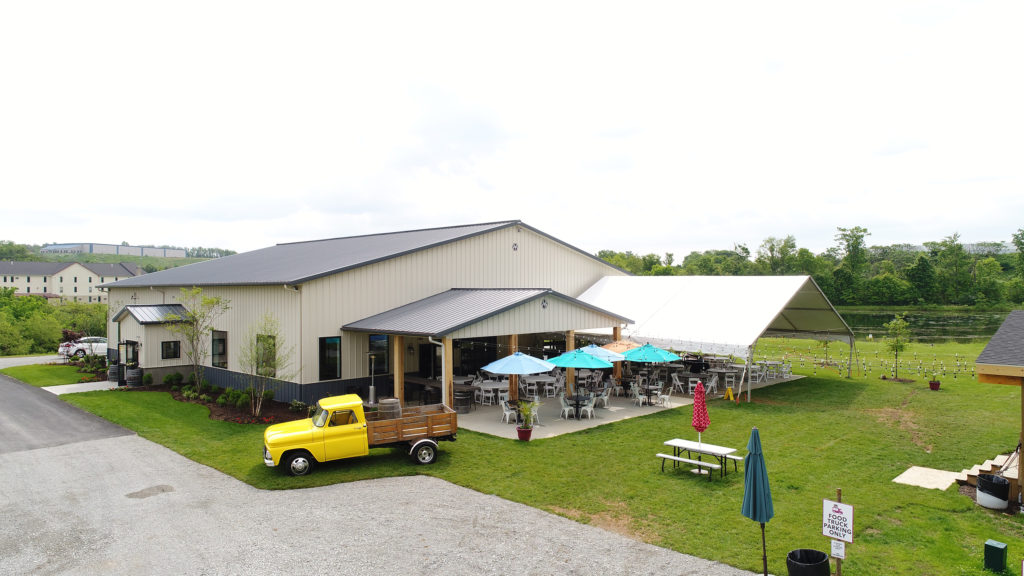
facade of a winery
Photo Courtesy of: Morton Buildings

By: Tracey L. Kelley

Sustainability is no longer a buzzword. Perhaps in the winemaking industry, it never really was. Growers frequently enact innovative solutions focused on water conservation, renewable energy and waste-free practices. For example, major producers such as Fetzer Vineyards and Shafer Vineyards adapted green solutions as far back as 1999, and organic growers go back even further.

  The initial costs of sustainable integration—easier for new projects rather than through retrofitting, although some effective solutions are viable for existing estates—provide significant return-on-investment over the life of the buildings and grounds. Now more than ever, it’s easier for progressive vineyards and wineries to take advantage of the latest eco-friendly technology and create properties that reflect their integration with the land, and honor the origin of their products.

  “They know sustainable-building strategies are good for the climate, good for their site and can make a huge financial impact when considered over the life of a building or business,” said Jon Gentry, owner and partner of goCstudio architecture + design in Seattle, Washington. “It’s our intent that projects use limited natural resources responsibly, and each design enriches its site and cultural landscape.” won an American Institute of Architects’ Emerging Firm Award in 2018.

Learning About Potential Solutions

Gentry told The Grapevine Magazine that clients benefit most by consulting with sustainability experts when they’re first curious about this direction, which helps determine site needs, budget and program. “Having solutions thoughtfully considered from the beginning leads to designs that function and look better in the end. These solutions might include natural daylight and ventilation, solar panel arrays, green roofs, locally-produced materials, geothermal heat pumps and striving to use materials that will be low maintenance and stand the test of time,” Gentry said.

  As one example, goCstudio designed several site-specific sustainable strategies for COR Cellars in Lyle, Washington. “The site has strong winds that funnel up through the Columbia River Gorge. It was important to deal with this element, so we created a courtyard building that provided a protected entry and event space,” Gentry said. “We also bermed the building into the natural sloping hillside using the earth’s mass to help insulate the structure. Finally, we created a flat, low-profile roof that allowed the owners to easily install a solar panel array or a built-up green roof.”

  During information gathering, all the terms and concepts for sustainability options might be a surprise. For instance, LEED stands for Leadership in Energy and Environmental Design. LEED is the blueprint to “create healthy, highly efficient and cost-saving green buildings,” according to the U.S. Green Building Council, which oversees the various levels of LEED certification and its rating system. One large step beyond that is the International Living Future Institute, or ILFI. This nonprofit implements even higher green building standards, which include living building certification, petal certification and net zero energy building certification.

  There are varying degrees of net zero status. Dwight Schumm is a senior mechanical engineer and managing principal at Design Engineers in Cedar Rapids, Iowa. His firm designs building systems—heating, cooling, plumbing, power and lighting—and its net zero headquarters is LEED and ILFI rated. The New Buildings Institute, a nonprofit that promotes better energy performance in commercial buildings, has Design Engineers on its 2019 list of only 580 “getting to zero” certified, verified and emerging projects in the entire United States and Canada. The firm designed another net zero building on that list: Indian Creek Nature Center, also in Iowa, and winner of the 2019 High Performing Buildings Technology award.

  “Net zero describes a number of different things,” Schumm said. “A net zero energy building means it produces as much energy as it uses—that would be total amount of all types of energy. So, for example, if you have natural gas consumption, you’d need to produce enough energy to offset that. Net zero electricity is separate from net zero energy, but most rated buildings with this intent are electric, so it’s usually the same thing,” he said.

Net Zero Water Leads Conservation Efforts

  Schumm also noted that properties can strive for net zero water management. A primary concern for vineyards, this means all water used onsite comes from a well, and all rainwater that falls on a property stays there—there’s not a storm runoff removal system. “With our office building, even though much of the area is covered with pervious material so water can infiltrate, we also designed an infiltration basin—sometimes called a bioswale,” he said. “Instead of holding and then moving water away—which often happens around many non-pervious parking lots—this basin is designed to ease water into the ground.”

  Allen Rossignol is president and CEO of Edge Architecture in Rochester, New York. As a certified LEED professional, Rossignol guides his firm to apply green and sustainable practices to winery and craft beverage projects throughout the Northeast, such as Red Tail Ridge Winery in Penn Yan—New York’s first LEED Gold Certified winery—and the FLCC Viticulture and Wine Center. Rossignol provided some additional specifics for water conservation.

  “The amount of water used for cleaning is a large concern for all wineries. We often suggest a metered water system so owners can be aware of their consumption and make efforts to reduce the amount used,” he said. “Further, as wastewater from the winemaking process is large in quantity and has high levels of BOD (biochemical oxygen demand), there are two solutions: 1) hold and treat or 2) septic systems. With the first solution, we successfully reuse the water for irrigation of the vineyards. The second allows natural replenishment of aquifers.”

  Architects and engineers aren’t the only sustainability professionals thinking about water management. Matt Milby is the designBUILD project development manager for Morton Buildings, based in Morton, Illinois. The company pioneered green construction practices with its first building in 1949, and implemented early advances in Energy Star and LEED certification in its industry. “Renewable energy initiatives such as water reduction or advanced heating and cooling systems that also provide cost-savings are important to wineries,” he said. “Also, low-flow water fixtures are easy to find and significantly reduce water usage without sacrificing service.”

Your Partnership With Architects, Builders and Engineers

  If you’re passionate about sustainability, sourcing the right design and building partners are essential to your success. “We encourage owners to first connect with an architect whose work they’re drawn to,” Gentry said. “Architects generally have strong relationships with talented builders that do great work. Make sure it stands up to how they’re presenting their services and that sustainable strategies are built into their processes from the beginning.”

  “An experienced winery architect can help streamline your facility, resulting in better operational flows and a more efficient building,” Rossignol added. For Red Tail Ridge, Rossignol and his team “included the use of a geothermal heating and cooling system that serves the building and the winemaking process equipment, which is unique to the wine industry,” he said. “Natural ventilation and wastewater harvesting are additional features that contribute to the green design.” Combined with high-efficiency windows and skylights to maximize daylighting and a white-reflecting roof to reduce temperature, Rossignol said the winery’s energy efficiency is 40% greater than baseline equivalent buildings.

  “Consumers are looking for more out of their wine experiences. A knowledgeable winery architect can help you create the destination they’re seeking, and a well-designed winery or tasting room is the key to increasing traffic and interest in your winery,” Rossignol said.

  “The absolute, number one thing any user can do to be sustainable is minimize how much energy they use,” Schumm told The Grapevine Magazine. “To incorporate these principles and goals, the earlier you start, the better, so hire engineers and other design professionals with the appropriate sustainability expertise. This is really critical because, in the beginning, you have a blank slate. But too far along in the process, more constraints exist, which limit your flexibility,” he said. However, if you want renewable solutions for an existing facility, Schumm advised getting a feasibility study and an energy audit, and making adaptations where you can.

  Design Engineer’s website has articles featuring real-world numbers demonstrating where to find net zero savings. Not surprisingly, the primary category contributing to energy efficiency is conservation. “Methods such as daylighting, energy recovery for ventilation, good passive solar design, southern exposure with appropriate shading and so on. Then, another quarter of the savings comes from geothermal heat pumps,” he said.

  Rossignol agreed. “Heat recovery systems such as ventilation systems re-circulate warm air, so energy used to heat buildings isn’t wasted. And geothermal has drastically proven to reduce heating energy and, for wineries, in particular, can be integrated with the cooling systems for fermentation,” he said.

  The structure that houses these systems shouldn’t be an afterthought. For example, Morton’s steel roofing and siding has high levels of recycled content and is completely recyclable at the end of its lifespan. “By combining sustainable building practices and our Energy Performer insulation system, many of our buildings are able to achieve national recognition for their efficiency,” Milby said. 

  Morton’s post-frame construction allows for continuous insulation between structural elements. “So plumbing, electrical and HVAC systems are placed between the insulation and in the finished wall or ceiling. This configuration results in no penetration of the insulation and an increase in energy efficiency and overall insulation performance,” Milby said. He added that cool roofing or high-reflective roofing products reduce the “heat island” effect on a building, and lowers energy use and costs. Foundations with concrete lower pier columns eliminate wood contacting the ground and wood treatment and require less excavation and less concrete. Morton even utilizes sustainable sourcing.

  “Long before the U.S. Green Building Council created LEED, Morton Buildings was already applying a number of sustainable building practices. Since 1949, we’ve used timber frames manufactured from renewable wood sources. To conserve energy and natural resources, the materials used in most Morton buildings are manufactured within 500 miles of each building site,” Milby said.  

What’s On the Horizon

  Now that sustainability solutions are more attainable, there are numerous trends to consider for your operation.

  “I think the rise in mass timber structures is very exciting,” Gentry of goCstudio architecture + design said. “We’ve used cross-laminated timber components on a smaller scale—like our renovation of the Substantial space in Seattle. Mass timber structural components require less than one-fourth the carbon emissions to produce compared to steel or concrete components,” he said. “There’s an elemental beauty to cross-laminated timber panels and glue-laminated structural beams that’s compatible with a lot of the winery spaces we love to imagine.”

  Milby of Morton Buildings is thrilled to see the trend of reusing old building materials in new buildings. “It connects the new and the old with really interesting and popular interior designs. At the same time, it’s helping the environment: fewer items put into landfills and less harvesting of materials, such as woods and minerals, along with the impact of not manufacturing new building products,” he said.

  Schumm of Design Engineers is hopeful about energy storage and electricity. “I think thermal and electricity storage is becoming more important and cost-effective. Soon, you’ll have electricity storage onsite to dispatch when it’s most advantageous for you. This trend will grow significantly,” he said. “Additionally, electrify everything. If you’re able to transition from any kind of combustible—natural gas, diesel, anything—to electric, you’re reducing C02 emissions as well as relying on 100% renewable energy.”

“The consumer appetite for environmental design and interest in learning about the process of beverage making has pushed wineries to evolve into more of a destination than ever before, and it’s been really great to see how this industry embraces this new role,” said Rossignol of Edge Architecture.
Proper Vineyard Equipment Enables Successful Vineyard Management

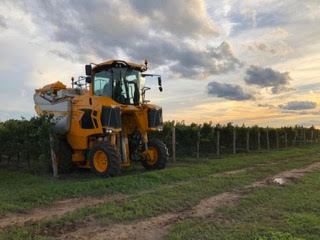
vineyard equipment in action

By: Gerald Dlubala

Whether we’re considering leaf pullers, harvesters, sprayers or some other piece of machinery, good vineyard management starts with the right equipment. Properly matched vineyard equipment helps necessary tasks get completed on time, and are crucial to running and maintaining the efficient operation and growing conditions that lead to a successful harvest. Additionally, having the proper vineyard equipment available saves time and money by reducing the number of working hours while contributing to larger, more bountiful harvests and heartier crops.

  However, the proper vineyard equipment, (including the amount you’re willing to spend on them), can be subjective, so it’s always recommended that you research and get the equipment that’s best suited for your specific situation.

Labor And Resource Saving Spray Systems

  “The right equipment for your vineyard always comes down to your needs,” says Willie Hartman, President and owner of Oregon-based On Target Spray Systems, a manufacturer of next-generation electrostatic sprayers. “Your most used, and subsequently, most needed, vineyard equipment indicates how important the task is to you and your vineyard. So, in our case, we ask how important spraying is compared with the other tasks in your vineyard management process.”

  The answer depends on the amount of time and money spent on spraying throughout the production cycle. A significant issue over the past couple of years, especially on the East Coast, has been the need for more disease and pest control, and vineyards have increased their spraying to combat these issues. Vineyard managers have been tasked with finding the most efficient way to achieve consistently better coverage with the least cost. On Target electrostatic sprayers can provide just that, leading to better results than standard sprayers.

  “Now, more than ever, it’s extremely important that you use a sprayer that provides complete overall coverage,” said Hartman. “It’s easier to control mildew early on when you’re able to apply spray coverage both over and under leaves while also wrapping around the vines themselves. When you spray with electrostatic sprayers, you’re using less water while saving time and money.

“A standard sprayer will typically use one hundred gallons per acre sprayed, whereas our electrostatic sprayers will only use twenty gallons over that same area. We can spray ten acres versus a standard sprayer’s two acres using the same two-hundred-gallon tank. That’s an opportunity to immediately reduce your tank fills by 80%. Add in the time lost because of return trips to refill the tanks, and you can see that valuable time can be recovered using electrostatic sprayers. Less overall material to spread means less time spent on the tractor, saving money on fuel and man-hours. By using less water, we concentrate our spray, resulting in less runoff, minimal drift, and improved chemistry coverage. This increased performance is especially important in having the ability to move away from systemic treatments and stay with contact treatments such as those needed in the organic farming industry.”

  Along with the extended use available with electrostatic sprayers, Hartman tells The Grapevine Magazine that it’s vital to perform an exact application when spraying, so from their largest to smallest sprayers, they all leave the shop with rate controllers.

  “The most important maintenance issue for sprayers is rinsing after use,” said Hartman. To make this as easy and economical as possible, his sprayers all have onboard rinsing tanks that are accessible with the flip of a switch. Additionally, all of the components needed for droplet charging in electrostatic spraying are separately enclosed, including liquid, air and the twelve-volt power source.

  “And now, we’re making our sprayers smaller, lighter and even more economical,” says Hartman. “This is great news for smaller growers because our three-point trailered electrostatic sprayers can be used with smaller tractors. A very popular model is our one-hundred-gallon trailer that only requires 20 horsepower to operate. And when you use smaller, less expensive tractors combined with smaller sprayer units, you get the additional benefit of less ground compaction.”

Multi-Use Equipment For Efficiency And Cost Savings

  Bill Reiss, owner of BDI Machinery Sales Inc., has seen it all. So he knows that there’s a lot that goes into the management of a vineyard, including the inherent belief that when it’s all said and done, it’s always the vineyard manager’s personal decision on how best to run their vineyard. Reiss doesn’t want to sell anything that won’t help the vineyard manager improve the land.

  “It’s not just about the right equipment, it’s about the equipment that’s available to you,” says Reiss. “The equipment that you want may not be economically feasible if you are a small vineyard. You won’t have the spending money to invest in a lot of specialty equipment, so it’s imperative as a supplier to always be looking for time and labor-saving ways to get things done. Some vineyard equipment may be good in one region but not useful at all in another growing region. Most decisions are made based on the timing of the growing and harvesting process. There may be tasks that you’re willing to do by hand, but is that going to put you behind on other critical tasks? Can you get it done on time? Are there better ways to get that task done and stay on the critical timeline of your vineyard management?”

  Reiss and BDI Machinery stay focused on tools that have multiple, useful functions for vineyard owners. Their leaf pullers come as attachments, hooked onto a frame that can be attached to a tractor.

  “The latest trend in leaf pullers has been to use the air impulse pruners,” says Reiss. “A controlled blast of air shatters the leaves away from the plant. These have been around since the nineties, but better technological developments have made them trendy now, especially on the East Coast. Earlier models included a simple fan that used velocity to suck leaves into an impeller blade to be chopped up, and the double drum leaf pullers, still being sold and in use today.”

  With additional attachments available that can be attached to the same frame, a single tractor can now be used for hedge clearing, pruning and suckling removal. Once these implements are hooked up to a tractor with hydraulic capacity, they’re controlled with a joystick for safety and comfort.

  “Now you’re helping your clients have access to more machinery at less cost,” says Reiss.  “They’re only having to buy the attachments that they need for their specific vineyard process. This is good for immediate tasks, but also future planning. Additional attachments can be purchased later on an as-needed basis, knowing that they already own the base frame and tractor needed to use them.” 

  Reiss tells The Grapevine Magazine that rather than concentrating on one single piece of equipment, BDI is always on the cutting edge of new technology regarding all vineyard machinery. They are continually looking for new ways to be economically and environmentally friendly while creating the ideal tool for grape growers and wineries. 

Whether Large Or Small Operation, Grape Harvesters Save Money And Time

  Jesse Willms, Operations Manager, and Duarte Oliveira, Sales and Customer Relations for Lakeview Vineyard Equipment Inc., know the importance of keeping costs down in the vineyard. Anchored in this knowledge is the belief that every vineyard, no matter the size, should look to mechanical harvesting as a way to reduce labor costs and increase the quality of their harvest.

  “Mechanical grape harvesters perform great for all grape varietals,” says Willms. “Some adjustments need to be made depending on the grape that is going to be harvested because each variety does pick differently and at different stages of ripeness. With the correct setup, modern harvesting machines can provide 100% picking rates and zero loss.

  “With the increased potential of finding quality used harvesters, as well as the many choices when buying new, there are reasonable options for all sizes of wineries and growers to take advantage of mechanical harvesting machines,” says Oliveira.

  However, before choosing a grape harvester, consideration has to be given to a vineyard’s unique set up and layout. There are different machines to handle the different growing styles, including Geneva Double Curtain, Smart-Dyson or Vertical Shoot Positioned. The terrain and landscape slope of a vineyard will dictate the need for a two-wheel or four-wheel-drive system. The correct choice of harvester for a vineyard will also be determined by the width of the rows, as there are different sized harvesters made for both wide and narrow spacing needs.

  “Once the size of the grape harvester is determined, look for a harvester with on-board destemming and sorting,” says Willms. “On-board sorting equipment has evolved recently and continues to be a focal point of the mechanical harvesting function. With on-board sorting, you lower the amount of interaction between material other than grapes (MOG) and recently harvested fruit. Just as importantly, the sticks, leaves and stems are left in the vineyard to be worked back into the soil. Providing MOG free grapes with low maceration is the goal, even in challenging post-frost or rotten fruit conditions. Ultimately, with the ability to automatically remove the MOG, you increase the ability to deliver your harvest in a more efficient and timely manner.”

  “Adding to their affordability and usefulness factor, harvesters can often be used as over-the-row tractors as well, making them functional for year-round use,” says Oliveira. “The picking head can be removed from the tractor base of the machine and be replaced by different attachments like a pre-pruner, leaf remover or multi-use sprayer.”

  Oliveira tells The Grapevine Magazine that new developments have shown up in automatic steering and on-board yield mapping as well. The automatic steering is guided by a vineyard’s physical layout and landscape properties, while on-board yield mapping provides the grower with comparative, year-to-year data identifying the parts of the vineyard that are cropping heavier than others. Vineyard managers then use this information to make well-informed decisions about pruning, thinning and fertilizing for the following growing season.  

Owning and running a harvester does require a bit of maintenance simply because of the number of moving parts involved, and since harvesting is a time-sensitive task, you don’t want to run the risk of breakdowns. Seasonal maintenance is always recommended, including belt and chain tightening, greasing all bearings and bushings, and annual maintenance of the on-board engine.

Exploring the Diversity of European Grenache Wine

Peter Fraser in Vineyard

By: Becky Garrison

Grenache has the distinction of being one of the world’s most widely planted wine grapes. Addi-tionally, this versatile wine pairs very effectively with food. Grenache wines have diverse levels of texture and depth with a slight spiciness that work well with a wide range of braised, grilled and stewed meats, as well as the milder styles of Asian cuisine. 

  As part of Feast Portland 2019, a regional food and drink festival with international appeal, Hoke Harden, SWE Certified Spirits Educator, offered an industry presentation into European Grena-che wine. He focused on those wines that range in cost from $10 to $20. At this reasonable price point, Harden describes the wines as “not wine you take home and save, but wine you take home and drink.”

  Although lower priced Grenache may not be the sort of wine one ages in a cellar, these wines have a distinguished history that belies their price tag. Carbon dating of seeds and leaves discov-ered at archeological sites indicate Grenache was planted as early as 153 BCE. Most likely, Gre-nache originated in the region of Spain now known as Aragon, where it goes by the name Garna-cha. However, some have speculated the grape originated in Sardinia, where the grape is called Cannonau.

  As these vines flourish best in hot, sunny and dry conditions, the Mediterranean climate proved to be ideal for growing them. Grenache vines were then planted in Catalonia and then in places outside of Spain that were under the Crown of Aragon, such as France, Corsica, Southern Italy, Sicily, Croatia and Greece.

  The old vines currently growing in the region can be over one hundred years old. They tend to produce a finer and more complex wine than Grenache produced in areas where the vines are much younger.

  The grape comes primarily in three versions: red—Grenache Noir, white—Grenache Blanc, and a version of white known as Grenache Gris. The Grenache Noir is round and smooth with notes of prunes, cherries and other red-pitted fruits. Conversely, Grenache Blanc has a combination of floral, fruity and herbaceous notes and fresh aniseed licorice flavors for a fleshy, mellow wine of medium intensity, a medium to high acidity and high levels of alcohol. The Grenache Gris pro-duces pale rosés and mineral-driven whites with copper hues and citrus notes that are fleshy, round and elegant.

  Additionally, there are two less common Grenache grapes—the Lledoner Pelut (black) and Gar-nacha Peluda (hairy). The Lledoner Pelut, which is a cousin to the Grenache Noir, is very similar but has more structure and a bluer color. Garnacha Peluda, which gets its name from its hairy leaves, has a lower alcohol content, medium acidity, aromas of red fruits, and rapid oxidation.

  From these varieties of grapes, winemakers can produce a vast array of wines ranging from light- to full-bodied red or white wines, as well as rosé wines, fortified wines, natural wines and spar-kling wines. Each of these varieties is highly sensitive to the growing conditions of a particular region. Depending on the soil, climate and elevation, wines produced from these grapes can vary dramatically from one appellation to another. For example, one appellation may yield full-bodied, black-fruited wines, while a nearby region produces a more light-bodied wine made with red fruits. 

  While Grenache can grow in a diverse range of soils, the vines respond best to the schist, lime-stone and clay soils abundantly found in Northeastern Spain and the Roussillon in southern France. Here the grapes’ tight clusters make it a perfect choice for these hot and dry soils. How-ever, the same tight grape clusters make Grenache prone to downy mildew and bunch rot when grown in humid or rainy locations. Also, as the grapes ripen relatively late, they work best in very warm regions.

  Another positive attribute of these hardy and vigorous Grenache vines is that they use less natu-ral resources than many other vines. In fact, Grenache could be seen as the world’s most eco-friendly and sustainable grape. As this grape adapts to arid weather conditions, it can be grown using environmentally friendly vineyard practices. For instance, these vines are not dependent on rainwater because their roots can delve deep into subterranean water tables. In addition, the plant has a robust wooden frame that is drought and disease resistant. Often Grenache is grown as a free-standing bush with its strong, sturdy trunk able to survive in strong winds. In consideration of all these attributes, in 2011, the World Climate Change and Wine Conference with Kofi An-nan in Marbella, Spain recognized Grenache as a product well prepared for climate change.

  Currently, over 90 percent of Grenache grows in Spain and France. The regions have been certi-fied in two European Union quality schemes: PGI (Protected Geographical Indication) and PDO (Protected Designation of Origin). The EU established these schemes in 2012 for agricultural commodities to ensure that the products originated in this particular region. Also, these schemes ensure that the product has been produced in accordance with European agricultural production methods that focus on nutrition and health, food safety, traceability, authenticity and labeling.

  Five PDO vineyards in Spain specialize in the Grenache grape variety: Somontano, Terra Alta, Cariñena, Calatayud, and Campo de Borja. Within these regions exists 5,500 wine growers and 144 wineries, with Grenache repenting about 40% of their vineyards. (Other varieties are Tem-pranillo, Cabernet Sauvignon, and Syrah). Rosé and White Grenache is grown in the Terra Alta PDO, while Red Grenache is the main variety grown in the other four PDOs.

  Roussillon in France houses 2,200 winemaker families, 25 co-ops and 350 private cellars. The varied topography of this region produces a wide variety of Grenache grapes that can create a range of wine styles, including dry still wines and fortified sweet wines.  

  Most of the reviews about Grenache wines tend to focus on blends such as the Châteauneuf-du-Pape wine blend from France’s southern Rhône Valley. French winemakers discovered this va-riety in their search for a grape that would add alcohol, body and fruity flavors to their existing wines. Other noted blends made using Grenache can be found in Gigondas, and in the Priorat reds produced in the Priorat county, situated in the southwest of Catalonia in the province of Tar-ragona. Many of these wines tend to carry a significantly higher price tag than the moderately priced wines highlighted by Harden, with select bottles garnering a price as high as $800. 

Winter Pruning Tips: Prepare Your Vineyard for Success

staff pruning stems

By: Alysa L. Ochs

Although the busy days of harvest are now behind us, there isn’t much time for vineyard staff to sit back, relax and enjoy the fruits of their labor. Now begins the important task of pruning, and winter is the ideal time to separate healthy wood from the dead and damaged. Whether you’ve just started vineyard operations or have been running a vineyard for decades, it never hurts to be reminded of the best dormant pruning practices and learn about emerging technology to make this vineyard task easier.

The Purpose of Pruning

  Dormant pruning is critical to grape growing because it maintains the training system, allows operators to select fruiting wood, and manipulates the quality of fruit produced. It helps maintain vine form, regulates the position and number of shoots on a vine, improves fruit quality, stabilizes production and improves bud fruitfulness through careful bud placement and selection. Pruning is also an opportunity to get control over weeds, identify vine diseases and address pest concerns before they become significant issues.

When to Prune

  As a general rule, dormant pruning can be done anytime between leaf drop in the fall and bud break in the spring. Vineyards around the country may start pruning right after Thanksgiving into mid-December, but this tedious job usually extends through March. Some vineyards wait until January to begin their dormant pruning because this is when the canes become woody.

  Jordan Lonborg, viticulturist at Tablas Creek Vineyard in Paso Robles, California, told The Grapevine Magazine that his vineyard chooses when to prune largely based on weather.

  “We typically start pruning in January,” he said. “But the majority of pruning takes place in February and March.”

  Vineyards may postpone pruning to assess cold injury better and adjust pruning levels to compensate for losses. Double pruning is sometimes used to avoid spring frost injury. However, the availability of labor in the winter months has a big impact on when vineyards do their pruning as well.

  “Pruning your grapes too early in the season is a mistake that novices make that can result in no fruit production,” Randy Killion, president of Zenport Industries in Sherwood, Oregon told The Grapevine Magazine. Zenport manufactures and markets professional and consumer specialty horticulture tools and supplies for the lawn and garden, landscape, irrigation and agriculture markets.

“If low temperatures and strong winds follow pruning, it’s very possible that the pruned parts will freeze,” Killion said. “This will make you lose all or part of your crop. Therefore, it’s recommended that pruning is delayed until February.”

Types of Pruning

  Cane pruning is most commonly used for grape varieties that have low natural fruitfulness on the basal buds. This type of pruning requires vineyards to replace the one-year-old canes annually.

Spur pruning is most often used for high fruitfulness varieties and is relatively easy to do. This is the most popular method of pruning among vineyards today, particularly for grape varieties like Merlot and Cabernet Sauvignon.

  Meanwhile, head training is sometimes practiced by vineyards without trellising. While this practice is economical, it’s important to watch for rot and mildew, as well as congested canopies that can topple under their own weight.

  “We spur prune the majority of the vineyard because 65% of the vineyard is on trellis,” said Lonborg. “Ten percent of the vineyard is cane pruned as well. A majority of the cane pruning occurs on Syrah and Viognier due to their vigorous nature.”

Disease Identification and Weeding While Pruning

  Grapevine diseases can occur at any time of the year, but the winter season is a useful time to check plants for abnormalities and take action. Some of the most common diseases that grapevines experience are Pierce’s disease, phylloxera, downy mildew, powdery mildew, gray mold, black rot and vine truck diseases such as Petri disease and black measles. 

  While pruning, keep an eye out for discolored lesions that are red, brown or black. Other signs of disease are curling leaves, weak or short shoots, rapid wilting and shriveled leaves or grape clusters. Also, look for grapes covered in a gray or tan powder or leaves with yellow edges.

  However, a visual diagnosis may not be sufficient, and it may require laboratory analysis to identify certain bacterial and fungal diseases correctly. To protect the healthy plants in the vineyard, promptly remove diseased wood and either burn it (if your area allows burning) or add it to the green waste bin to be hauled away.

  Pruning and weeding go hand-in-hand around this time of year, and there are important factors to consider when developing a vineyard weed control program for the dormant months. Nicola Rinieri of Rinieri S.R.L. in Forlì, Italy, told The Grapevine Magazine that customers must think about the conditions and their most common practices. For example, vineyards in the Northeast hill up the soil to protect the vines, which requires specialized equipment. Rinieri provides agricultural machinery for vineyard processing, pruning machines, offset machines, in-and-out rotary tillers and cultivators.

Pruning Tools and Supplies

  While the process of pruning may seem simple enough, some specific tools and supplies help get the job done right in the most efficient way possible. The most basic hand tools needed for pruning are a few good pairs of pruning shears, loppers and saws. Vineyards also use hand-held scales to measure pruning weights and ribbons, garden tape or cloth strips to identify fruiting canes and renewal spurs.

  There are pros and cons to both manual and mechanical pruning, and decisions in this regard are often the result of long-standing vineyard traditions.

  “All of our vineyard is manually pruned,” said Lonborg. “Maintaining the proper structure of the vine is of the utmost importance when producing high-quality fruit.”

  Rinieri said a common mistake that vineyards make when doing mechanical pre-pruning is trying to use a machine to do a job where it’s not appropriate in the vineyard.

  “It is common to have the wires not tighten enough so the machine can catch them or to have a cross arm so wide that the machine cannot open enough to avoid them,” she said. “This was happening many times in the past, but fortunately not as often lately.”

  Amanda Van Hoorn, operations manager for INFACO USA in Livermore, California, told The Grapevine Magazine that the F3015 Electrocoup pruning shear with a patented safety system is popular among vineyards for pruning purposes. The history of INFACO dates back to 1984 when M. Daniel Delmas invented the world’s first electric shears. Today, INFACO offers a versatile and compatible product line that also includes an electrical tying device, electric olive harvester and battery-powered tools.

  “No other company offers the safety and versatility of the F3015 Electrocoup shear,” Van Hoorn said. “Specifically, we offer a patented safety system that ensures workers won’t injure their non-pruning hands. Users can also increase cutting capacity by just changing the head on the shear. This means that vineyard managers can use the same tool for cane pruning, converting vineyards and cutting out Eutypa. The shear’s battery is also compatible with a variety of other INFACO tools for vineyards, including an electric tie gun and suckering tool.”

  Killion of Zenport Industries told The Grapevine Magazine about the wide selection of quality hand pruners, loppers and saws that Zenport offers, as well as the company’s series of battery-powered pruners. Popular Zenport products are the Zenport EP108 CORDLESS ePruner, a 0.5-inch cut battery-powered electric pruner, and the Zenport EP2-778 ePruner, a 1.25-inch cut battery-powered electric pruner.

  “These two pruners are immensely popular for vineyard use because of reduced fatigue upon workers, dramatically increasing pruning efficiency and speed,” Killion said. “Both pruners enable the user to prune for an entire day.”

  Meanwhile, Rinieri offers two types of machines for pruning, called CPL, and each type has four different sizes based on cutting length. “It is important to find out if a vineyard is cordon or guyot and then decide which length the customer needs,” Rinieri said. 

  Rinieri also sells many weeding tools, including Bio-Dynamic, TURBO with hoeing blade, plow kit and Bio-Dynamic tools, and TURBO EVO with power harrow, disc hoeing units, mini shredder plus the blade and plow. These units are available with single or double side blades. Other offerings are the EL power harrow single-side, FS tiller single-side, and EP heavy-duty power harrow – all PTO driven.

  FELCO can also be counted on to help vineyards prepare for the winter season, and it has been producing high-quality pruning tools for 75 years. FELCO’s Ryan Amberg told The Grapevine Magazine about their newest tool, the FELCO 822, launched just this year.

  “It maintains its predecessor’s position as the most powerful electronic pruner on the market with new features, such as HSS XPRO blades for increased longevity, smaller multi-position power pack for ergonomics, and the first-of-its-kind connectivity for future vineyard management applications,” Amberg said. “If you are looking for a solution to carpal tunnel or a solution to a lack of labor, the FELCOtronic can be a real solution this winter.”

Pruning Considerations and Tips

  Proper pruning practices come with time and wisdom collected over many winter seasons. Being prepared and having a plan in place for dormant pruning is always a good idea, but it is also necessary to be flexible in case weather, the labor supply, or other factors throw a wrench in your plans.

  Van Hoorn of INFACO USA said that labor is a huge factor when planning for pruning and buying new pruning tools.

  “The labor crisis is here to stay, and with it comes increased prices for every operation in the vineyard,” she said. “Proper pruning is crucial to producing great grapes but is one of the most labor-intensive tasks on the vineyard. The F3015 pruning shear from INFACO has shown an average productivity increase for vineyards of 30% and also increases the number of years workers can continue pruning. Powered pruners have an inherent risk, though, and that’s why the F3015 pruning shear features a patented safety system to protect workers’ non-pruning hands. There is no doubt that this is becoming a must-have tool for vineyard managers who need to find ways to use less labor and keep their best workers.”

  Van Hoorn said vineyards should, “Switch to an electric shear before the labor market chews you up and spits you out!”

  Killion of Zenport reminded vineyard managers that pruning tools are used extensively, and battery-powered pruners, in particular, need to be serviced periodically. 

  “Choose a manufacturer that stocks replacement parts, like blades and bumpers,” Killion said. “For electric pruners, it is imperative that a service center with quick turnaround is available.”

Killion also said it is crucial to identify last year’s growth because this is where the coming season’s fruit will form.

  “The wood where the fruit is produced on the last year’s growth will have a different color than the older wood that can’t produce fruit,” Killion said. “You will usually be able to identify the last year’s wood because of its reddish color.”

  Rinieri of Rinieri S.R.L. said that the main factors to consider are the size of the vineyard and row width.

  “When a vineyard is large in size, it needs a quick machine, like Bio-Dynamic, TURBO or TURBO EVO,” she said. “If it is small, it can use EL, FS or EP. Also, finding out what type of work a vineyard wants to do is important because some machines can use different working heads, like TURBO EVO and TURBO, with no power tools. The width of the row is important because all machines have a range of widths in which they can work.”

  Amberg of FELCO said that three things should come to mind when purchasing new tools: the application of the product, the longevity of the product, and the ability to maintain the product. Product application is vital for improving vineyard ergonomics, which is why FELCO offers so many different hand pruner models.

  “We believe ergonomics are key in a high-stress pruning environment like the vineyard,” Amberg said. “A tool should be bought, taking into consideration hand size, left or right-handedness and average cut diameter. We make tools for all varieties of these combinations.”

  Regarding longevity, Amberg said hand tools are the workhorse of a vineyard crew’s arsenal during pruning season, which means they are put under a lot of stress and abuse.

  “This is why we protect our tools with military-grade aluminum handles, as well as our precise manufacturing process that allows these tools to tolerate the stress of intensive pruning without issue,” he said. “Look for tools that are built to last and that you will not replace multiple times in a season.”

  Amberg also pointed to proper maintenance as a way to get more life out of your tools and extend your return on investment.

  “We build our tools so that with just simple blade and spring changes, you can maintain your tool for a lifetime,” Amberg said. “This means on any aluminum-handled FELCO, all parts can be changed and replaced with ease, thanks to our precision machining. We produce our tools out of an old watch factory in Switzerland, giving us the ability to put tools back together hundreds of times without any give in the mechanics.”

  However, it doesn’t matter what tool you use if you start too early, said Longborg of Tablas Creek. “If you have the ability to wait as long as possible, do so!” he said. “If you can wait to prune until the vines start bleeding, you greatly reduce the risk of Eutypa infection.”

NEW ‘Wine Village’ in British Columbia’s Okanagan Acts as a Launchpad for Small-batch Wineries

By: Briana Tomkinson

rendered wine village

A new project breaking ground this year in British Columbia’s Okanagan Valley aims to bring together small-batch wine, beer, cider and spirit producers to create Canada’s first “wine vil-lage.” Here visitors can explore craft beverages and culinary delights created by up-and-coming craft beverage producers.

  District Wine Village (DistrictWineVillage.com) will be surrounded by vineyards and will include production facilities and consumer-facing tasting rooms for 16 producers, as well as a 600-person entertainment and event center and on-site eateries. Beverage producers will benefit from shared resources, such as a communal crush pad. 

  According to spokesperson Lindsay Kelm, by gathering so many craft beverage producers to-gether in one place, the District Wine Village aims to create a tourism draw that is greater than any new small-batch winery could create on its own.

  “People are looking for niche producers, artisans and craftspersons. It’s a trend that’s here to stay, to support local,” Kelm said. “We’re building people up and giving them a platform to share their story.”

  The circular site is designed in the shape of a wheel, with a partially covered pedestrian plaza and partially covered event space at the hub, and the facilities for each producer as the “spokes.”

  Tasting rooms and event facilities will face the interior of the wheel, while delivery trucks can load and unload grapes, bottles or other material with the help of an on-site operational team directly into each facility through doors facing the perimeter. Producers who lease space in the village will also benefit from a streamlined licensing process, and co-operative marketing and PR.

people getting busy at a wine village

  Each of the 16 “pods” will feature a fully-equipped production area complete with tanks, hoses and other equipment, which will be leased to the craft beverage producer. Also included in each space is a customer-facing tasting room and patio, which can be designed and branded to suit each occupant. Pods will also include room for barrel and case storage.

  Kelm said the project aims to be a launchpad for grape-growers or garagiste producers who have the passion and skill to produce wine but lack the deep pockets needed to fund a tradi-tional winery. Although Kelm said most spots are likely to be snapped up by small wineries, she said other craft beverage producers also need these kinds of spaces.

  Land is expensive in the Okanagan, Kelm said. To buy a small winery may cost between $1.5- to $3-million at the low end. Because all the production equipment is leased to the producers, the startup cost within the District Wine Village is much more affordable than buying or building a dedicated space, she said.

  Construction is anticipated to begin in spring 2020. The first four to six pods will be ready by fall 2020, and all 16 are expected to be completed by summer 2021.

  The project was designed by Penticton’s Greyback Construction (http://www.greyback.com/), which was involved in building many other local wineries, including Painted Rock, Arrowleaf Cellars, Culmina, Wild Goose, Church + State, Nk’mip Cellars, Burrowing Owl and Black Hills. 

In a press release announcing the project’s launch, Greyback Construction General Manager, Matt Kenyon, said the project aims to create a sense of community and connection among the site’s wineries, cideries, breweries, distilleries and eateries as well as the broader region.

  “We are really looking to be a significant economic driver for our local communities and sup-port the future growth of wine and culinary tourism in the South Okanagan,” Kenyon said. 

  The District Wine Village project is located in the small town of Oliver, in the South Okanagan, in the heart of one of Canada’s most successful wine-producing regions. The town is home to half of British Columbia’s vineyards and more than 40 wineries.

  Although Oliver has a year-round population of only 5,000 people, it swells with tourists in the summer months. In the fall, the town’s population doubles during its annual Fall Okanagan Wine Festival. The festival includes the Cask & Keg, a brewery and distillery showcase, and the family-friendly Festival of the Grape (http://oliverfestivalofthegrape.ca/), which features tastings from more than 50 British Columbia wineries alongside food trucks, children’s activities, and costumed competitors in the annual Grape Stomp contest. 

  The town’s Half-Corked Marathon (https://www.oliverosoyoos.com/half-corked-marathon/), a wine-soaked fun run through scenic vineyards featuring wacky costumes, fine food, wine-tasting and a who-cares-who-wins attitude, is another popular tourist draw. Participants have a maximum of three and a half hours to complete the route, which winds through as many area wineries as possible. The race is so popular that registration is by lottery; spots in the 2020 race in May are already all sold out. Organizers say over 8,000 people entered the lottery for this year’s race, which was capped at 1,500 participants. Tickets are $185 and include race entry, transportation to and from the start/finish lines, lunch, wine and food tastings along the route, a swag bag and a bottle of the Half Corked signature wine blend.

  Approximately 84% of British Columbia’s vineyard acreage is located in the Okanagan Valley, according to the British Columbia Wine Institute (winebc.com), a non-profit industry organiza-tion representing British Columbia wine producers. The 250-kilometer valley includes four dis-tinctive sub-regions: Golden Mile Bench (located near Oliver), Naramata Bench, Okanagan Falls and Skaha Beach. The area is warmer and arider than California’s Napa Valley and gets almost two hours more sunlight per day during the growing season. 

  Yet unlike California, winter temperatures dip well below freezing. Area wineries began harvest-ing frozen grapes for ice wine in late November when temperatures dropped to -8 degrees cel-sius (17.6 degrees Fahrenheit). According to the BC Wine Authority, 20 wineries registered to harvest ice wine grapes this winter, with approximately 463 tons of grapes expected over 124 acres in the Okanagan Valley, Similkameen Valley and the Shuswap region.

  To qualify for the British Columbia Vintners Quality Alliance (VQA) certification, harvesting and pressing of grapes for ice wine must occur in temperatures below -8 degrees Celsius. Artificial refrigeration of grapes, juice, must or wine is prohibited.

  The interior of British Columbia, which includes the Okanagan area, is the only wine-growing region to regularly experience the frigid temperatures required to produce ice wine.

Tariffs and the Industry: Impacts of the Trade War on Wine, Beer & Spirits

2 wine corks fighting

By: Jessica Spengler

Throughout 2018, the Trump administration’s implementation of tariffs on several foreign goods, and the retaliatory tariffs that followed suit have confused markets and worried many businesses. The alcohol industry—wine, beer, spirits and those who support them—have all been affected in some way by these tariffs, or expect to be in 2019 if they continue. With the news on tariffs changing almost monthly, it can be hard to keep up, which causes further insecurity for the industry.

Timeline of Events

  Trade tensions began in January 2018 when the Trump administration imposed tariffs on solar cells and washing machines after a report stating that imports were hurting the domestic U.S. market in those businesses.

  On March 8, 2018, President Trump announced a 25 percent tariff on imported steel and a 10 percent tariff on imported aluminum to take effect on March 23. At this time, Canada and Mexico were granted an exemption pending talks to renegotiate NAFTA. After threats from the EU to impose retaliatory tariffs, the administration allowed exemptions for the EU, South Korea, Brazil, Argentina, and Australia through May 1, which would eventually extend to June 1.

  On April 2, China imposed tariffs ranging from 15-25 percent on various U.S. products, including fruit, wine, whiskey, and other products totaling approximately 3 billion U.S. dollars.

  On June 1, exemptions from the steel and aluminum tariffs ended for the EU, Canada and Mexico. Argentina and Brazil struck deals with the Trump administration limiting the quantities of steel and aluminum they ship to the U.S., while Australia negotiated for no trade restrictions.

  In retaliation, on June 22, the EU imposed tariffs on $3.2 billion of U.S. products, including a 25 percent tariff on Bourbon and whiskey. Then, on July 1, Canada also imposed retaliatory tariffs on $12.8 billion in U.S. products including 25 percent on steel, and 10 percent on aluminum and whiskey. In addition, Mexico implemented a 25 percent tariff on Tennessee whiskey.

  After talks with China failed in May, the first phase of the trade war occurs in mid-June, with the Trump administration announcing it will enact a 25 percent tariff on $50 billion more in Chinese goods. Beijing retaliated, placing more tariffs on $50 billion in U.S. products.

  In September, President Trump announced another 10 percent tariff on $200 billion more in Chinese products, that he planned to increase to 25 percent at the beginning of 2019. These tariffs impacted manufacturers of fermentation tanks outside of the U.S.

  On September 30, a compromised was made between the U.S. and Canada for an updated NAFTA. Mexico and the U.S. had already come to an agreement by this point, and so the new agreement, called by the Trump administration the United States-Mexico-Canada Agreement, or USMCA, would be signed by the three leaders at the end of November. Mexican and Canadian governments were both hopeful that tariffs would end before signing.

  In November, President Trump and President Xi Jinping of China both showed interest in coming to a compromise, ending a tense few months of escalation.

  On November 30, 2018, President Trump, Canadian Prime Minister Justin Trudeau and Mexican President Enrique Peña Nieto signed the USMCA in Buenos Aires on the first day of the G-20 summit in Buenos Aires without any agreement to end the tariffs. At the time of publication, talks to alleviate tariffs with Mexico and Canada but implement quotas are in progress, but no deal has been reached.

  On December 2, 2018, at a dinner between President Trump and President Xi, they agreed to a truce, putting a stop to any further tariffs for 90 days to give the two countries time to come to an agreement. At the time of publication, Robert Lighthizer is leading negotiations, but no deal has yet been made.

Effects to the U.S. Wine, Beer, and Spirits Industries

Wine

  China has been a growing market for American wine for nearly 20 years. The market has increased almost 1200 percent since 2001 despite an already steep tax of 54 percent on imported wine. China’s retaliatory tariffs threatened to stop that growth in its tracks if the tariffs continue. After two rounds of tariffs on wine, the first in April at 15 percent and the second in September at 10 percent, the current taxes and tariffs for U.S. wine going into China is 79 percent. That percentage is quite unsettling for winemakers who have a market stake in China, particularly if no agreement is reached and the current truce ends.

  Igor Sill, owner of Sill Family Vineyards, told The Grapevine Magazine in an email: “Yes, I’ve been very concerned over the latest exchanges between U.S. and China trade given that we are already being penalized with a 15 percent tariff. The newest retaliation from China to our steel and aluminum trade policies will add 25 percent to that existing tariff, essentially pricing me out of the China marketplace. It’s a real shame, frustration, and disappointment as we have nothing to do with manufacturing and construction materials, but yet are hit with this inability to compete in China’s luxury wine sector against other imported wines. I really pray that the trade dispute with China is resolved equitably and quickly. At $185 per bottle, my Chinese customer would need to pay some $275 per bottle to enjoy our wines. That would greatly reduce China sales for us.”

This reduction is particularly disappointing for Sill Family Vineyards, winners of the China Spirits and Wine Associations’ 2018 Wine of the Year for their 2015 Napa Atlas Peak Cabernet Sauvignon, as well as the coveted Double Gold Medal for excellence.

  “We’ve been focused on sales and distribution to the China marketplace since 2014.  It’s a huge market that appreciates the quality of exceptional fine wines and, specifically, they have grown their appreciation for Napa Cabernet Sauvignon by some 10-12 percent each year.  When you have some 1.5 billion people in China, those consumption numbers are more than substantial to someone like us—a small, family producer of limited production, high-end wines, crafting a mere 800 cases of wine per year.”

  Sill planned to increase the percentage of his business in China from four percent to eight in 2018 and with a 15-20 percent increase annually through 2023.

  “These plans have since changed,” said Sill. They now plan to refocus on the U.S. market, concentrating on high-volume wine consuming states such as Texas, New York, New Jersey, California, Illinois and Florida.

  If the tariffs continue, pushing Sill and other California wineries out of the Chinese market and back into the U.S., it could cause problems for lesser known wines.

  “If these California wineries decide to curb sending that wine into China, the wine needs to be sold somewhere, and it could come back here to the United States, which could lead to more competition for shelf space and storage with other state wine industries,” said Michael Kaiser, Vice President of trade group, Wine America.

  However, Kaiser said, despite the high tariffs that threaten to increase, even more, it doesn’t appear other California wineries are following Sill out of China.

 “The exports to China from the U.S. are up 18 percent this year so far. It’s still increasing. I think it was the number fifth-highest market last year for U.S. wine. About $80 million worth of U.S. wine was sent into China last year. So, it doesn’t appear that the tariffs are compelling people not to export their wine to China. I think that it shows how valuable a market it is that people are willing to pay these new tariffs on their wine going into that market,” said Kaiser.

  That doesn’t mean that there hasn’t been an effect, said Kaiser. The impact will be more apparent after the new year. “It’s hard to really quantify because [the tariffs] haven’t really been around that long, but we’ll have to look and see what it’s like in January and February when we have the numbers for the year,” he said.

Beer

  For many in the brewing industry, what should have been a banner year of expansion and growth ended up as something much different. In December 2017, Congress lowered the federal excise tax from $7/barrel on the first 60,000 barrels for domestic brewers producing less than two million barrels annually, to $3.50/barrel. For imports and domestic brewers producing over two million barrels annually, barrel costs were reduced from $18/barrel to $16/barrel on the first six million barrels. The tax cut opened up staffing and expansion opportunities that excited many brewers.

  “Then a few months later, unfortunately, the Trump administration imposed a 10 percent tariff on aluminum, which raised costs for brewers,” said Jim McGreevy, President and CEO of The Beer Institute, the oldest beer trade organization in the U.S.

  “We’re seeing an impact to the industry and brewers big and small. We estimate that the tariffs are a $347 million tax on beer. I told you about that tax relief we received in December—that was roughly $130 million of tax relief for beer. So, we received $130 million tax relief in December, and in March we received a $347 million tax increase. This is definitely affecting the industry as a whole.”

  The tariff on imported aluminum contributed to the rising prices of cans – in a time when more breweries than ever are embracing use of 12 and 20 ounces cans, as well as the to-go style “crowler.” The extra cost can severely affect the bottom line.

  “Aluminum is the single biggest input cost for beer brewers. Of the 6,000 or more breweries in this country, you see more and more distributing their beer, and you see more and more putting their beer in aluminum cans and aluminum bottles. So this is a major input cost for beer brewers, big and small. That 10 percent tariff affected beer brewers because a large portion of aluminum used to put beer in comes from outside the country,” said McGreevy.

  It doesn’t seem to matter where or how a brewer buys their aluminum either.

  “One large brewer announced a few months ago that this was a $40 million cost to them every year. We’ve had small brewers who are members of ours—even small brewers who are not members of the Beer Institute—tell us that their aluminum costs are going up, even if they get their aluminum from a broker. This is affecting the price of aluminum up and down the chain, no matter how you get the aluminum, whether you have long-standing contracts with aluminum providers, or you’re a smaller brewer, and you’re getting your aluminum from a broker,” said McGreevy.

Bourbon and Other Spirits

  The U.S. Bourbon industry is hit hardest in the EU where retaliatory tariffs of 25 percent threaten to stifle what has been, over the last few years, a booming industry. Eric Gregory, President of the Kentucky Distillers’ Association, a non-profit trade association founded in 1880, told The Grapevine Magazine that Kentucky Bourbon is an $8.5 billion industry with the state, employing 17,500 Kentuckians with a payroll of over $800 million. Bourbon distillers contribute $815 million each year in local, state, and federal taxes, with much of their local and state taxes going to fund education.

  According to Gregory, Bourbon has remained relatively safe thanks to the foresight of larger distillers. “So far, and I say that with a word of caution, we have not had that much of a dramatic impact. The reason is mainly two-fold: a lot of the smaller craft distilleries really haven’t gotten into the export market yet—they’re barely able to produce enough product just for the regional market at best. The bigger distilleries that have the global distribution network and who are expanding at rapid rates, mainly to meet that global demand, most of them had the ability to stockpile product overseas before the tariffs hit. From every indication I’ve been told, that is carrying them through until about the first of the year,” said Gregory.

  However, after the stockpile dwindles, prices will likely go up, and Gregory said that will likely keep Bourbon from continuing its uptick as a serious contender on the world stage.

  “I don’t think you can find a better example of free and fair trade than Kentucky Bourbon in the last 20 years. We have grown exponentially. In 1999, just a couple years after the tariffs, NAFTA and the free trade pact with the EU took effect, as a state we only produced 455,000 barrels of bourbon. Last year we produced 1.7 million barrels of bourbon. Much of that is going to the global exports. [We’ve been able to] put ourselves on a level playing field with our friends in the Scotch industry and other great whiskey markets. We’ve been able to convert drinkers to Kentucky Bourbon, and if we have a problem with competing on the shelves and prices, then we can lose some of those converts who might look at what they used to drink, and it’s less expensive, and they’ll start drinking that again. At that point, if we’ve lost them, we might have lost them for a generation,” Gregory said.

  Bourbon distillers can choose to absorb the cost of the tariffs, which hurts the local economy as a whole. “That’s less money and profits coming back to your companies, which means less investment in Kentucky, fewer jobs, and we don’t like that either,” said Gregory. “In Kentucky, with Bourbon being such an economic driver, both from jobs to tourism, we are just now starting to ratchet up production and tourism opportunities, and it’s really like throwing a wet blanket on a booming industry.”

  What worries Gregory the most, is the long-term effects that the tariffs may have within the Bourbon industry and on Kentucky. “Worst case scenario, you get to a price war, where there’s an abundance of Bourbon on the market, and that drops down prices, and that significantly harms our smaller craft distillers. They’re just now trying to survive in this market,” he said. “Even worse, worst-case scenario, if distillers start to produce less Kentucky Bourbon, which has a dramatic ripple effect across the Kentucky economy, and not only means fewer jobs and less investment, but we are the only place in the world that taxes aging barrels of spirits. So if you’re enjoying an 18-year-old bottle of Kentucky Bourbon, it’s been taxed 18 times, and the great majority of that tax revenue goes back to fund local schools. If for whatever reason we get to the point where we’re producing less, then, it can ultimately hurt education and other public health and safety programs here in Kentucky.”

  Other spirit producers have lost contracts, been forced to lower price points in other countries, and had to adjust future growth projections due to the tariffs, American Craft Spirits Association Executive Director Margie Lehrman told The Grapevine Magazine.

  “I’ve had distillers tell me that they had contracts on their desk ready to be signed for export to China, for instance, and those contracts got ripped up. It’s just simply off the table,” she said. “I’ve had other distillers tell me that they had actual product on freight going over to Great Britain, where they were told by the importer, ‘If you want us to off-load your freight, your price point has to drop down to this.’ I had one distiller tell me they had estimated over 30 percent of their business [would go to] export sales and because of the tariffs, they needed to knock that down to 15 percent, which is really significant for these small businesses.”

Suppliers

  Some industry suppliers who manufacture their equipment anywhere other than the U.S. were hit by the second round of tariffs in September. This tariff affects manufacturers of stainless steel fermentation tanks, such as William Cover’s company, Fermenters Choice Stainless Ltd. They import stainless steel fermentation and storage tanks for wineries, brewing and industrial purposes;  manufacturing their tanks in China, and then shipping them to the U.S. and Canada. Because of this, their fermentation tanks were hit with a 10 percent tariff in September, and, if the talks between the U.S. and China fall through, could increase to 25 percent in early March 2019. Cover only recently expanded into the U.S. in 2017. Previously he’d serviced only Canada.

  Cover told The Grapevine Magazine that right now he cannot compete with American made tanks, but he believes that once stocks of pre-tariff steel deplete and manufacturers begin buying more expensive U.S. steel, he may see a swing back in his direction, though, at a higher price.

  “There are also tariffs on imported stainless steel–the raw stock used by U.S. based tank manufacturers to make tanks. So once their current inventory of stock and their costs and final product cost is likely to increase as well. That should make my price competitive again, although at a higher final cost to the winery and brewery than before,” said Cover.

  For now, Cover looks to markets other than the U.S., a move he believes many other manufacturers will make. “The products produced in countries like China now need to find another market. There will likely be a reduction in their export price. I am now expanding my business to South America – there are large wine producing regions in Chile and Argentina. This is an example of the consequences of tariffs– other countries will buy less expensive products, decrease their costs and increase their market share.  These new tariffs will contribute to lower cost, foreign growth in the wine industry,” he said.

  Imported brewing equipment such as bright tanks have remained mostly unaffected by the tariffs but already carried a four percent tax before the trade war.

Restaurants and Retailers

  For restaurants and retailers, the tariffs affect the bottom line when their alcohol suppliers—breweries, wineries and distilleries—increase prices due to rising production costs. Justin Shedelbower,  Communications Director at the American Beverage Institute, a trade organization that represents restaurant chains that sell alcohol, told The Grapevine Magazine what happens when these price hikes flow downward.

  “For an industry such as the beer industry, that uses a lot of aluminum, [the aluminum tariff] increases the production cost significantly, which forces them to raise the price of their products. That price increase rolls downhill to the consumer and restaurant level,” said Shedelbower. “Once you get to the restaurant, it’s higher priced beer. The restaurant has two choices. They can either keep their prices the same and eat that extra cost, reducing their profit margins, or they can increase the price they sell to their customers with, and that just ends up reducing sales. If something costs more, people buy less of it.”

 Reduced sales lead to reduced profits, which may lead to canceling plans for future expansion or cutting staff.

  “Many of these restaurants already have slim profit margins as it is. When profit margins are eaten away further by either taking on the costs of these tariffs or just not selling as much because the prices are higher, it just eats away at it further. So now they don’t have this extra cash on hand, whether maybe they were planning on expanding, so maybe now they can’t expand or hire the additional employees that they needed. Or it can induce layoffs,” said Shedelbower.

A Possible Solution in the Works

  With the signing of the USMCA and the 90-day truce with China, it’s possible that the worst is over, and the world will soon see a return to normal trade routines. Reactions to these events are encouraging to both trade organizations and producers; however, there is still plenty of work to do.

  “We were pleased to see there will be a pause in any tariffs for at least 90 days. We will continue to let Congress know about our feelings on the tariffs. What it means, in the long run, is anyone’s guess,” said WineAmerica’s Kaiser.

  “The signing of the USMCA is definitely a step in the right direction and will help alleviate tensions between the three countries. However, the tariffs on imported steel and aluminum still remain—an elephant in the room that needs to be addressed. The U.S. imposed tariffs, and the subsequent retaliatory trade penalties continue to threaten the hospitality and alcohol industries with higher operation and production costs, as well as induce growing challenges for accessing foreign markets,” ABI’s Shedelbower told us.

  “We hope lawmakers require the administration to end tariffs as a condition of support for the United States-Mexico-Canada Agreement. In our eyes, the deal is incomplete until the administration eliminates all steel and aluminum tariffs,” The Beer Institute’s McGreevy said.

  Cover of Fermenter’s Choice is happy about the truce, but he thinks a deal will take into account the changes the tariffs made to the market. “It remains to be seen how long it will take to remove them altogether. I don’t expect that to happen quickly as the American companies that ramped up production of steel and other commodities—reopening old plants, hiring new workers, etc., will lobby hard for some time to recoup their investment. It’s not fair to them to remove the tariffs so quickly—and a bad political move for Trump. I would expect the second tariff to come off after a few months, but the first tariff could be a year or longer.”

  Igor Sill is relieved, not only for himself but for the positive impact a deal could have on both the Chinese and U.S. financial markets. “China’s financial market has been severely depressed since Trump announced his policy’s intention, and of course, we’ve seen Wall Street’s, and the global stock markets drop as well. With today’s “truce” announcement I sense that wiser minds will prevail and an equitable resolution, i.e., no tariff, or considerably lower tariffs will salvage the global economic markets and my ability to sell our wines into China. Overall, I’m much more optimistic now.”

WINERIES and the HOLIDAYS: Inseparable Partners in Making the Season Merry

By: Cheryl Gray

Portrait of Santa Claus watching tv, celebrating with a glass of champagne and panettone

With the holiday season comes infinite ways to celebrate the fruit of vineyards from coast-to-coast. Wineries and tasting rooms across the U.S. count the time between Thanksgiving and New Year’s to be amongst their busiest and, in some cases, amongst their most profitable. Moreover, ancillary businesses, including hotels, inns, restaurants and special events venues, benefit from creative partnerships with local wineries during the holidays.

Walter Clore Wine & Culinary Center

  The Walter Clore Wine & Culinary Center stays open year-round and features Washington wines in its tasting room and during special events. The space was named for the man whose years of scientific research established Washington state as the second-largest premium wine producer in the country. According to the Center, Washington’s wine industry contributes approximately $14.9 billion to the U.S. economy and supports an estimated 27,000 jobs. Those numbers underscore why the holidays are an important component of marketing the state’s wine producers and grape growers.

  The Clore Center showcases Washington’s wine industry, as well as the science of enology, through a combination of educational, experiential and entertainment activities. Its holiday events kick off just before Thanksgiving, featuring established and up-and-coming Yakima Valley wineries. On Saturdays throughout November and December, several Yakima Valley winemakers will be pouring at the Center’s “Meet the Makers” event with the pertinent theme, “Thanksgiving in Wine Country.” In December, the Center will feature sparkling wines from Washington’s Columbia Gorge. 

  The Center’s holiday events will also include classes every Saturday in November and the first two Saturdays in December, according to Deb Carter, the Clore Center’s Wine and Culinary Program Director. That might, for example, include a cooking class from a local master chef on how to pair local wines with farm-to-table meals using local produce.

  In addition to educational classes, the venue rents out space during the holidays for corporate gatherings, parties and other holiday-centered outings, many of which choose to feature local wines.

  Wineries, tasting rooms, restaurants and others vested in promoting Yakima Valley wine during the holidays are, at the same time, raising money for a charitable cause—fighting hunger. “Thanksgiving in Wine Country,” will benefit Northwest Harvest and kicks off during Thanksgiving weekend. The event also allows visitors to take advantage of deals on wines and related products.

Milbrandt Vineyards

  Other Yakima Valley December events include Prosser, Washington-based Milbrandt Vineyards’ “Holiday Flights and Bites,” featuring holiday wines and food pairings with live entertainment.

  “The holidays are key for us because customers tend to purchase more of our higher tier wines like our Reserves, especially if they are buying wine as gifts,” says Milbrandt Vineyard’s Tasting Room Manager, Karen Ballew. “This holiday season is particularly special because we will be releasing our ‘Bottle Your Charity’ Sparkling Rosé with the winning charity’s mission featured on the back of the bottle. Direct donations from wine sales go to the charity.”

  One of Millbrandt’s holiday marketing strategies, says Ballew, is a play on words derived from a holiday favorite, Twelve Days of Christmas. “We will be bringing back our 12 Days of Deals, an online campaign we ran during the holidays that was incredibly successful the last couple of years. We will also be launching our Cyber Monday campaign where customers can get up to 40% off certain cases of wine.”

  As for partnering with local businesses, Ballew says Millbrandt favors specialty food shops, whose treats pair well with Milbrandt wines. “We partner with a few local business, most notably Jade’s British Girl Treats,” she says. “Jade’s is a local bakery/chocolate/sandwich shop in Prosser. They just opened a few months ago in downtown. They handle catering for our events and also cater our small plate menu that we offer in the tasting room daily.

  We also feature for sale a small selection of Chukar Cherries that are specifically paired with some of our wines. Another partnership is with Wine Country RV Park. We pour at their evening tastings about once a month during their peak season. They promote our events on their emails and on the TV in their retail shop.”

Tourism on the 45th Parallel

  Hotels and inns tied to wineries have a unique focus on the holidays. In Northern Michigan, wineries and tasting rooms dot the landscape along the same 45th parallel as Washington’s wine region. Among them is the internationally renowned Black Star Farms, a family-owned enterprise known for, among other products, its signature ‘Pear in a Bottle’ wine. 

  Black Star Farms provides a backdrop for holiday-inspired events, such as snowshoeing on its vast grounds and cooking classes that teach guests how to pair wines with various cuisines. Its most notable event, however, is the annual New Year’s Eve Wine Dinner, a formal occasion featuring a multi-course meal paired with wines produced by Black Star Farms. The event is popular enough that tickets go on sale beginning in early fall. Sherri Campbell Fenton, whose parents, Kerm and Sallie Campbell, established Black Star Farms in 1998, is managing proprietor. She told The Grapevine Magazine that the holidays are, indeed, big business. 

  “The holidays are a key time for Black Star Farms, for both holiday wine sales and the hospitality side of our business,” says Campbell Fenton. “Obviously, wine sales are strong for gifting and parties. We have a luxurious 10 room inn on our 160-acre property, which is a favorite for guests as a quiet, romantic escape, especially during the winter when blanketed in snow. We also host holiday corporate wine paired dinners as well as private or family gatherings. Holidays are a strong time for these. Many times, gift certificates are purchased for wine sales or inn stays during the holidays, as a gift of Black Star Farms is a very special one for anybody.”  

  At Washington’s end of the 45th parallel, there’s the Hotel Maison, a landmark in downtown Yakima, listed on the National Register of Historic Places. The hotel’s holiday offerings include a package featuring Yakima’s annual “Sip, Stroll & Stay.” This promotional event features a downtown stroll with food, entertainment, and, at the end of the evening, an opportunity to overnight at the historic Maison, built in 1911 by Yakima Freemasons. Guests receive their choice of a bottle of wine, cider or beer delivered to their room. In addition to hosting wine tastings with local sommeliers, Hotel Maison does its part to promote wineries during Yakima Valley’s ‘Thanksgiving in Wine Country.’ They feature an overnight package that includes a bottle of Yakima Valley wine and a gourmet cheese board delivered to guests.   

  A quieter holiday respite can be found at Washington’s Cozy Rose Inn, an acclaimed bed and breakfast owned by husband and wife Mark and Jennie Jackson in Yakima Valley’s Grandview area. The Jacksons have relied upon friendships with local wineries over the past 27 years, which keeps guest referrals coming in both directions. Having a great location, Mark Jackson says, goes a long way. “Guests come to the Valley for the sunshine and wine. We’re just in a prime location, being in the middle of Yakima Valley. They taste on their way down the Valley, stay here, eat dinner, and the next morning, they’re off to Red Mountain and Prosser Wineries.”

  In addition to its chef-inspired gourmet breakfast, during the holidays the Cozy Rose Inn offers guests staying at least two nights a candlelit dinner for two, which includes a bottle from one of the region’s wineries.

Holiday Food Pairing

  Foodies looking for a Southwestern flavor to pair with Washington wines during the holidays turn to Los Hernandez Tamales, another family-owned business in Yakima Valley. They tout an authentic family recipe, combining it with local, Washington state ingredients, including the state’s bountiful asparagus crop. Rachel Wilburn, whose father, Felipe Hernandez, started the business in 1990, says the holidays are tremendously hectic for the Hernandez clan.  

  “Tamales are traditionally a holiday season food. Christmas, in particular, is the busiest time for them. We open early, and everyone gets tamales with or without an order. We usually have 400 to 600 dozen in pre-orders, but we sell 1,000 dozens (12,000 single tamales) by the end of the day, all made by hand.” Wilburn says that Los Hernandez Tamales is also called upon all over Washington to participate in events that pair their famous tamales with regional wines.

  Gingerbread co-stars with wines at Desert Wind Winery, which supports a local charity through its annual “Gingerbread Build Off.” This holiday-themed event, held in November, draws professional bakers from throughout the Yakima Valley region.  Wine barrels serve as the background for gingerbread creations large and small in a winery whose Southwestern style architecture belies its Washington state location. 

  It’s not difficult to see how the holidays bring out the best in wineries and related industries across the United States. From charitable giving to savvy marketing, synergy builds between businesses that understand the value of partnerships during the holiday season.

HERBICIDE DRIFT: A Common Issue Affecting Vineyards Worldwide

helicopter sprinkling herbicide to crops

By: Judit Monis, Ph.D. and Brian D. Kaider, Esq.

Last July, Judit was invited to speak to a group of growers in Pennsylvania. The presentation focused primarily on grapevine diseases caused by bacteria, fungi, and viruses but at the group’s request pesticide drift was also covered.  Extension specialist colleagues: Mike White (recently retired from Iowa State University), Tim Martinson (Cornell University), and Bruce Bordelon (Purdue University) helped by providing photos of herbicide injury in vineyards.  However, according to the audience and what was seen the next day at the vineyards, other more drastic symptoms are observed in their vineyards, such as complete wilting of leaves in the vine and rapid defoliation (see photos taken by Judit). 

The Problem

  So many times, throughout our careers, plant pathologists are called to check out vineyards that have “interesting” symptoms that do not necessarily fit with the symptoms caused by the “usual suspects”.  It seems like more often than not, vineyards are affected by chemical products that were not intended to be applied to the vines.  The effects of these unwanted chemicals can cause long term and often times irreversible damage to grapevine (and other crop) plants.   This article will have a different focus and will cover pesticide drift, specifically the injury caused by herbicides in vineyards.

Pesticide Drift

  Pesticide drift is defined as the movement of a pesticide to unintended areas from the site of application.   Pesticide drift can be harmful to humans, animals, and plants.  Obviously, when a product is applied during a time of heavy winds, it is expected that the product will be transported to another field in the direction of prevailing winds.  However, many herbicides (especially the ester formulations of 2-4-D) are able to volatilize, forming clouds that may be transported and ultimately land miles away from the application site causing tremendous damage to the vineyard plants.

  Herbicides are chemical products that are used to control weeds in agriculture lands, lawns (e.g., golf courses or homes), highways, etc.  The herbicides most commonly used are plant growth regulators (PGRs).  While PGRs are used to kill weeds with broad leaves, these chemicals have detrimental effects on important commercial crops.  The most common situation is when herbicides applied in neighboring farms that grow row crops such as corn, sorghum, or soybeans, are transported to a vineyard.  The effect in the vineyard can go from distorted leaves, shortened internodes, complete defoliation, to vine death.  Depending on the time in which the injury occurs it can have severe effects on the quality of the grape fruit to complete loss of production.  The the effect of herbicides in the grape clusters can be seen in Fig 1.  Initially the herbicide damage may be observed in one or two of the berries in a cluster.  But later, the damaged fruit becomes susceptible to infection by secondary saprophytic organisms that ultimately deteriorate the whole cluster.

  The damage caused by PGRs can be long lasting and in some cases the only solution is to replace the affected vines with new plants.  Unfortunately, vineyards may suffer more than one drift incident during its lifespan resulting in an uneven vineyard consisting of vines of different ages and sizes.  The diverse size of vines creates a challenge to the grower as each plant must be managed differently due to their nutrition and water requirements, not to mention that younger vines are more susceptible to herbicide injury.

  When damage caused by an herbicide is noticed in the vineyard, growers must act quickly to determine the injury’s cause.  In all instances, damage must be documented with photos.  In addition, physical samples must be submitted to a lab to determine which pesticide is the culprit of the injury.  Since there are many different possible chemicals that can cause similar symptoms, the grower needs to have some knowledge as to what chemical is suspected as the laboratory needs to perform specific tests to confirm the presence.   A common problem is that chemicals can move a long distance, hence not always easy to determine where the drift originated.  However, if the grower, knows the origin of the herbicide (saw spraying activity in a nearby farm), s/he could attempt to ask the farmer to follow label directions to avoid drift or to use a less volatile product.  If the activity continues in spite of the request, the only viable solution may be to take legal action against the perpetrators.

  Although the U.S. Environmental Protection Agency (EPA) requires all pesticides to be registered, through the Federal Insecticide, Fungicide, and Rodenticide Act (FINRA), regulation of pesticide application is generally the responsibility of each individual state’s department of agriculture or environmental agency.  Naturally, each state’s approach has been tailored to the unique requirements and circumstances of its jurisdiction, resulting in a broad spectrum of regulatory frameworks.  Accordingly, the strategy for taking legal action in the event of pesticide drift will depend greatly upon the state in which the damage occurred.  However, the following are some of the most common legal theories under which these cases may be brought.

Negligence

  A legal claim for negligence occurs when four conditions are satisfied.  Someone owes a duty of care, that person breaches their duty of care, another person or their property is damaged, and the breach of duty is the cause of that damage.  It is generally accepted that someone applying pesticides owes a duty of care in their application methods.  Further, demonstrating that a neighboring crop or property was damaged is fairly easy.  The difficulty in these claims is proving that the applicator breached the duty of care and that the breach was the “proximate” cause of the damage. 

  Whether there is a breach of duty depends, in part, on the extent of the drift.  Nearly all pesticide applications involve some amount of drift.  The applicator is only negligent if the pesticide is used under conditions or in a way that exceeds normal drift. 

  There are many ways in which a pesticide applicator may breach their duty of care.  Commercial pesticides, such as 2,4-D, come with instructions specifically designed to minimize the risk of drift.  For example, 2,4-D instructions say not to apply the chemical when the wind is stronger than 15 miles per hour.  There are also instructions relating to concentration, droplet size, temperature, and suitable equipment.  Further, state and local jurisdictions often have regulatory requirements involving crop buffer zones or setbacks.  Failure to abide by these instructions and regulations would likely be considered a breach of the duty of care. 

  Other actions may not be as clear.  For example, in an aerial application of pesticide, the higher the altitude at the time of chemical release, the greater the risk of drift.  How high is too high in a given case will depend on many factors, including; the type of chemical, the form of the chemical, the equipment used, the wind speed, the topography of the land, etc. 

  To prevail on a negligence claim, you must prove not only the breach of duty, but that the breach caused the injuries to your land.  This may be especially difficult if there are multiple land-owners surrounding your property and each of them uses the same or similar pesticides.  How do you know which one caused your damage?  Some successful claims have included testimonial evidence that aerial application was made across property lines and that visual pesticide residue or odors were detected on the damaged property after observing application on the neighboring property. 

Res Ipsa Loquitor

  There are some circumstances in which the damage itself is sufficient evidence of negligence.  In these cases, there is a legal doctrine known as res ipsa loquitor (Latin for “the thing speaks for itself”) that applies.  Essentially, the argument is that some events do not ordinarily happen in the absence of negligence.  So, for example, if a crop duster suddenly drops its entire load of pesticide on a property 10 miles away from the intended target, that is sufficient proof that the pilot was negligent in operating and/or maintaining the equipment. 

Strict Liability

  Some products or activities are so inherently dangerous that even when exercising great care, injury is likely to occur.  The classic example is owning a tiger.  It doesn’t matter how strong a cage you use to hold the tiger, how much training you have in working with tigers, or what precautions you use to ensure your is restrained.  If your tiger escapes and bites someone, you will be liable, because tigers are inherently dangerous. 

  Many states have specifically found that pesticide application is NOT inherently dangerous, meaning that strict liability does not apply.  There is one 1961 case, however, where a court disagreed.  In Young v. Darter, the Oklahoma Supreme Court held that application of 2,4-D was inherently dangerous and found the applicator strictly liable for damage to his neighbor’s cotton crop.  It is worth noting that both cotton and grape vines are highly susceptible to damage from 2,4-D.

Trespass

  Most people understand that if a person enters their land without permission, they are guilty of trespassing.  Some jurisdictions, however, have also held that releases of chemical substances that settle on the property of another can constitute a trespass.  For example, in 1959, the Oregon Supreme Court held in Martin v. Reynolds Metals, Co. that the defendant’s release of fluoride gas that settled on adjacent land, rendering it unfit for cattle grazing, was an actionable trespass.  Unlike a negligence claim, actual damage to the subject property is not a required element in a trespass claim, though lack of injury may dramatically restrict the amount of any monetary recovery.

Nuisance

  Whereas trespass law addresses physical intrusion of pesticide particles onto the property of another, nuisance law addresses the interference with the use and enjoyment of the land that results from such an intrusion.  So, for example, if a pesticide drifts onto vineyard property in detectable amounts, it may constitute a trespass, whether there was damage or not.  But, if the grapevines on the property were damaged, it would interfere with the owner’s use and enjoyment of the land, giving rise to a nuisance claim.  It is worth noting that at least one jurisdiction, Minnesota, has held that pesticide drift can ONLY constitute a nuisance and not a trespass, because the particles are not a “tangible” object that affects the owner’s exclusive possession of the land. 

Additional Issues

  Two other points are worth mentioning.  First, before bringing suit in a pesticide drift case, it is important to know who applied the pesticide.  If the owner of the neighboring property or one of his employees did it, then he is liable.  But, if it was applied by an independent contractor hired by the neighbor, it may only be the contractor who is liable.  In some cases, where the neighbor specifically directed the contractor to use certain chemicals, or to spray them in a particular manner, both the neighbor and the contractor may be liable.  Second, there have been cases in which pesticide drift has caused the damaged property to lose certification as an “organic” farm.  Some states, such as Maryland, have databases of sensitive crops.  Owners should be sure to list their organic fields in these databases to alert neighboring farms to exercise caution in pesticide application.

  Judit Monis, Ph.D. is a California-based plant health consultant, provides specialized services to help growers, vineyard managers, and nursery personnel avoid the propagation and transmission of disease caused by bacteria, fungi, and viruses in their vineyard blocks.   Judit is fluent in Spanish and is available to consult in other important wine grape growing regions of the word.  Please visit juditmonis.com for information or contact juditmonis@yahoo.com to request a consulting session at your vineyard.

  Brian Kaider is a principal of KaiderLaw, an intellectual property law firm with extensive experience in the craft beverage industry.  He has represented clients from the smallest of start-up breweries to Fortune 500 corporations in the navigation of regulatory requirements, drafting and negotiating contracts, prosecuting trademark and patent applications, and complex commercial litigation.  bkaider@kaiderlaw.com, (240) 308-8032

Wine Industry 2019 Email Benchmark Results

Email marketing with young man

Presented by WineGlass Marketing

A clean, transactional website that conveys a story, a consistent and authentic social media presence, and thoughtful targeted emails are the digital super group in your marketing arsenal. Although it seems every year someone comes out and predicts the death of email, it is still the best direct marketing tactic available to you. In the U.S., email usage has grown every single year since 2012 and 91% of American internet users use email (statista.com).

  But, that thoughtful and targeted part ain’t easy. After you find your audience and convince them to subscribe, which is a challenge in itself, you then have to keep their attention. (It takes an average of six to eight touch points to generate a qualified sales lead. (Salesforce))

The WGM Client Email Project is Born

  When we are working with our client on their email-marketing efforts, many of our clients want to know what others are doing. The internet is full of benchmarks and studies about email marketing, but very little exists about wine-related content. Can we assume that we are most analogous to a “Retail” category? Agricultural? Food and beverage? We’re never sure.

  So we started a project in January 2018 that entailed recording every email we sent for our clients: 3,089,124 emails across 1,697 campaigns for 43 clients over 21 months, to be exact. We removed administrative and club emails and checked for statistical significance and can confirm this is a large enough sample to be confident about the findings. Our goal was to compare our clients’ results to the posted industry benchmarks to see if they were a good judge of success. What we uncovered was interesting.

We are not the same!

  Immediately, we saw that our emails performed differently than the posted benchmarks. We had always used Mailchimp’s “Retail” benchmarks for our marketing – but never knew if this was a good comparison. It turns out that its’s not.

Graph showing Winery Open and CTR versus Mailchimp "Retail"

I’d like to say that the emails we create for our clients are so creative and impactful that they perform 20% better than industry average, and there might be some small truth there. But, it’s more likely that the wine category, as a whole, gets better response than the average category.  “Retail” is a broad category for any email that is selling something from Amazon to Zappos. But our clients are selling wine, which, in most people’s world, is a good thing and a welcome distraction from their daily drivel. Our theory is that winery customers look forward to news about their wineries, their favorite wines or upcoming events because it is an enjoyable hobby they have chosen to learn about and follow, versus the Sunday white sale at Macy’s which, may or may not be, relevant this week.

Getting Their Attention: Thoughts on Open Rates

  The two best predictors of whether an email will be opened is the subject line, and when the email is sent. We wanted to isolate both of these variables. According to data from Marketo, 41 characters–or 7 words–is reported to be the sweet spot for email subject line length in 2019. We counted all the characters (including spaces) in our campaigns and came out with an average of 42…so, we were pretty confident about our test results.

  But when we got into the data we were surprised. We couldn’t find any general statistical significance between open rate and the length of the subject line. (For you nerds out there, in our analysis, R2 =.04894 indicating that there is no linear relationship.) Put another way, if you have more, or less, characters in your subject line, we couldn’t say if your email is more, or less, likely to be opened. Length didn’t matter when looking at the emails in aggregate.

Graph showing Impact on Length of Subject Line

  However, when we look at the type of email, we saw trending. We bucketed emails into groups of club emails, eCommerce or sales emails, event announcements and emails with just information or news. We then looked at the open rate of emails whose subject line were low (1-25), medium (26-50), high (51-75) and very high (over 75) character counts. What we found was club emails perform better with brief subject lines, whereas event and newsletters are more likely to be opened with a longer, more explanative subject line. The fact that eCommerce shows little difference between lengths of subject lines indicates that it is the message that matters – or, simply, what is the offer?

Graph showing Impact of Day on Open and Click Through Rates

The frequently debated topic of which day to send emails was also on our radar. Old-school folklore says Tuesdays are the best, but we should know by now that mobile phones have changed the way we consume email. It is now a 24-7 activity done on the bus, in line at the lunch counter, during weekends and before bedtime. Also, most people use mail applications that merge personal and work email together on their phone or they switch back and forth. So, it’s no longer a world where we read our work emails at the office desk between 9-5 on weekdays, and our home emails at the weekend home computer. In fact, there is substantial research indicating that a hobby topic like reading about wine is most often enjoyed and acted upon during weekends. So, we had our doubts.

  Looking at our clients’ data, the majority of the emails were sent on Thursday, and this coincided with a peak in open rate and click through rate. We surmised that for each client we naturally started optimizing to the best send day, and it is definitively Thursday. (Since they are all averages, the increased number of email campaigns on Thursday shouldn’t necessarily mean that open and click through rates are better, so we feel confident that mid-week is still the best time to send for optimal performance.)

Keeping Their Attention: What About Frequency?

  Then there is the question of frequency. Frequency is a complex mix of your unique databases’ relationship with your winery, and the quality of content you deliver to them. Some wineries may have developed a relationship that their customers tolerate several emails a week. Some only email twice a year. The only true way to tell your particular ideal frequency is to test and look at unsubscribe, open and click through rates.

Pie Graph showing Frequency of Email Sends

The client pool for our data collection was wide and diverse. It included large, distributed mass-market brands, as well as small, allocation-only wines. It should be noted, generally, that the larger the winery, the more frequently they emailed their database. But, when we looked across all 43 clients, more than half of them are sending emails once or twice a month. Only 10% are sending weekly, and 9% are sending every 6 weeks or every 3 months. The 13% of wineries sending every 6 months are all on allocations.

Graph showing the Affect of Frequency on Email Performance

  But, the question becomes, what is the optimal frequency for performance? Well the answer there is more is not better, but there’s a catch. At first glance, the data suggests that every six months gets you the best open and click through rate, but take into consideration these communications are highly anticipated semi-annual release allocations. For those of us that don’t have a line waiting around the block for our wine, it appears somewhere around 4-5 weeks is the sweet spot. This is also supported by the data and knowledge that segmentation and smaller lists get better response. Remember – it’s not how often you send an email, but how often any one person on your list receives one. So, your best bet is to spread out your communication and don’t hit everyone all the time. Segment your lists by their preference, location, or buying habits, and your frequency will naturally drop.

Getting To The Sale

  Not all of our email campaigns were sales based (yours’ shouldn’t be either.) Some were event invitations or newsletters, but we did pull out the eCommerce emails for sales statistics. Klaviyo.com quoted the average conversion rate on 18,000 customers across 13 industries during the full 2018 calendar year at .09%. We felt pretty awesome at our. 48% average. But once again, take into account this is wine versus kitty litter or whatever other offer ends up in your inbox. Our consumers generally want to hear about our winery and order our wine because they choose to enjoy it.

  If you were to project out response, you can assume about $334 AOV and 7-8 orders on an average campaign.

Winery Benchmark Averages

Conclusion

  So, what does this all mean? Here are our take-aways:

1.  Wine is a cheerful addition to the inbox, so set your goals higher than posted averages. Below is what we’re using for our winery benchmark performance moving forward.

Winery Benchmark Averages

2.  Go ahead and use those long subject lines and test emojis and other attention grabbers. But on sales emails, keep the offer short and to the point.

3.  Don’t feel stressed about making a specific send day of the week. It is true that Thursdays are the best day for email drops. But if you miss that, Tuesdays, Wednesdays and Fridays are good, too.

4.  While most of us send emails every 2-4 weeks, it appears that spacing this out to every 4-6 weeks would be beneficial. Rather than cutting back on good content, try segmenting communications to who might best respond to the message.

5.  Smaller lists perform better. Always. Get out of the habit of sending every message to everyone on your list. Its more work to segment, but it’s worth it.

  We were pleased with the results of this inaugural benchmark, and will continue and broaden our study, and continue reporting annual results.

  We are curious – does this match with what you see in your own database? If you have comments, we’d love to hear them at service@wineglassmarketing.com.

  Susan DeMatei is the President of WineGlass Marketing, a full-service direct marketing firm working within the wine industry in Napa, California. www.wineglassmarketing.com

Don’t Get Caught Off Guard During Wildfire Season: Tips for Your Winery

By: Markel Corp.

winery in front of a vineyard

Weather conditions and natural disasters occasionally take a toll on vineyards and other agricultural production systems. Due to climate change and prolonged drought, the frequency and severity of wildfires is expected to increase. These risks highlight the need for winegrowers and winery owners to be as prepared as possible to reduce risk.

Putting Your Plan Together

  Many wineries may have already revisited their evacuation plans and filed them with their respective state agencies. Staying current of wildfire season developments can help enhance your ongoing planning and preparedness. Technology can also support your wildland fire planning and response. Additional planning resources by the American Red Cross is available at: www.redcross.org/get-help/how-to-prepare-for-emergencies/types-of-emergencies/wildfire.html

Steps to Take Before a Wildland Fire Event

•    Take a close look at your program’s communication protocol for evacuations. Everyone should have a clear understanding of alarms that signal when you need to evacuate. Assign specific accountabilities to staff so everyone works collectively to achieve a positive outcome of protecting lives and property.

•    Work with your regional Forest Service to better understand emergency evacuation procedures in your area.

•    Coordinate with the American Red Cross, FEMA, and other emergency agencies to give them the locations of your evacuation sites. Invite your local fire department out as part of a fire pre-incident plan. They should be provided a map of your property, highlighting planned evacuation routes. They can also offer technical assistance to support your plan.

•    Prepare and post route maps for each site, including alternate routes. With a large fire, you may need to use “Plan B.”

•    Consider forming a cooperative agreement with another site to share resources and serve as an evacuation site.

•    Identify key equipment to be evacuated, including computers and other vital records. As part of your business continuity planning, programs should already have information backed up and stored remotely. But, in case you don’t, practice removing this equipment as part of your practice response.

•    Stock an ample supply of water and easily-prepared foods until rescue arrives.

Controlling Wildland Fire Exposures

Wildland fires are one of the most catastrophic threats to wineries.  Protecting your structures from ignition and fire damage is an important program objective second only to an evacuation plan. Taking precautions ahead of time can help reduce the exposure of a wildfire intrusion. There are a number of proactive measures a winery can take to mitigate the property damage a wildland fire can cause.

  To support a fire adaptive community philosophy, the local fire department or authority having jurisdiction for your program should require you to develop a landscape plan for the property. It is wise to seek their advice and incorporate their recommendations as you develop a plan specific to your location. You can learn more about fire adaptive community planning at the Fire Adaptive Communities, www.fireadapted.org

  According to the NFPA 1144 – Reducing Structure Ignition Hazards from Wildland Fires, fire protection plans should address four zones around a property.

What are the primary threats to property during a wildfire?

  Research around property destruction vs. property survival in wildfires point to embers and small flames as the main way that the majority of properties ignite in wildfires. Embers are burning pieces of airborne wood and/or vegetation that can be carried more than a mile through the wind, they can cause spot fires and ignite structures, debris and other objects.

  There are methods for property owners to prepare their structures to withstand ember attacks and minimize the likelihood of flames or surface fire touching the structure or any attachments. Experiments, models and post-fire studies have shown structures ignite due to the condition of the structure and everything around it, up to 200’ from the foundation. 

  This is called the Home Ignition Zone. (Or referred to in this document as the structure ignition zone.)

What is the Structure Ignition Zone?

  The concept of the structure ignition zone was developed by retired USDA Forest Service fire scientist Jack Cohen in the late 1990’s, following some breakthrough experimental research into how structures ignite due to the effects of radiant heat. 

The structure ignition zone is divided into three zones; immediate, intermediate and extended.

Immediate Zone

  The structure and the area 0-5’ from the furthest attached exterior point of the structure; defined as a non-combustible area. Science tells us this is the most important zone to take immediate action on as it is the most vulnerable to embers.

  START WITH THE STRUCTURES then move into the landscaping section of the Immediate Zone.

•    Clean roofs and gutters of dead leaves, debris and pine needles that could catch embers.

•    Replace or repair any loose or missing shingles or roof tiles to prevent ember penetration.

•    Reduce embers that could pass through vents in the eaves by installing 1/8” metal mesh screening.

•    Clean debris from exterior attic vents and install 1/8” metal mesh screening to reduce embers.

•    Repair or replace damaged or loose window screens and any broken windows. Screen or box-in areas below patios and decks with wire mesh to prevent debris and combustible materials from accumulating.

•    Move any flammable material away from wall exteriors – mulch, flammable plants, leaves and needles, firewood piles – anything that can burn. Remove anything stored underneath decks or porches. Intermediate Zone 5-30’ from the furthest exterior point of the structure.  Landscaping/hardscaping – employing careful landscaping or creating breaks that can help influence and decrease fire behavior

•    Clear vegetation from under large stationary propane tanks.

•    Create fuel breaks with driveways, walkways/paths, patios, and decks.

•    Keep lawns and native grasses mowed to a height of 4”.

•    Remove ladder fuels (vegetation under trees) so a surface fire cannot reach the crowns. Prune trees up to 6-10’ from the ground; for shorter trees do not exceed 1/3 of the overall tree height.

•    Space trees to have a minimum of 18’ between crowns with the distance increasing with the percentage of slope.

•    Tree placement should be planned to ensure the mature canopy is no closer than 10’ to the edge of the structure.

•    Tree and shrubs in this zone should be limited to small clusters of a few each to break up the continuity of the vegetation across the landscape. Extended Zone 30-100’, out to 200’. Landscaping – the goal here is not to eliminate fire but to interrupt fire’s path and keep flames smaller and on the ground.

•    Dispose of heavy accumulations of ground litter/debris.

•    Remove dead plant and tree material.

•    Remove small conifers growing between mature trees.

•    Remove vegetation adjacent to storage sheds or other outbuildings within this area.

•    Trees 30 to 60’ from the structure should have at least 12’ between canopy tops.

•    Trees 60 to 100’ from the structure should have at least 6’ between the canopy tops. If an evacuation becomes evident

•    If possible, identify the location and direction of the fire event. Remain cognizant that this can quickly change direction and speed.

•    Clearly explain your evacuation procedures to all that may be involved.

•    Identify special medical needs and gather emergency equipment and necessities, including trauma supplies for ready access.

•    Designate enough vehicles to evacuate everyone safely. Reinforce safe driving practices with all drivers.

•    Equip staff with emergency communications equipment (cell phones, walkie-talkies, whistles, flares, colored smoke canisters, etc.). Ask your local jurisdiction authority for suggestions.

•    Load key equipment, vital records, food, and water.

•    Ask qualified associates to disconnect and move LP gas tanks to a safer location, such as a gravel lot, or follow the manufacturer’s instructions to empty the tanks.

•    Warn firefighters of underground fuel storage or LP gas tanks before you leave. Making your facility fire resistant can help reduce property loss. However, keep in mind that these steps should be done only by assigned staff in conjunction with an evacuation and never require or allow staff to remain behind. Close and secure all doors and windows once combustible materials have been moved away from these openings.

•    Wet down buildings and roofs. There are commercial grade fire retardant products available that can help support your efforts to protect your property. But do your research ahead of time; and don’t let the application of these products reduce the priority of evacuating.

•    Have qualified personnel cut down trees in the fire path, bulldoze a firebreak, and cut field grass as short as possible.

•    Remove brush and dry vegetation near buildings.

  Fire EvacuationWhat you need to know

During wildfire season, you may be forced to evacuate in a hurry. People are your first priority; to include guests, staff and firefighters. Most fire evacuations provide at least a three-hour notice; but due to the scope of your operation, you may need to do it sooner. Take proactive steps before and during an evacuation to reduce anxiety and avoid injuries. Plan, prepare and practice.

Filing claims

  In the event your area experiences a wildfire event, it is highly likely it will not only be monitored by your insurance agent, in addition to your insurance company. Pre-loss documentation, such as video recordings and pictures of buildings, business personal property inventories, should be up to date and included as part of your evacuation materials. Working with your agent is a great resource to understand what might be necessary to help with documentation, if you should need it.