


Page 11 - Grapevine July-Aug 2020
P. 11
In The Winery


                  “The 640-acre property was one of Napa’s few        The cave-building odyssey lasted nine years and
               contiguous vineyards to retain its acreage after     now stands as a technological wonder in Napa
               prohibition,” Christian Palmaz told The Grapevine    Valley. At 100,000 square feet, it is the largest wine
               Magazine. “Henry Hagen had planted grapes at         cave in Napa, as well as the largest soft-rock exca-
               three different altitudes, and we wanted to retain   vation in a single space in the area. In a testament
               that philosophy. With so many different soils and    to the Palmaz family’s commitment to sustainabili-
               microclimates, the place was begging to be planted   ty, the cave houses its own water treatment plant,
               by terroir.”                                         capturing and treating 1.5 million gallons of water
                                                                    per year, water which would ordinarily be drawn
                 Before planting, the Palmaz family analyzed        from the water table.
               4,900 core samples from around the property to
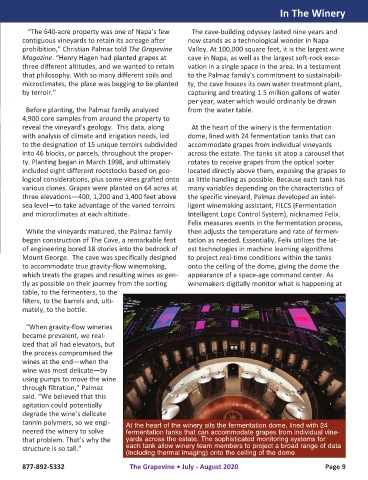
               reveal the vineyard’s geology.  This data, along       At the heart of the winery is the fermentation
               with analysis of climate and irrigation needs, led   dome, lined with 24 fermentation tanks that can
               to the designation of 15 unique terroirs subdivided   accommodate grapes from individual vineyards
               into 46 blocks, or parcels, throughout the proper-   across the estate. The tanks sit atop a carousel that
               ty. Planting began in March 1998, and ultimately     rotates to receive grapes from the optical sorter
               included eight different rootstocks based on geo-    located directly above them, exposing the grapes to
               logical considerations, plus some vines grafted onto  as little handling as possible. Because each tank has
               various clones. Grapes were planted on 64 acres at   many variables depending on the characteristics of
               three elevations—400, 1,200 and 1,400 feet above     the specific vineyard, Palmaz developed an intel-
               sea level—to take advantage of the varied terroirs   ligent winemaking assistant, FILCS (Fermentation
               and microclimates at each altitude.                  Intelligent Logic Control System), nicknamed Felix.
                                                                    Felix measures events in the fermentation process,
                 While the vineyards matured, the Palmaz family     then adjusts the temperature and rate of fermen-
               began construction of The Cave, a remarkable feat    tation as needed. Essentially, Felix utilizes the lat-
               of engineering bored 18 stories into the bedrock of   est technologies in machine learning algorithms
               Mount George.  The cave was specifically designed    to project real-time conditions within the tanks
 Palmaz Vineyards:   to accommodate true gravity-flow winemaking,   onto the ceiling of the dome, giving the dome the
                                                                    appearance of a space-age command center. As
               which treats the grapes and resulting wines as gen-
                                                                    winemakers digitally monitor what is happening at
               tly as possible on their journey from the sorting
 The Winery of the Future   table, to the fermenters, to the
               filters, to the barrels and, ulti-
               mately, to the bottle.
  By: Nan McCreary     “When gravity-flow wineries

               became prevalent, we real-
               ized that all had elevators, but
               the process compromised the
               wines at the end—when the
               wine was most delicate—by
               using pumps to move the wine
               through filtration,” Palmaz
               said. “We believed that this
               agitation could potentially
               degrade the wine’s delicate
               tannin polymers, so we engi-     At the heart of the winery sits the fermentation dome, lined with 24
               neered the winery to solve       fermentation tanks that can accommodate grapes from individual vine-
               that problem. That’s why the     yards across the estate. The sophisticated monitoring systems for
               structure is so tall.”           each tank allow winery team members to project a broad range of data
                                                (including thermal imaging) onto the ceiling of the dome.
               877-892-5332                      The Grapevine • July - August 2020                              Page 9


          Grapevine Main Pages GV070820_Layout 1-1 .indd   9                                                        6/18/20   4:47 PM

