


Page 13 - Grapevine July-Aug 2020
P. 13
In The Winery


               ting produced faster than I
               could find a place to store it.”


                 Before Veeam, Palmaz was
               storing all of its information on
               the cloud. The cost was high,
               and the data was unorganized
               and difficult to access. With
               Veeam, data is arranged in a
               chronological format.  Some
               data— the more important
               data that needs to be readily
               accessible—is stored on site.
               The rest resides in the cloud.


                 Today, while founders Julio
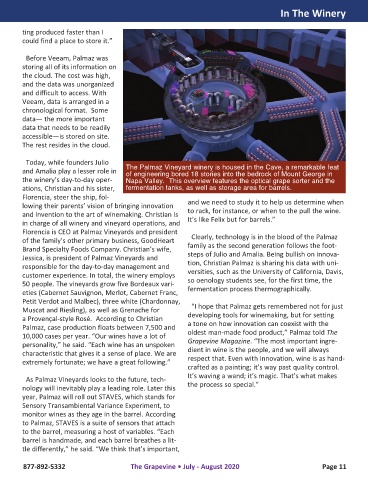
               and Amalia play a lesser role in   The Palmaz Vineyard winery is housed in the Cave, a remarkable feat
                                                of engineering bored 18 stories into the bedrock of Mount George in
               the winery’s day-to-day oper-    Napa Valley.  This overview features the optical grape sorter and the
               ations, Christian and his sister,   fermentation tanks, as well as storage area for barrels.
               Florencia, steer the ship, fol-
               lowing their parents’ vision of bringing innovation   and we need to study it to help us determine when
               and invention to the art of winemaking. Christian is   to rack, for instance, or when to the pull the wine.
               in charge of all winery and vineyard operations, and   It’s like Felix but for barrels.”
               Florencia is CEO at Palmaz Vineyards and president
               of the family’s other primary business, GoodHeart      Clearly, technology is in the blood of the Palmaz
               Brand Specialty Foods Company. Christian’s wife,     family as the second generation follows the foot-
               Jessica, is president of Palmaz Vineyards and        steps of Julio and Amalia. Being bullish on innova-
               responsible for the day-to-day management and        tion, Christian Palmaz is sharing his data with uni-
               customer experience. In total, the winery employs    versities, such as the University of California, Davis,
               50 people. The vineyards grow five Bordeaux vari-    so oenology students see, for the first time, the
               eties (Cabernet Sauvignon, Merlot, Cabernet Franc,   fermentation process thermographically.
               Petit Verdot and Malbec), three white (Chardonnay,
               Muscat and Riesling), as well as Grenache for          “I hope that Palmaz gets remembered not for just
               a Provençal-style Rosé.  According to Christian      developing tools for winemaking, but for setting
               Palmaz, case production floats between 7,500 and     a tone on how innovation can coexist with the
                                                                    oldest man-made food product,” Palmaz told The
               10,000 cases per year. “Our wines have a lot of
               personality,” he said. “Each wine has an unspoken    Grapevine Magazine. “The most important ingre-
               characteristic that gives it a sense of place. We are   dient in wine is the people, and we will always
               extremely fortunate; we have a great following.”     respect that. Even with innovation, wine is as hand-
                                                                    crafted as a painting; it’s way past quality control.

                 As Palmaz Vineyards looks to the future, tech-     It’s waving a wand; it’s magic. That’s what makes
               nology will inevitably play a leading role. Later this   the process so special.”
               year, Palmaz will roll out STAVES, which stands for
               Sensory Transambiental Variance Experiment, to
               monitor wines as they age in the barrel. According
               to Palmaz, STAVES is a suite of sensors that attach
               to the barrel, measuring a host of variables. “Each
               barrel is handmade, and each barrel breathes a lit-
               tle differently,” he said. “We think that’s important,

               877-892-5332                       The Grapevine • July - August 2020                            Page 11


          Grapevine Main Pages GV070820_Layout 1-1 .indd   11                                                       6/18/20   4:47 PM

