Don’t “Blow Off” Cybersecurity

person wearing a black jacket

By: Mark Sangster, Vice President and Industry Security Strategist, eSentire

Martin Luther, the famous German theologian and religious reformer, is credited with saying “Beer is made by men, wine by God.” Had he lived another 475 years, he likely would have added that “Cybercrime is made by the Devil.”  And, he wouldn’t have been too far off.

  Cybercrime is insidious: It knows no borders and as we’ve seen, knows no bounds. In fact, a report from Cybersecurity Ventures predicted that the global cost of cybercrime will reach $6 trillion USD this year. According to the 2019 Cost of Cybercrime study by Accenture and the Ponemon Institute, the average cost of cybercrime to a U.S. organization was $13 million — a significant sum. And, a report from my own company eSentire found that cybercriminals netted more than $45 million in the first four months of 2021 alone. But before you start thinking that means cybercriminals only go after the big guys, consider the fact that it’s small and medium-sized businesses (SMB) that are the primary targets for data breaches (Data Breach Investigation Report, Verizon 2020).

  To be sure, there are threat actors that are out to make trouble, whether it’s disrupting critical fuel pipelines or, like the modern-day equivalent of sleeper agents, quietly accessing classified systems to gather top-secret information or cripple it at a later date. However, what most companies encounter comes as the result of unadulterated greed from a run-of-the-mill cyber crook. Just like your average street criminal, these people attack businesses because that’s where the money is. And like it or not, SMBs, such as family-run wineries and vineyards, make for low-hanging fruit. Cyber attacks on the wine, spirits and beer industry have ramped up in the past year including hits on Brown-Forman, E & J Gallo Winery, Molson Coors, and the Campari Group.

The Earth Is Mine. (What About Your Network?)

  On the one hand, it’s a brave new world for the farming and production aspects of winemaking, thanks to automation advances. But on the other hand, a great deal of manual labor is involved, and despite advances, the wine industry is still considered very much old-school, lagging behind other industries when it comes to the use of technology.

  When you consider the production process from grape to glass, some of the greatest risk of cyber exposure lies on the farming side. Growing the perfect grape comes with a lot of moving parts, and like other production businesses, enterprise resource planning (ERP) systems are in place to track a variety of processes, from what pesticide was applied on which date,  to the costs involved, etc. Whereas how these things are tracked will vary from vineyard to vineyard, the common denominator is that in most cases the people interacting with these systems are predominantly field workers who might not be the most tech-savvy. Add to this the fact that many front-line remote systems are loosely managed and run on personal field laptops or mobile devices, and you have an ideal attack vector.

  Regardless of whether you are operating a small, family-run vineyard or have a large-scale wine operation, you face an even greater risk each time you sit down at your desk. The vast majority of cyberattacks begin with malware, typically embedded in an attachment sent with a seemingly innocuous email. Maybe it’s an invoice from a distributor you work with, maybe it’s your bookkeeper asking you to review a document, or maybe it’s a complete stranger, hoping you’ll slip up, open his attachment, and launch a malware script that will encrypt your data until you give in to his demands.

  While unsecured computer systems and mobile devices are common attack vectors, it’s safe to assume that as your operation grows, so too does your attack surface. Now wine operations have barcoded, inventory-tracking devices that are used on a remote workflow in the field. That information is fed into a central ERP system that’s tied to another automation system, and so on throughout the production process, as tank temperatures and acidity levels are monitored. Then, too, consider the controls that regulate humidity levels inside a facility or the transfer of wine from tank to tank. Any and all of these systems can be tampered with and if they are, it can negatively affect the end product and your business.

Data, Decanted

  Outside the confines of your vineyard or winery lie even further risks. Supply chains are attractive targets not just for the information they hold but the damage they can inflict if disrupted. Distributors, especially smaller ones, often track depletions manually and share updates via email. Consider the example of a small warehouse in Kansas City that might have 20 pallets of your wine and little to no security solutions in place and then consider how quickly a threat vector could spread via a spreadsheet attachment.

  On the retail side of wine operations, both on- and off-premise operations, offer up other strike zones. Each of these channels has its own supply and inventory management systems that track activity all the way out to individual shops, bars, and restaurants, which again, may or may not have the strongest security posture.

  Nor can you overlook the direct-to-consumer aspect. Customer relationship management(CRM) systems that are used to manage your wine club or market tasting events hold a wealth of personal information, not to mention credit card numbers. They’re gold mines for those looking to sell that information on the Dark Web for a tidy profit and scarily enough, you might never know you’ve been compromised.

Just Enough Rain to Stress the Vine: A walk in the cloud(s)

  In the face of myriad risk and attack vectors, it’s tempting to take the path of least resistance, and send up a prayer that you’ll be among the lucky ones to not suffer a cyber breach. But in today’s climate, that’s risking a lot more than bottle shock. Companies today, regardless of their size or industry, need to assume that it’s not a matter of if they will be targeted by cyber crime, but when. Depending on your size and budget, running a full-scale Security Operations Center might not be in the cards, but there are steps you should be taking to protect your business today and in the future:

●    Suspicious emails should trigger the same reaction as a wine that’s corked. Avoid it at all costs. Phishing emails are a popular attack vector, and unless you know what to look for (and how), you are putting yourself and your company at risk each and every day. Educate your staff on what to look for and make sure that whatever training they receive is specific to the vineyard/wine industry. People like to think they won’t fall for the “Congratulations! You’re a winner” emails, but are they prepared to investigate those emails from your attorney or best vendor? Additionally, you should ensure that your department systems are segmented, preferably using the principles of Zero Trust. That way, if one person accidentally opens a malicious email, they won’t be granting a hacker access to the whole system.

●    Maintain Security Hygiene: Network systems need to be maintained and cared for just as you would oak barrels. Security  hygiene is a critical component of cybersecurity and at the very least should include:

1.   Regularly patch and update your software You’d be surprised at the number of breaches that could have been avoided simply by keeping software systems patched and up-to-date. It’s estimated that a third of all data breaches come as a result of unpatched vulnerabilities when patches were available. (Looking at you, Equifax).

2.   Two-Factor Authentication Is a MUST . Make sure to implement two-factor authentication around all of your company’s key software applications and systems, providing an additional layer of security. Never, ever reuse passwords across accounts or devices, and if your budget allows, implement solutions that employ a Software Defined Perimeter (SDP) approach. Be aware, however, that while these solutions offer advanced security, because they are more complex they are costlier; plus, there are the added costs associated with hiring staff who have the proper expertise to manage them.

3.   Operate on a need-to-know-basis. In general, it’s a good idea to limit the amount of network access your employees have — compromised accounts can be used to create shadow employee accounts which in turn can be used to move around a network. It’s especially important that top-level executives and owners aren’t given the full set of keys to the kingdom just because they’re the boss. Senior-level employees and owners are prime targets for cybercriminals looking for ways to infiltrate a system and move around with impunity. Someone might ask why your front-desk staff is nosing around a payroll system, but no one will question the boss.

4.   Virtual private networks (VPN) are more than a good idea. They provide secure and encrypted connections between systems (files shares, email servers, etc.) and ensure that your communications can’t be intercepted.

5.   Lock down your operational technology (OT) systems and ensure that they are not left internet-facing.

●   Automation technology is complicated and protecting it, even more so. You can’t assume that everyone further down the supply chain is taking a serious approach to cybersecurity or even knows where to start. It’s incumbent on you to protect your business, so talk to the experts. Be sure to talk with your insurance providers, legal team and other key vendors to ensure you have a plan in place for when the inevitable happens.

Something to Think About

  Too often, companies fail to adequately protect themselves against cybercrime, because they are laboring under a trifecta of misconceptions:

●   “We’re not a bank or even a household brand name so we aren’t a target.” This is a prime example of absolutist thinking and the harm it can cause. To the thief, even the poorest person has something worth stealing.

●   “We could never defend ourselves against massive ransomware gangs and state-sponsored actors so why even try?” When it comes to the average cybercriminal, Thomas Crowne they are not. That said, there’s no reason to stand up when the bullets are flying. By carrying out basic cyber protections you can reduce your risk by up to 80 percent.

●   “We never saw it coming.” In the world of cybersecurity, by the time you see the red flag, it’s too late. Heed the little signs. They won’t all pan out to be cyber attacks, but when things go bump in the cybernight, it usually means there’s a monster there. It just hasn’t struck yet.

  The wine industry has a long and storied history and holds an important place in culture and daily life. From small vineyards to wine conglomerates, there are financial gains to be made for the hacker looking to grow his ill-gotten gains. By following some basic steps, you can ensure that cyber criminals are the only ones claiming sour grapes.

About the Author

  Mark Sangster is vice president and industry security strategist at eSentire. He is the author of No Safe Harbor: The Inside Truth About Cybercrime and How to Protect Your Business. Mark is an award-winning speaker at international conferences and prestigious stages including the Harvard Law School and RSAConference. He has appeared on CNN News Hour to provide expert opinion on international cybercrime issues, and is a go-to subject matter expert for leading publications and media outlets including the Wall Street Journal and Forbes when covering major data breach events.

The Pandemic’s Impact on the Wine & Spirits Industry

man in mask looking at wine section

By: Quinton Jay

The year 2020 was a complicated one for the wine and spirits industry. According to information published in Beverage Industry, the sale of wine at retail and convenience stores grew by some 11.4% in multi-outlet stores throughout the 52 weeks between December 1st, 2019, and November 29th, 2020, and champagne, as well as other sparking wines, saw year-over-year growth by nearly 29%, topping sales at roughly $1.6 billion.

  This boost to wine sales, however, could not fully offset the losses incurred by many other businesses throughout the wine and spirits (WS) industry.

  Fortunately, the U.S. seems to have since turned a corner in the pandemic struggle, and most restaurants and other WS businesses like wineries, distilleries, and breweries (WDBs) that were able to survive the brunt of the COVID-19 pandemic’s impact are now back open and able to serve customers indoors, or at least in some form of hybrid indoor-outdoor seating arrangement. While this return to normalcy should help the WS industry experience an upswing capable of putting business back on track, some industry experts are still analyzing the true depth of impact the pandemic has had on the industry and the businesses in it, regardless of whether those businesses survived the pandemic’s fallout or not.

  One such expert is Quinton Jay, a WS industry expert, Japanese whisky otaku, and industry consultant with more than 20 years of experience in owning, building, operating, and investing in businesses–specifically those in the wine and beverage industry. We recently sat down with Quinton to learn more about the trends he saw arise within the WS industry throughout the events of last year’s pandemic, how those trends impacted the WS industry as a whole, and where he sees the industry heading over the next few years as a result.

WS Trends Resulting From COVID-19

  According to Jay, one of the most widespread trends that impacted the WS industry as a result of the pandemic was the increase in the amount of WS businesses – including WDBs – that began offering e-commerce and Omnichannel retail marketing. By offering these channels, businesses across the entire WS industry were able to continue selling products directly to consumers (D2C), saving many businesses from having to shut their doors to customers – both online and offline – for good.

  “Methods like Omnichannel retail allowed businesses in the industry to continue selling products D2C,” Jay tells us. “For many businesses, especially WDBs, this was the difference between surviving the pandemic or not.”

  Along with the growing trend of Omnichannel retail marketing, many business owners in the WS industry have experienced what Jay refers to as “business fatigue.” This feeling of fatigue is one that many business owners who experienced the pandemic can sympathize with, but for the WS industry specifically, it could mean more owners of WDBs, restaurants, eateries, or other businesses preparing for financial exits from their ventures.

  “Business fatigue is a real thing,” Jay tells us, “and rather than simply close up shop and call it a day, the better option for business owners is to sell their company to someone willing to acquire, rebrand, and revitalize it.” This trend of business fatigue, according to Jay, could hint at other ways as to how the pandemic left a lasting impact on the industry.

The Lasting Impact of COVID-19 on the WS Industry

  In describing the ways that Omnichannel retail marketing has affected the WS industry in recent years, Jay also mentions the historical lack of innovation – particularly technological innovation – within the industry. In mentioning this, it begs the question as to just how innovation, both during the pandemic and immediately following it, will evolve both for businesses and consumers.

  “Many WDBs and other businesses in this industry aren’t necessarily at the forefront of innovation, especially when it comes to growing their market share,” Jay says. However, as Jay continues to explain it, the writing is literally on the wall for the continued growth of Omnichannel retail, given the industry’s historical customer demographics, current and emerging technologies, as well as the ever-evolving nature and growing competitiveness of the WS industry’s supply chains.

  “The U.S. has been lagging behind much of the world in Omnichannel retail offerings, obtaining less than 10% of all global e-commerce sales for the WS industry compared to China’s roughly 25% share,” says Jay.

  In these matters, Jay’s predictions may not be far off from aggregated industry data. For instance, according to McKinsey’s 2021 Consumer Report, e-commerce sales in the U.S. were projected in 2019 to reach 24% of all retail sales by 2024. This projection later increased to 33% by June of 2020 after the onset of the COVID-19 pandemic, seeing larger growth in e-commerce retail across the U.S. in six months than it had over the past 10 years.

  “As we continue to emerge from the pandemic,” Jay continues, “I expect many more businesses in the WS industry – especially WDBs – will begin offering or broaden their offerings regarding Omnichannel retail as more American consumers opt for D2C retail channels.”

What’s Next for the WS Industry

  As a result of the COVID-19 pandemic, every global industry was forced to evolve virtually overnight. The WS industry was no different. Along with broader implementations of Omnichannel and D2C retail methods and deeper technological innovations, Jay tells us that he also expects many businesses in the industry to rethink the way they operate internally and interact with customers on all levels.

  “Overall, I think the pandemic has left many business owners in this industry feeling defeated,” Jay says. “As a result, we can expect to see an increasing number of companies in this industry become more creative in the ways they can target, reach, and sell their products to consumers, as well as become more innovative in the ways that they handle and react to crisis situations.”

  Indeed, the revitalization of crisis management detail is one vital aspect that every business that survived the pandemic will inevitably have to revisit. For the WS industry in particular, this could mean the addition or inclusion of additional D2C sales channels (similar to the inclusion of Omnichannel retail), but also the way that many establishments in the industry hire and retain talented employees.

  “The U.S. has been experiencing a hiring crisis over the last few months,” Jay adds, “and tons of restaurants, eateries, WDBs, and other businesses that survived the pandemic initially are now struggling to keep up with increased consumer demand as the threat of COVID-19 wanes. By implementing policies that promote employee safety and wellness, offering more competitive wages, and remaining adaptable enough to stay ahead of society’s ever-changing curve, the industry as a whole can prevent the detrimental effects that came as a result of last year’s pandemic from having such a deep and lasting impact in the future.”

How to Succeed in WS Post-Covid

  As Jay mentions, there are a number of precautionary methods and strategies that business owners and managers, and other industry professionals in WS can use to better protect their businesses from suffering in ways similar to how they may have during the onset of the COVID-19 pandemic.

  “The first step every business in the WS industry should take is to implement more actionable mea

sures in planning their business strategy,” Jay says. “Start by taking a look at what types and quantities of grapes you have coming in, what bulk wine you have in the tank, your total count of bottled finished goods, and become intimately familiar with your sales run rate: if you know those 4 things, you can plan out your business very well and forecast what your business should be focusing on acquiring in order to avoid jamming up your supply chain.”

  For example, if your winery business finds that its sale run rate has slowed down, perhaps the winery needs to look at selling its bulk wine (wine in barrel or tank), or perhaps can temporarily focus on committing fewer grapes for an upcoming vintage. However, once any particular wine has been bottled, that’s it, which is why Jay says to avoid bottling your inventory until you know what your sales run rate is and how it directly impacts your business. While selling out of a certain inventory item can sometimes be a boon for your business, not selling enough can cause inventories to back up, alerting you that your business will need to discount other items and sell that portion of your inventory faster in order to get back into balance.

  A second method WS businesses should consider, according to Jay, is to revisit and revitalize their plan regarding capital management, or the funding of their business initiatives as they pertain to the needs of a business’s financing or cash flow.

  “Most business owners and professionals in the industry want their business to grow,” Jay adds, “but don’t realize how much money they need, especially regarding the lead time required for fine wines and of many products in the industry as a whole, especially aged beverage products.”

  Indeed, as Jay explains, it can often take one year for most white wines and Pinots to be made and bottled, as well as 2-3 years on average for wines like high-end cabernets. Most red wines can take anywhere between 12-30 months to properly process in-barrel and add to their in-bottle age time from Grape to Bottle. This, of course, takes cash, which is why planning your capital budget is just as important as your sales plan.

  By carefully considering these crucial factors to any business in the industry, Jay explains that they can be better positioned to survive in the face of the next inevitable threat the industry will face in the years to come.

Trends in Wine Packaging

Follow Consumer Awareness, Expected Use & Material Availability

beer beverage in a grocery stall

By: Gerald Dlubala

Statistics prove that a well-designed, eye-catching package can set the tone for consumers’ perception of a product’s quality and desirability. But with all the different wine packaging options available, how do you know which is the right one for your wine? Demographics and the corresponding lifestyle can heavily influence your packaging choices. By recognizing your preferred market segment, you can choose the most appropriate product packaging to enhance shelf presence and heighten your product’s perceived quality and desirability.

  Glass remains the overall preferred choice because of its ability to hold the wine’s intended sensory applications better than the alternatives, sometimes up to twice as long when compared to plastic options. In addition, glass can be molded into endless eye-catching, distinctive shapes and sizes, making it accommodating for different uses down to single-serve glass bottles, presenting a modern premium feel and look. Alternative and more innovative designs might feature Stelvin, or cork finishes on the bottle.

  Single-serve wine packaging has grown due to the pandemic and continues, including single-serve cups and goblets, plastic bottles, cartons, aluminum cans and anything else that offers convenience and transportability.

  Cork for use as a closure remains strong due to being an original and traditional choice, now enhanced by improved and more cost-effective technical corks. Aluminum screw caps and plastic dispensing closures on some current packaging present the opportunity for resealing and recycling.

  Ultimately, containers and bottles that are aesthetically appealing and fit a consumer’s lifestyle are the products that will cause them to stop, take notice and pick up the package. Consistency in using that same packaging will build consumer loyalty and recognition of your products in the future.

Using Packaging Options to Appeal to the Consumer

  Alcoholic beverages rely on packaging to maintain the integrity of the content’s chemical composition. For example, packaged wine must maintain the intended aroma, flavor and appeal. Glass keeps the chemical composition intact and has no chance of reacting with the alcohol. Additionally, colored glass adds a layer of protection against changes due to light exposure.

  “Glass goes as does the economy,” said Bradley Tucker, Vice President of Sales for Encore Glass. “When the economy gets tight, companies look to cut costs. Unfortunately, it’s common for packaging to take the hit, whether switching to lightweight bottles, choosing more cost-effective labels, or changing shipping methods. Our shippers remain popular because they are cost-effective, lightweight and stackable, made from 99% recyclable materials, and are themselves 100% recyclable and biodegradable. We also distribute custom printed boxes, decorated bottles and custom molds to meet specific customer needs.”

  Tucker said that all current packaging options have their place and purpose. Still, he believes glass will always be the preferred choice, especially when bottling premium wines. “Glass provides an extended shelf life, providing a premium touch and visual aesthetic without changing the taste, aroma or overall quality of the wine inside. We see increased use in the smaller 375 ml bottles. And the smaller, single-serve bottles are another way to appeal to customers who love wine but drink it only occasionally or want to avoid waste. Honestly, the bigger issue in packaging right now is supply. Like everything else right now, supply channels are difficult to maneuver. It’s a constant battle just trying to get the amount of glass needed, and it’s not going to get better anytime soon. Again, it’s a global issue. Orders that used to be ready in three weeks might now take six to nine months, so some winemakers are just going with what they can obtain.”

  When asked if the glass shortage may be driving some producers to choose aluminum packaging, Tucker told The Grapevine Magazine that it might be accurate, but aluminum distributors are going through the same supply difficulties as everyone else.

  “The most important thing to do is choose a packaging supplier that also can provide a type of supply insurance. Encore Glass fulfills your order by offering great selections of glass bottles, expert preparation, and a commitment to get your bottles to you when you need them.”

Aluminum Brings Versatility into Focus

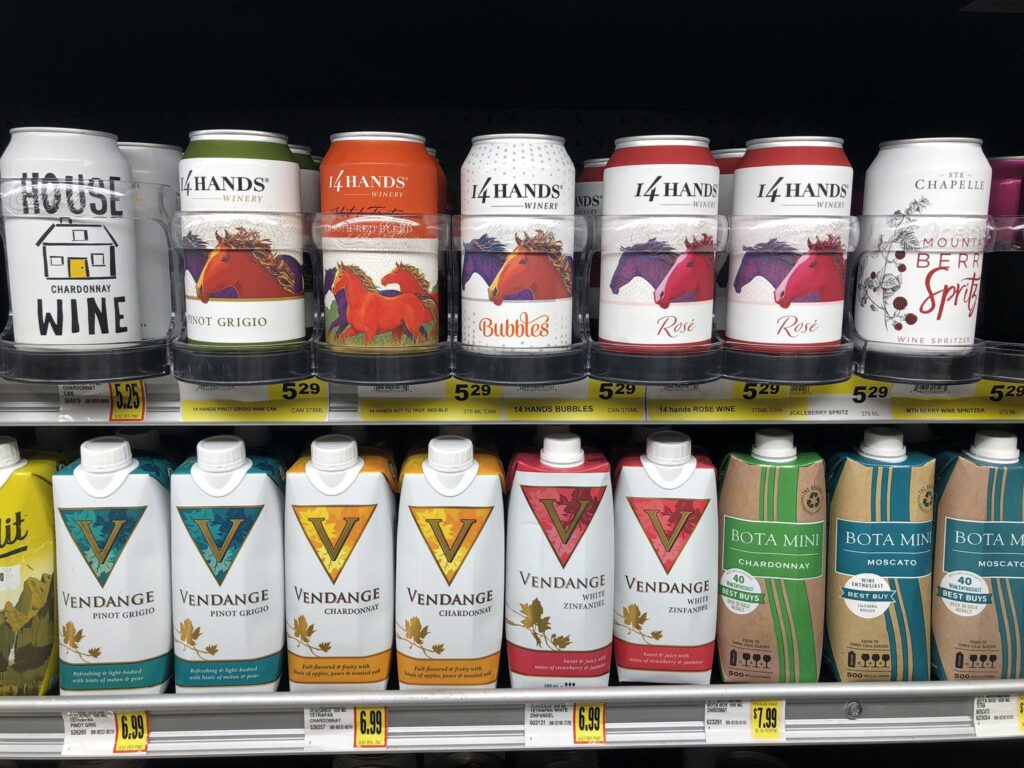
  Like glass, aluminum is a solid and cost-effective choice for overall packaging effectiveness and performance, but similar difficulty in sourcing can be an issue. Aluminum offers convenience, recyclability, maximum portability and, in some cases, the ability to be resealed. Canned wines gained popularity and broader acceptance during the pandemic and continue to be favored by following the successful methods pioneered by canned cocktails and seltzers. Aluminum is easy to handle and customize with uniquely designed sleeves for shelf appeal and is perfect for occasions where glass containers are not allowed or practical. In addition, aluminum packaging is much lighter to ship and can ultimately help cut price points on wine.

Polyethylene Terephthalate and Plastic Find a Niche

  The pandemic brought on the idea that consumers would more frequently look to purchase and drink wine at home. To support this, wine companies looked to offer minimal contact accessibility, and plastic provided a solution.

  Garcon Wines acted on that new dynamic, finding that traditional bottles used in the wine industry no longer fit the dynamics of how and why most wine is purchased and consumed. With the growing belief that the existing carbon footprint of wine is unsustainable, they developed a 100% recyclable, 750 ml, flat Polyethylene Terephthalate wine bottle. It is designed to fit through mail slots and is manufactured from 100% food-grade, post-consumer recycled PET, saving energy and weight.

  When compared to the traditional glass bottles, they are 87% lighter and 40% smaller spatially. The flat bottles are a little taller than standard bottles and are stackable to save space. The taller profile helps them stand out and be a little more noticeable on a retail shelf. They pack tightly into shipping cartons without additional packaging, better utilizing the space on a standard pallet. Fewer deliveries are needed, and with more efficient loading and unloading times, the savings add up.

  However, under 30% of PET containers are recycled in the United States, so good intentions aren’t producing the proposed results. In 2023, Bacardi will begin using novel plastic for their containers that use seed oil rather than crude oil. The biopolymer bottles are made by fermenting canola and other seed oils that biodegrade within 18 months in any environment containing microorganisms, including compost bins and fresh or saltwater.

Alternative, Sustainable and Eco-conscious are Trending

  Packaging trends are moving towards more eco-friendly and sustainable options, thanks to shifting consumer ideology. Winemakers have found that the key to storing their wines in alternative containers is providing a tight seal. Among these options, boxed wines have been the most popular and recognizable, opening up new possibilities of how and where wine is consumed. Although it’s still a small segment compared to other packaging choices, bag-in-box wines are attractive to those who shop less and want to enjoy an occasional glass of wine at home without worrying about spoilage and waste. The inner pouch removes the need for glass, and the box shape makes them easy to store, transport and use without the chance of breakage. Additionally, they can offer a better price point, modern look and shelf appeal to consumers looking for more thoughtful, eco-friendly and sustainable options.

  With the pandemic driving consumers to drink differently and more often, boxed wine allows them that opportunity, staying fresh for six weeks after breaking the seal. Consumers continue to value convenient and lifestyle-friendly products—boxed wine answers that demand with a 2.25-liter box that perfectly fits a refrigerator shelf, saving space and offering on-demand accessibility.

Bag-in-a-bottle: a Paper Bottle

  Bag-in-a-bottle is an option for consumers who want all of those eco-friendly benefits but still yearn for the traditional bottle. Like the bag-in-box, the outer container is recyclable paperboard fused with water-based glue and molded with heat and moisture into a more conventional wine bottle shape. It is five times lighter than glass and is resistant to spillage, humidity and breakage, with a 12-month shelf life. Proponents believe a time will come where the paper bottle molding unit would be available for use on-site or near the winery for on-demand bottling. Five times more paperboard blanks than rigid bottles can ship at once wherever needed to be assembled and filled.

Return and Reuse: the Good Old Days

  Because only a little over 30% of glass wine bottles get recycled in the U.S., some distributors want to revisit the bottle deposit and return practice for use with wine bottles. The idea is that each glass wine bottle could be reused up to 10 times, allowing the consumer to experience the traditional and romantic experience of wine in a glass bottle while being eco-conscious. In addition, this practice hopes to appeal to those that still want to please those guests that are not comfortable with bag-in-box or canned wines. This business model would issue digital credits to distributors for returned bottles and help the winemaker build loyalty, communication and marketing contacts with participating distributors. The plan is to have the returnable program in thousands of venues, natural wine shops and participating big box stores in 2022, as a three-month pilot program in New York saw an 88% success rate.

  “Encore Glass started their business by sterilizing and recycling glass wine bottles to have an encore use, but with all of the current bottle shapes, sizes and custom structures, it would be nearly impossible to continue on a broad scale,” said Tucker. “I would have doubts about the feasibility of the program, including the willingness of consumers to continue long-term participation.”

Match Packaging to Consumer Awareness

  Creative packaging has always been one of the best and most effective ways to help a brand get noticed in a crowded market. But consumer awareness of a winemaker’s story combined with convenient options in packaging has never been more vital. Over half of consumers are committed to buying from sustainable brands when possible, and they are searching for more responsible behavior from the vineyard through the retail channels. Matching these behaviors with responsible packaging will help winemakers successfully differentiate their products and fuel their brand’s growth in today’s market.

Dutcher Crossing: An Idyllic Slice of Heaven

winery in front of a wine trail

By: Nan McCreary

Every now and then, when traveling the wine trail, one comes across a true hidden gem, one of those wineries that have it all: beautiful wine country views, award-winning wines and warm hospitality that beckon the visitor to return again and again.

  One such destination is Dutcher Crossing, a charming winery that sits in the picturesque hills of Dry Creek Valley at the crossing of two creeks, Dry Creek and Dutcher Creek, in Sonoma County. Sitting in their classic 1900s style farmhouse tasting room, one feels transported to another world, where fellow wine lovers—and dog lovers—gather to enjoy the views, the wines and the camaraderie, not to mention the attention of the staff’s dogs who “officially” greet visitors.

  This little piece of wine heaven belongs to Debra Mathy, who purchased the property in 2007. At the time, the operation included 35 acres and made five wines. Today, under Mathy’s leadership and creative vision, Dutcher Crossing offers 30 wines from various premier vineyards in Sonoma, Napa and Mendocino counties and owns 75 acres of estate-designated vineyards. Production averages 12,000 cases per year.

  Mathy’s story is as revealing of her character as her winery. Growing up in Wisconsin, she knew she did not want to follow in her family’s footsteps in the construction and timber industries. Instead, she sealed her destiny with a high school trip to France. “To be honest, the only reason I studied French was so I could go to France,” Mathy told The Grapevine Magazine. “While I was there, I fell in love with wine. Until then, I knew nothing about it. I’d never seen vineyards, and I’d never seen people drinking wines.  It had never occurred to me that people could make a living in that field. It was an ‘a-ha’ moment. I came home, and I told my dad I wanted to get into the wine industry.”

  She put that dream on hold while pursuing an education, but years later, when her dad was facing stage IV cancer, he encouraged her to revisit her goals. “He said, ‘life’s too short,’ and if I still wanted to open a winery, we could do it together in the time he had left.” 

  So, the journey began and, with the help of consultants, Mathy discovered Dutcher Crossing.  The winery wasn’t for sale, but she recognized it as a perfect fit.  “I liked the sense of family and the quality of the wines,” she said.  “The winery had a nice foundation—it wasn’t showy—and it would give me a good base to build on, wherever I decided to go. The confluence on Dry Creek and Dutcher Creek gave the winery a sense of place too, which was really important to me.” 

While the owners had bought the winery with plans to sell eventually, Mathy convinced them that they should sell now and that she was the right person to buy it. “They didn’t want to sell to the corporate world,” she said. “They wanted it to be in great hands and ended up turning it over earlier than planned.”

  New to the industry—this kid from Wisconsin who had transplanted herself to California—Mathy faced the challenges of not only being an outsider but of being the first single female winery owner in Sonoma County. “I had to prove that I was serious about this, that it was not just a hobby,” Mathy said. “I got active in the community, developed relationships and learned everything I could from others. I also surrounded myself with great people. I come from a family where we know that it takes a lot to succeed, but if you have good people around you, your chances of success are much better. On the path upward, we win as a team, and we lose as a team. It’s been a nice journey.”

  At the beginning of this journey, Mathy retained the winemaker and staff from the previous owner and hired winemaker Nick Briggs to take over the reins eventually. “We wanted to diversify and make great wine, so, in addition to growing our own fruit, we searched for the best grapes we could find to expand our portfolio,” Mathy said. “Fortunately, we were able to find premium winemakers who would give us a shot, but we had to prove ourselves first.” 

  And prove herself she has. Today, Mathy is recognized as a pillar in the community, offers a stunning array of award-winning wines and has established a loyal wine club, selling out of her wines every year. She said, “Our path has been to create a well-balanced, three-legged stool: making the best wine by staying true to the vineyard, vintage and varietal; preserving a beautiful sense of place in our vineyards and winery; and offering a level of hospitality that allows visitors to feel like they are part of our family. Not everyone has that balance in their business. We’re fortunate that all who work with us buy into this philosophy and take pride in it.”

  Under Mathy’s careful guidance—and that of winemaker Briggs—Dutcher Crossing farms premium fruit from four vineyards on 75 acres. Grape varieties include Chardonnay, Semillon, Roussanne, Viognier, Riesling, Grenache, Mourvedre Syrah, Cinsault, Petit Syrah, Zinfandel, Cabernet Sauvignon, Cabernet Franc, Malbec and Muscat. The winery doesn’t use all the grapes for its own production but sells some of its fruit to other wineries. With fires, droughts and other whims of Mother Nature, farming is always a challenge, according to Briggs, who oversees the viticulture program.

  “Farming is dynamic—it’s different every year,” he said. “You have to have experience and pay attention to what’s going on, whether that involves taking petiole samples to check for nutrients, watching how the vines are growing or, once there’s fruit, making judgments about the balance of the crop.”

  Dutcher Crossing farms sustainably to ensure that the land will stay healthy for years to come.  “It’s important to us to preserve the land for the next generations,” Briggs said. “We know that vineyards can be successful for hundreds of years, as long as you apply sustainable principles of integrated pest management, nourishing soils and healthy vines.”

  In the winery, Briggs is a big advocate of blending. “We don’t always take the fast and easy approach in fermentation. Rather, we make small batches and see how they come out, then blend them later. Blending is the most artistic part of winemaking. To find the perfect wine, you just keep blending and blending until you end up where you want to be.” 

  With minimal intervention, Briggs strives to coax as much out of the fruit as he can. His goal is well-balanced wines with aromatics, fruit flavors and acidity that all carry forward to a lasting finish. “We take great pride in producing drinkable wines on release,” he told The Grapevine Magazine. “When we offer tastings, our visitors enjoy all of our wines, not just one or two.  That’s quite an accomplishment.”

  When not in the winery, the vineyards or greeting customers in the tasting room, Mathy and her staff are active members of the community. Mathy, for example, has been involved with the Boys and Girls Club for a dozen years and has served on boards that help various children’s causes. The winery also donates proceeds to melanoma cancer research in honor of Mathy’s late father. During the recent fires, Mathy’s staff of 20-plus people took it upon themselves to cook for firefighters and help find homes for displaced people.

  “When people ask me what the greatest thing is about being a winery owner, I tell them it’s watching my staff grow and mature to become better professionals and better leaders,” she said. This is where the excitement is for me right now.” 

Mathy has established a dynamic where all of the staff members consider themselves part of a family. “When the fires break out, we call each other first and say, ‘Hey, I need help,’ and no one says ‘I can’t.’ It’s always ‘Come, we’ll figure it out.’”

Unfortunately, Dutcher Crossing lost 98% of its crop to smoke taint in last year’s fires. “It was awful,”

  Mathy said.  “But when I look back, I see that the community grew together, and the relationships we had built also grew. And it could have been worse. If the firefighters had not done their job, it would have been catastrophic.”

  As Dutcher Crossing looks to the future, the team is considering options for diversifying by creating more wine brands or finding opportunities for grape-growing in Oregon and Washington State. But what’s primarily on everyone’s mind are the unknowns: those that come with fires, smoke damage and climate change. One challenge Mathy and Briggs face, for example, is how to balance cover crops that provide nutrients to the soil but also add fuel to the fires. “We may have to make strategic changes in the vineyards,” she said, “and will face some hard choices in the next five or six years. But primarily, we want to be good stewards of the land so that when we leave, the property will be better than it was when we found it.”

  Whatever direction Mathy and her team decide to go, you can be sure that the winery will remain a favorite go-to destination as long as she is in the picture. “It’s a beautiful, old farmhouse, and it’s very quaint in the way it’s oriented,” Mathy said. “When you walk through the breezeway, you see the beautiful hills of Dry Creek Valley. It’s so cozy, so comfortable, that you just leave your worries behind.”

  If that view isn’t enough, when the tasting room is open, you can relax by the stone fireplace, constructed of old railroad pieces, and admire the 1892 penny-farthing bicycle that sits nearby.  The bicycle is the last Christmas gift Mathy received from her late father. It also features on the Dutcher Crossing wine labels as a tribute to their wine journey together, a journey that made a dream come true for a young girl from Wisconsin.

For more information on Dutcher Crossing, visit www.dutchercrossingwinery.com

Sweet Vines of Tennessee

barn in front of the Smoky Mountains
A barn at Tsali Notch Vineyards in front of the Smoky Mountains in Madisonville, Tennessee.

By: Hanifa Sekandi

When most people think about Tennessee, they think about whiskey. There is no disagreement that people are talking about the best bourbon in town or the best whiskey they ever had. The dispute of who makes it better can last hours. But what about wine? Does viticulture have a place among the crown spirit of the south and the best whiskey? It seems it does, and it is just as good as your taste buds can imagine. There is more to southern wine than strawberry wine, and for North American wine enthusiasts supporting local and imbibing in something homegrown is a palate-pleasing dalliance.

Viticulture in the South

  In comparison to other wine regions across the world, winemaking in Tennessee is in its infancy.    The lineage does not run deep and is not riddled with the same political turmoil and unpredictable weather fluctuations that one would find in South Africa or Germany. There is no sad story to tell. Perhaps a few good stories about hidden wine that bootleggers used to sell during Prohibi-tion. Wine, just like the music in this state, is the birth of something new. It becomes something you never stop hearing about when done right and given a little patience.

  Tennessee winemaking is a new, lucrative frontier, thanks to settlers from Europe who migrated to the region in the mid 19th century and brought their winemaking skills. During this time, it was a burgeoning wine industry with only approximately 1,128 acres of grapes planted, but it proved to be quite lucrative. A yield of over 64,000 gallons of wine was valued at $90,000. If you consider currency during this period, a golden price tag and limited supply marked these Tennessee wines a rare Southern find.

  Although a promising beginning saw wines made in this Southern region as a possible competitor of those produced in California, this potential Napa Valley of the south experienced slow growth due to the impediment of the 18th Amendment to the U.S. Constitution, establishing total alcohol prohibition throughout the nation. Even when Prohibition ended 13 years later with the 21st Amendment, a hold on wine production in the region lasted more than 50 years. This hold meant that Tennessee winemakers who entered an already booming wine industry were decades away from gaining recognition among wine connoisseurs.

  With the changing times of the 1970s, when archaic production laws were finally put to bed, wine cultivation in Tennessee experienced its freedom and led to the slowly growing industry now seen today. The West Tennessee Experiment Station, the Plateau Experiment Station and Middle Tennessee Station spearheaded research on grapes and how to best cultivate them in the region. This endeavor in the mid-1970s opened the door for establishing vineyards and creating signature Tennessee wine blends. By the end of that decade, Tennessee had 125 acres of planted grapes.

Easing Into Ripe Times

  It has been a slow start for Tennessee winemakers, simply because it was not until 1980 that grape cultivation licensing to produce wine for sale was available in the state. Forty years in an industry with a long, diverse lineage allows Southern winemakers to see what has been done be-fore, make it better and add their own flair to stand out amongst the best. With that said, it also puts them a step behind since making a name for their brand and enticing local and international acclaim is not easy, as winemakers around the world know. For a wine to truly become a mem-ber of the elite, it must be something special.

  What winemakers have done for centuries is work with what they have. Whether it be the scarci-ty of materials or challenging terrains, they made it work. Even with small but mighty vineyards, the Tennessean winemaker’s hard work is apparent. Wineries span the state from east to west, and to date, there are approximately 40 wineries. The wine produced here ranges from a smooth Merlot, rich flavored Cabernet Sauvignon and refreshing Chardonnay to popular signature homegrown blends Muscadine, Traminette, Catawba and Chambourcin. Muscadine is a well-known wine made from the oldest grapevine planted in the U.S., and its grapes are also used to make jams and jelly.

Tennessee Wineries  — a Southern Blend

Highland Manor Winery

  If you are going to Tennessee to experience Southern-made wine, you must start at the first li-censed winery in this wine region, Highland Manor Winery, near Jamestown. The array of wine produced at this winery is due to the variation in microclimates and nutrient-dense soils that al-low vines to grow with ease. It is family-owned by Rhonda and Frederick Moody, who acquired it from Frederick’s aunt and uncle Gertie and Butch Campbell, who devoted a fortuitous 17 years to this historic vineyard.

  For a mid sized winery that has only been running for 40 years, there is a vast selection of wines to enjoy. Their best seller, Muscadine, is made from the white Muscadine grape grown through-out Southern vineyards. Another unique sweet blend is the Cab Berry, a beautiful marriage of red wine and blackberry wine. It is also worth mentioning the combination of flavor profiles found in each signature wine. For example, the Southern Blush, a dessert wine, is delicately infused with peach. The wines produced at this winery imbue a relaxed sophistication that complements the easy going Southern sensibility.

Grinders Switch Winery

  Sometimes a hobby can become more than you could have imagined. Grinders Switch owners Gail and Joey Chesser describe their decade long success at their 7 acre vineyard as “a hobby out of control.” The winery is located in Hickman County in middle Tennessee, a quaint and serene countryside. The winery holds up to 15,000 gallons of wine. If you cannot make it out to the country, the Chesser’s opened up a location in Marathon Village amongst all the live music in downtown Nashville. Here you can enjoy wine in between a few live shows while exploring this vibrant city.

  Aged for three years in an oak barrel, their 2015 Sintra, a silky sweet ruby wine with notes of smokey caramel, will have you singing high notes. The 2020 Vidal Blanc is a citrusy dry white wine with notes of tangerine and grapefruit. It is an excellent accompaniment for fresh caught grilled fish. Grinder’s Switch also makes a Muscadine called General I.

Arrington Vineyards

  If you are looking for the Napa Valley experience with a sophisticated yet laidback Southern flair, make your way to Arrington Vineyards, a winery with expertly crafted, award-winning wines. This middle Tennessee winery, owned by country music icon Kix Brooks, entrepreneur John Russell and pro-vintner Kip Summer, opened in the summer of 2007. The winery merges two different properties: a 25 acre hog farm bought by Summer and adjoining vineyards purchased by Brooks. Russell’s addition in 2008 allowed for larger distribution via the Lipman Brothers.

  Appreciating a glass of their award winning 2004 Syrah vintage while taking in the breathtaking views and listening to music at the Music in the Vines venue sounds like the perfect way to es-cape from your worries. Add that missing spark with one of their refreshing sparkling wines, Sparkle, a light fruit-infused dry white wine with floral aromas. The 2020 Chardonnay aged with French oak provides a perfect balance for those who like a buttery vanilla oak texture and finish along with a bright and sweet burst of flavor. Lastly, if you can get your hands on a bottle of their 2020 Honeysuckle, a dessert wine that is a blend of Riesling and Gewurztraminer grapes, be sure to pair it with lemon pound cake.

Symposium Reveals Novel Uses for Precision Viticulture

man operating a drone over a vineyard

By: Annie Klodd, University of Minnesota Extension 

What role do you see precision agriculture playing in the world of viticulture, and how do we get over the growing pains to make it a reality? These were the key questions addressed during a recent Precision Viticulture Symposium co-hosted by the American Society of Enology and Viticulture and the National Grape Research Alliance


For many grape growers, precision agriculture may be a totally new concept, while others have been using it, knowingly or unknowingly, for a while. It is an ever-growing field of technology where growers map data across their fields to manage crops more profitably and efficiently. Think soil moisture, plant vigor, pests, and soil nutrient content. 

  According to Rob Bramley, symposium speaker and a Senior Scientist at CSIRO in Australia, precision agriculture is built on the principle that land is variable. If a variable landscape is all managed the same, some areas will be profitable and others will operate at a loss.  

Concord Vineyard Data Layers

  So instead of managing an entire vineyard the same way, what if a grape grower could cater their management to the needs of each part of the vineyard? This is called “precision viticulture (PV).”  

  For example, a trained grower or advisor can create a vineyard map showing spatial variation in vine health, identifying low-performing areas that need extra attention and cutting costs on areas that need less help. 

  Simple maps can be created by plotting data that the grower collects on the ground, like from soil samples. In more advanced applications, maps incorporate data collected by satellites, drones, or sensors mounted to tractors and harvesters. 

  Research on PV has come a long way since the first juice grape yield maps of the 1990s. Still, it has a long way to go. Grape growers are just now starting to adopt precision agriculture, which is already widely used in row crops like corn and soy.    The symposium speakers expressed that as the research advances, PV should become increasingly accessible to the average grape grower. To dig into how this might look, let’s start with some of the most promising applications of PV: 

How is Precision Viticulture Being Used Today? 

  Today, researchers, consultants and farmers use app-based mapping software to create maps of important crop traits like soil qualities, yield, pest pressure, and plant health. Here are seven emerging or “future” applications that the symposium speakers highlighted for vineyards specifically: 

  Vine Vigor: Mapping vine vigor is one of the more basic uses of PV but does require access to drone or satellite imagery. Several companies offer drone and satellite imagery services for the ag sector.  

  Growers can use vine vigor maps to identify problem areas and improve canopy management.  

  Variable Rate Fertilizer & Pesticides: I have yet to meet a grape grower who thoroughly enjoys spraying. Growers could use nutrient and pest maps to apply only what is needed, and to vary what is applied across the vineyard based on need. This could be achieved by mapping vine vigor, soil qualities, foliar nutrient concentrations, and weed populations, among other things.  

  Mapping soil and foliar nutrient data is one application I would recommend for growers who want to dip their toes into PV – it is relatively easy to collect that data, and many of us do already. I talk later about app-based platforms you can use to plot data. 

  Early Pest Detection: Dr. Katie Gold, Assistant Professor of Grape Pathology at Cornell University, is using hyperspectral imaging to detect locations of key pests early so growers can target them more efficiently and effectively. 

  Dr. Gold leads a study that uses NASA’s AVIRIS satellite imagery to detect early signs of grapevine leafroll virus in California vineyards. She hopes this technology becomes accessible to growers and aims to expand it to other grape diseases like powdery mildew. 

  Precision Irrigation: Vinay Pagay and Bruno Tisseyre both discussed exciting research on precision irrigation. That is, mapping vine water status across the vineyard to apply irrigation by zones rather than applying the same amount of water everywhere. Pagay’s group is researching the use of crop water status index and drone-mounted NDVI sensors for this purpose. 

  Estimating Yield: Mason Earles and Jaco Fourie both spoke about ongoing research on image-based yield estimation. They are deploying sensors through the vineyard to capture images of clusters, to estimate fruit density throughout the vineyard and create yield estimation maps.  

  If the researchers are able to train the sensors to accurately recognize clusters and cluster size, this could enable more efficient yield estimation for larger vineyards where yield estimation by human crews is too time consuming. 

  Split Picking: Bramley described one intriguing use of PV, for “split picking.” That is, pricing fruit based on quality in particular areas of the vineyard. By mapping differences in fruit quality, anthocyanins, malic acid, and YAN across the vineyard, growers could identify their highest quality blocks and sell that fruit at premium prices. This is not currently a common practice. 

  Bramley argued that California wineries grade the fruit once it comes in, making split picking less relevant. However, I would also argue that it has potential in many wine-growing regions of the US where grading practices are not standardized. I could see it playing a role in Minnesota, where I am based. 

  UV light for disease control: Dr. David Gadoury, plant pathologist at Cornell University, has worked extensively to develop a method to control pathogens with UV light exposure during the night. Thanks to ongoing research efforts, this practice has come a long way over the last 30 years or so.  

  Currently, Gadoury’s team is finding excellent suppression of powdery mildew and mites using nighttime UV exposure. They have also had good suppression of sour rot based on one year of data. Their data also suggests that UV treatment can suppress downy mildew in a mild year but not a severe year.  

  They have found no evidence of harmful effects of nighttime UV application on the vine, and have found that it is effective across multiple specialty crops. Read more about this project here. 

  My personal take-home message was that UV technology is very promising, and equipment manufacturers will need to get on board in order for it to be widely adopted. 

Where are we on Adopting Precision Viticulture? 

  Are you feeling intrigued but don’t know where to begin? You’re not alone. Not too many grape growers have embraced PV yet. 

  But many feel that this is just the beginning of PV adoption, and some of the speakers cited strong interest in their regions. They feel that the potential for these tools is strong, because of their ability to improve vine management.  

  Most of the applications described above are not yet fully available, as researchers work to develop them. However, some applications such as yield maps, soil fertility maps, and vine vigor maps are entirely possible for growers willing to give them a try.  

  One major obstacle is finding the expertise and technical support to make it happen, and learning how to map data on your vineyard. Fortunately, Researchers are also working hard to develop tools that will allow growers to more readily use it. 

  Terry Bates from the Cornell Lake Erie Research and Extension Lab suggested that PV developers work on creating free, user-friendly web-based platforms that growers can use to get started. He and other speakers argued that working with PV-trained vineyard advisors would make this easier as well.  

  Bates works on the Efficient Viticulture Project and the myEV Platform (my.efficientvineyard.com), where growers can create accounts and collect, organize, map and interpret their own vineyard data. The goal is to make it easy and accessible. 

  According to Bates, many growers shy away from PV because of the learning curve. Bramley argues that avoiding PV due to the learning curve would be a “missed opportunity” for America’s grape industry.   

  I will add that some PV applications are much simpler than others, and growers can start small while learning the ropes. 

  Bates also recommends growers have a goal in mind for what they want to use PV for, rather than just generating (or paying for) cool vineyard imagery and then wondering how to use it.  

  For instance, if a grower is struggling with soil fertility, they could make it a goal to use PV to refine their nutrient management practices. They could do this by mapping soil and foliar nutrient data and vine vigor across the vineyard, and then altering their fertilizer regimen based on the needs of each zone. As emerging technologies become more accessible, such as the aerial-based nitrogen mapping described by speaker Alireza Pourreza, growers could combine that with their ground-level data to improve their level of information. 

  Ideally, they could find a consultant trained in precision agriculture to help them get rolling. 

  One of the biggest takeaways I got from the symposium was that trained viticulture consultants and perhaps even some Extension professionals will likely play a big role in helping growers implement PV in the future.  

  According to Bruno Tisseyre of L’institut Agro in France, trained advisors are key because they can become experts in the technology. They could provide the equipment and interpret the PV data it generates, allowing growers to focus on all of the other aspects of vineyard management. 

  The Precision Viticulture Symposium was co-hosted by the American Society of Enology and Viticulture and the National Grape Research Alliance. Funding was provided by USDA’s National Institute of Food and Agriculture, and sponsored by Turrentine Brokerage. The full speaker lineup can be found at https://graperesearch.org/asev-ngra-precision-viticulture-symposium/ 

The Role of Cover Crops in the Vineyard

crops in a vineyard

By: Becky Garrison   

The United States Department of Agriculture defines a cover crop as “a crop generally recognized by agricultural experts as agronomically sound for the area for erosion control or other purposes related to conservation or soil improvement.” The USDA National Resources Conservation Service website offers this concise explanation of the multiple benefits of implementing a cropping system. “They can prevent soil and wind erosion, improve soil’s physical and biological properties, supply nutrients, suppress weeds, improve the availability of soil water and break pest cycles along with various other benefits. The species of cover crop selected along with its management determines the benefits and returns.” 

  While many vineyards have been utilizing cover crops for years, are they maximizing the poten-tial of this agricultural practice? During the 2020 Oregon Wine Symposium, held virtually from February 16 to 19, 2020, two panels delved into the nuances of what defines high quality soil and the role cover crops play in generating organic soil, focusing particularly on how to best utilize cover crops in the vineyard setting.  

  At the first panel, “Soils and Cover Crops: Back to Basics,” James Cassidy, Senior Instructor in Soil Science & Sustainable/Organic Agriculture at Oregon State University, opened with a short presentation on Soil 101. He described soil as “rotted” rock and decomposed organic matter. Next, he broke down soil into soil solids (mineral 45%, organic 5%) and pore space (air 20-30%, water 20-30%). Carbon from the atmosphere and energy from the sun transform these materials into soil courtesy of the billions of organisms present in a single pinch of soil.  

  “Internalize the idea that soil is habitat for everything that is alive on this planet,” Cassidy said.  

  During irrigation, rain or another precipitation event, gravity pulls the water into the soil’s macropores. As water flows through these macropores, it sticks in the micropores inside the soil and eventually fills with water. Then the soil drains, and there’s air in the soil.  

  “When the soil is draining, it’s actually breathing,” Cassidy said.  

  The rate at which water moves into the soil is impacted by various factors, including soil type (texture structure, aggregate stability, hydrodynamic characteristics), topography and morphology of slopes, flow supply (rain intensity, irrigation flow), and the initial condition of the soil’s humidity.  

  Currently, on Earth, a hectare of productive soil is lost every six seconds. While farmers can’t change their land’s soil type or topography, they can manage for stable aggregates, a wide pore size distribution structure and minimized compaction. Well aggregated, stable soil pulls in water. This means the water goes deeper into the soil instead of producing runoff, which carries away the small particles and organic matter that hold nutrients in the soil.  

  For every 1% increase in organic matter, soil can store up to 25,000 more gallons of water per acre. In Cassidy’s estimation, cover crops represent the easiest way to add organic matter to the soil. “Cover crops improve the soil structure by punching big holes into it with their roots. When those roots decompose, they stabilize the aggregates so those macro pores stay there a long time and can actually reverse compaction.” In comparison, tillage breaks up the macros, thus shredding all the organic matter that’s connecting and holding the soil together.  

How to Choose Cover Crops  

  At the second panel on cover crops, “Digging Deeper into Cover Crops: What’s Happening in Oregon?” Gordon Jones, Assistant Professor, OSU, Southern Oregon Research & Extension Center, delved into the myriad ways to utilize cover crops in the vineyard. Before planting, Jones recommends that growers clearly define their goals. Is their intention to increase production or profitability, improve soil health or appeal to consumers looking for wines made using sustainable means? When viewed in conjunction with a given vineyard’s particular climate and soil, these goals will inform the type of cover crops that would lead to optimal results. 

  Perennial crops such as ryegrass and tall fescue have been bred for forage and high yield, and they do require frequent mowing. Legumes like fava beans, white clover and strawberry clover can add nitrogen to the soil. Be mindful when sharing the land with livestock, as Jones addressed a fungus – endophyte – that can be present in certain turf-type cover crop grasses and can be harmful to livestock if grazed. 

  From an environmental perspective, planting deep-rooted perennial crops can improve soil health and decrease runoff. These crops will sequester carbon that helps to address some climate change concerns and build soil organic matter. 

  The planting schedule for cover crops varies according to a given region. For example, in a state like Oregon, known for hot, dry summers, many cover crops are planted in the fall to establish their root system before the summer. 

  The way a field is mowed, irrigated or fertilized will result in different mixtures of species of cover crops dominating. While complex mixtures of cover crops are often planted, Jones said that generally, only a few species within a mixture contribute significantly to the cover crop’s biomass. Over seeding in alleyways can result in an improved cover crop, though one must be mindful that any existing cover crop or weeds can be quite competitive with the newly seeded plants. 

  When debating to till or not to till, Jones said that tillage could be hard on soil aggregation and the pores in the soil. “If you’re interested in maximizing infiltration and soil health, consider a notill system.”  

  He added that tillage and herbicide can be used to kill all existing plants, and they are important tools in many growers’ toolboxes. Once the soil is devoid of existing vegetation, one can more successfully establish a cover crop free from unwanted plants. Those opting to farm using organic and low-input means by not using pesticides may need to contend with other plants sprouting alongside their cover crops. Also, self-seeding or self-regenerating winter annuals planted in the fall that go to seed by May and sprout again in the following fall can afford minimal soil disturbance. 

  In conclusion, Jones pointed to preliminary research in Southern Oregon, Ithaca, New York, and South Australia that suggests actively growing cover crops directly underneath the vine can de-crease the need for under-vine herbicide or tillage. Which species of under-vine cover crop to plant in Oregon is still an open question. The ideal species would be low growing, competitive against weeds, but not too competitive with the vines. Further work needs to be done in evaluating undervine cover crop options before growers add this to their toolbox.  

Additional Resources  

  Those looking for professional guidance can hire a consultant such as Rebecca Sweet-Smith of Buzz Cover Crop Seeds and Corridor AgLand Consulting, who provides diverse and organic seed mixes for ecologically minded vineyards and farms in the Pacific Northwest. While not in-volved directly in growing grapevines, Steve Groff, founder of Holtwood, Pennsylvania’s Cover Crop Coaching and author of The Future Proof Farm: Changing Mindsets In A Changing World, can offer assistance to those looking to explore organic ways to mimic nature when growing cover crops.  

  Also, Amy Bartow with the USDA NRCS Corvallis Plant Materials Center presented an overview of the costshare programs available for cover cropping in vineyards along with examples of their projects to date. She recommended that interested parties get in touch with their local Soil and Water Conservation District to get information about specific programs available in their particular area.

Changes to Gift Tax Exemption Laws Could Affect Winery Estate Planning

estate planning worksheet

By: Kemp Moyer and Sachi Danish, BPM LLP 

For owner-operators of wineries and other closely held businesses, now may be an opportune time to maximize estate planning through the utilization of gifts of ownership interests. The Tax Cuts and Jobs Act (TCJA) of 2017 has been broadly seen as favorable to businesses, high-net-worth individuals and estates, including the temporary doubling of the lifetime federal exemption for gift, estate and generation-skipping taxes, which stands at $11.7 million in 2021.  

  However, the combination of a new administration, as well as increasing federal deficits in the wake of the COVID-19 pandemic fallout and federal response, means the higher lifetime exemption may be in jeopardy. Many in the tax policy and preparation communities are expecting the recently elected Congress and administration to accelerate the rollback of the exemption increase. Sweeping changes have been proposed by the Biden administration and now it is widely considered just a matter of when and how much. Among the potential early targets is the larger estate tax exemption, which will sunset back to pre-TCJA baselines at the end of 2025 without further action from Congress.  

Estate and Gift Tax Law 

  As noted previously, the current gift, estate and generating skipping tax (GST) exemption amount is approximately $11.7 million per individual. This exemption amount is currently required under the law to be cut by 50% in 2026, to about $6 million per person, depending on adjustments made for inflation. This reduction is built into current law, and it has created a use-it or lose-it opportunity for high-net-worth individuals. However, the following Biden proposals are even more dramatic: 

• Reduce the estate and GST exemption to $3.5 million and only permit $1 million in tax-free lifetime gifts. 

• Increase the estate tax rate significantly from 40% up to a 65% top rate. 

• Eliminate the stepped-up basis rules at death. This would be a significant change as a carryover basis may create an income tax at death (“death tax”) or upon later sale on all appreciated property.  

• Limit valuation discounts between family members. 

• Include grantor trusts in the grantor’s estate and eliminate use of short-term grantor retained annuity trusts (GRATs) and sales to intentionally defective grantor trusts (IDGTs). 

• Limit duration of GST trusts. 

  The above proposals make it urgent to address your estate tax planning now, rather than waiting for what the future may bring, although planners must also consider the possibility of retroactive law changes. 

  Some estate and gift opportunities to consider under current law include: 

• Use your annual exclusion gifts of up to $15,000 per person ($30,000 if both parents make gifts to that individual). Over time, these gifts can accumulate into significant amounts. These amounts could be on top of direct payments to a provider for medical services or educational tuition for anyone, related or not, which are not considered gifts.  

• Make large gifts of assets with potentially depressed values and subject to discounts. Leverage the current $11.7 million unified credit amount with gifts of fractional interests in real property or ownership interests in a family or closely held business that qualify for valuation discounts. To protect against retroactive changes to the $11.7 million gift exemption amount planners should also consider use of disclaimers, formula gifts, and lifetime qualified terminal interest property (QTIP) trust elections as part of the planning with trusts. 

• Make low-interest loans to children. Loans for homes or business opportunities are often very attractive, with August 2021’s Applicable Federal Rates (AFRs) at .19% for loans three years or less, 1.00% for loans more than three years and not more than nine years, and 1.87% for loans more than nine years. 

• Gifts and sales to intentionally defective grantor trusts (IDGTs) can be used to transfer cash, securities, business interests, real property and other investment assets to descendants in a tax-beneficial manner. The sale or gift of assets from the parents or grantors to an IDGT is not subject to income tax, because the grantors are treated as having sold the assets to themselves. Only gift tax is due on the transfer. Assets transferred to the IDGT remain in the trust and grow outside the grantor’s estate, allowing them to appreciate tax-free. 

  Owner-operators of successful businesses likely already have some familiarity with the estate tax. This tax works in conjunction with the federal gift tax, which applies to transfers of property during one’s lifetime. In theory, both estate transfers and gifts made during one’s lifetime are currently taxed at a maximum marginal rate of 40%. 

  The gift tax annual exclusion allows individuals to gift up to $15,000 per recipient per year tax-free. The lifetime gift tax exemption currently stands at $11.7 million, and this maximum amount represents the sum of all taxable gift, estate, and generation-skipping giving allowed before taxes are due. The temporary nature of the current higher lifetime exemption has created a level of urgency in many estate strategies. 

  There are proposals in Congress to reduce the estate and GST tax exemption to $3.5 million and the gift tax exemption to $1 million, limit valuation discounts for family businesses, and trigger income tax when gifts and transfers of appreciated property exceed $1 million.  Political analysts expect these proposals to be among the Democrats’ top priorities, not to just increase taxes but to redistribute wealth in our country. This puts some pressure on larger estates that may be affected, including many winery owners. To utilize the higher lifetime exemption before it expires, many high-net-worth individuals are acting urgently to accelerate their estate planning strategies to avoid a much greater potential estate tax burden. 

Winery Ownership Estate Planning 

  Even in an increasingly corporatized wine space, many wineries continue to be family-owned businesses. Many owners of closely held wineries, desiring to keep their legacy in the family, already intend to pass down the business upon their death to their children or other inheritors. The increasing likelihood of a rollback on the lifetime exemption means winery owners may want to consider transferring at least some portion of their business in the near future via gifts, or sales to IDGTs rather than waiting until death. Gifts and sales of appreciated assets may trigger immediate to grantor trusts are  

  While certain wine industry segments have recovered to or even exceeded their pre-COVID sales, many closely held wineries are experiencing challenges such as reduced tasting room visits and lower sales to restaurant customers due to COVID-19, which often contributes to a lower business valuation. A lower valuation means a smaller gift in the eyes of the IRS, and less estate taxes or even avoiding them altogether. 

  The benefits of any reduction in business value due to the pandemic and the availability of the favorable tax rules related to grantor trusts may not be here for long. This is a unique opportunity for winery owners to take care of what they were already planning to do down the line, while taking advantage of historically favorable tax conditions. Estate planning is a process, not a one-time trust agreement, and as you become more educated in the process through your trusted advisors including your attorney, accountant, wealth and insurance advisors, your ability to make the key decisions in the process will become easier. 

  Kemp Moyer is Certified Valuation Analyst and a Director in the Advisory practice leading the Firm’s Valuations and Appraisals team at BPM LLP.  

  Sachi Danish is a Director in Tax Private Client Services and leads the Estate & Trust practice for BPM. 

The Importance of Review Sites

By: Susan DeMatei 

We all have a love/hate relationship with online reviews. We get angry when someone points out our flaws on Yelp, but we look for multiple reviews when considering something on Amazon. 

Four Reasons You Should Care About Online Reviews 

  Let’s start with your consumer. Chances are, if you’re a winery and you’re selling mid-priced wine, your consumers fall into the Baby Boomer and Generation X demographics. (The 2021 Silicon Valley Bank reported that Boomers and Gen Xers account for 71% of wine consumption.) 

  However, this won’t be the case for long. If you consider the SIZE of each generation, Baby Boomers are aging out, and GenXers aren’t that big of a group of individuals. The oldest Millennials turn 40 this year. So very soon – as in the next five years – our targets will be Millennials. 

  The shift is significant because of the vast difference in values between Boomers and Millennials. Boomers are the responsible generation and did what they could to justify purchases with tangible data like scores. They also liked outward recognition and status to validate that they made the right decisions. Millennials, on the other hand, tend to look for a purpose or meaning behind their products. Ideally, they search for companies and products with detailed backstories that offer intrinsic value to make them feel good about themselves and the purchase. And they care about what their cohorts think.  

  So, over the next 5-10 years, we will witness a massive shift in marketing, and one of the major transformations will be in the area of influence.  While today’s wine consumers are widely influenced by the established press or reviews, the consumers of tomorrow care about what peers say – even if they’re anonymous peers. 

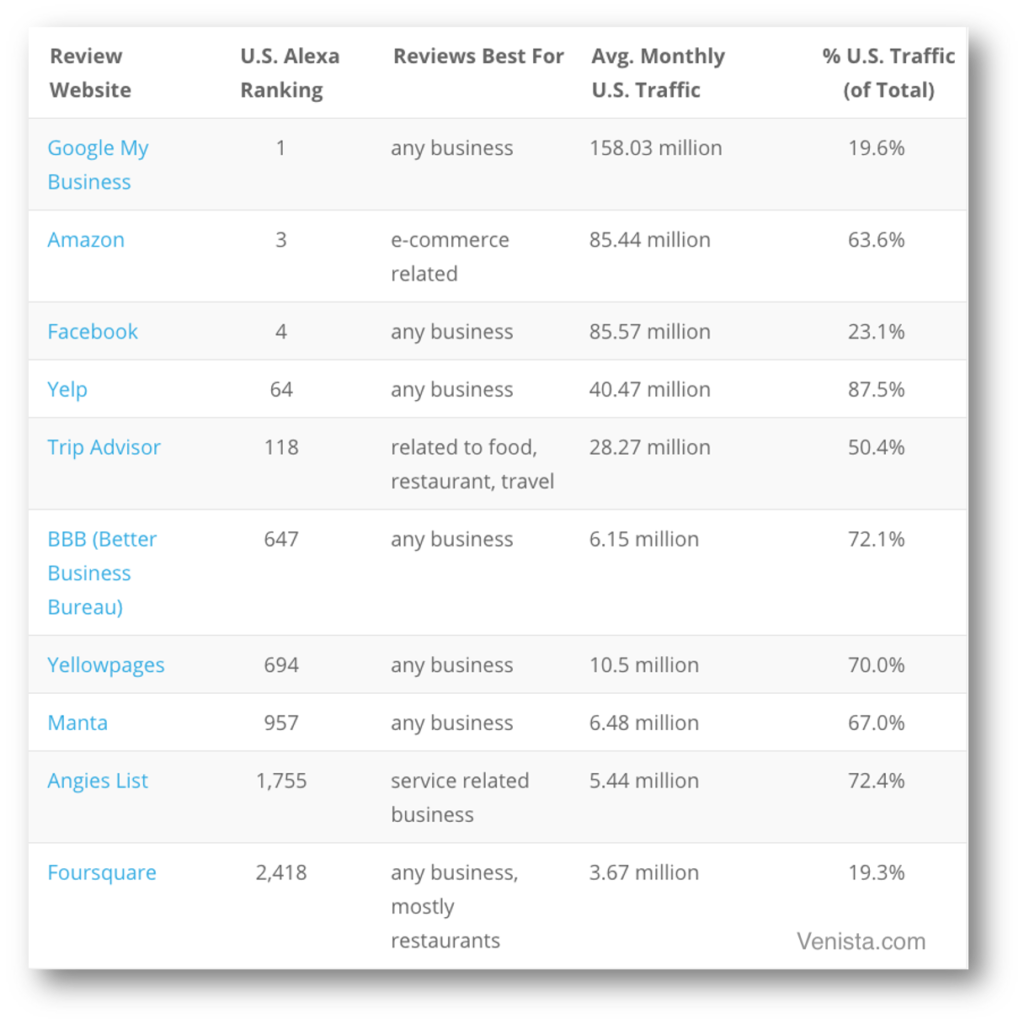
  The second compelling reason is the sheer number of review sites and our reliance on them for purchase validation. It’s already evident that we’re groomed to look for ratings and reviews before we buy. Here is a brand-new ranking of the top 10 review sites based on searches. You can see here that these sites get millions of views a month.  

Vendista Chart

  A third reason to care about online reviews is Google. Reviews appear in, and help, Google search ranking. And incidentally, they also appear in search results by Alexa in voice-search. The number and quality of your reviews directly contribute to, or inhibit, people’s ability to find you and your products.   

  The best strategy here is to harvest Google reviews. Google supports Google. Google wants you to use its tools. So, it makes sense that Google cares if you have your Google My Business Page set up and that you’re collecting reviews. In addition to nepotism, it’s good business because Google will see that you’re a valid business and will have more credibility returning your company and product in search results. 

  The fourth reason you should care about review sites is because your customers care about review sites. 92% to 97% of customers look for or read a review before doing business with a company. 80% of us trust reviews by strangers just as highly as a reference from our friends. 72% of us look for only positive reviews, and 86% will not do business with those with negative reviews. (Clutch.co) 

  And it is surprising how quickly comfort levels fall when you go from five to one-star ratings. 94% of us will use a business with a four-star rating, but only 14% will consider a two-star rated business. 

  My advice is to be familiar with what people say about you. Search your brand. Know where you and your wine show up and what feedback you’re receiving. 

Tools to Help 

  Ok, but how can you efficiently monitor all those online review channels. Especially when you already have your hands full trying to run your business’s day-to-day without scouring Yelp and Google for new posts. Fortunately, there are some reputation management tools you can use to help out. 

  The easiest tool for tracking any mention of your company or product online is Google Alerts. This is a free search that lets you create daily alerts for any mentions of your brand online. Enter the name of your brand or product in the search bar to see who is talking about you. Then you can create a constant alert to get results emailed to you. The downside is it can be tough to filter the information out in an intelligent way. For instance, when I worked with Opus One, I was reminded daily how many products and companies contained “Opus.” That said, it’s a free, easy tool. If you’re a small winery on a time crunch with a limited budget, Google Alerts is worth your time. 

  ReviewPush is an excellent tool if you do have a small budget and want to take it one step further. With this service, for $89 a month you can create alerts for over 20 different review sites and have them sent to your inbox. Even more timesaving is a feature that allows you to respond direct to reviews from within those email alerts. This alone might be worth the cost. You can also involve an extended team with distributed reports and access to dashboards. So if you have multiple players in your tasting room or wine club, this might be an efficient way to have the entire team monitor and response quickly.  

  There are many other tools in this space that also fall into reputation management. So in addition to looking at reviews, they can monitor what anyone is saying about you on social media platforms like Facebook and Twitter. These are pricier options and typically involved working out your needs with a sales rep. 

  So hopefully this gave you some incentive to include reputation management as part of your marketing strategy, and some tools to help. In the next article we’ll talk about how to work with your tasting rooms to request reviews – it’s not as scary as it sounds. But until then, start to pay attention to where your customers are trying to communicate about you. Start thanking and replying to them if you aren’t already and take the view that feedback as gift to help you improve and delight future customers. 

  Susan DeMatei is the President and Nathan Chambers is an Account Director at WineGlass Marketing, a full-service direct marketing firm working within the wine industry in Napa, California.  www.wineglassmarketing.com

Demetria Estate Winery: All-Natural Wines from Grape to Glass

2 wine glass

By: Nan McCreary 

When John and Sandra Zahoudanis founded Demetria Estate near Los Olivos, California, in 2006, their goal was to honor John’s Greek heritage and family tradition of farming and careful stewardship of the land. To achieve that objective, they committed to farm sustainably and biodynamically, using phases of the planets and the moon to govern farming practices.  These practices, and a natural approach to winemaking, have led to highly-rated wines and a reference to Demetria Estate as “one of the hidden jewels in California.” 

  While biodynamic farming principles are not new—the Old Farmer’s Almanac has been recommending “planting by the moon” since 1792—Demetria Estate was one of the first in Santa Barbara County to embrace the concept. “Biodynamic winemaking is our passion,” the Zahoudanis’ son, Alexis, who now runs the winery, told The Grapevine Magazine.  “We are trying to put back in the earth what we’ve taken out, and we’re doing it in the most natural way possible while incorporating the lunar calendar.”   

  Demetria, named for John and Sandra Zahoudanis’ daughter, sits on 213 picturesque acres above Foxen Canyon in the Santa Ynez Valley. The altitude of the property ranges from 1,100 to 1,450 feet, making it one of the highest in the appellation. When the Zahoudanises purchased the hillside vineyard from the well-respected Andrew Murray Family, it was planted exclusively with Rhône varieties. Today, the family farms 43 hillside acres of Rhône grapes, including Viognier, Marsanne, Roussanne, Picpoul Blanc, Grenache Blanc, Cinsault, Counoise, Grenache, Syrah, and Mourvèdre, plus small plantings of Tempranillo and the Greek Assyrtiko. Demetria also produces Burgundy-style wines, sourcing organic Pinot Noir, Chardonnay, Pinot Blanc and Pinot Gris grapes from select cooler-climate vineyards in the Santa Rita Hills and Santa Maria Valley. 

  From the beginning, the Zahoudanis family has farmed sustainably and biodynamically. Their first winemaker, Michael Roth, now of Lo-Fi Wines in nearby Los Alamos, was a big proponent of natural wines, as is current winemaker Ryan Roark.  Philippe Armenier, the renowned biodynamic expert from the Rhône Valley, guides Demetria’s farming practices. They treat the vineyard as a living organism, with soil, plants and animals working together to promote health and vitality. Farming is entirely organic, meaning no chemical fertilizers, herbicides or pesticides. For example, sheep on the property eat weeds and fertilize the soil during late winter and early spring when the vines are dormant. Demetria also plants cover crops, including nitrogen-rich legumes and daikon radishes, to protect the topsoil and nourish the vines. The major pest, according to Zahoudanis, is leafhoppers, which are controlled using natural predators such as ladybugs and organic, biologically-approved pesticides, including sprays containing fermented and herbal teas. 

  From pruning to planting to harvest, vineyard tasks are determined by a biodynamic calendar, which categorizes days into four groups—flower, fruit, leaf and root—based on lunar cycles and astrological signs. Each day also coincides with one of the four elements of nature—earth, water, fire and air. Root days, for example, are when the moon travels through any of the Earth signs (Capricorn, Taurus, Virgo) and are best for planting, replanting and pruning. Fruit days are associated with the Fire constellations (Aries, Sagittarius, Leo) and are ideal for harvesting crops. For some, planting according to lunar cycles is somewhat of a mystery, but proponents consider this an attempt to harmonize with nature to maximize yields and keep the vineyard sustainable.   

  “Our consultant, [Armenier], works with our vineyard manager and vineyard foreman to care for the vines,” Zahoudanis said, “and I let the wines speak for themselves. The fruit is really gorgeous and expresses itself beautifully as a more natural product.” 

  Demetria applies the principles of biodynamics and sustainability in the cellar as well as in the vineyard. “We know our vineyard well, and we know when to pick so we don’t have to manipulate the fruit,” Zahoudanis said. “We use minimal sulfur, and we don’t add acid or tannins. We don’t want a chemical experiment going on in our winery.”   

  Demetria relies on native yeasts to start fermentation and does not inoculate for malolactic fermentation. Zahoudanis said they filter their wine simply by racking and will only apply fining if the tannins are too harsh, and then they will use bentonite, a natural product. Ultimately, he explained, the goal is to “produce wines that are complex, while being food-friendly and approachable, not just for the connoisseur, but for the everyday wine lover that lives in all of us.” 

  Demetria has achieved that goal. Its wines—and its beautiful Mediterranean-style winery with panoramic views of the vine-covered hills—have received enthusiastic reviews from critics and everyday consumers alike. Recent awards include 2016 Rosé – “Year’s Best Rosé! Wine & Spirits Magazine; 2014 “Cuvee Sandra” Pinot Noir – 94 points, Wine Enthusiast and 93 points, Wine Spectator; 2014 “North Slope” Syrah, 91 points, Wine Enthusiast; 2013 Estate Chardonnay (Santa Barbara County) – 93 points, Vinous; and 2013 “Cuvee Matia” Grenache – 91 points, Wine Advocate. 

  Even with a barrel full of awards, Demetria is not resting on its laurels. Since establishing the Demetria Estate, the family has been changing the composition of the vineyard, uprooting much of the once-predominant Syrah, and planting grapes such as Mourvèdre to produce more interesting blends. A favorite is Cuvee Constantine, a red blend styled after the famous Chateauneuf du Pape reds made from Grenache, Mourvedre, Cinsault and Syrah. Another favorite is Cuvee Papou, which includes Grenache Blanc, Marsanne and Roussanne. The name “Papou” is Greek for grandpa and honors Demetria’s founder John Zahoudanis, a grandfather who passed away in 2020. Demetria also releases a sparkling version of the Cuvee, produced at Rack & Riddle in Healdsburg, California. “We really like the sparkling wine,” Zahoudanis said, “but it’s not our forte.  It’s too time-consuming.  We might as well give our grapes to folks who know how to make it.”  

  Demetria has recently begun producing a wine from the Rhône grape Picpoul, which is gaining traction among wine aficionados all over the world. Beton Blanc (beton means “concrete white” in French) is 95% Picpoul Blanc and 5% Assyrtiko and is aged and fermented in concrete eggs. “Concrete is a neutral vessel, so you don’t get flavors like you do from oak barrels,” Zahoudanis said. “But because it’s semi-porous, you do get oxygenation, which enhances the minerality that already exists in a lot of varietals.”   

  According to Zahoudanis, wine can be made quickly in concrete eggs: the Beton Blanc is ready five months after harvest and can be bottled by February. 

  Currently, Demetria makes 6,000 to 9,000 cases of wine annually. “We can’t plant more because we’re limited by geographical constraints,” Zahoudanis said. “We sell some of our fruit, so we could scale that back and produce 10,000 cases, but generally, we’re good where we’re at(sic).”    

Zahoudanis does envision planting more.  

  Tempranillo, a grape that’s doing exceptionally well on his property. Whatever he endeavors to do, if the past is prologue, the future looks very bright for Demetria Estate. “We’re just glorified farmers,” he said. “We’re beholden to Mother Nature, and yes, winemaking requires knowledge and art, but it’s not rocket science.  If you don’t over-manipulate it, you can make very good wine.” 

To learn more about Demetria Estate, visit…www.demetriaestate.com