Tips & Best Practices for Wildlife Control in the Vineyard

Few things frustrate vineyard operators more than producing healthy grapes only to have them eaten by pests. Small insects are a significant cause for concern, but larger animals often put delicate grapes at risk as well. This article will discuss the topic of wildlife control in the vineyard and the various ways that vineyards can effectively and humanely deter wildlife to protect their valuable grapes.

Wildlife That Impact Vineyards

Matt Doyle of Doyle Vineyard Management in Hammondsport, New York told The Grapevine Magazine that the most common pest problems that occur in the Finger Lakes region are deer, birds, and turkey. A premier Finger Lakes region grape grower, Doyle Vineyard Management also offers full-service vineyard management services and sustainable vineyard programming.

Meanwhile, in the Sebastopol, California area, Rick Williams of Harmony Farm Supply & Nursery said most of the wildlife issues that plague vineyards in this region are gophers.

“Most of the problems that they cause are with new plantings, whereby they will eat the tender roots of new plants,” Williams said. “Established vines have such an extensive root system that the gophers don’t generally pose a serious threat. The holes that they dig cause issues within the vine rows, creating soft spots that tractors and other vehicles traveling down the vine rows can sink into.”

Williams said that rats and mice climb vines to feed on the berries. “Most other problems are from coyotes that come into the vineyards and are digging after the gophers because they dig large holes,” he said.

According to Williams, birds also cause a significant problem in vineyards when they eat the berries as they mature. Wayne Ackermann of the Wilsonville, Oregon-based Bird Control Group told The Grapevine Magazine that the type of birds that cause damage and financial loss to vineyards largely depends upon the location.

“On the west coast, we tend to see most damage caused by starlings and blackbirds,” Ackermann said. “On the East Coast, cedar waxwings and robins tend to be the issue, but in all regions, there are many birds attracted to the sweetness of the ripening grapes.”

Not only can wildlife pests eat the grapes and gnaw on the roots and trunks of grapevines, but they can also cause other significant types of damage as well. For example, wildlife pests can damage irrigation systems, cause erosion, and leave bacteria and fungus on grapes from their fecal matter. These behaviors cause contamination, bunch rot, and off-flavors in the final product.

Wildlife Control Solutions for Vineyards

Fortunately, there are many ways to prevent and control wildlife through vineyard management and safeguards. There is rarely a one-size-fits-all approach to wildlife control, so vineyard owners should consult with pest control experts in their local area for advice.

Deer in the Vineyard

Deer tend to enter vineyards early in the year to graze on young shoot growth, which can destroy a vineyard’s training system. Deer can also be a significant nuisance when it comes time for harvest. It is best to use deterrents before the animals have discovered the potential food source.

Sunni Ashley, co-owner of Vineyard Industry Products, and said that deer, pigs, and bears are best controlled with fencing. The company has stores in Windsor, Paso Robles and Los Alamos, California carrying a variety of wildlife control products for vineyards. Their products include barbed wire, bird netting, mylar tape, traps, grow tubes and, of course, fencing. Fencing that extends six to eight feet high and made of woven wire can be installed to deer-proof a vineyard.

“Deer require at least six feet of fencing, but depending on the area, you may need to go higher,” Ashley said. “You can add two strands of high tensile wire at the top to get to seven feet. For pigs, putting the barbed wire along the bottom and connecting it at each stake (and sometimes another stake in between the standard fence posts) helps.”

Meanwhile, physical barriers, such as grow tubes and mesh vinyl screens, can be placed to protect young vines. In some regions, vineyard owners can obtain deer damage permits to hunt deer that cause substantial damage to crops and to reduce the population outside of the established hunting season. Odor repellents can be useful for deer control, acoustical repellants can scare away both birds and deer, and dogs can be trained to deter deer and protect vineyards too.

Doyle uses many of these options to keep deer from his vines. “The ways we control [deer] are utilizing fences for severe deer pressure, pig blood spray to deter deer from eating the vines, and having people fill out NYSDEC deer nuisance permits. We use Plantskydd deer repellent sprays on newer vineyards,” he said.

Rodents in the Vineyard

Many pest control and vineyard management companies use traps and baiting to control wildlife, mainly gophers. It is recommended to set many traps, note the location of gopher mounds, and place bait in the pests’ underground tunnels.

This process requires a substantial amount of patience and effort, which is why fumigation may be used simultaneously to control gophers and other rodents using aluminum phosphide in the late winter and early spring with moist soil. Other wildlife control solutions include bringing in barn owls to help control field mice, voles, and gophers. Nest boxes in the vineyard help owls set up habitats to accomplish this type of rodent control.

Williams of Harmony Farm Supply & Nursery said that they “carry a variety of traps to kill the gophers.” He also said they do not have cost-effective organic rodent deterrents for large-scale application.

Birds in the Vineyard

Birds often pose late-season threats to vineyards, especially for those in a migratory pathway. Bird control is typically a point-of-contact effort, with netting and scare devices among the most common deterrents.

“For birds, we typically use BirdGard brand devices to deter birds, bird bangers, or occasionally net varieties that have heavy pressure. We have no real control measures for turkey, but they cause minimal damage compared to the deer and birds,” said Doyle.

Netting is a popular choice among vineyard owners, although bird nets can be a hassle to put on and later remove. Over-the-row netting is often used in vineyards to cover large surface areas. These nets are made of nylon, plastic, cotton, polyethylene, or a lightweight acrylic material to drape over plants. Netting can be a costly investment for a vineyard, but a quality net lasts several years.

Scare devices such as motion-activated water sprinklers and electronic scarecrows are also typical.

Bird Control Group is the world leader for laser bird deterrents and bird repellent solutions that have proven to decrease bird nuisances by over 70 percent. The company offers a fully automated bird repellent system that effectively scares away birds by projecting a laser beam towards them. The birds perceive the laser as a danger and fly away. It’s a one-time investment that does not harm the animal or the environment, and it has patented safety features to eliminate potential hazards.

Bird Control Group initially targeted commercial blueberry growers in 2017 because they do not have the option of netting and often depend on expensive falconers for bird control. After immediate success providing an effective, cheaper solution, the company ran two experiments with vineyards that same year in Petaluma, California and the Willamette Valley in Oregon. Both vineyards saw great success and saved on labor.

“In 2018, many vineyards incorporated our laser technology in California, Washington, Oregon, Texas, Nebraska, New York, Rhode Island, and New Jersey,” Ackermann of Bird Control Group said. “We have also seen our sales aggressively grow with vineyards in Australia and Chile, as their season is just getting going. The lasers are a very good tool, and the trend is for customers to return for additional units and also send their friends to us. We always say that farmers vote with their wallet, and when they return to buy more lasers, we know it’s doing something well for them.”

Ackermann of Bird Control Group reminds vineyards there is no silver bullet and that vintners should incorporate methods that fit into their current pest management strategy. Noisemakers, netting, and Falcons all have their successes, but they can also create challenges with neighbors, become labor-intensive, and drain a vineyard’s budget.

“Our lasers aren’t a 100 percent cure, but they do work well and provide a large amount of control,” Ackermann said. “The key advice, I would say, is to start early. Your best success is to keep birds out of the vineyard and not let them get a good taste of the fruit. Just like other measures of a good IPM Program, prevention is always easier than eradication when farming.”

To comply with the Federal Migratory Bird Treaty Act, vineyard owners should check the local and state laws before controlling any bird species. This act protects all birds aside from pigeons, starlings, and sparrows; however, local ordinances may vary from place to place.

Organic and Natural Wildlife Control

For a more natural approach to wildlife control in the vineyard, adding plants is a simple, humane, and proactive way. Aromatic deterrents are ideal for rabbits and deer because both are sensitive to smells. Marigolds, for example, can be planted at the end of vineyard rows to deter rabbits. Vineyard operators can plant strong-smelling herbs such as tansy and artemisia near the vineyard. Culinary herbs, like mint, thyme, oregano, chives, sage, rosemary and dill have a similar effect.

These methods play into the strategy of biodiversity within a vineyard and may be more of a priority for organic winegrowers. Organic strategies typically revolve around creating habitats for beneficial animals and plants that are native to the region, as well as utilizing integrated canopy management and vine balance to keep the fruiting zone aerated, equipped with enough sunlight, and with the right amount of nutrients and water.

Pest Prevention and Monitoring in the Vineyard

Proper planning and preparation go a long way in keeping unwanted animals out of your vineyard and away from your grapes. In all seasons, it is critical to monitor the vineyard for large wildlife pests. Control strategies should be implemented at the very first signs of pest activity.

“The best way to monitor the vineyard for wildlife pests is to regularly walk the vineyard and inspect for evidence of these pests,” said Harmony Farm Supply’s Williams.

Ashley of Vineyard Industry Products and her team advise vineyards to keep gates closed, check around the perimeter daily for pests, and keep fencing in good repair. “Check for holes and damage in your bird netting prior to installation, install at the appropriate time, and secure it under the canopy properly,” she said.

Doyle of Doyle Vineyard Management emphasized that to have decent yields on grapes, you need to have some way of keeping the wildlife off the vines. “They can cause severe economic damage on some types of grapes,” he said. “In the Finger Lakes, it does seem that the pressure from these pests can vary greatly from one year to the next.”

Waterloo Container Will Be At Upcoming Trade Shows

FOR IMMEDIATE RELEASE
February 25, 2019

Contact: Bobbi Stebbins
Telephone: 315-539-3922  ext 47
Email: bstebbins@waterloocontainer.com
Website: Waterloocontainer.com

Waterloo, NY, February 25, 2019– Waterloo Container is pleased to announce that we will be showing off our packaging and product options at several upcoming local and national industry trade shows.

National Tradeshows give Waterloo Container the opportunity to reach out to a wider circle of potential clients, and to learn about what is trending in the industry. This helps us decide what to add to our own bottle portfolio.  Members of our team have also attended classes at shows to improve knowledge of the industry and make valuable connections.  This year, Waterloo Container can be found on March 19-21st at Booth #512 at the Eastern Winery Exposition in Syracuse, NY.  We will also be focusing on the craft beverage industry at the Craft Brewers Conference in Denver, Colorado April 8-11.

This year’s Eastern Winery Expo boasts more than 230 industry vendors and suppliers under one roof. According to the EWE website, there will be 46 speakers and 35 workshops and conference sessions this year at the OnCenter.  The show is designed for equipment purchasing, wine tasting, meeting the experts, socializing, and sharing wine, knowledge, tips & techniques.  In between sessions, Waterloo Container meets with attendees and customers to show off new wine glass products and services like their popular UV ink glass printing and new high speed shrink sleeving.

At the Craft Brewer’s Conference, Waterloo hopes to expand their presence in the ever-expanding market of craft beverage packaging.  The CBC is America’s largest craft brewing industry gathering, with over 13,000 attendees and 800 exhibitors.  Beer, Spirits, Ciders, and Meads are just some of the products discussed and highlighted by the program. Waterloo Container will present a tailored selection of glass bottles appropriate for this market.  New sparkling (pressure rated) bottles will be showcased along with the classic amber craft options.  George Hall, Sales manager at Waterloo Container says “Trade Shows are a great environment to engage in an open packaging dialogue with existing customers or get introduced to a future customer to collaborate on their plans to grow”

Smaller, local tradeshows allow vendors to meet one on one with our current and future clients.  Attendees can put their hands on the bottles and get valuable information about our many value-added services and packaging options.  Cornell Cooperative Extension sponsors two shows in our region this year, including the B.E.V. NY show at the RIT Conference Center (Feb 27-Mar 1) and the Finger Lakes Craft Beverage Conference at Del Lago on March 26th.  Waterloo container plays important sponsor roles at each event.

“Each show has a unique clientele and atmosphere” says Waterloo Container Marketing Director Bobbi Stebbins.  “We adapt our display, staff and featured items specifically for each show in hopes of introducing current clients to new products, and to acquaint prospective customers with our company values and products in general”

About Waterloo Container: Waterloo Container is a family-owned and operated business started in 1980 by Norm and Bill Lutz to support the burgeoning wine industry in the Finger Lakes of New York and on the East Coast.  Today, we offer an extensive selection of glass wine and spirits bottles manufactured right here in the United States.  We also stock and source many imported wine, spirit and specialty bottles.  Our vendor partners have been extremely influential in our success and we are proud to work with the best in the industry for glass, corks and closures.  We offer a personalized packaging program that includes services like eight color UV ink glass printing and high-speed shrink sleeving.   We also provide in-house repacking, quality select and warehousing for our customers and employ our own fleet of trucks and skilled drivers. We take pride in being a reliable provider of the highest quality glass containers and packaging products available. We are proud to have been an integral part of the wine and craft beverage industry’s growth in Eastern North America. We look forward to continuing to grow together over the years to come. Visit our website at www.waterloocontainer.com  today!

What Wineries Should Know About Labels, Printing, and Bottle Engraving

By Alyssa Ochs

In the wine industry, a label is much more than a sticker on the bottle identifying the brand. Rather, a label is an opportunity to tell consumers about your winery, the intricacies of a particular type of wine, and to highlight its character and quality. That is why it’s so important to put as much time and thought into what’s on the outside of the bottle as what’s inside.

The Importance & Basics of Wine Labels

The importance of effective label printing is to differentiate your product from other wines and help it stand out in the competitive market. Labels provide valuable information to consumers about the winery’s location, tasting notes and alcohol content. In the U.S., labels must also adhere to and be compliant with Alcohol and Tobacco Tax and Trade Bureau standards.

To best serve consumers, wineries must consider temperature change, moisture and humidity when choosing label materials. Increasingly, wineries are choosing labels that are eco-friendly and sustainably sourced using biodegradable polylactic acid film, tree-free label stock made from bamboo or sugar cane, or FSC-certified paper.

Sara Nelson, president of Sara Nelson Design, told The Grapevine Magazine some designers stick strictly to art, while others, with more training and broader experience, can help wineries figure out how to visually express their brands.

“Depending on the research you read, from 50 percent to 75 percent of wine buying decisions are made based on the label. Your logo and label have a job to do: sell wine,” said Nelson. “To that end, whether you prefer flowers or animals on labels or whether you like blue is just one small consideration. A designer with experience in the wine industry should also be very familiar with TTB rules, regulations and policies. They should also be helping you to make sounds decisions that help both maximize revenue and minimize cost. That means attention to your competitive situation – anticipated price point; production; how you plan to bottle and label; and where and how it will be sold.”

Printer Options for Wineries

For wineries with in-house design teams or with the ambition to make their own, there are several printers in the marketplace capable of printing professional-looking labels. Options include both laser and inkjet printers, as well as flexographic label presses to transfer images onto labels for large runs of custom labels. Digital label presses are often ideal for small wineries, small batches and short-run labels. For all wineries, the primary considerations when choosing a printer are size, capacity and cost.

One option is the Kiaro! QL-120 inkjet label printer, which offers flexible printing options and speeds that can produce thousands of labels per hour. Meanwhile, some wineries choose to print and apply their labels with LX-Series Color Label Printers and AP-Series Label Applicators.

However, Nelson advises that the quality of DIY labels may not stand up to the expectations of the winery or the consumer. “It seldom makes sense for a winery in a competitive situation to design or print its own labels,” she said. “Very few consumer-grade printers can print with enough consistent precision or use materials necessary to compete with commercial print companies that specialize in beverage labels. Even if the hardware were available and affordable, consumables (ink or toner) can be atrociously expensive and not easy to source.”

 Kevin Crimmins, the director of strategy and business development for The Label Printers in Aurora, Illinois, told The Grapevine Magazine that the best technology for wineries is dependent upon what considerations and needs a winery brings to its printer.

“The dominant technology in label printing for a long time, whether for wine or really any bottled product, has been flexography,” Crimmins said. “Flexographic printing technology is well-suited to label printing due to its ability to efficiently imprint a high volume of identical images and complete the other steps necessary to produce finished labels with minimal handling and reliable consistency.”  However, Crimmins pointed out that digital printing technologies have also become widely used by wineries in recent years.

“Unlike flexography, digital technologies imprint images without reliance on plates,” he said. “This enables printers to create labels with variable images—every label can be different from all the others. Digital printing also delivers crisp, high-resolution images, and in some cases, it can enable a printer to more efficiently respond to requests for smaller quantity runs.”

David Noone of Noontime Labels in San Ysidro, California agreed that the best labels for a winery depend on the customer, product, and budget.  “We use digital presses exclusively, which provide a quality label that is very cost-effective,” Noone said. “Other printing techniques, like offset printing and flexography, do provide a bit higher quality but require much larger quantities to be affordable. Most of our customers find the differences nuanced and opt for the cost savings of digital.”

Savannah Bergin, the director of sales and marketing of Bergin Screen Printing & Etching in Napa, California, told us that her company thinks applied ceramic labels, also referred to as direct screen printing, are the most creative.

“Screen printing allows for the entire surface of the bottle to be used as the canvas,” Bergin said. “Use of a 360-degree design, shoulder and neck decoration is possible with screen printing. With other label application, that is not possible without either applying separate labels. Heat shrink sleeves would be the closest comparison, yet still not directly applied and fused to the glass.”

Material Options

When it comes to label materials, wineries can choose from paper stock, stick adhesive, and waterproof labels made with industrial materials. Wine bottle labels come glossy white, semi-gloss material, matte white, transparent or feature a cream texture parchment sticker. Another option is a transparent polypropylene label material for a “no label” look. Standard sizes include 5.5-inch by 4.5-inch labels with rounded corners and 3-inch by 5.5-inch oval labels.

Bergin told The Grapevine Magazine that paper, pressure sensitive labels, applied ceramic labels and heat shrink sleeves are commonly used by wineries today.

“Paper has been around for a very long time and is still widely used,” she said. “The alternatives have become labeling innovations in an effort to provide decoration solutions outside of paper. Everyone wants their label to stand out, and having multiple label printing options for everyone is what allows every brand to choose their own identity for packaging.”

Noontime Label’s Noone said that his customers only ask for pressure sensitive “peel and stick” labels.   “They can be printed on many different kinds of materials, from plain paper to textured estate papers, as well as vinyl and clear plastic,” he said. “They’re also available with different adhesives depending on the customer’s needs. Some of our customers recycle their bottles, so the high-tack removable adhesive is a pretty popular choice. Noone said that the “peel and stick” labels have the added benefit of being applied on an automated bottling line or by hand if needed.

“The most common materials our customers buy are the plain paper and the estate paper,” Noone said. “The plain paper is the most economical and can easily have a gloss laminate applied to make it waterproof, and the estate papers add texture for a higher-end look and feel.” Noontime Labels provides different label quantities, from 30 labels up to approximately 10,000 per label design.

Meanwhile, Crimmins of The Label Printers says for them no specific label type is more popular than others because wine branding has changed so drastically over the past 20 years. Wine labels were traditionally printed on paper-based label stock, often described as estate papers, that are suited to the high-end aesthetic for which wine brands strive.

“An equally compelling, but very different, aesthetic can be achieved by selecting one of the many plastic film-based label stocks available in today’s market,” Crimmins said. “For example, a metalized film might be chosen for its ability to give a label, or select elements within that label, a glistening or reflective effect.”

Crimmins went on to tell The Grapevine Magazine that, “It’s important to work with a professional printer who will take into consideration things like the surface onto which the labels will be applied, how they will be applied, and how the product is to be used. That way, they can help the winery make the right decisions about coatings that the material will need and which adhesive will allow the label to achieve a lasting bond with the bottle.”

Engraving Directly onto Wine Bottles

Wineries can also engrave labels and information directly onto the bottle. Engraving is typically more expensive, making it most commonly used for rare releases, special occasions, and milestone gifts. Engraved bottles offer a personalized touch that cannot be mistaken for anyone else’s product.

Laser technology, such as MAG PRO or MAG BOX, can be used for engraving, with custom and ready-to-order designs start at around $18 per bottle, plus a $75 setup fee. Bergin Screen Printing & Etching, for example, offers hand-etched and hand-painted bottle creations, providing an alternative to printing large paper wine labels for bottle sizes between 1.5 liters to 27 liters.

  Choosing the Right Printing and Labeling Strategy

After selecting a label design, assessing the number of labels needed, and determining the amount of labor that label-making will involve, wineries should be able to decide whether it’s best to print their labels or hire a printing company to handle the task for them.

Crimmins of The Label Printers emphasized that the label is what customers see before they taste, or even buy, a bottle of wine.  “Give some thought to how the aesthetic of your label will present your brand and will convey the feelings that you think your brand should evoke,” he said. “An experienced printer will have some ideas that could highlight your brand or support your aesthetic even more effectively than what you come up with on your own. Don’t be shy about asking a printer how they might enhance your label; you may really like their ideas.”

Crimmins understands the attraction of print-it-yourself devices because, after all, why pay a professional to make your labels if you can handle it on your own?    “Well, maybe I can put it this way,” he said, “I think it would be fun to plant some vines, collect the grapes, press them and go through all the steps to turn my juice into wine. Can I expect my homemade wine to be as good as the wine produced by vintners who’ve dedicated their careers to winemaking? Should I expect to make some missteps along the way in my winemaking venture? Maybe that approach is acceptable for a hobbyist. However, if wine is your business, the label really should reflect the same care, professionalism, and skill as you put into the wine itself.”

Nelson of Sara Nelson Design reiterated this point but also offered suggestions on how working with a designer can help wineries take advantage of both worlds.  “For a winery with a small budget, an experienced designer might take advantage of a printer’s collection of stock—cutting dies to save money, or they may design a label such that it can be printed on a digital press at your neighborhood print shop if you want to hand-apply them,” said Nelson. “With a healthier budget, a designer might include luscious finishes like deep embosses, holographic films and foils, laser cutting of intricate patterns, flocking, or more.”

However, Nelson said that high-end finishes are not always affordable or appropriate for winery labels.    “It may seem like a good idea to try to make a $7 bottle of wine look like $20 on the theory that it will look like a great value, but most that try it find that it doesn’t usually work out,” Nelson said. “There are times to use foil, precious metal inks, etched bottles, and such, but go carefully. Your designer should be able to help you think through the cost versus the ROI.”

Bergin of Bergin Screen Printing & Etching says that decisions of whether to hire a company to print labels, self-print labels, or invest in new label equipment depends on the size of the winery.    “When picking a label printing company, we recommend they physically visit their facility or showroom to get a feel for their portfolio of work, as well as the confidence they can produce quality results with precision,” Bergin said. “Choosing a label design and its application medium is a huge decision in the packaging phase for a brand.”

Accordingly, Noone of Noontime Labels advises wineries to take some time to think about what their needs are they can choose the appropriate printer.  “If you’ve been making wine for decades and have specific issues you’re trying to resolve or marketing goals to achieve, then finding the printer who can accomplish what you need at the price you want should be fairly straight forward,” Noone said. “However, if you’re fairly new to the business, you might not even know what you don’t know. If you think you might need a little ‘hand-holding’ and special attention, you need to make sure the printer you choose is willing to provide that.

“Many companies are very willing to educate their customers and actively find solutions for their needs, while some just expect the customer to give them what they need to provide the label that they want,” said Noone. “So, you should make sure your needs match the level of customer service that the printer is willing to provide. Establishing a long-term relationship is optimal, so you won’t have to worry as much if emergencies and problems arise.”

Welcome to Fizz Club

By April Ingram

Over the past 15 years, international sales of Champagne and sparkling wine have strengthened. The increased sales are due, in part, to the increase in exceptional sparkling wines being made in wine regions throughout the world, including Canada. Even though Champagne remains the gold standard, with the rise in quality sparkling wines at reasonable prices, consumers no longer have to wait for a special occasion to pop open a bottle, and sales have skyrocketed.

Belinda Kemp, senior scientist in Oenology at Brock University, wanted to provide a technical foundation for the growth of Canada’s sparkling wine industry, so in 2013 she worked with Brock University’s Cool Climate Oenology and Viticulture Institute (CCOVI) to create Fizz Club.

According to the Brock University website, the CCOVI was established in 1996 in partnership with the Grape Growers of Ontario, the Winery & Grower Alliance of Ontario and the Wine Council of Ontario. They focus on assisting grape growers and winemakers to produce top quality sparkling wines. Much of the research conducted at CCOVI surrounds the affects soil types have on sparkling wine flavor, mouthfeel, and texture. Kemp works out of her “Bubble Lab,” known for its leading sparkling wine research and outreach work, culminating in an annual event called “Fizz Club.”

Fizz Club is a rare opportunity for Canada’s leading sparkling winemakers to come together and talk shop. The club is members-only, limiting membership to sparkling winemakers or wineries already underway or considering a sparkling wine program. At the event, winemakers discuss the most significant issues facing the Canadian wine industry, hear presentations on the newest research and technology, network, compare notes, exchange ideas, and of course, taste wine.

Each year, the event has grown. In its inaugural year, only a handful of Niagara wineries participated. In 2018, more than 80 winemakers stepped out of their cellars and came together in Niagara, Ontario with the goal of making Canadian sparkling wine even better. To that end, the corks of more than 130 bottles from four provinces were popped while Canadian winemakers talked candidly about sparkling wine production.

In an article in Brock University’s Brock News entitled “How Fizz Club is shaping Canadian sparkling wine,” Simon Rafuse, winemaker at Blomidon Estate Winery in Nova Scotia said, “The winemaking community doesn’t have a lot of opportunities to come together and spend time face-to-face with other winemakers across the country.  To focus in on one specific style of wine, which is one we do extremely well here in Canada, and to be able to spend the time to hear the latest research being done at Brock is a great opportunity.”

In the same article, winemaker Karen Gillis of Red Rooster Winery in British Columbia said, “It is nice to be able to be in a room where you can openly communicate with other winemakers because there are certainly some challenges that everyone faces, to have that opportunity to work that out with other people is great. We are looking to learn from our peers from across the country and share some knowledge and challenges to try to see how we can do a better job and make sparkling wine that is competitive around the world.”

Lawrence Buhler, winemaker at Henry of Pelham, has been attending Fizz Club since the beginning, telling Brock News, “The first Fizz Club was a few of us hanging out tasting wines in a lab, and now you can see how valuable something like this is based on how fast this group has grown. It is great to see people attend from across the country, including veterans in sparkling wine whom you can learn a lot from and people who are pushing the boundaries when it comes to winemaking.”

According to “How Fizz Club is shaping Canadian sparkling wine,” topics discussed at the December 2018 event included yeast strains and pétillant-naturel, also known as “methode ancestrale,” a reemerging process of winemaking where sparkling wines are bottled while they’re still fermenting. Its origins are thought to have been a mistake, with early winemakers thinking fermentation was complete and bottling their wines too soon. The result was a particularly fizzy sparkling wine.

Rafuse told Brock News, “It is great to see the efforts in studying that style, figuring out techniques and ways to make those wines and hearing from winemakers who have experience making them. Knowing where we can focus our own research, and our own trial efforts will hopefully lead to us making better wines at Blomidon Estates and across our industry as a whole.”

Rafuse and other Canadian winemakers are certainly succeeding at creating bubbles that attract attention—winning medals and awards on the world stage—leading to surging sales, nationally and internationally.

Tom Stevenson, one of the world’s leading sparkling wine experts and the founder and head judge for the Champagne and Sparkling Wine World Championships, traveled from the United Kingdom to Brock University to sample wines at Fizz Club. “I am really pleased because there are a lot of really good sparkling wines here. After the first flight I found a few potential gold and silver wines,” Stevenson told Brock News.

He hopes some of those potential gold and silver winners will participate in global competitions. “It would increase the profile of Canadian sparkling wine. We haven’t typically had many entries from Canada in the past to really see what these producers have available from a competition perspective,” Stevenson said.

Overall, Kemp found the 2018 Fizz Club to be a success and thinks Stevenson could be on to something with his praise of Canadian bubbly. “I’m so pleased we were able to showcase wines from so many wineries,” she told Brock News. “It is quite incredible to watch the progress of Canadian sparkling wines as we raise awareness of production techniques and tackle challenges with CCOVI research. This is just the beginning for Canadian sparkling wine.”

The Spirit of Alliance: Oregon’s Philosophy of Collaboration

By Robin Dohrn-Simpson

Although Oregon has been home to vineyards as far back as 1847, after the end of Prohibition in 1933, it needed a bit of rebuilding. It wasn’t until the 1960s and 70s that winemakers made the trek from the Mediterranean and mild climates of California to do just that, throwing their hats in the ring to grow grapes in a new and very different terrain.

It was during this time that well-known names like Dick and Kina Erath, Dick and Nancy Ponzi, Susan and Bill Sokol Blosser, David and Diane Lett and David and Ginny Adelsheim put down roots around the state of Oregon and started vineyards. Some had education and training in viticulture; some did not. Most had a pioneering spirit. It is this spirit that has seen them through the trials and tribulations of grape growing and winemaking in a new frontier.

Susan Sokol Blosser chronicles these trials in her book, “At Home in the Vineyard: Cultivating a Winery, an Industry and a Life.” In a state with no tradition in fine winemaking, she and husband Bill helped create one by taking a leap of faith, moving to Oregon without farming or winemaking experience, buying property and planting grapes. The struggle was real and took perseverance. Through trial and error, she and her husband finally harvested their first vintage in 1977.

By 1979 the Oregon wine industry was recognized at the Wine Olympiad in Paris when Eyrie Vineyards’ 1975 South Block Reserve placed in the top ten pinot noirs. In a rematch one year later Eyrie came in second, only 2/10s of a point behind the winner, a 1959 Chambolle-Musigney from Joseph Drouhin. Suddenly Oregon was a force in the wine world.

After Eyrie’s success, Oregon’s wine industry grew leaps and bounds. By 1990, there were 70 bonded wineries and 320 growers. In the same year came disaster—phylloxera—forcing vineyard owners to rip out vines and replant on grafted phylloxera-resistant rootstock. This replanting allowed Oregon growers and winemakers to rethink and resurface stronger than ever.

Collaboration

Eventually, the growing regions were separated into AVAs, and the Oregon Wine Marketing Coalition formed. All the while growers and winemakers collaborated–discussing strategy and banding together in times of need for growers and employees alike. That has never ended.

“Every wine region claims to be collaborative, but in Oregon, it’s truly a close-knit environment. I have worked in other wine regions, and this one really does feel genuinely tight–people make wine together, share equipment, come together to help each other when disaster strikes, and trade knowledge and advice. I’ve been told by several owners that when they started out, the community was incredibly supportive of them throughout the learning curve of starting a winery,” said Julia Burke, Marketing and Communications Coordinator for the Willamette Valley Wineries Association.

“I remember being impressed by the close community when I visited Oregon for the International Pinot Noir Celebration (IPNC) while I was a winemaker in California,” said Anthony King of The Carlton Winemakers Studio. “The Oregon winemakers were friendly and welcoming to those of us from out-of-state, but extremely close and familiar with one another. Now that I’ve been here for thirteen years, I know that camaraderie is true. That spirit, I think, comes from the founders of the industry, who helped each other in the beginning and have continued to help the industry through combined efforts to tell the story of Oregon wine.”

In 1999, state legislators passed HB3429, allowing multiple winery licenses on a single premise, and, in 2002, The Carlton Winemakers Studio formed. This unique facility, pioneered by Eric Hamacher, Luisa Ponzi and Ned and Kirsten Lumpkin as an incubator and home for multiple producers, is the ultimate in collaboration.

Today, Anthony King is one of the winemakers at The Carlton Winemakers Studio and consults as the general manager. When asked about collaboration at the Studio, he mentioned an ongoing project with Patrick Reuter at Dominio I, one of the first winemakers at the Studio. “In 2015, Patrick and I started a collaborative project that we named after our grandmothers, ‘Agnes and Luisa.’ It focuses on Italian varietals and is meant to be a learning experience and exploration,” said King. “We all help each other. Jerry Murray of Project M explained to someone just today that it is easier to help someone and know that you’ll likely need some help sometime later that day. I, for one, love that I can walk around the Studio with a barrel or tank sample and ask ten winemakers whom I respect what they think of it.”

Collaboration is not limited to members of the studio, however. Tim Ramey of Zenith Vineyards in the Eola-Amity Hills told The Grapevine Magazine, “I agree that winemakers are collaborative. Our annual winemaker dinner is a great example of this. We invite all of the winemakers who produce wines from Zenith, and they come and present their wines to each other where the common denominator is vintage and Zenith – the variables are winemaking and vineyard block. It is hugely informative,” he said.

“We borrow equipment. We help each other with vineyard problems. I have even harvested grapes at Seven Springs as a favor to a winemaker since in 2006 there was no one to harvest.”

Winemakers also provide feedback to one another through tasting groups King told The Grapevine Magazine.

“Most winemakers have tasting groups or cellar crawls where they visit each other’s cellars throughout the year,” King said. “One group has been tasting together for years and started https://www.cellarcrawlwines.com. Their tastings have likely helped us all to be better winemakers, as they learned from each other and then passed that knowledge on to the rest of us.”

Vintners Associations and Wine Festivals

Oregon wineries have many vintners associations and wine boards that transcend AVAs. “The Oregon Wine Board covers the whole state, focusing the efforts of AVAs across the state. That organization hosts the Oregon Symposium each year in Portland that is well attended by winemakers, cellar workers, marketing folks, direct to consumer and national salespeople,” King said. “The seminars are designed by people in our industry and each year are pertinent to our ongoing conversations. We also have a research group that reviews research proposals and allocates OWB funds to wine and vineyard research annually.”

“The vast majority of the wineries in this region belong to associations–most of them belong to several, as there are smaller nested AVA associations and then our organization and the Oregon Winegrowers Association and Oregon Wine Board and others. I have noticed a tremendous willingness to talk out differences and resolve issues as a community. Everyone has an eye on perspective and the bigger picture,” Burke said.

With collaboration also comes celebration, in the form of festivals honoring Oregon’s status in the wine world. “The International Pinot Noir Celebration is based in McMinnville and brings us together annually to showcase our wines in the context of some of the best Pinot Noirs in the world. We often find ourselves discussing and formulating seminars that we hope both the winemakers and attendees will find compelling,” King said. “The Oregon Chardonnay Celebration is similar but has not been quite as developed as IPNC, but gets better every year. Oregon Pinot Camp is probably the ultimate of collaboration in Oregon. Each year 280 sommeliers and buyers come from across the country to visit, taste and attend small, intimate seminars. Planning takes the entire year, and the seminars are in a constant state of evolution. Although not all the wineries participate in OPC, I believe that it continues to be the kindling for our industry’s collaboration. Collaboration is a regular topic of conversation with the sommeliers and buyers. They all love the collective spirit and typically one or two of them each year ends up moving here to be a part of it.”

For winemakers in Oregon, community support and collaboration are only natural, given their roots.

“Camaraderie is a part of Oregon’s culture. People are neighborly and value community over competition. Part of it is that we’re a young region. Our founders had already observed other wine regions around the world and came here with intent, and they knew that a rising tide lifts all ships,” said Burke. “Part of it is that we have one focal grape, Pinot noir, and yet an incredible diversity of sites, and it would be crazy not to share knowledge and experience with each other. I think the biggest factor is that about 70 percent of wineries in Oregon produce less than 5,000 cases, which means we trend very small. We have a lot of small producers who rely on each other, and the larger producers remember what it was like to be just getting started.”

WHERE THE MAGIC HAPPENS: Fermentation And Storage Tanks

By Gerald Dlubala

The style and type of fermentation and storage tanks used in wineries are dependent on many factors, but always includes the winemaker’s beliefs, experiences and history regarding the quality and traits of the wine they want to produce. Tank suppliers have become true partners with wine producers, shouldering the trust and responsibility for providing quality vessels to ferment, hold and enhance the winemaker’s product while sometimes even providing insight on the proper use of their chosen vessel.

Terracotta Amphorae

Such is the case with Manu Fiorentini, Founder and CEO of Itek Wines, a tank supplier, distributor and filtration service provider servicing California’s Central Coast.

Itek Wines’ offerings include oak barrels from the French region of Burgundy, Italian concrete tanks from Nico Velo and a complete line of stainless-steel processing equipment for wine production. However, it may be Fiorentini’s line of Terracotta Amphorae fermenters that may be their most intriguing line of fermentation and aging tanks.

“Terracotta and clay are where it all started, used as the primary vessel to ferment, store and carry wine as far back as the Roman Empire,” says Fiorentini. “The actual reasons that terracotta fell out of favor have never really been identified. We don’t know if they had to stop using terracotta for a specific reason or they just found other means, but about fifteen or twenty years ago, there was a bit of a resurgence in using terracotta and other clays for the purpose of fermenting and storing wines.”

Itek carries terracotta amphorae crafted from the renowned Impruneta clay, a unique blend of natural ingredients found in Tuscany and made by what he calls “local mom-and-pop producers.”

“There hasn’t been a whole lot of modifications to the vessel itself, just different mixtures of clay to control porosity without excess leakage. That porosity allows for natural micro-oxygenation which is beneficial for a healthy fermentation and bonding anthocyanin for better color in red wines. Additionally, amphorae are thin-walled, measuring only about an inch thick. This allows the amphora to sweat, eliminating excess wetness without adding in any strong tannins or aromas like oak,” says Fiorentini. “[These fermenters] are crafted primarily of minerals similar to those that are found in actual vineyard soil. The grapevines have been feeding off these types of soil-based minerals their entire lifespan, so continuing with fermentation and storage in that same, neutral environment allows for full expressions of flavor and minerality of the grapes, whether red or white. The results are very smooth tasting wines, with a soft, almost plush, pulpy mouthfeel, sometimes featuring a very slight mineral or earthy tone. It’s a happy result that has carried through even within our blending experiments.”

The benefits of this vessel extend to temperature control as well. “Terracotta amphorae also possess an extraordinary thermal insulation capacity that keeps contents cool by evaporating excess heat. The fermentation is slightly slower than you may be used to in other materials, staying steady and without heat spikes. Amphorae work for both wine and beer, providing a richer and brighter mouthfeel for either,” said Fiorentini.

Maintenance on amphorae is minimal. “They need, for now, to be washed with hot water at one hundred twenty degrees or less, due to the expansion possibilities of attached stainless hardware. That expansion can put pressure on the clay and possibly cause cracking,” Fiorentini told The Grapevine Magazine. “With our newer models, the stainless accessories are no longer attached to an embedded framework, so this is no longer an issue. You can use chemicals to clean and sanitize if needed, and then later to neutralize, but the amphorae are light and durable enough to tilt or lay flat for total access and superior drainage. Some wine producers have lined the interior of the amphorae with organic beeswax. This affects the oxygenation rates, and is usually done only with white wine varietals.”

Terracotta tanks have demonstrated superior lifespans when cared for properly, with some original vessels documented at over one hundred years old. The newer versions have been around for twenty years with little to no issues, and are rated comparable to concrete for longevity. If small, hairline cracks ever do show up, food grade resins, the same ones used for concrete tank repair, are perfect for correcting the cracking. Itek adheres to a detailed, multiple point inspection process from shipment to delivery, and the terracotta amphorae can be installed on powder coated frames if desired, making them easier to move and set in place with forklifts.

Tim Mondavi, American wine royalty and winegrower and proprietor at Continuum Estates, appreciates this type of vessel. “Concrete or various types of earth or clay are among the oldest containers known to man and among the oldest used for wine. They develop more elegance and tenderness of texture,” he says.

Rocking The Concrete

Concrete tanks remain a preferred choice for fermentation in many progressive wineries. Some of the most renowned wines in the world, including Château Petrus in Pomerol and Cheval Blanc in Saint-Émilion currently rely on concrete to produce their wines.

Experienced residential and business concrete companies like Sonoma Cast Stone of Petaluma, California have seen a resurgence in concrete use within wineries, designing and building concrete fermentation and holding tanks throughout Napa and Sonoma.

For wineries desiring a custom built concrete fermentation tank, casting the first mold comes with certain upfront costs. However, concrete is a balanced compromise between nonporous stainless steel and flavor-imparting oak barrels. Like clay, concrete allows a slower exchange of oxygen, and because of the tank’s massive size, temperatures rise slowly and steadily, eliminating heat spikes. Concrete fermentation tanks don’t require the cooling that stainless tanks need, so fermentation happens more naturally, resulting in better textures and aromatic notes. Like oak, but on a much smaller scale, concrete tanks retain a small amount of yeast and other natural byproducts from previous uses that impart additional qualities during future fermentations.

Applying epoxy coatings to concrete tanks may stop surface erosion caused by acidity in fermenting wines, but while epoxy covered tanks make cleaning and maintenance easier, some winemakers reported issues with temperature control and oxygenation. About ten years ago, this led some concrete tank manufacturers, including Nico Velo in Italy, to go back to using concrete without epoxy. However, they created new formulas, using concrete mixtures far superior to old ones, with no lime, silica, or other toxins typically used in standard, structural concrete. Manufacturers prep these modern concrete tanks with high acidic treatments to create a natural barrier that stops wine penetrating the concrete walls. Temperature control plates equipped inside tank walls provide slow, consistent temperature changes.

Tank shape can be custom molded and designed to fit any available space. Egg-shape tanks are popular since they lack corners or pockets for fermenting liquids to settle and stagnate. Other options include cubes and tulips, as well as round, cylindrical and custom shapes, limited only by the imagination. Customers install concrete tanks above ground, buried into the earth for thermal regulation, or even integrate them into the structural engineering of their building. Glycol temperature control systems can be embedded into the walls of concrete tanks, keeping them out of direct contact with the wine and preventing hot and cold spots.

Wood is Still Good

With all this talk about clay and concrete, for many vintners wood has not yet lost its charm or usefulness. Oak casks and vats offer quality holding power while providing outstanding and significant aromatic results. Even better, wooden vessels can now be fitted with many of the same convenience options that stainless-steel tanks offer, including the crawl-through doors, sash doors, top hatches, easily accessible drainage pipes, temperature control plates, thermometers and leveling gauges.

Red grape varietals are regularly housed in wooden vessels during early fermentation. Cabernet Sauvignon varietals are especially receptive to French oak barrels, readily accepting the familiar nose, tannins and vanilla flavors that we have come to expect. Bordeaux and Burgundy cooperages also use mainly French oak. Pinot Noirs and other lighter wines of the Pacific Northwest age exceptionally well in oak casks. Winemaker Chris Cooney of Dana Estates in Napa Valley says that wood tanks provide the great insulation that moderates the speed of temperature during the early fermentation process, allowing for smoother texture with less astringent properties.

Stainless For A Modern World

When it comes to cleaning, sanitation and maintenance, vintners are always looking for a better, more efficient way. It was partially because of this that stainless-steel tanks in wineries became the norm. Stainless steel is easy to clean and sanitize by hand or through a clean-in-place system. Also, their size is customizable, they can be modified to maintain proper temperatures easily, and they’re lightweight, making shipping and tank mobility simpler. These benefits, according to Colin Laursen, International Sales Manager for Paul Mueller Company, make stainless the best option.

“Presently, within wine production, we largely focus on stainless steel fermentation vessels because other than routine cleaning, there is very little regular maintenance required on a stainless-steel tank,” says Laursen. “Over time, the gaskets will need to be replaced, and if you use a tank with an agitator, some moving parts will need service, but honestly, I’ve seen our tanks currently in the field that we built back in the 1960s. Our tanks are known for their longevity.”

With global partners including Kendall-Jackson, Beringer, E & J Gallo and others, the Paul Mueller Company is no rookie when it comes to providing top quality, stainless steel tanks for the winery business. They offer standard tanks in different sizes but are also able to accommodate the individual needs of a winery when needed.

“The different red and white wine varietals won’t usually require different style tanks, but once you move into sparkling wines, you need different design specifications and considerations to produce a tank that can maintain high internal pressure,” Laursen says. “We also make stainless steel wine barrels to provide solutions for those winemakers looking for flexibility in their storage and fermentation choices.”

The simplicity of the stainless steel tank design makes improvements on it unlikely at this stage but opens the door for innovations in cleaning and maintenance. “Most of the trends we see coming aren’t about the tanks themselves, but rather in tank cleaning improvements and product agitation and recirculation,” says Laursen.

Laursen believes that stainless steel tanks are here to stay, with no new type of storage or fermentation vessel unseating them any time soon. “Tanks such as wood and concrete can have their place within the winery. The winemaker’s process will dictate tank requirements … but stainless is really the way to go.”

Embracing Marketing Automation in the World of Amazon

By Susan DeMatei

Amazon has changed the way we look at eCommerce. They arguably pioneered consumer ratings, suggested products, retargeting ads, and many of the online marketing tools we now take for granted.   All of these can be bucketed under the category of marketing automation. While that sounds scary, it really boils down to “getting the right message to the right person at the right time” because it removes some of the guesswork and human error out of our marketing communications.  Marketing automation is the hot trend of the business market. According to a December 2018 study by VentureBeat – 75% of companies are more likely to be purchasers of marketing automation software over this year.

What is Marketing Automation?

  1. Technology: It is software that is licensed, subscribed, or purchased.
  2. Marketing: Its main focus should be marketing, versus sales. Sales is responsible for bringing in leads and closing the sale, and marketing is responsible for keeping and reselling to loyal customers. In order to program marketing automation, you must know something about your customer so you must have encountered them before.
  3. Multichannel: Your marketing effort should ideally be across 2 or more delivery vehicles such as email, social media ads, SMS message, or a pop-up on your website. Marketing automation should involve one or more tactics working together to move a customer along the desired customer journey.
  4. Automated: As the name implies, it is meant to automate repetitive tasks with the benefit of efficiency, speed, and decrease of human error.
  5. Requires Input: Finally, since it is automatic and can’t think for itself, it can only take and act upon the data you supply it. This is a true garbage in/garbage out scenario.

Marketing automation can be used effectively to meet several objectives; the most common being the goal to move a customer along the path from that new sign up to a first-time customer, the first-time customer to a repeat customer, the repeat customers to a club member, and a club member to an evangelists. In their survey “Optimizing Marketing Automation” in June 2018, Ascend2 notes that 53% of customers surveyed say this type of customer experience mapping is the most effective tactic used to optimize marketing automation. Second was personalized or dynamic content at 51%. This is the use of Marketing Automation to deliver “dynamic” content, which is based on the user’s purchases (or other criteria), versus “static” content that is the same offer for everybody. 40% of the companies in this survey said prospect re-engagement was the most effective use for marketing automation. While above I said these types of automated communications are not typically helpful for the initial sale, if you have a lead source but you strike out on the initial touch point, it is helpful for customer re-engagement.

In a different study about the pitfalls of automating marketing by ACT-ON and Gleanster Research, respondents reference the “garbage in/garbage out” obstacle. When asked what are the challenges to setting up and using marketing automation, 95% of respondents said getting access to existing customer data was the number one hurdle, while 83% said fragmented systems and 80% said the limitations of systems. So the net take-away is that it isn’t enough to have the infrastructure, you also need to have it linked and pulling good directional data.

It is also no small feat to get marketing and sales on the same page, which many of you already know if you are in a DTC department and are tasked with coordinating with national wholesales and distribution. 90% of those surveyed in the Gleanster study said that getting marketing aligned with sales was one of the top challenges that caused them to fail at their current marketing objectives. Many DTC programs are not in concert with wholesale and this will create a disconnect between the first sale and customer re-engagement.

What About Implementation?

The good news is you can do this – now – as in tomorrow.  You do need to connect Google Analytics, your chosen eCommerce platform (e.g. WineDirect) and your email platform (e.g. Mailchimp). This is so that the related eCommerce data from your campaigns is passed into Google Analytics and then shared. (This can also track non-campaign ecommerce sales.) This process isn’t as hard as it sounds. WineDirect is able to do this for about $500, which is about what we would charge, depending on the channels.

What you should see when they’re connected in this manner is the syncing of information. For example, if customer X has a lifetime value of $200 and purchased   only Chardonnay, when you look at this customer profile in Mailchimp, you should see that their total lifetime value is $200 and that they’ve purchased Chardonnay.  We can then use this information for any targeted marketing to this customer.

Putting This to Work

Below are some examples, from easiest to hardest, of marketing automation you can do with relatively little expense and input.

The Abandoned Cart email is a valuable under utilized tool. Everyone should have it set up because it is easy and so very worth it. Two thirds of us leave carts––and the open, CTR, and conversion rate off of these emails is multiple times better than a typical sales email. According to Moosend Team’s 2017 article, more than 40% of cart abandonment emails are opened. Out of those, half are clicked on with a 21% click-through rate, with 50% purchasing. It is impossible to ignore the success rate of the abandoned cart email.

In Mailchimp it is easy to setup an abandoned cart email, go to Campaigns and choose to turn on the Abandoned Cart Email Automation. Then you will be given a layout and steps to follow to send out an email to customers who have abandoned their cart. You can choose when to send this email to them as well, whether its 6 hours or 24 hours.

The best abandoned cart emails have similar qualities:

  • They are specific to the product that is abandoned
  • They are creative and true to your brand (and usually humorous)
  • There is an offer or incentive to complete purchase
  • It suggests related items (you already know what they considered buying, so take the opportunity to suggest other options)

Asking for a review is another easy win. I mentioned that Amazon pioneered the “non-professional” peer review, and now 80% of us look at them. My husband won’t buy anything with out looking at the ratings. It’s also becoming so important that unless you are a known or trusted brand, most people won’t buy unless you have a high rating. So if you’re a smaller winery and are primarily trying to get online customers – reviews are going to be critical.

To ask for reviews, you simply go back to the same targeting area in Mailchimp and choose an email to send a few days after a purchase. You can also target based on purchase amount. Let’s say you want to send an email to a customer two weeks after they have purchased… and only send out to people who have spent $1000 or more in their lifetime. With most email tools it is easy to set the parameters in the campaign, allowing you to target your customers who are most likely to respond due to their purchase history.

Earlier I mentioned multichannel campaigns. It is always desirable to hit a customer with the same message in two or more channels (the customer sees the offer in an email on their phone, and then they swipe over to their Facebook stream and see it there, too.) But, what if a user didn’t take the action you wanted them to take the first time? Resends are standard, but chances are, your customer isn’t going to be inclined to open the second notification, either. In this case, try using a different channel to send the same message. For instance, why not schedule a Facebook ad to your list that hasn’t opened an email?

A multi-channel approach isn’t rude or pushy. Actually the opposite. It means that you’re always catching the prospect at the best moment, and in their chosen channel. Not everyone responds to his or her emails actively, and not everyone has a Facebook account – covering all areas online and offline means that you’re allowing your customers to interact with your brand in the way they find most convenient.

You can also try different messages in different channels and, over time, learn the impact of these message and channels. You will ultimately find out the best way to run a multi-channel and multi-ad campaign, which will best suit your customers. Creating dynamic and captivating campaigns will keep your customers engaged.

In essence, dynamic content is continuously updated information—copy, images, prices, or products—that can be inserted into emails in order to provide customers with a more responsive, relevant messaging experience. In this scenario, your chardonnay buyer gets an image and offer of chardonnay while your cabernet buyer gets an image and offer of cabernet.

Think about it this way: when you personalize a messaging campaign by including user first names, what you’re doing is pulling information held by your marketing platform (each recipient’s first name) and automatically adding it into each message that’s sent. A message that uses dynamic content works the same way, except that the information you’re including is taken from an API, rather than from your marketing platform’s collection of user profiles. Because the message will pull the information from the chosen API right as the message is sent, using dynamic content makes it possible to keep the information you’re including in messages as up to date and relevant as possible.

While different brands will likely use dynamic content in different ways, there are a couple significant benefits to taking advantage of this tool.

First, research conducted by Appboy has found that when marketers use tools like dynamic content to personalize the messages they send to customers, they see a 27%+ increase in related conversions, compared to messages without personalization. That represents a major opportunity to drive more users to your app or site, encourage deeper engagement, and convince more of your customers to make a purchase or sign up for a subscription.

Second, using dynamic content can be a powerful way to make the messaging experience better and more relevant for the people receiving it. Dynamic content is fundamentally of-the-moment, making outreach feel responsive and timely. If, for instance, you send an email with weather-focused dynamic content to a customer in Brooklyn while it’s raining at 9 a.m. and another one to a customer in the same neighborhood when it’s sunny at 10:30 a.m., each customer will receive a message with content that matches what’s happening when they receive it. That makes it possible to really take advantage of mobile’s potential for smart, real-time customer/brand communication, supporting higher revenue and stronger relationships with your users.

So, go forth and automate. The benefits of marketing automation has been proven as one of the most lucrative methods of marketing to your customers. This target marketing through direct and exact engagement will help position your company’s marketing path leading to a higher response rate and hopefully, increased completed sales.

  Susan DeMatei is the President of WineGlass Marketing, a full-service direct marketing firm working within the wine industry in Napa, California. www.wineglassmarketing.com

Spray, Mow And Mulch Your Way To Better Grape Yields

By Gerald Dlubala

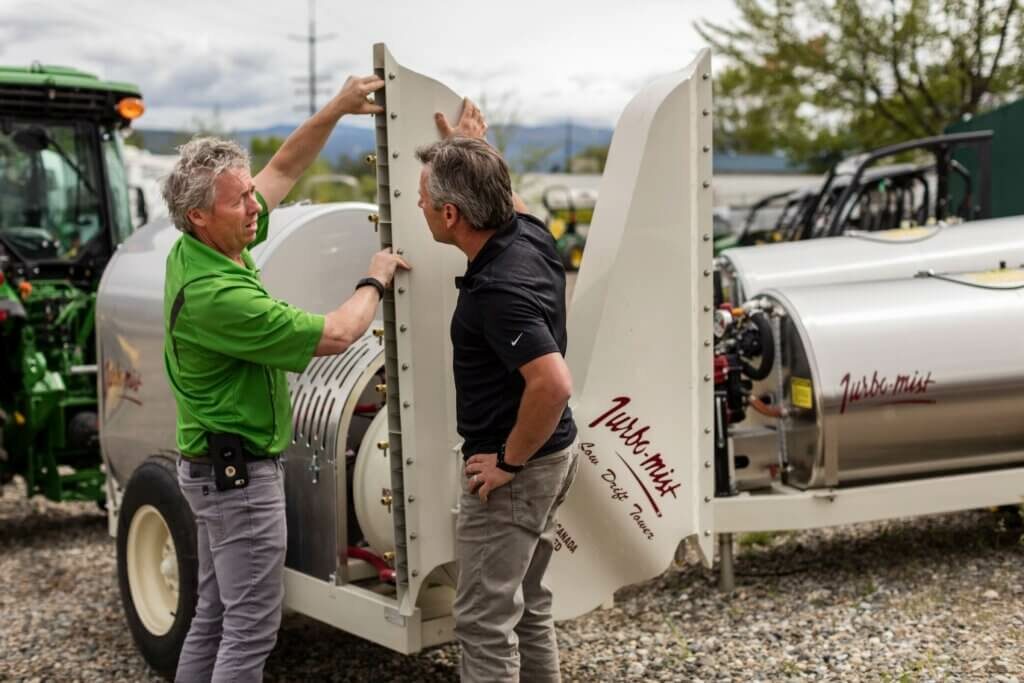
2 men inspecting a vineyard machine

Quality wines start with quality grapes. Quality grapes start with quality care, meaning everything from the soil to the prevention of disease and insect damage. Proper mowers, mulchers and spray systems can help with this process.

Slimline Manufacturing: Go With The Flow

Wayne Riddle sells Turbo-Mist Agricultural Sprayers for Slimline Manufacturing, based in British Columbia, Canada. Slimline sprayers take advantage of the wind’s trajectory, transforming a potential setback into the sprayer’s key feature.

“Any successful chemical application is based on good circulation,” says Riddle. “So, we control the movement of the wind to direct chemically loaded droplets to their target. The terminology that we use is the gear-up, throttle-down method, which is to say that we can speed up or slow down our machinery at the proper times to effectively change the speed and strength of wind flow, which then controls the direction and reach of the applied product. There can be different coverage needs for different areas of the vineyard based on factors like soil type, terrain makeup, disease or insect problems. This is where we need to adjust for different wind speeds to apply the right amounts of chemicals for a particular situation.”

Controlling coverage in this way means less waste, easier maintenance, and more environmentally responsible chemical application.

“This [feature] eliminates chemical waste and saves money on both fuel and equipment wear and tear. The tractor and sprayer don’t have to work as hard, so fuel consumption is more economical,” Riddle says. “We stay socially responsible by using the least amount of product possible and applying it most efficiently and effectively. By approaching spraying this way, we leave less of a carbon footprint.”

Slimline’s Turbo-Mist sprayer systems are made for farms of all sizes, from small hobby farmers to massive vineyards requiring four hundred-gallon sprayers. Riddle told The Grapevine Magazine that no matter the size, Slimline tends to attract forward-thinking, progressive farmers.

When it comes to future trends, Riddle is most interested in the management of the sprayers through the use of a data loaded spray controller and GPS technology.

“It would be extremely useful to load a spray controller with information including GPS data to manage and disperse the gallons per acre needed depending on the agricultural needs, regardless of tractor speed or nozzle wear.

BDi Machinery Sales

Bill Reiss, owner of BDi Machinery Sales of Macungie, Pennsylvania, stresses the importance of quality, easy-to-use spray systems that assist wine growers while letting them do things their way.

“Whether growers prefer a high wire, vertical shoot or another canopy system, it’s all about the delivery of the chemistry [sic] to the intended target while using the smallest possible chemically loaded droplet,” says Reiss. “The canopy style the farmer chooses to use determines the correct spray head for the application. Our CIMA sprayer systems can be fitted with a multitude of available spray heads appropriate for a variety of crops. We pride ourselves in finding solutions to the needs of farmers in America.”

Reiss told The Grapevine Magazine that disease and insects are the most significant problems facing wine grape growers simply because wine grapes aren’t native to the U.S. “Wine grapes need to be treated and monitored, and it’s always better to spray early in the season rather than waiting and trying to eradicate a problem once it shows up. Effective coverage is critical, and it takes better delivery using minimal chemistry [sic], smaller droplets with less overspray to reach the target,” he said.

BDi Machinery sells the Italian-made CIMA sprayer line. These sprayers use an atomizer and air shear nozzle to push the dead air out of the canopy, ruffling leaves as it goes. This movement guarantees the chemicals will hit all surfaces outside and inside the canopy.

“We minimize overspray by opening and closing the atomizer which controls the width and reach of every dispersed droplet,” says Reiss. “Calibration is as simple as tightening or loosening a couple of wing screws on a regulator to get the needed orifice opening for the desired coverage. You can easily change the calibration from field to field, block to block, or season to season with little effort.”

Maintaining CIMA sprayers takes minimal effort, something Reiss feels is pivotal for busy farmers. “Sprayer maintenance needs to be easy, or it simply won’t get done,” he says. “Look for things like rinse tanks and minimal grease fittings. Our CIMA sprayers have only three grease fittings and include both hand rinsing tanks and internal chemical basket mixing systems for chemical safety.”

Electrostatic Sprayers Use Laws Of Attraction For Efficient Coverage

“Honestly, the most important thing about vineyard sprayers is that they need to be reliable and work when we need them to work,” says Mark Ryckman, Sales Manager and co-owner of Progressive Ag Inc., in Modesto, California. “They need to be durable and heavy duty but offered in a simple package so they last while proving easy to operate. Ours are heavily constructed and powder coated to increase their longevity.”

Progressive Ag manufactures indirect charging, electrostatic sprayers in several models. “We put a static charge in each droplet coming out of our machines. Plants and vegetation are neutral, so the droplets are naturally attracted to the plant. With each droplet having the same amount of charge on it, the drops repel and push against each other like some of those magnets we’ve all played with as kids. By pushing against each other, they naturally space themselves apart, making sure the vine coverage is consistent and even,” says Ryckman.“The chemical loaded droplets can be dispersed in larger volumes through larger than the normal pinhole size nozzles. By using larger sized nozzles, we don’t have the plugging issue that standard pinhole nozzles can have. The chemical is then dispersed through air induction instead of pressure sprayed so it can naturally land where the attractive properties of the charged particles take them.”

Maintaining Progressive Ag’s LectroBlast sprayers doesn’t take long, but should be completed daily. Ryckman told The Grapevine Magazine it requires only a five-minute daily greasing along with cleaning the electrodes and regular flushing to “have the sprayer work when you need it.”

Ryckman is excited about future technological trends such as variable rate controls for the spray rates. “Through the use of drones, we’ll be able to locate insect problems or disease and fungus issues in specific locations of the vineyard. We’ll map it out, load it in the controller, and then be able to automatically apply variable rates of material depending on the specific needs of each location, more on the high-risk areas, and less on the areas that are doing well.”

Like Ryckman, Willie Hartman, President and owner of On Target Spray Systems in Mount Angel, Oregon, sees the importance of incorporating computerized rate control programming built through GPS or wheel sensors. “It’s one of the things that customers are continually asking for. They are looking for data and the valuable coinciding reports.”

Hartman also sells electrostatic sprayers for the vineyard and says that, now, more than ever, “It’s vitally important to get a sprayer that provides super coverage. Keep mildew at bay early with complete coverage, over leaves, under the leaves, and wrapping around the plant vines themselves.”

On Target sprayers charge the droplets through induction, meaning the particles run through an atomizer for absolute universal size. They don’t pick up their charge until run through the dispersing nozzle, where they get hit with one thousand volts on the way toward their target.

“We use the least amount of water per acre of all the other types of sprayers right now. With labor costs rising, we can save money on water use immediately. Less overall material to spread means less time on the tractor, translating into fuel savings. By using less water, we can concentrate our spray. When you use concentrated spray, there is less runoff, minimal drift, and improved chemical coverage leading to increased performance. In today’s world, that is extremely important because, with the organic farming push, we’ve moved away from systemic treatments and are now relying on contact treatments,” Hartman says. “Improved concentrations and better overall contact are critical and successful. We know it works because of situations like last year when the East Coast had terrible disease and fungus issues except for the handful of farms that were using our sprayer systems.”

Hartman told The Grapevine Magazine the maintenance step not to overlook is rinsing the sprayer after use. On Target sprayers reflect this belief through onboard rinsing tanks accessible with a flip of the switch. Additionally, all components, including liquid, air and the twelve-volt electric needed for droplet charging are separately enclosed.

Mowers And Mulchers For Ground Level Care

Replacement part availability is magnified when considering agricultural mowers and mulchers simply because of the complexity of these machines.

“It’s a real issue at times,” says Kevin Pereira, sales professional with Woodland, California-based Clemens Vineyard Equipment Inc. “We get calls all the time about replacement parts for mowers and mulchers because growers can’t get the right parts in a timely fashion. Sometimes we can help, but other times we can’t because they bought a machine that may not have a physical presence or supply outlet here in the states.”

Pereira says growers can avoid these issues by buying from an equipment company like Clemens Vineyard Equipment. “We have a tremendous history of over twenty years, with excellent support and a United States warehouse for priority parts availability when needed.”

“Mowers are mowers, and when you get down to it, they all do the same job,” says Pereira, “but parts and available service are just as important as features and pricing. Cheapest isn’t always the best, and in the case of mowers and mulchers, you generally get what you pay for. Clemens mowers and mulchers are built for heavy-duty use featuring long-lasting plates and components, and a premium flex adjustability feature for variances in row lengths.”

Proper mowing and mulching protects roots, increases soil structure, reduces soil erosion and temperature, and increases the vigor and yield of crops. Approach mulching much like spraying chemicals, by formulating a mulch mixture to best suit the needs of the area. Sections of a vineyard that have less than desired growth may need mulches with higher nutrient components, while organic based mulches can assist with water dispersal in lower elevations.

Row mulchers and spreaders save time and labor by efficiently spreading mulch, organics, compost and other soil mixes within vineyards. Since they’re considered specialty equipment, it’s critical that they provide a return on investment. For multiple rows, side mulchers are equipped with either dual or single side dispersing, but if needed, mulchers are available with remote and distance spreading capabilities to get the mulch to the targeted location.

“The type of mower or mulcher you should get is tied to your needs. Do you need to mow weeds and mulch, or mow, mulch and prune? The type and amount of versatility you’re after will make a difference in the machine you need. They’re not all created equal, with some being better at certain functions than others,” Pereira says. “Find the happy medium that fits your budget and priorities, but whatever type you choose, regular maintenance is very important. Daily greasing and a quick visual inspection to spot any excessive wear on parts or components is recommended. Depending on the size of the acreage and amount of use, mower blades should be changed either annually or bi-annually. Bearing checks are always a good idea, and as should be done with all machinery, occasional professional inspections are a good idea.”

Specialty Tractors for the Vineyard

By Jessica Spengler

large vineyard equipment

As mechanization of vineyards becomes the norm throughout the world, equipment manufacturers have seen an opportunity to specialize. Tractors, in particular, are being designed to fit down the narrow rows of vineyards and orchards, as well as with higher horsepower, better versatility and ease-of-use. Now is the time for vineyards to re-invest in a new machine, since industry leaders, including John DeereKubota, and New Holland, all sell models specialized for vineyards and orchards. With a little research and guidance, vineyard owners and managers can easily find the best tractor for their specific needs.

Many wine growers may question why they need specialized equipment when they can just purchase a utility tractor for their farming needs. However, the needs of vineyard and orchards extend beyond those provided by standard utility tractors.

“Many producers have specific crops and specific planting which require special tractor dimensions to operate in those fields, orchards, or vineyards. Although a utility tractor might fit some of these requirements, there will usually be modifications required to make the tractor completely fit the application. Our specialty tractors are designed to fit into those specific applications. Our narrow tractors offer spacious narrow cabs to fit perfectly in vineyard applications along with higher hydraulic flow than a standard utility tractor to meet those specialty implement requirements.” said Tyler Pittson, Kubota M-Series tractors product manager.

Nick Weinrich, Product Marketing Manager for John Deere, said the grapes, in particular, are a significant concern. “Producers, no matter their operation, need a tractor to meet their specific farming practice from horsepower, capability, and fit. In the case of vineyards fit, from a dimension standpoint, is the main need. When talking about vineyards and any other high-value crops, the fruit is the most critical subject, since it can easily be damaged, bruised, or even knocked off the plant if the machines operating in the field come in contact with it. This turns into loss revenue to the producer,” he said.

Essential Feedback

Kubota and John Deere have both sought out feedback from vineyard and orchard managers to improve and design the best machines for their needs.

Kubota found horsepower, comfort and versatility to be a high priority. “Through dealer and customer feedback we have learned vineyard and orchard managers are looking for higher horsepower, more versatile tractors,” said Pittson. “We designed Kubota’s M4N/M5N models to meet their specific needs and harvest demands. Take a seat in any one of these new tractors check out the comfort and space of our cab, and you’ll understand why they stand out against the competition.”  Pittson.

The result was their M series line of tractors.

“The M Series models feature updated engines, intelligently revamped operator stations and improved hydraulics. The M Series specialty models also feature highly versatile transmissions designed to provide superior power and efficiency, for the most rigorous specialty environments. The M4N/M5N tractors are equipped with wet hydraulic clutches standard which improves durability, life, and reduces maintenance. The M4N/M5N narrow tractors deliver Kubota’s renowned M Series power and reliability in tractors engineered specifically for work in vineyards, orchards and other narrow environments,” Pittson told The Grapevine Magazine.

The Kubota M-Series Specialty Tractors Lineup includes the M4N-071, M5N-091, M5N-091 Power Krawler and M5N-111 narrow tractors; and the M5L-111 low profile tractor, the M6L-111 low profile tractor, and the M6H-101 high clearance tractor. The M4 and M5 models are equipped with Kubota’s V-3800 Tier IV engine and redesigned operator stations that enhance ergonomics and efficiency. The M5L-111 low profile tractor has standard shielding and a sloping hood to reduce crop damage.

“Another excellent model that we have is our M5N-091 Power Krawler which has wheels in front and tracks in the rear. This model offers superior traction and better stability than the standard wheeled version for those more performance demanding applications. The Power Krawler can be an essential tool for producers located in rocky and hilly areas,” Pittson said. For pricing and finance, visit your local dealer Kubota dealer.

Ease-of-use was at the top of many of John Deere’s customer’s lists of needs. “The largest hurdles producers are facing today is labor and uptime. They need tractors that work when they need them to, and John Deere has the best dealer network and parts availability to keep machines operating in critical times. To help with labor issues, John Deere manufactures tractors that are intuitive to a range of operator skill sets, as well as comfortable to operate to keep the labor coming back,” said Weinrich.

Years of experience and the time spent gaining insight into the needs of vineyards and orchards resulted in John Deere’s 5 Series.

“John Deere offers a variety of tractors that meet the need of narrow row/vineyards, from our six 5G models ranging from 75-100 horsepower, and then our narrow cab offering on our 5M and 5R models ranging from 75-125 horsepower. The 5G’s can get as narrow as 38.7” which is the narrowest offering in the NA market,” said Weinrich. “Vineyards stand to benefit from these by having a variety of offerings to meet their needs, most of which have the best maneuverability, turning radius, power, and hydraulic capacities in the industry, giving them the performance and productivity they need in the critical times, such as harvest.” Starting price for a base 5G 75 horsepower tractor is around $38,500 up to $58,000 for the 100 horsepower.

Getting Attached

The narrowness and ease-of-use of a tractor mean nothing if it cannot accommodate the implements needed to maintain a vineyard. Both John Deere’s 5 Series and Kubota’s M Series offer attachment capabilities for new and existing implements.

“The compatibility of implements with these tractors is high. Vineyards require a number of unique implements and attachments to maintain, manage, and harvest. Most of their current implements and attachments are compatible with our offerings. The 5Gs can have up to seven mid-SCV’s to attach implements and the highest hydraulic flow in the industry for these implements,” said Weinrich.

“The M Series specialty tractors have more hydraulic valve options, ready to accept implements requiring multiple valves with different flow requirements. The new models offer two self-canceling detent deluxe built-in flow control valves, with an option to add up to five total valves on the M4N/M5N. Each tractor features a Category II three-point hitch with easy adjust stabilizers to handle the wide range of specialty implements,” said Pittson.

Keeping Up With Technology

The newest technologies – from touch screens to remote access to guiding systems – have proven beneficial to growers of all shapes and sizes. John Deere, in particular, has embraced these systems, which feature prominently in their 5R series.

“At this time the 5R narrow cab is the most advanced utility tractor offering with integrated AutoTrac guidance and JDLink. Optional JDLink provides remote access for monitoring critical tractor systems and functions. Machine information and programmed custom alerts can prevent downtime by helping customers avoid equipment failures.   When JDLink is combined with Remote Display Access, producers can give their dealer remote access to the machine to troubleshoot potential problems, provide faster repairs or schedule routine maintenance. The 5M’s also offer a field installed JDLink option,” said Weinrich.

Kubota’s M-series includes a touch screen control panel, optional guidance system, and are designed to maximize the operator’s comfort.

“A redesigned cab on the M4N/M5N models features an updated dashboard with a multi-function, multi-view Intellipanel and LED cluster lighting,” said Pittson. “The M4N/M5N steering wheel has 40 degrees of tilt, making it easier to get in and out of the suspension seat. All of our specialty tractors are ergonomically designed, with all main controls located on the right side.  The narrow cabs feature’s a spacious cab, hydraulic shuttle, and an optional air ride seat. These tractors can also easily be fitted with Auto-Guidance systems and controls.”

Choosing Well

As mechanization grows in popularity, vineyard operators see greater efficiency, less fruit variability, happier, healthier workers, and a bigger bottom line. These benefits only occur, however, when the vineyard owner or manager chooses the right model for the size and needs of the vineyard. Knowing the land, doing the research, and talking to a reputable dealer will make that decision much easier.

Navigating the Minefield of Wine Advertising and Promotion

By Brian D. Kaider, Esq.

corporate man standing in bombs

One of the take-home messages from the State of the Industry address at this year’s Unified Wine and Grape Symposium was that per capita alcohol consumption is flat.  This means that the various sectors of the alcohol industry can only increase sales by re-dividing the pie in their favor.  Although wine and spirits are making headway at the expense of beer, new players in the space, such as hard seltzers and pre-mixed cocktails are carving out their own slices.

One of the areas where wine is losing market share is with millennials, who are adopting wine as their drink of choice at a slower pace than prior generations.  Winning in this sector, and others, will require strong marketing efforts.  But, advertising and promotion in the alcohol industry is a messy affair with wildly contradictory rules in different jurisdictions.

This article surveys the laws in several states, not to provide a complete picture as to allowable advertising practices in the wine industry; that would be impossible, but to highlight some of the issues and how differently they are addressed in different states.

Traditional Ads in Print and Digital Media, Radio, and Television

Generally, traditional ads in these types of media are allowed in most jurisdictions.  However, in the words of the Genie in Disney’s Aladdin, “there are a few provisos; a couple of quid pro quos.”  For example, in Texas, a winery cannot buy title sponsorship of “hotlines” from radio stations where listeners call to hear prerecorded list of events at retail locations.  In Virginia, advertisements in print or electronic media are permitted so long as they are not in publications primarily marketed to persons under the age of 21.  And, in Missouri, emergency legislation was passed in response to Missouri Broadcasters Association v. Taylor, expanding the definition of advertising to include electronic means of dissemination, though this legislation will expire on April 17, 2019 unless further action is taken.

Outdoor Advertisements

Typically, in states that allow the use of billboards for general purposes, they are allowed for alcoholic products, as well.  Maryland requires, however, that the ad specifically identify the supplier and not be for the benefit of a specific retailer.  Texas requires the supplier to get a permit for a billboard if it is within 200 feet of a retailer that sells the advertised product.

Texas also prohibits the use of an inflatable advertisement outside a retailer’s establishment and only allows them indoors if they are not visible from the outside.  Maryland allows the use of inflatables in parades and other functions as long as they not brought to permanent rest in front of a retailer premises.  However, they may be on or near retailer premises if promoting an event sponsored by the supplier and not intended to promote a particular retailer.

In Oregon, a winery may give exterior signage to a retailer, so long as it does not exceed 2,160 square inches in size.  In Virginia, however, a winery may not sell, rent, lend, buy for, or give to any retailer any outdoor alcoholic beverage advertising.In Texas, a winery may display a branded promotional vehicle inside or outside of a retail licensee’s establishment, but for no more than five hours per day.

Cooperative Advertising

In Oregon, a winery may list on its website the retailers carrying its products, but it must include all such retailers and may not include pricing information that would appear to promote one retailer over another.  In neighboring Washington State, wineries can not only list their retailers, but include links to their websites, as well.  The law is silent as to whether all retailers must be listed, but that would certainly be the safest practice.

In Virginia, a winery may not engage in any cooperative advertising on behalf of any retail licensee.  But, in Michigan, while a winery’s advertising material may not include the name of a retailer, it may include that of a wholesaler.  A winery may also pay the cost of painting a wholesaler’s trucks and may supply brand logo decals and advertising mats to the wholesaler at no cost.

Signage Inside Retail Establishment

Most jurisdictions will allow a winery to provide retailers with indoor signage, though paying directly or indirectly for sign location, floor space, shelf space, or other advertising space is a big no-no.  What a winery is allowed to provide, however, varies widely.  In Maryland, the value of any single advertising item may not exceed $150 and the total cost of all advertising at a particular retailer may not exceed $450 without authorization from the Comptroller, which may allow up to $600 on a case-by-case basis.

In Missouri, the total value of all permanent signage and point-of-sale materials given to a particular retailer may not exceed $500 per calendar year per brand, though the signage may include the name and address of the retailer.  In Virginia, a winery may only provide (either for free or for a cost) to a retailer non-illuminated advertising materials made of paper, cardboard, canvas, rubber, foam, or plastic that have a wholesale value of $40 or less per item.  And, in Michigan, a winery may only provide non-illuminated signage less than 3,500 square inches (unless in a sports/entertainment venue) and it may not include the name or address of the retailer.

Coupons

In many jurisdictions, such as Missouri, Texas, Oregon, and California, a winery may not issue coupons for its products.  In Maryland and Virginia, however, coupons may be provided to consumers at the point of sale, through direct or electronic mail, or through print media.  The coupon must have a definite expiration date, require proof of purchase, and require purchaser to be 21 years old or older.  Virginia further requires that the coupon may not exceed 50% of the normal retail price of the item and must be redeemed via mail by the manufacturer or their designated agent, but not by the retailer or wholesaler.

Sweepstakes and Contests

Most states allow wineries to hold sweepstakes and contests.  Generally, in a sweepstakes, every entry has an equal chance of winning, whereas in a contest, the winner is determined by skill, knowledge, or ability rather than random selection.  In states that allow such events, several features are commonly required.  First, consumption of alcoholic beverages may not be an element of the game and alcoholic beverages may not be awarded as a prize, though in California, alcoholic beverages may be included if they are incidental to the total prize package.  Second, participants must be of legal drinking age.  Third, there must be a way to enter without purchase.

Some states have additional requirements.  For example, in Missouri, point-of-sale advertising is allowed only if no value is provided to the retailer for conducting the sweepstakes or contest.  In Texas, prizes cannot be awarded on the retailer’s premises.  In Maryland, proposals must be submitted to the Alcohol and Tobacco Tax Bureau of the Comptroller of the Treasury in time to be approved at least 14 days before the start of the sweepstakes or contest.  Maryland also allows instant winner vouchers, but only if placed randomly in product packages and the retailer has no knowledge of the placement.

In Virginia and California, entry forms may be attached to removable neck hangers, but Virginia requires that they be offered to all retailers equally and each retailer must provide their consent for such materials, whereas California will allow them so long as there is no purchase required to enter.  California also allows codes to be affixed to the original label, container, or packaging that can be scanned by the consumer to enter.  Instant or immediate awarding of a prize is not permitted in California, but, like Maryland, instant notification that a consumer is a winner is allowed.

Novelties

Perhaps the biggest discrepancies, and the most surprising, involve novelty items.  One of the most permissive jurisdictions is Missouri, where wineries may give shirts, hats, bottle openers, corkscrews, etc. to retailers for unconditional distribution to the public.  Even the $500 aggregate limitation on point-of-sale advertising does not apply to these items.

Virginia law draws several distinctions.  Items not in excess of $10 wholesale value may be given to retailers in quantities equal to the number of employees of the retailer present at the time the items are delivered; and the employees can wear or display the items thereafter.  Wineries and retailers may not give such items to customers unless they are participating in a tasting at the retailer’s premises.  Smaller items, such as napkins, placemats, and coasters may be provided to retailers only if they contain a message relating solely to and promoting moderation and responsible drinking.  They may contain the name, logo, and address of the winery, but only if subordinate to the message.  Finally, items such as glasses, napkins, and buckets may be sold to retailers, but the retailer must maintain records of such sales for two years.

In Maryland, promotional items such as paper cups, matches, brochures, napkins, calendars, etc. may be provided to retailers if the advertising is general in nature, does not identify a specific retailer, is provided in “trivial” quantities, and does not relieve the retailer of an ordinary business expense.  Hats, shirts, glassware, etc. must be sold to the retailer at fair market value.

Michigan allows wineries to give matchbooks and calendars directly to customers, if nothing else of value is included. The winery can only give calendars or matchbooks to a retailer for distribution to customers upon written order of the commission.  Nothing of value may be given to a customer.  Other novelty items bearing the winery’s advertising may be sold to retailers only with a written order from the Liquor Control Commission and may not be sold below cost.

Finally, Washington State allows wineries to provide branded promotional items of nominal value, such as lighters, coasters, napkins, clocks, mugs, glasses, bottle openers, corkscrews, hats, shirts, etc. to a retailer, but they must be: used exclusively by the retailer or its employees; include only the advertising matter of the winery and/or a professional sports team for which they have a license; and may not be provided by or through retailers to retail customers.

Conclusion

In a crowded market where every winery is competing against not only every other winery, but every brewery, distillery, meadery, cidery, and other alcoholic beverage supplier, good advertising and promotion is essential.  The issues highlighted in this article represent only a fraction of the issues surrounding the advertising and promotion of wine and do not provide a complete picture of those issues even within the jurisdictions mentioned.  Before engaging in any marketing campaign, it is imperative that a supplier know the laws and regulations affecting their plans.  Consultation with a knowledgeable attorney is always the best practice.

Brian Kaider is a principal of KaiderLaw, an intellectual property law firm with extensive experience in the craft beverage industry.  He has represented clients from the smallest of start-up breweries to Fortune 500 corporations in the navigation of regulatory requirements, drafting and negotiating contracts, prosecuting trademark and patent applications, and complex commercial litigation.

bkaider@kaiderlaw.com

 (240) 308-8032