The #1 Pruning Tool Your Vineyard Needs Right Now

Picture of hand holding INFACO_sécateur_F3020 pruner in vineyard

By: Alyssa L. Ochs

Here at The Grapevine Magazine, we have covered many pruning-related topics for vineyards in past issues, such as pruning techniques, best practices and seasonal tips. But if your vineyard is looking to really improve your pruning practices this year, you may benefit from specific product recommendations from industry experts that can make your life easier by saving you time and money while keeping employees safe.

  For example, a pruning shear called the Infaco F3020 is one of the best products available on the market today for vineyard pruning to consider buying for your wine grape maintenance and upkeep. Two industry experts told The Grapevine about this tool and what vineyard owners should know before buying it. 

Pruning Tools and Techniques

  Pruning may seem simple enough on the surface, but the tools you use and how you train your staff really go a long way in a vineyard. While removing unwanted fruit and foliage, you are also helping to control vine damage, prevent disease and improve your chances for a successful yield.

  The most common vineyard tools used for pruning are hand and lopping shears, but you may also need saws and larger tools for challenging jobs.  

  Safety must always be the top priority while using sharp tools among the rows of grapevines, so it is helpful to be well-stocked with gloves and accessories that make the job easier and more efficient. Meanwhile, properly training your staff members to use these tools can prevent many common pruning-related injuries, such as hand lacerations, strained shoulders and aching neck and back muscles.

  The pruning process is relatively straightforward: remove the canes first, remove the spurs second and ensure all old growth is out of the way of new fruiting canes and renewal spurs. Yet recent innovations in pruning tools make this tedious but necessary maintenance task more productive than ever. 

Infaco F3020 Professional Battery-Powered Pruning Shear

  While researching the latest and greatest pruning tools for vineyards, Infaco’s brand-new F3030 electric pruning shear stood out. After over six years of research, tests and fine-tuning, Infaco released this new and improved version as a follow-up to its F3015 model. The new F3020 builds upon the F3015’s technical base and adds numerous improvements to improve cutting speed and work comfort. It is ideal for vine pruning and is lighter, more compact and easier to handle than the previous versions of the tool.

  Infaco-USA, Inc. carries on the legacy of M. Daniel Delmas, who invented the world’s first electric pruning shear in 1984. The company has designed, produced and sold over 350,000 pruning shears in more than 45 countries.

  “Our founder invented the world’s first-ever electric pruner in response to friends he had in Southern France with vineyards,” Ananda Van Hoorn, operations manager for Infaco-USA, told The Grapevine Magazine. “At the time, they had an incredible labor shortage, and back in the 1980s, pruning was the single biggest labor expense for vineyards, just as it is today. So, the shear he invented was designed to work with all kinds of vineyards – cane pruned, cordons, goblet and so on.”

  Van Hoorn said that the F3020 electric pruning shear increases productivity by an average of 30 percent in a vineyard since users can keep making the same number of cuts per hour all day long.

  “So, vineyards that switch to our shear will find that they don’t need to purchase one shear per worker,” she said. “Instead, some of the workers who were previously pruning will be reassigned to cleaning up canes or other vineyard tasks.”

  Van Hoorn explained how this shear has a built-in safety system, so her top safety tip is simple: use the F3020, and you’ll never have to worry about losing a finger again!

  “The trigger on the new F3020 is metallic and connects to your entire body’s electric system through your trigger finger,” she said. “This means that when you touch the metal blade of the shear to your skin, the circuit is grounded out.”

  She also said that maintenance of the tool is easy and only involves greasing the tool once per day and sharpening it twice daily with the included grease and sharpening stone.

  Among the various pruners and canopy products offered by BDi Machinery, Paul J. Licata, the owner and president of this company, says that the best and most commonly purchased pruner is the battery-powered Infaco F3020. BDi Machinery Sales, Inc. is a complete source for innovative, specialty agricultural machinery and offers everything from pruners to sprayers, hedgers, leaf-removers, shredders, cultivators, mowers, row-mulchers and more. BDi Machinery is an authorized Infaco provider for routine and annual service programs. Licata spoke to this pruner’s cutting speeds, work comfort, compact design and ease of handling. The F3020 is used for pruning during the dormant and growing season. 

  “Loaded with technological advances, the pruning shear can now be ‘connected’ using an optional Bluetooth box,” Licata said. “This new system makes it possible to report highly relevant data in order to achieve ever more effective pruning work.”

  Licata also said that this connectivity option, combined with the Infaco application, can make many adjustments directly from a smartphone, such as adjustable blade opening management, blade crossing and new “soft mode” speed configuration. Additionally, it offers advanced reading and analysis of the data collected during the device’s use.

  “A technology differentiator is the Infaco electronic safety system (DSES) – Wireless DSES/hard-wired DSES,” Licata said. “Infaco has always considered safety to be essential. A true pioneer in the 1990s, it has never stopped investing in cut-prevention solution research for its user clients. The new safety system comprises a conductive trigger that connects the user’s body and the shears’ electronic system, Infaco patents. As soon as the cutting head touches the opposite hand, bare or wearing a glove, the pruning shear instantly opens to prevent injury.”

Pruning-Related Parts and Accessories

  When discussing additional parts and accessories that vineyards may need for their pruning tools, the suggestion of additional head sizes arose. Infaco’s shear is the only electric shear in the world that features interchangeable heads, so the most common accessories that Infaco’s clients buy are additional head sizes to increase their cutting capacity up to 55 millimeters or 2.17 inches.“

  This lets vineyards use the same tool for cane pruning as they do for Eutypa surgery without having to invest in a whole new set; just buy the head!” said Van Hoorn. “We also find some vineyards using our electric shear with the medium head 100 percent of the time. This is because with manual pruning, some vineyards have workers carrying around two different tools that they have to switch between when they identify a larger cut to make. Buying the F3020 with medium head gives workers a 1.75-inch cutting capacity, and they can easily flip between a customized smaller opening and the full capacity. This means that this one tool replaces carrying around a set of pruning shears and a pair of loppers or saw and cuts down on wasted time switching back and forth between tools.”

  BDi Machinery’s Paul Licata pointed out that you can carry the Infaco F3020’s battery in four different ways: on a vest with straps, on the belt without the removable straps, using the trouser belt clip or directly in a pocket thanks to its small format. He also said a new shear holder with a minimal size is secure and easy to use because the cutting head is protected and stored in its sheath with just two steps.

The tool’s main asset is its versatility, thanks to the medium and maxi kits,” Licata said. “It only takes five minutes to easily transform your shears for other occasional or permanent pruning applications. The Infaco design office engineers have completely revolutionized the pole system to propose an innovative and ergonomic solution. Simply clip the F3020 pruning shear to the end of the pole and the battery to the other end: that’s it, the tool is ready for use. Forget the previous cables, and operate your tool using a wireless Bluetooth trigger system. Also, you can keep the blade profile sharp easily and in record time using the Infaco electric sharpener.”

Innovations and Considerations

  Van Hoorn from Infaco-USA told The Grapevine Magazine how you’ll see many things her company offers that the competition can’t match because Infaco has been perfecting its shear for nearly 40 years. This includes the built-in safety system, more accessories to increase the tool’s versatility and the absolute lightest battery on the market that will power a shear for an entire workday.

  “Quality and reliability have always been core concerns to Infaco,” said Licata from BDi Machinery. “From design, through production, then in the after-sales department, it offers users excellent products and services that fulfill the company’s strong values.”

  Looking ahead, Van Hoorn from Infaco shared with us something new that will be coming from the brand in the months ahead.

  “Infaco will be announcing a brand-new tying tool that works with the same battery as our F3020 shear for this spring,” Van Hoorn said. “The new AT1000 electric tying machine is designed specifically for cane-tied vineyards and will be an absolute game-changer!”


New Grapevine Crop Insurance Coverage Now Available

stormy dark skies over a vineyard

By: Trevor Troyer – Vice President at Agricultural Risk Management, LLC

The USDA Risk Management Agency has just released the new Grapevine crop insurance plan.  This has been something that vineyard owners across the US have wanted for years.  Coverage is now available starting for the 2024 crop year. The sign-up deadline is November 1st in all states where it is available.

  The states where you can obtain this new coverage are: California, Idaho, Michigan, New York, Ohio, Oregon, Pennsylvania, Texas and Washington.  It is not available in all counties though.  The counties that are listed in the actuarial documents are not the same as the Grape crop insurance program.  This new program is available for grafted grapevines only in 91 counties.

  What is covered with this new insurance product?  The Causes of Loss that are listed in the Grapevine Crop Provisions are below:

      11. Causes of Loss

      (a) In accordance with the provisions of section 12 of the Basic Provisions, insurance is provided only against the following causes of loss that occur within the insurance period:

(1) Freeze;

(2) Hail;

(3) Flood;

(4) Fire, unless weeds and other forms of undergrowth have not been controlled or pruning debris has not been removed from the vineyard;

(5) Insects, diseases, and other pathogens if allowed in the Special Provisions; and

(6) Failure of the irrigation water supply if caused by an unavoidable, naturally occurring event that occurs during the insurance period.

      (b) In addition to the causes of loss excluded in section 12 of the Basic Provisions, we will not insure against damage other than actual damage to the vine from an insurable cause specified in this section

  The vine needs to be completely destroyed, or is damaged to the extent that it will not recover in the 12-month insurance period from November 30th.

  Any damage other than damage to the grapevine from an insured cause is not covered.  For example, chemical drift, terrorism etc. are not covered.  Failure to follow good farming practices or the breakdown of irrigation equipment are also not covered.

  For the grapevines to be insurable they must be adapted to the area they are being grown in.  They must be being grown and sold for fruit, wine or juice for human consumption.  The vines must be grafted to be insurable as well.  The Crop Year begins December 1 and extends through to November 30 of the following year. You must have a minimum of 600 vines per acre to be insurable also.

  Vines are classified into 3 stages of growth for the policy.  Here are the exact definitions:

      (a) Stage I, from when the vines are set out through 12 months after set out;

      (b) Stage II, vines that are 13 through 48 months old after set out; and

      (c) Stage III, vines that are more than 48 months old after set out.

  Values are determined by the Stage (age) of the vine and the county they are located in.  Obviously Stage III vines are worth more than Stage I vines.  These prices are set by the USDA Risk Management Agency.

  Vines are insured in four different categories; Group A, Group B, Group C and Group D.  Without listing all the varieties in each group, which would take up a lot of space, suffice to say that any variety can be insured.  Group A for example has Concord, Niagra and other natives and some hybrids.  Group B has mostly hybrids such as Chardonnel, Diamond, Elvira, Vidal Blanc but does have some Vitis vinifera like Reisling.  Group C has the most European grapes, Cabernet Sauvignon, Chardonnay, Gamay and others but does have hybrids as well.  The catch all is Group D which has “All Other Varieties”.  You can select a different coverage level for each Group.  You could have 60% coverage on your Group A and 75% coverage on your Group C vines. Depending on which vines you think are more at risk.   If you choose Catastrophic Risk Protection (CAT) level for any vine type then CAT will be applicable for all of your insured vines in that county.

  You can choose coverage levels for your Grapevine insurance from CAT (Catastrophic) to 75%.  CAT insurance is 50% coverage but you only get 55% of that 50% value per vine. Coverage increments are 5%, so you have 50%, 55%, 60%, 65%, 70% and 75%.   There is a sort of a double deductible with Grapevine insurance.  You have a damage deductible and a value/price deductible.  For example, if you choose 75% coverage you would have a 25% damage deductible.  That means that the first 25% of damage is not payable.  So, if you had 30% of your vines killed because of a freeze you would have a payable claim of 5% (30% minus 25% deductible).  There is also a value deductible as well. Again, if you have 75% coverage you would have a grapevine value deductible of 25%. For example, if the grapevine is Stage III in California in Napa County it would be worth $39.  At the 75% coverage level the dollar amount for that vine would be $29.25.

  There is an optional endorsement that changes the damage deductible.  This endorsement does cost a little more but is worth it, in my opinion.  This is called the Occurrence Loss Option or OLO for short.  It changes the damage deductible to a 5% damage trigger.  If your loss is 5% or more of the total value of the vines in a unit you would have a payable loss.  Plus, you are paid on the full value percentage of the loss.  So, if you had a 30% loss, you would get paid on the full 30%.  This does not change the value percentage of the coverage level, if you choose 50% you get that amount.  You cannot exceed the total insured value, Liability, of the vines in any case. 

  OLO has been available for other types of insurance like citrus trees, avocado trees etc.  To keep premiums down growers often elect lower coverage levels with OLO.  That way you are likely to get a claim paid but the premium is not too high, you just get a little less per vine.

  Once you sign up and complete all the forms with your agent, they are then submitted to the underwriter.  The underwriter will open an inspection and an adjuster will come and take a look at your vineyard.  The adjuster will determine if the grapevines in your vineyard are insurable.  The vines could be uninsurable for any of the following reasons.  The vines are unsound, diseased or in someway unhealthy.  They could have been grafted within a 12-month period before the beginning of the insurance period. Or they could have been damaged prior to the beginning of the insurance period.  Once the adjuster has completed the inspection, it is sent to the underwriter and then on to the USDA Risk Management Agency for final approval. 

  If you have damage from an insured Cause of Loss, you should contact your agent to get a claim opened.  It is always best to get a claim opened up sooner rather than later.  48 – 72 hours after discovering damage is best.  I know that a lot of growers want to wait and see how much damage there is before they do anything.  It is always better to get a claim opened up rather than wait and see.  If there is not enough damage then you just let the adjuster know.  After you open up a claim an adjuster should be out within 10 days to inspect the vineyard.  Do not remove any damaged vines until it has been inspected!

  This is a good program, and it will provide protection to vineyards that need to mitigate losses from Freeze, Hail, Flood, Fire etc.  But you will have to determine, with your agent, whether or not it is a good fit for your vineyard.  Some growers and locations have less risk than others.  While some areas are constantly pummeled by the elements and other factors.

Uncorking Accessibility

Ensuring Your Website Complies with the ADA

PICTURE OF KEYBOARD SHOWING ADA ICONS IN BLUE

 By: Vanessa Ing, Farella Braun + Martel

In today’s digital age, having an online presence is crucial for businesses, including wineries, breweries, and other beverage companies. Accordingly, it’s essential to ensure that your beverage website meets federal standards for accessibility to avoid lawsuits and fines. In this article, we will help beverage companies understand how to comply with federal law and implement accessible features on their websites.

Why is Web Accessibility Important?

  In 1990, Congress enacted the Americans with Disabilities Act (ADA). It prohibits businesses open to the public (otherwise known as “public accommodations”) from discriminating against people with disabilities in everyday activities. These everyday activities can include purchasing goods and services, or offering employment opportunities. 

  In March 2022, the U.S. Department of Justice issued web accessibility guidance, reiterating that ensuring web accessibility for people with disabilities is a priority for the Department. Relying on the ADA’s prohibition against discrimination and its mandate to provide equal access, Department of Justice emphasized that the ADA’s requirements apply to all the goods, services, privileges, or activities offered by public accommodations, including those offered on the web. The Department of Justice’s guidance was particularly timely given that many services moved online during the pandemic. 

  In its guidance, the Department of Justice explained that people with disabilities navigate the web in different ways: for example, those with visual impairments might require a screen reader that reads aloud text to the audience.  Those with auditory impairments might require closed-captioning software, while those with impaired motor skills might require voice recognition software.  A website, therefore, should be compatible with the full range of such software. 

Is Your Beverage Company a “Public Accommodation” Business?

  Public accommodations include businesses that sell goods and services, establishments serving food and drink, and places of recreation or public gathering.  Companies that sell drinks, wineries that offer a tasting room, or breweries that host events are all considered public accommodations.  Thus, those businesses’ websites must comply with the ADA by being accessible to people with disabilities. 

  It is an open question whether beverage companies without a physical location open to the public must still have ADA-compliant websites. Some jurisdictions, like the Ninth Circuit (which has jurisdiction over Alaska, Arizona, California, Hawaii, Idaho, Montana, Nevada, Oregon, and Washington), have tied the necessity of ADA-compliant websites to the existence of a brick-and-mortar location (Robles v. Domino’s Pizza, LLC). However, the Department of Justice, along with several federal circuit courts of appeals, has taken the position that even a public accommodation business without a physical location must have an ADA-compliant website. 

  Given the increased prevalence of online-only services open to the public, it is very likely that litigation over the next few years may resolve this open question.  In the meantime, it is wise for beverage companies to take preventative caution and ensure that their websites are accessible. 

What are some Website Accessibility Barriers?

  To ensure ADA compliance, beverage companies must be aware of common website accessibility barriers.  These include poor color contrast, lack of descriptive text on images and videos, mouse-only navigation, and more.  By addressing these barriers, beverage companies can enhance the user experience for people with disabilities.

  Six examples of website accessibility barriers highlighted in the DOJ’s accessibility guidance include:

Poor Color Contrast: Ensure sufficient color contrast between text and background to aid individuals with visual impairments or color blindness. Use color combinations that are easy to distinguish.

Use of Color Alone to Give Information:  Avoid using color alone to provide information.  Using color alone can be very disorienting for someone who is visually impaired or colorblind.  Someone who is colorblind might not be able to distinguish between shades of gray.  One solution might be to ensure that symbols conveying information are differently shaped.    

Lack of Descriptive Alternative Text for Images and Videos: Provide descriptive text (alt text) for images and videos, allowing screen readers to convey the information to visually impaired users. This makes your content more accessible and inclusive.

No Closed Captions on Videos: Include closed captions for videos to accommodate individuals with hearing impairments. Utilize manual or automatic captioning options and review the captions for accuracy.  Free options are available on the web.

Inaccessible Online Forms: Make online forms user-friendly for people with disabilities. Provide clear instructions before the form, ensure that a screen reader could recognize required fields and fields with special formatting, ensure keyboard-only navigation, use accessible labels for inputs, and display clear error messages.  Note that an image-based CAPTCHA is not a fully accessible way to secure your form; your CAPTCHA should offer users who are visually impaired an audio alternative.

Mouse-Only Navigation: Enable keyboard-only navigation on your website to assist individuals with motor skill impairments or those who cannot use a mouse or see a mouse pointer on the screen.  Make sure all interactive elements can be accessed using the tab, enter, spacebar, or arrow keys.  Use a “Skip to Main Content” link to ensure that users employing only a keyboard can easily navigate the website’s primary content. 

  To implement these features, beverage companies should discuss accessibility concerns upfront with the web developer.  Beverage companies should keep in mind that posting a phone number on a website to call for assistance, as commonly utilized by businesses, does not sufficiently provide equal access to the website and the services or goods provided.

Who can Sue Beverage Companies?

  Non-compliance with ADA standards can lead to potential lawsuits.  Although some courts have held that a nexus must exist between a private plaintiff’s disability and the web accessibility barrier claimed, a private plaintiff may easily surf the web for websites that are inaccessible.  A private plaintiff may then file a lawsuit in federal court without first notifying the business.  Further, liability under the ADA is strict, which means that the intent of the business to comply is immaterial.  Thus, it is prudent for beverage companies to proactively address accessibility issues to avoid potential legal troubles. 

  Private lawsuits under the ADA can result in injunctive relief (a court order to comply with the ADA) and attorney fees.  And in some states, like California, the state law version of the ADA may enable plaintiffs to demand monetary damages ($4,000 per violation of the ADA). 

  Government involvement, while less frequent, is possible in cases involving national retailers.  If the Department of Justice observes a pattern or practice of discrimination, the Department will attempt to negotiate a settlement, and may bring suit on behalf of the United States. At stake are fines of up to $75,000 for the first ADA violation, and up to $150,000 for each subsequent violation.

What are the Rules for Website Accessibility?

  Although the ADA itself does not spell out the rules for website accessibility, several sources provide detailed rules that can aid beverage companies in building accessible websites. 

  First, the ADA authorizes the Department of Justice to enforce the statute.  Accordingly, the Department develops and issues regulations explaining how businesses must comply.  Specifically, § 36.303 of the Electronic Code of Federal Regulations specifies that a public accommodation shall provide auxiliary aids and services when necessary to ensure effective communication with people with disabilities, and that a public accommodation should consult with people with disabilities whenever possible.  The Department also issues administrative guidance, such as its March 2022 guidance described above.  

  Second, Section 508 of the Rehabilitation Act of 1973, which requires federal agencies to make their electronic and information technology accessible to people with disabilities, provides detailed guidance concerning the display screen ratios, status indicators, audio signals, and other accessibility features. 

  Third, the Web Content Accessibility Guidelines 2.1 (WCAG 2.1), which were originally designed by a consortium of four universities, provide highly specific web accessibility guidelines grounded on the idea that information on the web must be perceivable, operable, understandable, and robust.  These guidelines are widely referenced in court cases and settlements with the Department of Justice, as the guidelines address numerous aspects of web accessibility and offer three different levels of conformance (A, AA, AAA). Beverage companies can consult the WCAG 2.1 guidelines (including a customizable quick reference guide, at https://www.w3.org/WAI/WCAG21/quickref/) to ensure their websites meet ADA compliance. 

Looking Ahead

  Web accessibility standards evolve over time, with updates being released periodically. Beverage companies should stay informed about changes and updates to ADA compliance regulations. For example, the WCAG 3.0 is scheduled for release in the latter half of 2023, further refining accessibility guidelines.

  In sum, by understanding and identifying web accessibility barriers, and implementing necessary accessibility features, beverage companies can enhance user experiences and minimize the risk of legal repercussions. Embracing web accessibility is not only legally required but economically prudent in the long run, as it enables beverage companies to cater to a broad and varied audience, and demonstrates a commitment to inclusivity in the digital realm.

  Vanessa Ing is a litigation associate with Farella Braun + Martel and can be reached at ving@fbm.com. Farella is a Northern California law firm representing corporate and private clients in sophisticated business and real estate transactions and complex commercial, civil and criminal litigation. The firm is headquartered in San Francisco with an office in the Napa Valley that is focused on the wine industry.

Update on Grapevine Plant Quarantine and Certification Programs

healthy nursery row of grapevines

By:  Judit Monis, Ph.D. – Vineyard and Plant Health Consultant

New methods are being applied for the testing of imported plants and the certified foundation mother blocks at the University of California at Davis that manages the foundation blocks for the California (CDFA) certification program.  After so many years of considering the biological indexing technique a gold standard, the methodology has been replaced with modern technology that is able to detect any virus in the propagation material.  Furthermore, due to the infection and spread of Grapevine red blotch virus (GRBV) in the former CDFA (Russell Ranch) certified foundation block, new measures are being applied to avoid that the problem occurs again. 

Plant Quarantine Programs

  Plant quarantine programs have been developed worldwide to reduce the risk of introducing foreign plant pests and/or pathogens not found in a particular state, country, or region.  My expertise is plant pathology and throughout my career I have specialized in the application and development of methods for the detection of bacteria, fungi, and viruses that cause diseases in vineyards and fruit orchards.  In spite of the current existence of plant quarantine programs, most grapevine pathogens with rare exceptions occur in all grape growing areas in the world.  The reason is that in most cases, quarantine programs were implemented after the introduction of the infected plant material.  In addition, modern techniques for the detection of these pathogens were not available at the time of plant introduction. In other words, the majority of grapevine pests and pathogens were moved unknowingly.  The advancement of science and the use of sophisticated detection methods for grapevine pathogens and isolation has helped keep certain viruses outside of Australia.  For example, Grapevine fanleaf (GFLV) has not been reported in Australia as of yet.  Presently, with the use of advanced methodologies, new pathogens continue to be discovered. As science progresses with the development of more refined technology (e.g., next generation sequencing also known as high throughput sequencing), it is expected that new (or unknown and established) pathogens will be discovered. In practice, most grapevine pathogens have originated at the centers of origin of Vitis species (a plant genus that includes both table, wine, and rootstock grapevine varieties) and moved to many grapevine growing areas of the world during plant introduction. 

  In the United States, the United States Department of Agriculture (USDA) Animal and Plant Inspection Services (APHIS) Plant Pest Quarantine (PPQ) unit regulates the introduction of plant material for planting from foreign countries.  However, the USDA does not have a centralized government plant quarantine center.  Instead, the APHIS PPQ  issues permits to specific clean plant centers with proper containment facilities and approved protocols to manage the quarantine of specific crops. For grapevines, two importation centers are available for introducing quarantined planting material: The Foundation Plant Services (FPS) at the UC at Davis and the Clean Plant Center at Cornell University in Geneva, New York.  

Grapevine Certification Programs

  Grapevine certification programs are needed to produce tested plant material that is free of important known pathogens.  These plants are then distributed to nurseries that propagate and sell these plants to growers.   In the United States, certification programs are voluntary and are managed by individual states.  I will describe the California certification program as many US grapevine growing regions purchase planting material from California nurseries. 

  The Grapevine California Registration and Certification (R&C) Program was first written into law in the 1980’s.   The Grapevine R&C Program is administered by the California Department of Agriculture (CDFA) and provides for the testing of source vines for grapevine viruses that cause important diseases. Registered sources and certified nursery stock are periodically inspected by the CDFA staff and are maintained by the participant nurseries.   Starting in 1996, I participated and provided input at the industry meetings that lead to the revision of the California Grapevine R&C program many years later.   In 2010 the Grapevine R&C program was revised to include testing of foundation mother vines for the presence of a comprehensive list of viruses.

  The California Grapevine R&C Program rules can be found in CDFA’s website:  https://www.cdfa.ca.gov/plant/pe/nsc/nursery/regcert.html

  With funding from the National Clean Plant Network, a new of foundation block named Russel Ranch was planted at the UC Davis in 2009.   The planting material (both scion and rootstock varieties) included in the new foundation block had to pass a rigorous testing program and have been propagated using the “apical micro-shoot tip culture” technique.   The apical micro-shoot tip culture process is a plant tissue culture technique that is used to eliminate pathogens from vegetative propagated plant material.  The testing program at UC Davis is known as Protocol 2010.  The maintenance and testing of the scion and rootstock mother blocks are performed by UC Davis FPS personnel.  Shortly after the update of the California Grapevine R&C Program, GRBV, a virus of significant importance for the vineyard industry, was discovered.  Consequently, the California Grapevine R&C Program was revised to include the testing of foundation and nursery increase blocks for the presence of GRBV.  Sadly, the Russell Ranch foundation block became progressively infected with GRBV.  The infection status was so high that FPS had to suspend the sale of plant material to nurseries. 

  The testing of the foundation mother plants includes a list of well characterized viruses, Xylella fastidiosa, and phytoplasmas using biological, serological, and molecular testing techniques (https://fps.ucdavis.edu/fgr2010.cfm).  The nursery increase blocks are inspected and tested by CDFA personnel with a reduced number of pathogens.  The updated Grapevine R&C added the testing for the detection of GRBV using the polymerase chain reaction (PCR) to vines in the foundation and nursery increase blocks.  Related to nursery certified plants, the rules are vague and state that certified plants may be tested (particularly if after inspection suspected symptoms are observed).  According to CDFA, the goal is to test a statistical sample with a 95% confidence level assuming a 1 % disease incidence.  It is disappointing that in spite of the importance of the decline and canker diseases caused by fungal pathogens (and how easily the pathogens can be transmitted by activities carried out at the nursery), the regulations do not include inspection or testing for fungal pathogens in foundation or increase blocks. 

  The use of certified material is expected to be less risky than planting field selections of unknown infection status.  However, it is always prudent to consult with me to assure that the planting material meets the expected cleanliness standards. An important piece of advice when working on the procurement of clean planting stock is to plan in advance.  Most nurseries in California collect cuttings for budwood as soon as the vines are dormant.  However, grafting activities are performed during the spring of the following year.  Planning with time will allow for inspection of the increase blocks early in the fall before a freeze.   Being familiar with the nursery’s operations and their staff is important.  Good communication will help with scheduling inspections and testing of the increase blocks from which bud wood and rootstock cuttings will be collected. 

Changes in the Testing and Management of UC Davis Grapevine Foundation Block and Introduce Quarantine Plant Material

  The FPS laboratory at UC Davis performed comparative studies between the traditional biological indexing technique and the high throughput sequencing (HTS) methodology.  To refresh my readers, the biological indexing technique or commonly known as woody indexing is an ancient method that relies on the grafting of grapevine (or other woody species) material onto an indicator host.  An indicator host, is a plant variety that is very susceptible to the disease we wish to detect.  For example, the indicator host for grapevine leafroll disease is  Cabernet Franc.  To perform the assay, buds from quarantine or foundation plants are grafted onto the indicator plants.  After a period of time (generally two years) the symptoms of the grafted plants are recorded. If the  buds of the grapevine plants that we wish to test for are infected with a virus that causes red leaf discoloration, and successfully transmits the virus to the indicator plant, it is concluded that the test vine is infected with a Grapevine leafroll associated virus (GLRaV). 

  However,  GRBV also causes red leaf symptoms in Cabernet Franc and other red grape varieties, therefore the test vines could be infected with GRBV.  In more simple words, the biological indexing technique is able to detect disease symptoms and not a particular pathogen that causes it. As long as there is a detection, there is no problem.  The problem occurs when a vine is infected but no symptoms are visible in the indicator plants.  In this case, the vines would be considered healthy and will spread a disease-causing agent.  After a series of experiments and discussions with regulators at USDA APHIS PPQ and CDFA, UC Davis FPS personnel have been able to implement the use of HTS instead of the woody indexing assay. This is a welcomed change I sincerely never expected to happen during my professional life! Another important needed change in the management of the UC Davis foundation plants is the construction of an insect-proof greenhouse that will host the CDFA certified mother vines.  The greenhouse is expected to be finished by the end of 2023.

Conclusions

  Diseases, pathogens, and/or their vectors do not know or respect the borders between blocks (at the nursery, foundation block, or your vineyard).  Even if the planting material came from a reputable certification program, paying attention to the surrounding vineyards as well as having knowledge of the potential presence of disease prior to planting is important.  The planning of a new vineyard is not trivial and requires specialized knowledge.  I am available to help look for suspicious symptoms (inspect scion and rootstock source blocks), evaluate the planting site, develop a testing plan based on science and statistics, and review nursery and vineyard disease testing history.  

  Judit Monis, Ph.D. provides specialized services to help growers, vineyard managers, and nursery personnel avoid the propagation and transmission of disease caused by bacteria, fungi, and viruses in the vineyard.   Judit (based in California) is fluent in Spanish and is available to consult in all wine grape growing regions of the word.  Please visit juditmonis.com for information or contact juditmonis@yahoo.com to request a consulting session at your vineyard.

Moving Wine in the Cellar

row of wine tanks in winery

By: Tom Payette – Winemaking Consultant 

Transfers are a large part of the day to day operations in the cellar and on the crush pad; yet, few documents exist what should be considered when doing transfers.  Below are some ideas and tips to think of when transferring wine or juice at the winery.  It is assumed the pump, hoses and receiving vessel(s) are all appropriately clean for the endeavor at hand.

Venting

  Always vent both tanks and double check this operation is done.  Often I will not only remove the airlock but I will unlatch the lid and flip the threaded latch inward so the tank top rests on top of the handle.  This is just double assurance the tank I am transferring from and to is completely vented.

Assembling Your Hoses

  Always place the pump as close to the tank you are coming from with as little hose as reasonably needed to get the job done.  Do plan for being able to gently bend or curve the hose into the doorway in the event a racking is being done.  Plan enough hose length for other future transfer needs when feasible.  Also make sure to place the pump away from any water such as wash down areas or leaky faucets etc.  These pump motors are electric and they generally are not made to be soaked with water.

Taste

  Before you start the pump – taste the tank or barrels you are about to transfer or rack.  Confirm it is indeed the wine / product you are interested in moving.  Does it taste clean and what you expect?  If not – contact someone above you on the winemaking ladder to confirm the flavors etc.

Checking the Connections

  Always double check your connection to confirm the hoses run from the tank desired to the receiving vessel selected.  Are the connections secured?  Should you attach to the racking valve of the tank you are transferring from?

  Are the lines secure at the pump?  Is the bypass on the pump, if equipped, open or closed?  Is there enough capacity in the receiving tank and did you look inside both tanks when you were venting them?

Valve at the Pump

  For control I typically prefer to have a valve installed at the pump.  This allows one to turn off the pump and immediately confirm the stop of liquid flow through the pump and lines set up.  (Note: this is not done if transferring must.)

Pump Choice

  The pump choice is often related to the wine and the overall goal of the transfer.  If speed is needed – choose the fastest pump.  If gentleness is desired – use your most gentle pump.  A centrifugal pump can be very gentle but it may not be the best choice for a red wine “pump over”, etc.  Know what limits each pump has and generally how they operate etc.

Staying with Your Transfer

  Never leave your transfer.  This is not the time to walk off into another area and to get distracted.  A racking valve could inadvertently be left open or a door leak could be discovered.  If a phone call, or other distraction, should come in that has you leaving the area – stop the pump and close all valves to the tanks.

Main Goal

  Keep in mind the main goal of the transfer.  If the wine is a delicate wine – use the inert techniques you have at your disposal.  This could include gassing your lines, with carbon dioxide or your inert gas of choice, before pumping liquid.  Gassing your receiving tank, as well, can limit exposure to oxygen.   If the wine needs a touch of air – use techniques that may achieve that goal.  An example may be splashing into a macrobin, or other open vessel, to give some air.  Be careful here.

Oxidation Control (Inert Technique)

  Is oxidation a concern during this transfer?  If so – many winemakers will flush their hoses and receiving tank with an inert gas such as Nitrogen, Carbon dioxide or Argon.  This can be done by simply connecting the hoses to the pump, opening the bypass and flushing the inert gas from the receiving line all the way through until you are comfortable the inert gas has reached the far side of the  transfer connections.  Then attach the hose to the bottom valve of the receiving vessel.   Further protection can be gained by flushing out the tank with an inert gas as well.  [Many wineries now have the ability to make dry ice (carbon dioxide) on site and they will place dry ice in both vessels while the transfer is being done].  These processes can be used on juice transfers also – not just wine!

Air – introduction

  In some cases you may want some air introduced into the wine.  If that is the objective you do this by attaching to the racking valve of the receiving tank at the start of the transfer.  Splashing will occur, in the receiving tank, until the wine reaches that point, of course.  This is a small amount of air especially when working with a “tight red”.   Other more severe forms of air introduction can be achieved with splashing into a bin and transferring out into the receiving tank, splashing into the top of the receiving vessel or starting the transfer and throttling back the valve on the suction side of the hose (positive displacement pump only) while slightly cracking the hose connection to allow air to suck in.  [Please have an experienced winemaker present to justify how or if these processes should be done as described in this section].  One could also assemble a special “T”, with valves, for more precise control on the suction side of the pump.  This process may be hard on the pump and damage it if not done properly.

Sloppy Racking

  This is often a term one will use when the amount of solids that may come over into the receiving vessel is not that large of a concern.  Examples of this may be when racking off a white juice after cold settling.  We want to make sure we retain as much of the saleable volume as possible so we may elect to have small portions of solids come over into the receiving tank.  [This is less of a worry if we have a Lees Filter Press is on site]

  Another example may be when racking off bentonite.  Small amounts of the fluffy bentonite layer may be allowed to transfer over, again, to make sure we retain as much saleable volume as possible but not jeopardizing the heat/protein stability of the final wine in the receiving tank.  Don’t get carried away with this concept but don’t be wasteful either.  It’s a balance.

Listen

  I often relate to new winemakers in a manner that tell them your senses are incredible when working in a winery.  Your eyes are a large part of seeing that the transfer is happening as planned but your ears can also be a huge part of catching problems. 

  Always stay near by the tank and listen for falling liquids, pump noise changes etc.  Once wine or juice has filled past any possible orifices, and no leaks discovered, then one can more freely move around the cellar with periodic checks.  Do not completely leave the area and always “have an ear on the situation”.

Watch

  Many wineries have translucent hoses.  Watch the liquid as it moves through the lines.  Do you see air?  Why?  If the wine lines start to contract or expand – take note as to why.  Did someone close a valve or has some other physical function changes the stature of the hoses.  Hoses typically don’t move, without reason, so be aware visually to this indicator something is happening.

Chasing Your Liquid

  At the end of the liquid transfer you may wonder how to empty your lines.   If you have a bypass you can often hook up an inert gas and push the liquid all the way through.   If you don’t currently have that option you can attempt to “push” the juice or wine with chlorine free water.  Simply place the suction line in water, after the wine or juice has vacated enough internal line, and allow the water to run through the pump.   Look through the hose to understand when the water reaches the receiving tank and then turn the pump off and shut the tank valve.

Never Run Your Pump Dry

  In most cases we all agree not to run your pump dry.  The pump needs liquid in order to make sure heat is not created.  There are variable options to this statement so if unclear …. Never run your pump dry.  That is the safest bet.

Summary

  Transfers are a large part of moving your precious liquids around the winery.  Stay nearby, listen to the equipment while visually looking for leaks.  Also – know what your goals are.  This should not be a mindless transaction in the cellar and the more you think through your goals for each wine the more creative ways you can achieve them even during these everyday tasks.  This is part of the winemaking process.

Other Helpful Tips

  Recall no hoses should leak in the cellar.  The paths for these leaks are areas for bacteria to breed and grow.  Further understand a leaking hose on the discharge side of a transfer wastes wine; but a leaking hose on the suction side of a transfer will mostly introduce air and possibly bacteria.   Oouch.

  When starting a racking I like to attach all the hoses and then open the bypass on the pump (if equipped) without starting the pump.  I then open the valve on the tank to be transferred.  This allows the winemaker to track the liquid, see that all valves are open and working, look for initial leaks and confirm all is performing well before turning the pump on.  It is very gentle and should minimize air, oxygen or gases from being dissolved in the liquid.

  In general, winemakers typically transfer out of the racking valve of the tank being racked from and into the bottom valve of the receiving tank.  There are, or can be, exceptions to this rule.

  Take into consideration the temperature of the juice or wine. As a reminder cold liquids dissolve more gases into them than warmer liquids.  Therefore a colder wine / juice may dissolve more oxygen than a warmer liquid.  

  Always clean the tank you emptied right after it is empty.  It cleans up so much better and actually saves time in the long run. 

  A racking is typically a term used when the transfer is started from the racking valve and then finished while “pulling the liquid” through the side doorway of the tank.  One typically uses a flashlight to discern the solids layer while obtaining the clear liquid.

  A transfer is often a term when going from the bottom valve of one tank to the bottom valve of another.  Still being cognizant of solids at the bottom but understanding the wine / juice is generally “clean”.

  Be sure to record all transfers: recording the tank transferred from (varietal and vintage), the volume(s), the receiving tank, date and gains or losses.

  If racking barrels you should taste each one of them first.  It is not uncommon to find the last barreled filled previously is more “reduced” than the others due to more solids in that barrel.  If this proves to be the case I will either rack that barrel first, with most of the air becoming in contact with that volume, or treat it for the reduction and rack it first.  In any case this may slightly mitigate some of the reduction.  Plus – if one barrel is not what you expect – you want to identify that before you pump it out into a larger blend.

  Have fun and make sure your transfers are successful, with intention and objective and with as little liquid on the ground as possible.  You are “pumping money around I like to say”!

References: 

  Verbal discussion with Mr. Jacques Boissenot, Mr. Jacques Recht, Mr. Chris Johnson and Mr. Joachim Hollerith.

Maximizing Weed Control with Herbicides

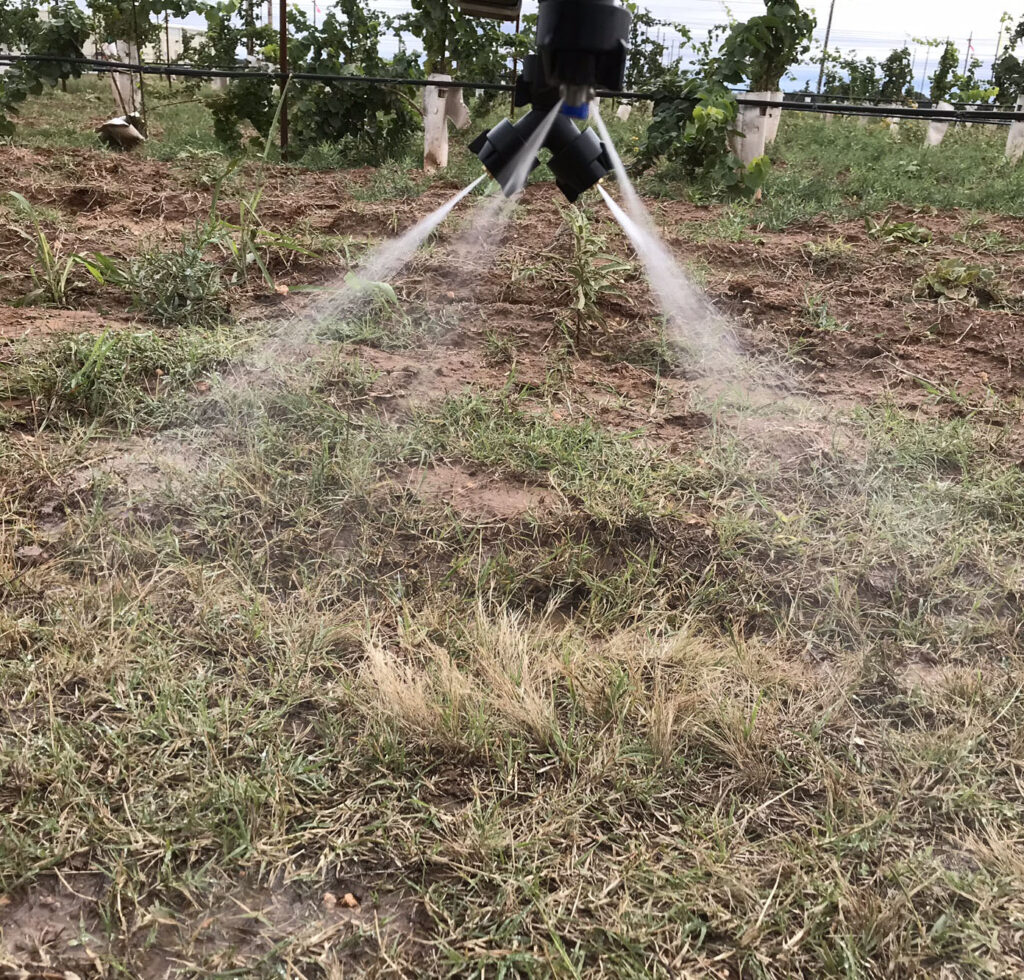
Image of double regular knozzels spraying down into vineyard

By: Kirk Williams, Lecturer-Texas Tech University

While there are many methods to control weeds, weed control with herbicides remains a viable option due to its lower cost versus other options such as mechanical cultivation.  When herbicide applications are done efficiently it can be a much faster process when compared to mechanical cultivation. 

  Application of herbicides through nozzles is important for correct herbicide distribution and dosage over the target.  The target could be existing weeds in the case of post emergent herbicides or the soil surface with pre-emergent herbicides or a combination of both existing weeds and the soil surface in the case of tank mixing post emergent and pre-emergent herbicides.  Coverage is critical for herbicides to work effectively.  Hydraulic spray nozzles create a wide range of droplet sizes.   These droplets are measured in microns with droplets from 200 to 400 microns considered the most appropriate size for herbicide applications.   Larger droplet sizes may bounce or roll off leaves while very fine droplets are more prone to drift.

  To provide satisfactory results, recommendations from Syngenta, one of the manufacturers of water sensitive cards, is to have 20 to 30 droplets per square centimeter for pre-emergent herbicides. For post emergent herbicide applications, it is recommended to have 30 to 40 droplets per square centimeter.   A square centimeter is about 1/6 of a square inch. 

  One way to increase and improve coverage in herbicide applications is to use a double nozzle body.  This allows two nozzles to occupy the same space as one nozzle.  The double nozzle body allows you to easily increase the volume of coverage no matter what kind of nozzle you using. This is especially true when you have to use a relatively large spray nozzle to apply higher volumes.  Larger sprayer nozzles tend to produce coarser droplets.  Splitting the required flow into two nozzles can produce an efficiency gain by decreasing the number of coarse droplets.  The double nozzle body also helps with increasing droplet coverage of target.  (See the double nozzle body set up in Image 1).

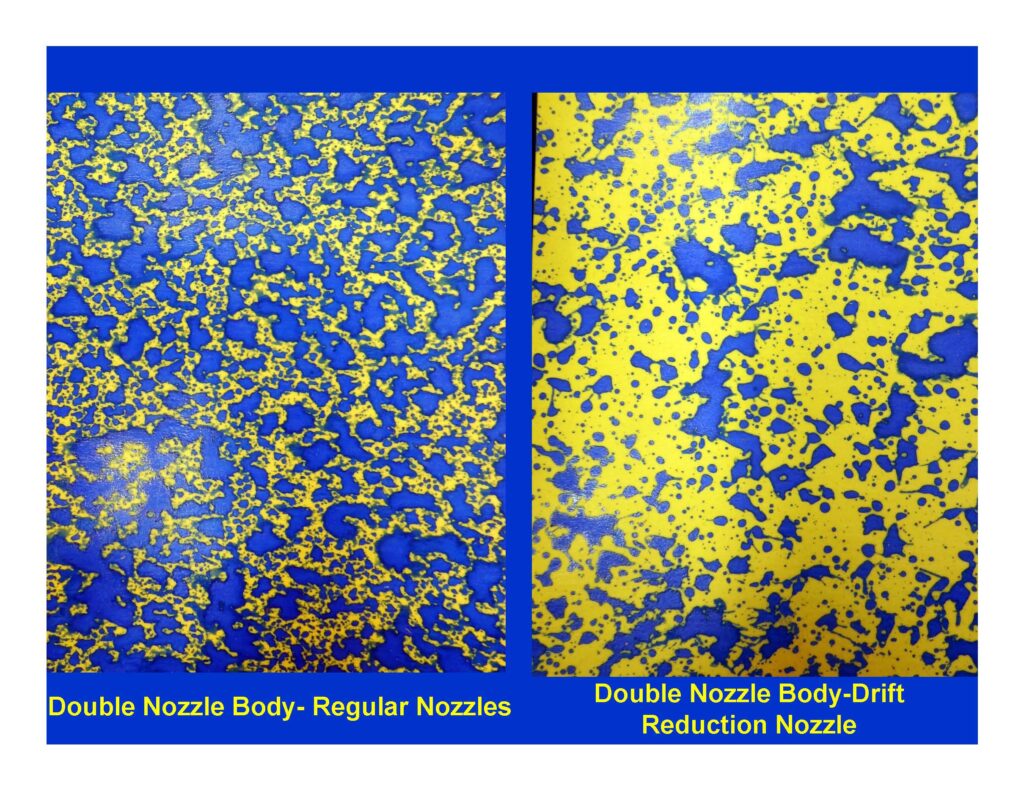
  It was found in a study with water sensitive cards that coverage was increased by 20% when double nozzle bodies were used when compared to single nozzle bodies.   The study used regular flat fan off center 03 nozzles, calibrated to deliver 47 gallons per treated acre and the water sensitive cards were placed on the berm underneath the grape vines.   While the double nozzle body had higher coverage the droplets per square centimeter went down due to the droplets running together versus the single nozzle body.  The single body nozzle had 43 droplets per square centimeter while the double body nozzle had 17 droplets per square centimeter but the droplets are much bigger.  (See the water sensitive cards in image 2).   While the droplets per square centimeter are out of the recommended range for droplets per square centimeter for herbicides with the double nozzle body the better coverage should result in similar or better weed control with both pre-emergent herbicides and post emergent herbicides. 

Regular single nozzle setup compared to double nozzle body regular nozzle

  Herbicide application technology has improved with a wider selection of nozzles available.  Adoption of these newer type of nozzles has been widely adopted in row crops but may be not as widely adopted for vineyard herbicide applications.  These newer type nozzles reduce drift but still deliver good weed control. 

  Air Induction nozzles are a newer type of nozzle that are available in a wide range of spray tips.  The air-induction nozzle is noted for producing large drops through the use of a venturi air aspirator. The venturi draws air into the nozzle through holes in the side of the nozzle and then the air is mixed with the solution to create larger spray droplets, which reduces drift potential.   These larger droplets are filled with air bubbles and explode on impact with the target surface and produce coverage that is similar to other nozzle types. 

  Many sustainable grape growing standards include drift management as a component of their plans.  The incorporation of air induction nozzles that reduce drift by reducing the number of fine, drift prone droplets could be a part of meeting the requirements of these standards.  Drift reduction is important during the growing season to reduce phytotoxicity due to herbicides.  When herbicide applications take place in the in dormant season, phytotoxicity to the grapevines is not an issue but with the wide spread adoption of cover crops, herbicide applications need to stay where they are intended to be, so they don’t impact the cover crops.     

  In a study, double nozzle bodies were equipped with air induction under banding nozzles (AIUB8503), calibrated to deliver 44 gallons per treated acre.  Water sensitive cards were placed on the berm underneath the grape vines.  This nozzle configuration delivered 56% coverage of the water sensitive cards and produced 26 droplets per square centimeter.  As you can see, in the water sensitive cards in (image 3) the droplets produced are large with few small droplets.  The droplets per square centimeter are in the recommended range for droplets per square centimeter for pre-emergent herbicides but outside of the recommended range for post emergent herbicides.  The coverage produced should result in similar or better weed control with both pre-emergent herbicides and post emergent herbicides when compared to the regular nozzle set up.  The air induction nozzles will also produce a minimum of drift prone fine droplets.  

Double nozzle body regular nozzles compared to double nozzle body drift reduction nozzle

  Adoption of double nozzles bodies into your herbicide application program will increase coverage for both pre-emergent and post emergent herbicides.   Switching to air induction nozzles is one way to make sure the herbicides that you are using stay where they are intended to.   

  In addition to coverage and nozzle selection, don’t forget about integrated weed management principles.  These principles include knowing and correctly identifying your weed problems so that appropriate herbicides can be chosen.  Controlling weeds when they are small when they are more susceptible to herbicides and easier to have better spray coverage.  Another integrated weed management principle is to keep annual weeds from going to seed which reduces the weed seed bank in the soil.   Other principles include rotating among herbicides with different modes or action or tank mixing herbicides with different modes of action together which helps manage weed population shifts as well as herbicide resistance.  Staying clean is easier than trying to clean up a mess, so pre-emergent herbicides may help to keep the vineyard berms clean.  

  Kirk Williams is a lecturer in Viticulture at Texas Tech University and teaches the Texas Tech Viticulture Certificate program.  He is also a commercial grape grower on the Texas High Plains.  He can be contacted at kirk.w.williams@ttu.edu

Wine Tasting Trials

a women in a lab coat standing in front of a table with several beakers of fluid and a syringe

By Thomas J. Payette, Winemaking Consultant

While in the wine business struggles often start with speaking and working in the odd amounts that we often hear in conversations with other winemakers.  Trials and fining agents are riddled with unfamiliar language and terms to many winemakers.  Grams per liter, pounds per thousand gallons and milligrams per liter project off most winemaster’s tongues as if the world is in tune.  Let’s review how to make this simpler and to understand.

When?  We should perform trials anytime a question is raised about how to improve or change a wine.  If a wine has a problem – identify the solution in a laboratory first.  Then apply the desired corrective action in the cellar.

Why?  The reason we do trials is to experiment with refinement and correction of a juice or wine.  Always work in small quantities with a wine so one does not create a larger problem, in a tank, in need of potential further corrective action.  These trials can be tasted and evaluated to see what the results would or will have been if the addition were made to the actual tank or vessel of juice/wine.  This eliminates guesswork and unnecessarily “shooting from the hip.”

Where?  One should do these trials in the laboratory where control, on a small-scale amount of wine, is essential.  The opportunities of what one can discover in the lab are almost endless.  Let’s always make our mistakes on a small scale in the laboratory before stepping into the cellar for any actions that may change the flavor, aroma, or chemistry of any juice/wine.  This lab area should be designed for this feature of experimentation. The metric system will be used.  Once this is attempted, one will not step back into some of the complicated aspects or other forms of measurement.  These trials can be used for many things including but not limited to sugar additions, acid additions, fining agents, concentrates, de-acidification’s etc.

Tools Needed

•   Scales that measure in grams preferably to a tenth of a gram

•   3 – 100 milliliter graduated cylinder (plastic preferred)

•   1 – 50 milliliter graduated cylinder (plastic preferred)

•   1 – 10 milliliter pipettes (Class A volumetric)

•   2 – 5 milliliter serological pipettes (Plastic preferred)

•   Small glass beakers 250 milliliters plus or minus

•   Representative sample(s) of each wine to be sampled.

•   Clean wineglasses

•   Watch glasses (to cover each glass)

•   Spit cup

•   Other testing equipment to answer questions at hand.

•   Magnetic Stir plate with stir bars and retriever for the stir bars.

•   Sharpie™ pen or pencil for marking beakers.

•   95% ethanol to remove Sharpie™ pen marks off glassware.

How?  Start with something simple where results can be easily determined with the wineglass to give the confidence needed to build upon the procedure.  An example of this may be a tartaric addition trial for pH correction and/or palate modification.  Let’s go over one example.

1.    Start with an ample quantity of wine to work with in the lab – perhaps an 800-milliliter representative sample from a wine vessel.

2.   Weigh accurately 1.0 grams of tartaric acid and fully dissolve the acid in approximately 85 milliliters of the base wine with which you are working.

3.   Once dissolved, place the full amount into a 100-milliliter graduated cylinder or as one becomes more experienced you may just make the solution in the 100-milliliter graduated cylinder.

4.   Bring the amount up to volume in the 100-milliliter graduated cylinder up to 100 milliliters mark with additional base wine.  [One should be clear they have made a solution of 1.0-gram tartaric acid dissolved into 100 milliliters of wine.]

5.   In a clean graduated cylinder, pipette 10 milliliters of the newly prepared acid stock solution into the cylinder.  Bring to the complete 100 milliliters volume mark with the base wine.  This should represent a 1.0 gram per liter tartaric acid addition.

6    .Pipette twenty milliliters from the stock acid solution made in step four into another graduated cylinder and bring to volume at the 100-milliliter mark to represent the next addition level of 2.0 grams per liter tartaric addition.

7.   Continue to add to the number of samples you care to do the trial on in standard logical increments.

Set up the Tasting Trial

1.    Pour about 50 milliliters or a quantity one desires to smell and taste, of the base wine, into a control glass and place it in the left-hand glass in the tasting area.  (One should always taste and compare against a control)

2.   Pour the trials to be tasted, made in steps 5,6 and 7 above, in increasing increments in each wineglass progressing from left to right.  Mark their contents.

3.   Add to this flight any wines from past vintages you may want to review or any other blind samples from other producers you may care to use as a benchmark.  Mark their contents.

4.   Taste and smell each wine several times.  Go through the “flight” and detect what wine may best match or improve the desired style one is trying to achieve.

5.   Select the match and leave the room for 1 to 2 hours.

6.   Return and re-taste to confirm your decision.

  Should chemistries play a significant role in reviewing certain additions be sure to run a necessary panel of lab tests to ascertain the proper numbers are also achieved.  One may need to balance taste, flavor, and chemistry to make some tough choices.  Have all the data necessary available to make those choices.  

Calculation:  Once the fear of the metric system is overcome and confidence is achieved, the calculations become extremely simplistic.  Let’s take the above as an example.  If we dissolve 1.0 gram of tartaric acid into 100 milliliters of wine, we now have 0.1 gram of tartaric acid in every 10 milliliters of wine.  From this base if we blend 10.0 milliliters (one-tenth gram of tartaric) into 100 milliliters of fresh wine – this represents the equivalent of one gram per liter.

If we were to have used twenty milliliters that would represent two grams per liter in the small 100-milliliter blend.  If we keep track of what we are tasting or testing and selecting the trial we prefer, one can mathematically calculate how much of the given addition is needed in a tank of known quantity of juice or wine.  One can also extrapolate this out to larger volumes in the laboratory should that be desired to work beyond a 100-milliliter sample.

Spicing it up!  Once the first set of trials is mastered one may build on to the next step projecting out what one may want to do with the wine.  This could eventually, and perhaps should, be built out to treating large enough samples that one could cold, and protein stabilize the wine in the lab, filter to the projected desired micron size and taste with a panel.

Double checking the results:  From experience, one can get so creative in a lab it can be difficult to trace exactly how one arrived at a certain desired concoction.  Copious notes should be kept and most often one can trace their steps.  When in doubt; however, re-perform the steps with each addition to reestablish and confirm the same results.  This extra time is well worth performing before stepping into the cellar.

Summary:  Given time and experimentation with this system many blending trials with additions will become easy and systematic.  Trials will often take less than ten minutes to prepare, and one may taste at several points during the day or use extra time to perform lab tests to confirm desired objectives.

Other helpful tips:  Keep in mind not to over scrutinize your accuracy in the laboratory.  By this I mean make sure that if we measure something very tightly in the laboratory make sure this action will be able to be duplicated outside the lab.  It is not uncommon, early on, for winemakers to get extremely exact in the lab only to step into the cellar with sloppy control over what they had just experimented with.  Something to consider on the practical side!

  One can use other base solutes should that be desired.  It does not always have to be wine.

  This system can be used for dosage formulation for sparking wines.

  If accurate scales may be an issue the winemaker may always start by weighing larger quantities and dissolving into solution, then breaking down that solution.  Example:  If a winemaker wants a 1.0 gram per liter solution and the scales are not accurate enough to weigh one gram the winemaker may dissolve 10.0 grams into 100 milliliters and then measure out 10 milliliters of that solution and this should roughly equate to one gram.

  Make sure all solids are dissolved and dispersed equally into any solution.

  One may also be able to blend two trials in 50% to 50% solutions to get an example of a trial in the middle without having to make one up specifically to match the amount desired.

  Always remember your palate may become desensitized while tasting and step away from tasting for an hour or two and then return to taste one’s preference.  You may be shocked you had become used to certain levels because of tasting such extremes.

Dedicated to:  Chris Johnson, a long-time colleague and friend who collaborated with me many years ago.  Chris passed away in April of 2009.  He was head of all red winemaking at Kendall Jackson, and he had his own family winery label called Blair in Northern Napa Valley.

Short Course:

•   Only be as accurate as your cellar can be – but do not be sloppy.

•   Build on trials to understand the ramifications of the next step.

•   Small trials before big decisions are made.

•   Experiment – Time is the only “cost.”

References:  Verbal discussion with Mr. Jacques Boissenot, Mr. Jacques Recht, Mr. Chris Johnson and Mr. Joachim Hollerith.

The Rise of Cultural Meh

a half filled wine glass next to a half filled wine bottle on a table in front of a person standing in front of a window not in focus

By Susan DeMatei, Founder of WineGlass Marketing

 I spend an embarrassing amount of time every January reading year-end recaps, trend reports, and “culture in review” pieces. It’s part professional habit, part curiosity, part doomscrolling with a notebook. But as I started flipping through 2025 retrospectives, something felt… off.

Not alarming. Not exciting. Just oddly muted.

  Nothing was shouting. Nothing felt particularly sharp. Even the topics that usually come with big opinions seemed softened, neutralized, turned down a few notches.

  So I pulled the thread and the more I looked, the more I began noticing the same quiet signals emerging in places that had no connection to each other: design trends, language, social behavior, media content, fashion, and even travel preferences. Different industries. Different audiences. Same emotional temperature…Meh.

  Which led me to a question I couldn’t shake:  Is this increasing indecisiveness a new form of rebellion? A sign of boredom? Or are we just culturally drained in a world that requires constant outcry, conviction, and commentary?

  Because what I kept seeing wasn’t outrage or disengagement; it was something more subtle—an actual preference for neutrality, comfort, and choices that don’t demand much emotionally. Not exactly apathy, but more like strategic restraint.

  Once you start looking for it, the pattern is hard to ignore.

Cloud Dancer:  Are We So Tired We Can’t Even Pick a Color? Pantone is a worldwide authority on color that offers a standardized language through its Pantone Matching System. Since 1999, it has chosen a Color of the Year to represent the link between global culture and design trends, impacting everything from fashion to interiors to branding.

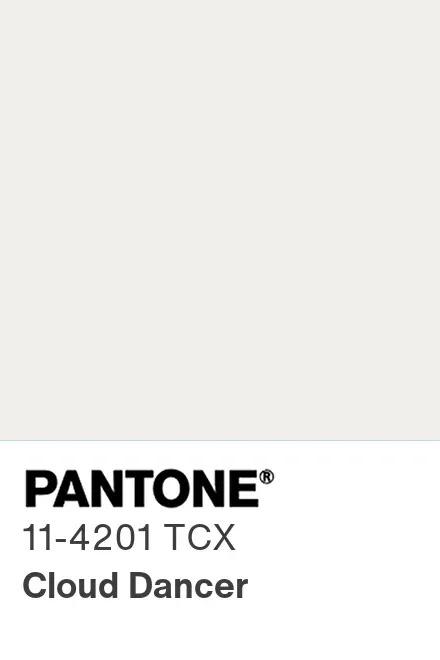
color pallette of Pantone by Cloud Dancer

  The 2026 Color of the Year is 11-4201, Cloud Dancer. Which is to say: white.

That might not sound radical until you realize it’s the first time a white shade has ever been chosen in the history of the program. Pantone’s explanation is predictably soothing — Cloud Dancer is meant to evoke calm, clarity, and quiet reflection in a “noisy world.”

  My first reaction wasn’t calm. It was: White? Really?

Are we so overwhelmed — so cautious — that we can’t even commit to a color anymore? Is white a thoughtful response to cultural overload, or a polite way of opting out altogether? A blank canvas sounds appealing in theory, but it also lacks a point of view.

  As a creative, I love color. Color has always been about mood, identity, and expression. It’s how we signal taste, emotion, and even rebellion. I’m all for generous whitespace, but choosing white as a central cultural symbol feels less like a statement and more like a pass — or perhaps a refusal to engage in the discussion at all.

  But maybe that is the point. In a world where every choice feels loaded, even color can feel like taking a side. White doesn’t Offend. It doesn’t provoke. It doesn’t require explanation. It’s safe, neutral, and comfortable. visual equivalent of saying, let’s not make this harder than it needs to be.

  Whether Cloud Dancer suggests thoughtful restraint or cultural timidity probably depends on your mood. However, it’s difficult to ignore what it communicates: a shared desire to step back, soften the edges, and avoid bold declarations — even in something as low-stakes as color.

Dictionary.com’s Word of the Year Isn’t a Word

  If Pantone’s color choice feels like a cultural sigh, Dictionary.com’s Word of the Year for 2025 feels like a shrug.

  The winning entry? “6-7.”

It’s not a real word and has no official meaning. It’s just a pair of numbers that serve more as a tone indicator—meh, so-so, middling, lukewarm—rather than language. It spread quickly on TikTok and other social platforms because it perfectly expressed a kind of emotional neutrality that many younger people already felt and were expressing without passion.

  In fact, many people searched for “what does 6-7 mean?” which reveals everything you need to know about its emotional economy.

  Think about that for a moment. A “word” that hardly means anything becomes Word of the Year because people are using it to describe how they feel about… everything.

That’s ambivalence turned into language. Not clarity. Not ardor. Just a gentle meh.

That’s not laziness, It’s emotional insolvency.

TikTok Trends: The Beige Flag Phenomenon

  If cultural ambivalence had a mascot on social media, it might be the “beige flag.” A playful counterpart to the dreaded red flag, a beige flag refers to behaviors that aren’t bad— just not exciting either. Mildly underwhelming. Emotionally neutral. Perfectly fine.

  People aren’t mocking beige flags. They’re celebrating them. The beige flag indicates low emotional tension. It’s like lukewarm coffee with a splash of oat milk — comfortable, steady, and unlikely to cause conflict or require vulnerability.

an example of TikTok's beige flag

(TikTok: cassandrapalumboo)

  But there’s another way to read it. Is beige really neutral? Or is it a softer form of resistance?

  Endless agreeableness. No strong preferences. No genuine stance. These traits avoid conflict, but they also prevent connection. Beige flags can feel safe — but they can also be quietly passive-aggressive in their refusal to show they care loudly about anything at all. It’s passive disengagement. Saying whatever works and meaning I’m not invested enough to be bothered.

  What makes this interesting is that it’s not just about dating culture. It’s about how we’re learning to manage intensity. In a culture that values calm, likability, and low drama, beige becomes socially acceptable armor. Emotional neutrality isn’t just tolerated — it’s becoming a coping strategy. One that helps people stay present without revealing too much.

  Why We Keep Tuning into The Office

  Have you noticed how many channels now air years of the same TV shows back-to-back? Full start-to-finish rewinds. Not nostalgia nights — just entire eras on repeat.

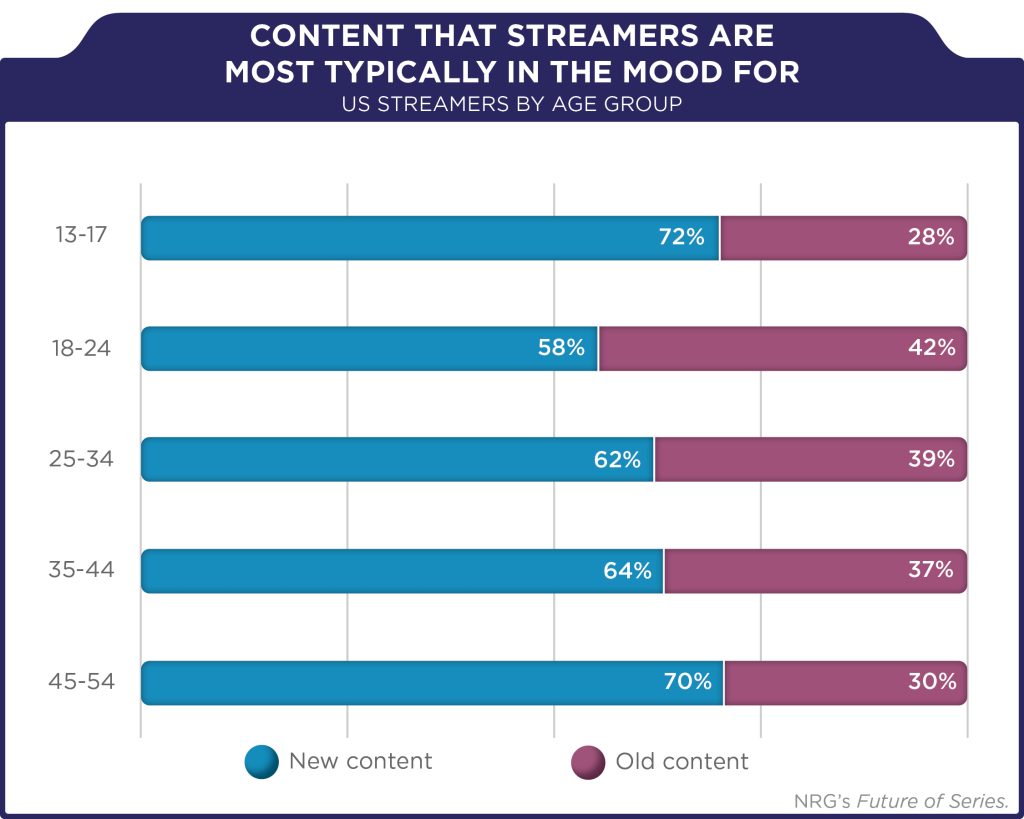
  Streaming platforms are experiencing a strong comeback of older TV shows and classic content, with much of the viewing time spent rewatching familiar favorites or discovering them for the first time. According to NRG’s syndicated Future of Series research, nearly 60% of total TV viewing on streaming services is dedicated to older content — shows people already recognize.

a chart showing content that streamers are most typically in the mood for

  Despite countless new choices, viewers opt for what feels familiar. There are a few reasons for this. Familiar shows are easy. They lower anxiety. They require less mental effort. You know who will disappoint you. You know who will redeem themselves. You know what happens with Ross and Rachel — and that’s part of the appeal.

  Nostalgia plays a role, but this isn’t just a phenomenon limited to Gen X or Millennials. Gen Z also has a strong interest in “older” content — especially shows from the 2010s that already feel safe, familiar, and emotionally accessible.

  There’s also a practical reason: older series are complete, with multiple seasons. No waiting, no cliffhanger anxiety. They’re perfect for binge-watching, half-watching, or playing quietly in the background while life goes on.

  Psychologists highlight another aspect: familiar shows serve as emotional comfort food. They ease cognitive load, calm stress, and offer predictable emotional rhythms that new content can’t provide. You’re not watching to be surprised. You’re watching to feel in control.

  This isn’t about avoiding risk; it’s about managing it.

It’s easier to rewatch a favorite sitcom than to commit to a prestige drama that demands attention, interpretation, and emotional stamina. Comfort viewing isn’t laziness — it’s efficiency. Cultural self-care. Emotional cost-cutting.

So What Does All This Add Up To?

  What this truly highlights is that ambivalence isn’t unintentional — it’s adaptive.

  People aren’t disengaging because they don’t care. They’re disengaging because caring too much, too often, is draining. Whether it’s choosing white as a color, using “6-7” to describe how you feel, embracing beige flags, or looping the same TV shows on repeat, the impulse is the same: to minimize emotional risk while staying connected.

Ambivalence, in this context, isn’t indifference. It’s preservation.

  Once you view it as a coping mechanism instead of a flaw, the pattern stops seeming passive and begins to appear deliberate.

So What Does This Mean for Marketers?

  For years, the common wisdom — and I’ve promoted this too — was that transparency, bold positioning, and value-driven storytelling were the way to go. People connect with people, not products. They want brands with values that feel authentic.

  That part is still tru. What’s changed is how those values land.

  We’re no longer in a moment where louder is better. Today:

•     Too much intensity feels overwhelming

•     Too many choices breed skepticism

•     Forced conviction triggers suspicion

  Consumers aren’t asking brands to go silent. They’re asking them to be clear without drama, specific without agitation, human without theatrics. They don’t want to be convinced. They want to be understood.

  That means embracing clarity and consistency. Making life simpler, not more difficult. Not dull — confidently straightforward.

  Here’s what that can look like:

•     Saying “here’s what we do and why,” without a manifesto

•     Offering quality and transparency, without hyperbole

•     Respecting time and attention instead of demanding emotional labor

  In a culture where ambivalence signals strength — not failure — brands that embrace intentional simplicity may connect more deeply than those pursuing loud differentiation.

  Here’s the question this cultural moment forces us to ask:

•     Are we too indifferent to care passionately anymore?

•     Or have we just become more selective with our emotional investments?

  I lean toward the latter.

Maybe ambivalence isn’t retreat. Maybe it’s reallocation — of attention, energy, and engagement — toward what truly matters, in ways that don’t demand constant volume.

•    Pantone provided us with a blank canvas.

•    Dictionary.com responded with a shrug.

•    TikTok offered us neutral flags.

•    And our viewing habits brought us comfort.

  These aren’t signs of collapse. They’re signs of selective engagement.

And that’s worth paying attention to.

  Susan DeMatei founded WineGlass Marketing, the largest full-service, award-winning marketing firm focused on the wine industry. She is a certified Sommelier and Specialist in Wine, with degrees in Viticulture and Communications, an instructor at Napa Valley Community College, and is currently collaborating on two textbooks. Now in its 13th year, her agency offers domestic and international wineries assistance with all areas of strategy and execution. WineGlass Marketing is located in Napa, California, and can be reached at707-927-3334 or wineglassmarketing.com.

When Correcting Vineyard Soils Costs Too Much

a man tilling the soil in the middle of a grape vineyard surrounded by mature vines

By Neal Kinsey, Kinsey Agricultural Services

What good is a soil test if it costs too much to follow the advice given? Many growers express concern about the expense involved in meeting fertilizer requirements, even when they recognize the importance of following recommended guidelines. Once it can be determined that the soil analysis accurately reflects the fertility of the area being evaluated, those results should then be used as a tool to help clarify what needs to be done based on the needs and goals for that specific vineyard.  Without understanding what is desired or expected by the grower, the best economic approach may not align with the recommendations that are offered.

  It is crucial to tailor the recommendations to the grower’s specific expectations and objectives. Too many soil samples are taken in a hurry, sent in a hurry and results are expected “in a hurry” as well. Consequently, valuable information that could be most helpful for recommending the best program to the grower may not have even been the most affordable proposal.

  Most soil laboratories provide a worksheet to be filled out as completely as possible by those sending samples for analysis and recommendations. Use of that information helps to make the best recommendations and to minimize delays in getting the results back in the shortest possible time.

  Worksheets sent along with samples for testing should include options for different recommendation programs: Excellent, Building, Maintenance, and Minimum. If no preference is given, the default is usually for the Excellent program. Many growers choose the Excellent program, sometimes by default, until they realize the associated costs— too much, even when such a program helps produce better quality or higher yields.  Rebuilding soil fertility can be costly, especially where crops have been produced there repeatedly without adequately replacing essential nutrients that have been removed.

  When growing grapes for years on the same land, without replacing what is taken out year by year, failure to replenish critical nutrients helps make restoring the lack of minerals for the highest levels of soil nutrition for grapes an expensive process. It is important to consider how long it has been since key nutrients, such as sulfur and micronutrients, have been adequately applied.  Large numbers of vineyard soils sampled throughout the world still show to be sorely lacking in vital minerals. Even soils that have received manure or compost and “token amounts” of various trace elements in purchased fertilizers for years often still fit into this category.

  Limited funds do not mean there are no viable approaches based on soil test needs? The question becomes which needs will deliver the greatest advantage for producing the best crop? While most growers aim for excellent soil conditions for growing their grapes, the costs of catching up after years of constant removal can be significant.

  This financial challenge often leads those who make the final decisions to consider minimum programs for vineyard fertility. However, minimum programs should only be considered when there is absolutely no other choice, and even then, keeping in mind that such means should only be considered as a very temporary solution. Using this type of program risks depleting nutrients that are currently sufficient which can seriously impact the condition of future crops depending on whether soil levels at the time these measures are initially instituted are poor, or good, or merely adequate.

  To be sure such measures are not a mistake, consider one other question.  How qualified is the person who makes such a decision?  Is it based on the ability to distinguish between which soils perform the best, those that perform well or the problem areas?  And can that be determined just by observing the test results without knowing where they were taken?  If not, then are they qualified as decision makers to decide what will and will not hurt each of those soils and the grapes to be grown there?

  There are yet additional choices that can be made when it costs too much to achieve an excellent soil fertility level in the shortest period for the needs of each vineyard.  For most vineyards, the fertilizer budget does not cover all that is needed to bring every one of the nutrients back in line at once.  When such may be the case, prioritizing which nutrients will provide the most benefit based on overall needs helps maximize results for the money being spent.  This enables the grower to go down the list and put the money where it will provide the most benefit.

  When funds are limited to such an extent that a grower cannot afford to follow the complete program, then spend the available budget where it will make the most difference for the grapes being grown there. In other words, request excellent soil fertility recommendations in at least one area of your property so you can see the difference in production and quality.  This will help create more profit by investing back into one of the most important resources you have: your soil.

  The better vineyards will generally need far less in terms of nutrients to reach excellent condition while the poorer producing vineyards can be quite expensive to get to that higher level of performance. If  vineyards are rated based on performance using a scale of 1-10 with 10 being the best, generally the return on investment will tend to be better on the “8” field than on the “3” field.

  Once confidence in the program has been built and proven to be worthwhile on a smaller portion of land, there is another option that some grape growers choose regarding achieving optimum performance from each field.  Instead of excellent, in the beginning check the box for the soil building program and ask that all nutrients be prioritized according to the fertility needs of the crop to be grown there.  First spend the allocated fertilizer budget on priority #1, then go to #2 and so on until the budgeted amount for that field is used up.  In this way, to the extent that “soil feeder” types of fertilizers can be applied to build fertility instead of fertilizers that are “plant feeders” used to supply the same nutrients year after year, the soil can be improved and the priorities adjusted as progress is made.  This allows spending the budgeted amount for fertility every year but putting that money where it will make the most difference for fertility and consequently the production improvements in each field.

  Growers often want to experiment with several types of soil building practices to determine which yields the best results for their operation. Some prefer using soil amendments as the preferred route, while others believe that cover crops or grazing livestock sufficiently improves soil fertility for vineyards.

  Each operation is unique, so it may be most beneficial to consult knowledgeable consultants and educators, as well as observe what other producers are doing, to gain insight into what might work better for each operation. 

  Based on fifty years of working with soil fertility on vineyard soils, our experience has been that on average to poor soils it can require decades to build up soils growing cover crops or grazing livestock.  Both are beneficial for specific purposes, but to restore needed fertility, use of mineral rich fertilizers and soil amendments take at most only a few years to accomplish the needed changes.

More on that subject next time.

  To learn more about the types of soil recommendations that Kinsey Agricultural Services provides, contact Neal at neal@kinseyag.com.

Wine & Hospitality

a man and a women sitting at a table next to a vineyard while a woman pours wine into their glasses

By Cory Krejcik, Founder of Thirsty Bandit

In a culture increasingly shaped by screens, algorithms, and artificial intelligence, wine and hospitality may represent one of the last places where people still gather, slow down, and remember what it feels like to be human together.

  We are living in the most technologically connected era in human history, and paradoxically, one of the most socially disconnected. Our interactions increasingly pass through screens. Meetings happen on video calls. Friendships live inside text threads. Entertainment streams on every device. Meals are ordered through apps, dropped at the door, and eaten in front of laptops. Even leisure time is optimized for efficiency.

  Convenience has never been greater. Yet loneliness continues to rise across nearly every demographic group, and public health experts now describe social isolation as one of the defining challenges of modern life. According to recent data from AARP and Cigna, roughly 40 percent of Americans over 45 report feeling lonely, while younger adults, particularly Gen Z, report some of the highest levels of loneliness of any generation, showing that social disconnection spans every age group.

  Against this backdrop, cafés, wine bars, pubs, restaurants, tasting rooms, and neighborhood gathering places take on renewed importance. They remain some of the last public spaces where people still encounter one another organically, where conversation unfolds without an algorithm shaping it, and where shared experiences happen in real time.

  For those of us in wine and hospitality, this moment feels both familiar and urgent. Because what we steward every day is not simply product or service. It’s critical human connection.

What AI Can (And Cannot) Replace

  Artificial intelligence is rapidly reshaping nearly every industry, including ours. It can generate tasting notes, forecast sales, streamline purchasing, personalize marketing, and recommend wines with startling accuracy. It can optimize menus, automate reservations, and predict guest behavior. However, it cannot read the subtle energy shift in a room celebrating good news. It cannot sense when a guest wants guidance versus quiet. It cannot recreate the comfort of being welcomed by someone who genuinely remembers your last visit or your favorite bottle.

  Hospitality thrives on qualities technology struggles to reproduce: the human touch that turns service into care, emotional intelligence that guides interactions naturally, and presence that allows guests to feel seen rather than processed. Technology can make us more efficient behind the scenes, but the reason people return again and again remains deeply human.

How Gathering Spaces Strengthen Community

  In early January this year, Dr. Mehmet Oz described alcohol as a “social lubricant that brings people together,” pointing to the ways shared social experiences can support emotional well-being when enjoyed responsibly.

  The remark sparked debate, but it underscored a long-standing truth: humans have always gathered around shared food and drink. Wine, in particular, encourages conversation and lingering. The 750ml bottle is a universally sharable format meant to be opened, poured, discussed, and passed around the table. Stories emerge. Conversations lengthen. Time slows.

  Furthermore, hospitality spaces have historically served as community living rooms. Local pubs, enotecas, and cafés have historically served as sacred places where neighbors meet, friendships deepen, business relationships form, and milestones are celebrated. They are where newcomers feel welcomed and regulars feel known. In an era increasingly marked by digital isolation, these physical gathering spaces reinforce the everyday social ties that hold communities together. They offer neutral ground where people from different walks of life can still share a table and, if only for a moment, feel part of something collective.

Emotional Connection as Competitive Advantage

  As technology commoditizes knowledge and routine service interactions, emotional connection becomes hospitality’s true competitive advantage. No app replicates the feeling of walking into a place where someone greets you by name. No algorithm recreates the comfort of a familiar table after a long week. In a future increasingly mediated by AI, these human advantages only grow more valuable. Hospitality’s power lies not just in feeding or serving people, but in creating spaces where people feel connected again.

  Industry leaders now carry responsibilities that extend beyond operations and profitability. We are not simply operators, beverage directors, sommeliers, or restaurateurs. We are culture carriers. Hiring practices, training philosophies, lighting, pacing, music, and room design all influence whether spaces encourage people to linger, converse, and belong, or simply move through as transactions. Every operational decision shapes the emotional temperature of a room.

  The question facing hospitality leaders is increasingly clear: are we building businesses optimized purely for efficiency, or spaces designed for connection? The future of wine and hospitality may depend on how we answer.

Action Items:

Reigniting Social Connection Over a Glass of Wine

  Here are practical steps wine and hospitality leaders can take to reinforce social connection in their spaces:

1. Redefine Success Metrics:  Shift from purely operational metrics (turn times, covers per hour) to connection-oriented ones.

•     Guest feedback on feeling welcomed and heard

•     Return visits for conversation, not just consumption

•     Word-of-mouth referrals rooted in experience

2. Train Teams for Emotional Intelligence: Invest in training programs that go beyond service technique.

• Active listening skills

• Reading room energy

• Recognizing moments for genuine human engagement

  Your team should be incentivized not just to serve, but to connect.

3. Curate Shared Experiences:  Design programs that encourage group exploration and story-sharing.

•     Guided tasting flights with shared narrative arcs (regions, themes, stories)

•     Winemaker dinners emphasizing conversation

•     Community-focused events that spotlight local producers

  These experiences make people feel part of something larger.

4. Create Intentional Spaces for Interaction:

  Spatial design matters.

•     Communal tables

•     Intimate seating nooks

•     Fireplaces or shared counters

•     Low-pressure tasting salons

  Make layouts that invite conversation, not isolation.

5. Champion Local Wine Culture:  Celebrate the stories of the people behind the bottles.

•     Bring in local winemakers for tastings

•     Host producer Q&As

•     Feature regional pairings that tie to community identity

  This reinforces that wine is of a place, not just in a place.

A Human-First Future

  AI will undoubtedly shape the future of hospitality, helping operators run smarter, leaner, and more efficiently behind the scenes. But what happens across the bar, at the table, and inside the room must remain unapologetically human.

  Wine and hospitality continue to remind people what it feels like to slow down, engage their senses, and connect without a screen between them. They offer places where strangers become regulars, neighbors become friends, and ordinary evenings become lasting memories. In a culture defined by speed and digital convenience, the simple act of sharing a glass of wine with others becomes quietly radical.

  The opportunity (and responsibility) for wine and hospitality leaders is to protect and amplify these experiences. To design spaces where people linger. To empower teams to engage authentically. To create environments where guests feel welcomed not as transactions, but as participants in something communal.

  In a digital-first world, wine-led hospitality remains proudly human-first. And as technology continues to reshape how we live and work, the places that help us reconnect with one another may become the most valuable spaces of all, not just commercially, but culturally and socially. The future of hospitality, at its best, is not simply about serving food and wine. It is about reminding people, again and again, how good it feels to be together.

  Corey Krejcik is the founder of Thirsty Bandit, providing strategic marketing, brand development, and revenue optimization for hospitality and wine brands. With over 20 years of executive leadership experience, he believes the best outcomes are found at the intersection of strategy, adaptability, and identity. Outside of work, he enjoys cooking, running, home renovation projects, and spending time with his wife and two teenage children in Malvern, PA.