Falconry at Featherstone

woman holding a bird

By: Michael Strickland

For Louise Engel and Dave Johnson, the decision to fly a raptor over their 23-acre vineyard and winery was a no brainer.

  Like so many other fruit growers across North America, the owners of Featherstone Estate Wineries in Ontario’s Niagara Region had waged a frustrating war against starlings. A flock of 5,000 can consume a ton of fruit in just 10 days, though they cause even greater damage by pecking more berries than they eat. The weeping fruit attracts fruit flies, which encourages rot.

  Grapes are often the last crop to be harvested, long after cherries, strawberries and tender fruit have left the field. With less soft fruit to binge on, bugs start to disappear. By October, grapes are one of the last food sources—a juicy-fruity one no less—visible from the sky.

  “When you look at that vineyard, and you’ve looked after and babied these vines along, and it’s now October 10th, and the fruit is loaded and healthy, and you see a flock of starlings—of five, six or ten-thousand—just descend on you, we run out and we’ve got all kinds of cannons and bangers, it is breathtakingly annoying,” says Johnson.  So, when Engel said she thought she had a solution, Johnson says, “it was a no brainer.”

  Engel attended a bird of prey demonstration in October 2003, four years after the couple opened Featherstone. She returned determined to take up falconry, undertook the 15-month certification required in Ontario and purchased a Harris Hawk named Amadeus.

  Today she is president of the 200-member Ontario Falconry Club. While falconry is a common bird abatement technique in the U.S., she’s not aware of anyone else really adopting the practice in Canada.

  “We’re certainly the only winery that has a resident bird of prey, or that does it on a regular basis,” she says.

  While Featherstone continues to use noisemakers and netting against starlings, few things work quite like Amadeus. “The one thing they never get used to is hawk silhouettes,” says Engel. “When you put a bird of prey in the air, everyone leaves, and it becomes very quiet.”

  Only for a little while, however. Like nets and noisemakers, falconry has its limits. Starlings will find holes in the nets, and they’ll return when the noise dies down, or Amadeus leaves the sky.

  “So it’s effective while I fly him, but then I put him away and go do other things, and it ceases to be effective,” says Engel. “So it’s best not to get on too much of a routine, to fly him as periodically as I can.”

A Working Relationship

  After spending one long night looking for Amadeus, Engel no longer flies him without a tracker. He is a bird of prey, she stresses, with no emotional attachments. He can and will leave if and when he wants. She relies on a trust relationship—a rather mercenary one—to bring him back at the end of each flight.

  Amadeus views Engel as a source of hunting opportunities. She regularly provides him with the chance to hunt starlings and, if he catches something, he gets to it eat it. Since he frightens away far more prey than he finds, Engel is also a ready source of food. When he returns empty-handed, she greets him with bits of quail.

  “So there’s a bond there that is predicated on positive reinforcement and hunting.”

  For growers interested in using birds as a pest control method but hoping for a little more control, Harris Hawks are a popular choice for beginners. They are one of the few avian predator species that hunt in castes, a family unit akin to a wolf pack, working collectively in the wild.

  “When I, as a falconer, am in the field with them, that kind of fits in with their paradigm quite naturally,” says Engel. “They’re a little less independent and a little more predisposed to want to work with you to find hunting situations.”

Natural and Eco-friendly

  Adding Amadeus to the mix of pest abatement strategies fits with Engel and Johnson’s eco-friendly approach to viticulture. They live on their 23-acre property, farming 20 acres of it, and have a vested interest in being responsible stewards.

  Featherstone has been insecticide-free since day one and has adopted a range of natural practices to deal with pests that threaten the vines. Methods include using diatomaceous earth (which is abrasive and irritating to insects), bringing in beneficial predatory insects like the ladybug, and using pheromones to disrupt mating cycles. In 2008, they purchased a recycle sprayer to capture and reuse any spray that does not stick to the vines.

  Johnson is mainly focused on natural ways of keeping his soil as healthy as possible. He plants cover crops (25% legumes, 25% daikon radish and 50% ryegrass) between rows of grapes. He’s also determined to fight soil compaction by reducing tractor passes, aiming to reduce the total by one pass each year.

  “The big issue for us, and the thing we’re working on all the time is compaction of the vineyard floor,” says Johnson. “We’re trying to get tractor trips reduced. I think that’s more important than organics, biodynamics or anything else. We need to get the equipment out of there.”

  To that end, Featherstone has adopted “lamb labor” to help keep the vineyards “sheep shape.”

  Johnson first learned of the practice in 2007, when he spent time in New Zealand as a guest Pinot Noir specialist at the Sileni Estates Winery and Cellar Door. He’d noticed that the leaf pulling was flawless—the low fruit zone was cleared, allowing sunlight and air to reach the grapes, while the upper canopy looked unmolested—and wondered how that was accomplished.

  At the time, Featherstone was paying migrant workers $200 to clear each acre. Sileni were letting sheep do it for free.

  “They can’t afford to irrigate a pasture for sheep,” says Johnson, “and the vineyards are all fenced to keep the sheep out. Then, at a certain time of year, they open the gates, and they allow the lambs to flood into the vineyards. They strip out the grass, then pick their heads up and start eating those lowest leaves.”

  Featherstone has been using lamb labor ever since. Each February, they purchase 25 or more baby sheep and begin confining them to one-hectare areas as soon as the first varietals, the Pinot and Chardonnay grapes, need leaf clearing. That seems the perfect number to entirely clear a hectare in roughly 10 days, after which he moves the flock to the next area. By the fall, they’re clearing the Cabernet Franc.

  Sheep are perfect because they eat only leaves. Goats, Johnson points out, would eat everything and likely destroy the vineyards. Lambs, it turns out, are also the perfect size.

  “What we worked out here is that they need to be no more than 22 inches high at the shoulder. Otherwise,” he says, “they reach too high and are stripping too many leaves. So we have set the vineyard and pruned it particularly so that the fruit zone is sitting at 22 to 32 inches above the ground. That is the reaching height of a lamb.”

  For Engel and Johnson, these eco-friendly practices are about living a more natural life, a life where all aspects are as fully integrated with nature as possible.

  “We’re interested in complete integration, in being integrated with all aspects of the property, and capitalizing on natural relationships where possible,” Engel says. “Whether its natural predator-prey relationships, or it’s help that just naturally grazes in the vineyards and then helps you with leaf removal, those kinds of integrations appeal to us on a number of levels.”

  The approach seems to be producing one key result: great wines. Featherstone turns 20 this year and was just named Winemaker of the Year at the Ontario Wine Awards. The judges recognized Featherstone’s consistent quality across the portfolio, successes in wine awards and overall contributions to the industry.

  Engel and Johnson realize that their approach is not for everyone. For one thing, it reflects their personal beliefs. They also acknowledge economics and other factors would make all of these practices more challenging if Featherstone were larger, or more commercial than craft.

  “We’re still classified as a small winery, at the larger end of small, but a nice size for us, given our tank capacity, the size of our press and all that,” says Engel. “Were we to get bigger, we’d need to get a lot bigger, and we’re pretty happy at this size. It lets us keep our fingerprints all over everything, and stay craft or artisanal.”

Needs of the Animals

  There’s also the added responsibility of owning livestock, which includes letting it out to pasture each morning, rounding it up each night, and maintaining fences. Ontario has problems with coyotes and other predators. Lambs are extremely sensitive to copper, so Johnson can’t use elemental copper, an inexpensive organic spray used to protect grapes from mildew, until after the lambs have cleared an area.

  “It’s an animal, so now you’ve introduced animal husbandry to what is normally horticulture,” says Johnson. “Once you have animals on-site, they add another layer of complication. They need to be handled. They need to be protected and looked after.”

  When you own a bird of prey, the demands are especially high.

  There’s a 15-month apprenticeship program to become a licensed falconer in Ontario. There are stringent rules around housing and care, though the requirements differ from those in the U.S. With only 200 licensed falconers in the province, says Engel, it’s easy to support one another and ensure all members are practicing falconry at the highest level.

  “It’s kind of like owning a horse. There’s a real commitment there,” says Engel. “These birds need to be worked and hunted and flown. They’re not just meant to be put on your glove and shown to your friends. You do them a real disservice is you’re not getting them in the air and hunting them on a regular basis.”

B.C. Wine Industry Launches 10-Year Growth Plan

B.C. Wine Industry facility
Penticton, British Columbia, Canada – October 26, 2017: Exterior view of Hillside Winery located in the Okanagan Valley on the Naramata Bench in Penticton, British Columbia, Canada.

By: Briana Tomkinson

The wine industry in British Columbia has bloomed over the past 30 years from a handful of grape growers and wine producers to several hundred. As the industry matures, producers are facing new challenges, including shifting consumer preferences and climate change.

  Industry players, including the B.C. Wine Institute, B.C. Wine Grape Council, the B.C. Grapegrowers’ Association, and the B.C. Wine Authority, have responded by coming together to create a unified vision for the wine industry and to support B.C.’s many smaller producers in meeting these challenges.

  According to a long-term strategic plan developed by Artemis Group and O’Donnell Lane for the British Columbia wine industry, the future of B.C.’s relatively young wine industry depends on tourism, export, and brand-building, as well as a strong focus on environmentally sustainable business practices.

  The 10-year plan was released in March at the B.C. Wine Industry Insight Conference in Penticton. Developed over 18 months, it included input from more than 650 industry stakeholders who participated in over 30 meetings in 12 locations throughout the province. The plan was funded by the governments of Canada and British Columbia through the Canadian Agricultural Partnership, a federal-provincial-territorial initiative.

  The plan highlights potential threats to the industry, including climate change, crop failure, land value inflation, decreasing talent pool, competition from exports and Canada’s fledgling legal cannabis industry.

  The Wine 2030 plan includes 12 strategic recommendations to strengthen the B.C. wine industry, including committing to industry-wide sustainability standards, promoting wine tourism and links with restaurants and other hospitality partners, and building name recognition for B.C. wines in leading export markets.

  B.C. Wine Institute President and CEO Miles Prodan said that many of the recommendations are in line with initiatives already underway, which he said was a good sign that the industry is on the right track. The plan has been endorsed by the Wine Institute’s board of directors and will influence operations planning going forward.

  “We’ve been doing too much, and spreading ourselves too thin,” Prodan said. “Now that we’ve sat down and identified what we need to do to sustain our growth, we can be more focused. This will rally the industry around the key objectives and strategies.”

  The number of grape wineries in B.C. has ballooned from just 17 in 1990 to more than 280 today. According to Wine B.C., wineries in the province welcome over a million visitors a year to its 370 licensed wineries.

  More than 90% of B.C. vineyards are located in the Okanagan and Similkameen Valleys, which boast ideal growing conditions for grapes: short, hot growing seasons in a dry, desert-like microclimate that is distinct from the rainy, cool coast. The area is known for its extreme temperatures, dipping as low as -4 degrees Fahrenheit in the winter and as high as 104 degrees Fahrenheit in the summer.

  Other Official wine-growing regions in B.C. include the Fraser Valley, Vancouver Island, Gulf Islands, Thompson Valley, Shuswap, Lillooet, and the Kootenays. Sub-regions include Golden Mile Bench, Okanagan Falls, Naramata Bench and Skaha Bench.

  There are over 900 vineyards in B.C., representing more than 10,260 acres of planted land. The ratio of white to red wine planted is nearly even, with red representing 51% of grapes planted.

  Consumer demand for locally produced wine is strong. B.C. VQA wine is the second-best-selling category in the province, representing about one-fifth of market share. The top-selling category is non-VQA wine produced in B.C., which includes both wine made from local grapes and international blends from imported and domestic wines.

  VQA, or Vintners Quality Alliance, is the official stamp to mark wine that produced with only B.C.-grown grapes. When including B.C.-produced non-VQA blends, B.C. wines represent more than half of the wine sales in the province. When it comes to imports, U.S. wines are the largest segment, at just under 10% of wine sales.

  While local support for B.C. wines is strong, the Wine BC 2030 report notes that future growth depends on exports. More than 90% of the region’s wine production sells within the province. In the next five to ten years, industry players hope to position B.C. wines as a premium product on the international stage. Prodan said another key goal is to lift restrictive interprovincial trade barriers on alcohol to open up new export markets for B.C. wineries within Canada.

  The report identifies that amping up promotion of B.C. as a wine tourism destination is an important tactic to build the brand reputation of B.C. Wines in international markets. According to research from Tourism B.C., inviting visitors to taste wines results in sales more often than not. It estimates well over half of wine tourist visits result in sales for wineries. Other noted benefits included higher margins when wine is purchased directly from the winery, the opportunity to attract new customers and enhance brand loyalty, and also to get detailed customer feedback on products.

  Prodan said that B.C. wine country was already gaining traction as a desirable tourism destination. Many wineries have begun investing in onsite restaurants and accommodations, making the experience an even more memorable one for visitors.

  Sustainability is another crucial area of focus for the industry, and not just for growers. A new sustainability certification program is in development from Sustainable Winegrowing B.C., which is expected to launch next year. SWBC was created by a coalition of viticulturalists, winemakers, hospitality directors, researchers and sustainability and marketing specialists.

  SWBC already offers several free online resources for vineyards, wineries and wine-related hospitality businesses, including online assessments, educational resources and training to help growers protect the health of their vineyards, cut costs and reduce the environmental impact of wine production.

  Because most B.C. wines are produced in desert-like climates, water-use efficiency is an essential component of SWBC’s sustainability education. While the cost of water alone may not be a significant line item on most growers’ balance sheets, SWBC notes that inefficient irrigation can have significant hidden costs, including increased system maintenance, a need for canopy management due to vigorous growth, the need to spray for powdery mildew and other diseases, and additional wear and tear on machinery.

  However, Prodan said the focus on sustainability isn’t just about farming; it extends to every facet of the industry from tourism to trade.

  “Sustainability is not a marketing tactic for us. It’s about taking care of what we’ve got. To be a winery here in B.C., you need to have land. Our wineries are literally tied to the land, so we can’t say if things aren’t good here, we can pull up and go somewhere else,” he said. “We know we have to take care of our land. Without it, we wouldn’t have anything.”

Pillitteri Estates Winery: The Passion Behind The World’s Largest Icewine Producer

By: Adrienne Roman

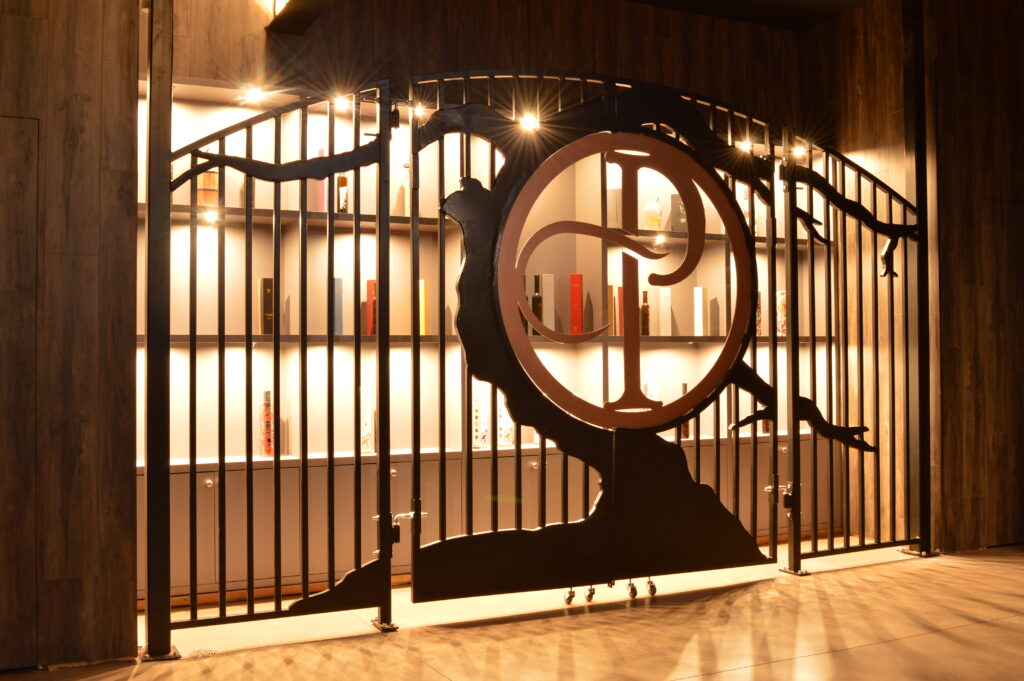
huge gate of a wine cellar

Globally recognized as the world’s largest estate producer of Icewine, Pillitteri Estates Winery in Niagara-On-The-Lake has provided excellence in viticulture since opening in 1993. Their premium V.Q.A award-winning ice and table wines are widely distributed to local events, businesses, and markets, and are currently being exported to International clientele in 39 countries. 

  The Niagara Peninsula is situated between two of the Great Lakes, Ontario to the North, and Erie to the South. The region is the largest wine producer in Ontario, with primary varietals of Riesling, Pinot Noir, Cabernet Franc, Chardonnay, and Vidal. With the protection of the Niagara Escarpment, and the moderating climate of the Lakes, the region’s temperature is similar to prime grape producing regions in France.  The cool climate sub-appellation terroirs allow for the development of diverse root character, complex grape flavours, and a number of new varietals.

  “ We bought a wonderful piece of land, ” said Charles Pillitteri, C.E.O and President of Pillitteri Estates Winery. Pillitteri’s cherished Sicilian heritage remains at the forefront of every aspect of the family business. Working alongside his two sisters, his sharp business acumen is focused on ensuring the winery forges forward for generations to come.

  A single glance of the majestic ten foot tall stainless steel doors leading into the Pillitteri’s press house and cellar reveals the imagination of blacksmith Ken Robertson’s unique vision. Carefully designed linear lines on the ground visually direct the visitor inside where they’re transported on an aesthetic adventure. Both natural and synthetic elements juxtapose together seamlessly to produce a truly imaginative space.  Ceramics, composites, polyurethane and steel tell the elegant story of natural growth, culminating in Robertson’s striking sculpture of the stages of grapes on the vine at the center of the atrium, depicting the flower, to veraison, and finally maturity. Intricately carved vine detail adorns the newel posts of the majestic staircase as you travel downwards and encounter the monolithic, Neo-Norman, and Roman influenced oak barrel cellar.

  Designed by close friend and Niagara architect Frank Wieler, a monumental 500-inch terrazzo top concrete table spans the length of the room, with 23 carved stainless steel chairs cleverly mounted on the adjacent walls representing the number that has significance to the family history. Each chair has it’s own designated position at the table, represented by a smaller carved triangle in the stainless steel denoting where it should be placed among the others. The unique chairs were commissioned by Pillitteri’s parents to tell the symbolic story of the winery.  

  Red wines are separate from the whites in the cellar, where the French and American oak barrels work to increase oxygen interaction, enrich development, and further flavour. The press house is no less impressive, with its large-scale open concept glass viewing station and colossal pressing machines that utilize pulse air technology to set the grapes in motion while ensuring the pressure remains gentle. 

  “Volume isn’t an issue for us, we’re a declassification house and we wait for the next great vintage. We’re all about quality and sustainability, it’s definitely our priority,” said Pillitteri.“ I’ve done a lot of method research and I’ve found that the carbon footprint can be remarkably higher with many types of organic farming. Copper doesn’t break down and can kill the insects that work to help the vines. We need to keep the vines as healthy as possible. “

  Their innovation excellence in grape and wine research was recognized in 2011 with an Ontario Premier’s Award for their work on the Verona Appassimento Project.  The family developed techniques now utilized by other wineries in the production of Appassimento wines. They planted the first Verona varietals in Ontario, and laid the foundation for their Riserva Famiglia series. Grapes produced during the Verona project were used to make their 2010 Riserva Famiglia Cabernet Franc, which won Red Wine of The Year and Gold at the Ontario Wine Awards in 2015. These reserve wines are hand crafted in the classic Appassimento style, as it was previously done for generations in Italy. 

  The chosen grapes are harvested by hand and dry naturally in racks over weeks or even months in order to concentrate the sugars.  “ We follow French rules when it comes to making reserve. I look to classification when choosing quality wines, an intense richness with our cabernet’s, elegant and not too tannic. Our reserve fruit definitely helps our baselines,“ said Pillitteri.

  It all started with one Black Tartarian cherry tree and a flash of entrepreneurial spirit.

  After settling in Niagara-On-The-Lake in 1965, Pillitteri’s parents Gary and Lena recruited their three children to sell the cherries on the roadside of their Niagara Stone Road property.  Their small fruit stand on the farm soon flourished and they opened “Gary’s Fruit Market” in 1973. In 1988 they decided to focus on the grapes, and the Pillitteri Estates Winery was born. The cherry orchard remains, as does their very first muse, that century-old Tartarian tree. Today, the first thing that appears on the fruit stand in the morning when the winery opens is a plump basket of cherries for sale.

  The Pillitteri passion for wine can be traced back to the region of Racalmuto in Sicily, where grandfather and father worked together grafting and tending to the vines. Gary, now 83 years young, remembers the oppression as though it were yesterday. The widespread hunger in Italy in the 1940’s instilled in him a social consciousness as a six-year-old child that brings tears to his eyes as he recounts a poignant story that changed his outlook on life at a very young age. Gary’s father Calogero asked him to give his shoes to another little boy who was barefoot, his first life lesson about the importance of giving to those less fortunate.  Gary has lived his life echoing those same values, working in farming and politics with the hopes of eliminating discrimination and promoting greater equality among his fellow men.  “ My life is a dream,” he said with a smile. Currently building a tree house for his grandchild, there’s definitely no slowing down in sight for this hardy yet hospitable Pillitteri gentleman.

  As official supplier and private label for Team Canada, Tokyo 2020, and the Paris Olympics 2024, the Pillitteri family are honoured to support the Olympic foundation with proceeds from their sales while helping to further expand the rapid growth of the Ontario’s wine industry.

  The true jewel in the crown for the Pillitteri family is their cherished Icewine. With the Niagara climate moving rapidly into colder temperatures after the summer season, it’s perfectly suited for the icewine grapes that like to go hot and cold, picked at just the right time when they are golden and endorphins are at their highest.  It’s been an evolution since their first Icewine developed in 1988, with 13 styles now available.  Pillitteri decided early on that he needed to take an assertive stand in the promotion and showcasing of Canadian wines, setting his sights on the Asian wine market, and making lasting connections in Australia, Taiwan, Hong Kong, and Shanghai.

  The Pillitteri’s understand that not every season will be what they had hoped. Luckily with a world-famous Reserve Vidal, and a Canadian trophy for Best Dessert Wine with their 2013 Reisling Icewine at the Six Nations Wine Challenge, the winery has the freedom to study, explore, and create. 

With over 1000 awards from top competitions, and 200 000 visitors a year, Pillitteri Estate Winery’s dedication to perfecting the art of making Canadian wine is evident. Each creatively designed wine label tells a story that follows the installations that came before. The Pillitteri logo is a representation of their treasured family Carretto, a hand-painted Sicilian cart, traditionally used to bring wares to the market, and personally brought to Canada in 1952 by Pillitteri’s grandmother.

  Wine bias of the past is waning in favour of a new set of rules, discerning clientele who look for quality and taste, and appreciate the progressive innovation of, “ old world meets new world “ experimentation.

  Pillitteri’s winemaker Aleksandar Kolundzic returns to Europe regularly to explore traditional methods, yet always keeping up to date on the latest practices to bring back to share with the winery.

  The Pillitteri story exemplifies the Canadian dream. With reverence for the past, fierce determination, and three generations of family strength, the Pillitteri’s are moving forward with their expanding collections, presenting Canadian wines to the world that are truly worthy of the award-winning recognition they so deserve.

Chi si volta, e chi si gira, sempre a casa va finire.

No matter where you go or turn, you’ll always end up at home.

For more information contact:

Pillitteri Estates Winery

 1696 Niagara Stone Road

Niagara-On-The-Lake

LOS 1J0

www.pillitteri.com

@pillitteriwines

STVM® WASHDOWN STATION COMBINES STEAM, WATER, AND SAFETY IN AN EASY TO MAINTAIN PACKAGE

ThermOmegaTech logo

FOR IMMEDIATE RELEASE:

(Warminster, PA USA) In food processing, dairy, beverage, chemical, petrochemical, and pharmaceutical facilities maintaining a clean environment is critical. High temperature washdown equipment is used to quickly and efficiently clean and sanitize equipment in place to keep production running on time. These washdown stations mix steam and cold water to provide hot water for facility clean up.

Maintaining competitor washdown units can be time consuming due to complex disassembly, special tooling requirements, and non-reusable components. ThermOmegaTech®, a leader in self-actuating thermostatic valve technology, supplies an innovative solution to the challenge of difficult to maintain washdown units. 

ThermOmegaTech®’s STVM® Washdown Station delivers a high temperature wash at a user-defined temperature using our proprietary Silent Venturi Mixing Valve (STVM®) to combine steam and water. Our mixing valve’s design is self-scouring, which prevents mineral buildup in tight spaces and reduces maintenance frequency.

To minimize downtime during routine maintenance, the STVM® Washdown Station has a simple cartridge design, which is removed with a wrench and cleaned in a descaling solution before reassembly. The station is in-line serviceable, so the operator simply switches out the STVM® Cartridge with a spare and the unit is operating in minutes. 

Worker safety is every facility’s priority, so we built it into our washdown’s operation. “The STVM® Washdown Station has two safety features to keep your employees safe. One, the mixing valve is designed to reduce flow if the output temperature exceeds the factory set-point and will completely stop flow 15°F above that,” Nick Tallos, ThermOmegaTech®’s VP of Engineering said. “Two, the unit has interlocking steam and water shut-off ball valves, so both inlets shut-off at the same time to prevent accidental steam-only, ‘hose full of steam’ operation.”

Due to the unique design of the STVM® Cartridge’s water and steam mixing spool, the unit operates at around 20 decibels less than competitor washdown units. This reduces overall operator stress and improves workplace conditions.

The unit functions completely mechanically and requires no outside source of electricity to operate. Compact and reliable, the STVM® Washdown Station is a beneficial addition to any facility.

ThermOmegaTech®’s STVM® Washdown Station is available for purchase through the company. For more information, visit www.ThermOmegaTech.com or call 877-379-8258.

About ThermOmegaTech®:

For over 35 years, ThermOmegaTech® has been a leader in the design and manufacture of self-actuated thermostatic technology. Founded in 1983, ThermOmegaTech® is a privately held organization with 40,000 square feet of manufacturing and office facility located near Philadelphia, Pennsylvania. The company provides innovative solutions for a wide range of applications including freeze & scald protection, mixing & diverting, steam traps, thermal bypass, tepid water delivery, washdown, balancing, drain tempering, and many other applications where temperature control is critical. Key industries it serves include railroad, commercial plumbing, aerospace & defense and industrial. Over 95% of its products are manufactured, calibrated, and tested in-house. R&D, prototype development, and integrated solutions are managed on site. ThermOmegaTech® has been ISO 9001 certified for over a decade and its products are distributed and used worldwide.

Five Areas to Focus on When Maintaining Your Website

By: Susan DeMatei

Website under construction with Laptop

Maintenance is an important and often overlooked part of having a website. Which is odd because you spend a great amount of effort on maintaining other aspects of your life and business. You go to the gym and the doctor to maintain your health; you repair and clean your house, your car, and your yard; at work, your tasting room, Wine Club, and your wine education or tasting senses are all given careful attention to make sure they are kept in shape. Why, then, do we expect to set up our website and then let it sit? Websites need to be maintained, too.

Your website is your front door to the entire world. Will customers or the trade find broken links, missing images, or an insecure page––or will they not even arrive at your website due to poorly tagged pages, making it impossible to find it on a search engine?

The bad news? The internet, software, hardware, and browsers are constantly changing. But the good news is there are lots of plugins and systems out there to keep your website up to date and healthy. Here are 5 areas you should focus on when maintaining your website.

Security

This may seem like it goes without saying, but if your website doesn’t use the proper, up-to-date security measures, your website will suffer. First, search engines will likely put you near the bottom of a list of search results or not even display your site. Second, a scary warning can appear where your website should be strutting its stuff.

Security is especially important if you have a WordPress site. WordPress powers over a third of the internet today. Because of sheer volume and the number of WordPress websites online, it’s the most hacked content management system on the web.

You should set up a routine schedule for removing malware, scanning for viruses or hacks, removing spam blog or product comments as well as spam signups to your mailing list. And don’t forget to monitor your SSL certificate to let purchasers know that you are safe to enter credit cards. Nothing says “don’t buy wine here” like a big security warning.

Data Preservation

You may not realize this, but on many mainstream platforms, including WordPress, there isn’t an automatic backup feature that you can just revert to if your website gets hacked, corrupted, or damaged.

This happens more likely than you think. Sometimes plugin updates can cause irreparable damage to the design. Other times, there’s human error when that new marketing intern deletes all your trade assets by accident.

It is up to you to back up your files. Luckily, there are many tools on the market that can do this automatically.

Broken Links

Whether your website is five pages or 30 pages, it can be easy to miss a broken link buried on your website. If the broken link is to your ecommerce store, it’s like having a malfunctioning door to your tasting room. Even if nothing is broken, if you don’t have a proper “continue shopping” link in your cart or checkout, you could lose the customer with their frustration. Maybe the link is minor and doesn’t lead to the store, but a broken link says you’re not paying attention, so why should your customers?

Again, routine maintenance should look for achieved products, employee bios, vineyards, vintages, distributors, events, or anything on your site that may be out of date and driving to a dead link.

SEO

Google is the most widely used search engine and now processes over 70,000 search queries every second, on average; which translates to well over 5 billion searches per day and closer to 2 trillion searches per year, worldwide. By 9:30 am on any given day there have been 2.5 billion searches on Google, globally.  Your winery is in there, somewhere, you just have to help people find it.

Search Engine Optimization doesn’t have to be overly complex. It’s primarily made up of tagging pages and images with keywords so Google can read them, and submitting the site and the sitemap to Google to index. The maintenance of these items requires checking that new pages and images are described and indexed. There are a number of tools on the market that will help identify and flag if a new page is missing tags, or if something is out of date.

ADA Compliance

There has been a lot in the news lately about ADA compliance, mostly coming from several lawsuits being brought against some wineries on the East Coast. The goal of this exercise is to make sure that everyone has equal access to the content on your site, including those with visual or mobility impairments.

Being compliant for something like ADA can be tricky and until the law has even more clear guidelines, it may be hard to be 100% compliant. But there are a number of ways to be accommodating for web visitors with disabilities. Think of it as very rigorous SEO: The requirements for being ADA Compliant cover tagging a large portion of your content, images, and overall accessibility. I would not recommend you try and tackle this on your own. There are scans and specific tasks required, like scripting to close modal windows, and tested functionality with the site text increased up to 200%. It is something your designer should look into. But once done, it needs to be maintained with each new image or block of text. The good news is, not only does it benefit your customers with disabilities, but it benefits your website functionality overall.

Ongoing maintenance doesn’t have to be a brain-teaser. If you consider the investment you put into your website and the sales you get out of it, then finding an agency with a maintenance package or setting up a series of plugins to manage these areas seems like a no-brainer.

Susan DeMatei is the President of WineGlass Marketing, a full-service direct marketing firm working within the wine industry in Napa, California. www.wineglassmarketing.com

Vineyard Technology & Equipment

By: Cheryl Gray

Drone flying above beautiful landscape
Drone flying above beautiful landscape with vineyards

At the moment a bottle of wine is uncorked and poured, the labor and innovation of the equipment industry helping to bring that wine from vineyard to table becomes inextricably tied to the end product consumers enjoy.  Across the United States, vineyards are dependent upon their equipment suppliers to provide them with the latest technology and product support  to keep costs down and produce a high-yield, high-quality harvest.

Take, for example, Progressive Ag, Inc., of Modesto, California, whose company history  reflects a cutting-edge approach to the design and manufacturing of sprayers used before harvest time.  Mark Ryckman, Progressive Ag sales manager and co-owner, keeps a close eye on technology focused on improving crop yield for his customers.

“New mapping software and drone technology are bringing in some great technology advancements into the spraying industry with variable rate application,” says Ryckman. The company manufactures its signature LectroBlast Electrostatic Sprayers with patented design elements aimed at delivering better coverage and reducing spray drift, both of which cut time and cost.  The technology-driven sprayers also promise delivery on other cost-saving measures, including more ground coverage in less time, fewer fill-ups, easy calibration, low maintenance and cheaper fuel and water costs.  The sprayers, which come in tank sizes ranging from 300 to 600 gallons, can be used for all vertical or cross arm vineyards.  These sprayers are capable        of handling vineyards of almost any size.

Progressive has another advantage.  The fact that the company’s manufacturing base is right in Modesto means that its local customers can readily get equipment parts either directly from the plant or at one of several parts depots throughout California, Oregon, Washington and Mexico with more parts depots coming in other locations soon.  As for new products, Progressive Ag has its Solar Blast Solar Panel Washer in production.

One of the largest expenses for vineyards is their labor force.  Years ago, a human workforce was a non-negotiable cost for vineyard owners, with jobs ranging from pruning, thinning, leaf removal to actual harvest.  Today, there is a trend toward using technology to escape heavy reliance on what is becoming an ever-dwindling labor pool, shifting instead to more mechanization.  Some experts predict a future with so-called “no-touch” vineyards, where every element is handled by machinery.

One of those industry experts, Gearmore, Inc., has been in business some 50 years and is on top of this trend.  As a farm equipment distributor, the company maintains its competitive edge by monitoring ever-evolving changes in equipment technology most attractive to its customer base and by keeping in touch with those customers beyond the point of sale.  It is a supplier to a target market that includes California, Hawaii, Nevada, New Mexico, Arizona and Texas.  Its global marketing efforts reach into Mexico and Canada.

Robert Emhoff, Gearmore’s president, describes the company’s singularly most important contribution to its commercial vineyards that he believes keeps those customers loyal to his brand.  “Gearmore supplies our customers with quality equipment sourced from leading manufacturers throughout the world and backs up these products with parts and service.”

The value of customer support after point-of -sale is not lost on those who run operations for vineyards whether large, medium or small.  Although mostly reliant upon trained, manual labor, Arizona Stronghold Vineyards in Camp Verde, Arizona, with an estimated 100 acres, knows all too well the importance of post-sale customer service for its equipment.  Matthew Raica, Winemaker at Arizona Stronghold, says that customer service is, “Critical, especially with how remote we are from where manufacturers or technical staff  are located.  When we have equipment go down that we can repair ourselves, we rely on good customer support to ensure we get back up and running.”

Trevor Amos, Director of Operations and Vineyard Manager at Rock Pocket Vineyards, agrees, emphasizing that this is especially true for small vineyards, whose investment dollars have to stretch farther than their larger competitors.  His company’s small vineyard is located in Oliver, British Columbia, considered the Wine Capital of Canada and part of the Okanagan Valley region.  Amos sees customer service for vineyard equipment important at every stage, from new purchase to need for repair.  “It’s important for good customer service pre, during and after the sale.  If people sell their product, they should support their product throughout its life span.”

Gearmore considers itself well-positioned to meet the needs of vineyards morphing into the “no touch” approach.  It can provide nearly every implement required for growing a successful grape harvest, including tillage tools, mowers, pre-pruners, vine trimmers, leaf removers and more.  The company offers Venturi Air Sprayers, available in 3-point or pull type, ranging from 75 to 500 gallons.  Distribution heads on Venturi Air Sprayers are versatile enough to fit any vineyard profile with nozzles that shear the chemical into fog-like droplets covering the entire plant.

Gearmore is also a chief supplier of Collard products, a family-owned business serving vineyards for five generations and responsible for inventing the first mechanical vine trimmer in 1962.  The Collard Vine Trimmer is especially designed for California’s multiple trellis systems, along with Collard Leaf Removers, which feature 3-point mounted air compressors that power the leaf remover’s defoliation heads. The system works through short, sharp bursts of compressed air blasting the leaves to open the canopy, allowing for more sunlight, better air flow and greater spray penetration.  Gearmore also is a supplier for the Collard Leaf Remover, an equipment choice that offers a solution to debris removal around grape clusters, which ultimately provides for a cleaner harvest.

Canada’s Slimline Manufacturing, based in British Columbia, touts itself as the sprayer manufacturer of choice for grape growers in the Okanagan area, Niagara region, California’s Napa Valley, Oregon and Washington coastal areas as well as other grape growing communities throughout North America.

Turbo-Mist Sprayers have been around in some form since 1948.  When engineer Kim Blagborne purchased the product and founded Slimline Manufacturing in 1991, his experience in design and fabrication led to many of the features and options now available on the modern day versions of Turbo-Mist Sprayers.  Return on investment, through product reliability and amortization, is something the company touts, as its team points out that some of its long-time customers are using versions of Turbo-Mist Sprayers built some 50 years ago.

Careful planning is essential to any farming enterprise and no less important for vineyards.  Slimline Manufacturing revolves its season around its customers’ needs, adding that its Turbo-Mist Sprayers play a vital role.  Slimline Manufacturing boasts of a dealer network that teams up with customers well before harvest time, often up to a year in advance. The goal is to help these customers achieve optimally planned, well managed and environmentally sustained spraying practices.

Rachelle Wirth, Marketing & Communications Manager for Slimline Manufacturing, says the company strives to provide customers with genuine solutions in real time.  “Fuel costs in many of our customers’ regions are becoming astronomical; water shortages are becoming the new normal.  Operating as if these issues are going to correct themselves is not an option.”  Wirth says that Turbo-Mist products enable growers to drastically reduce fuel costs and water use without sacrificing coverage, yield or crop quality.

Working in tandem with vineyards to develop new products is another method by which some manufacturers, including Slimline, keep pace with customers’ needs.  Steve MacDonald manages some 300 acres under MRS Vineyard Service in Oliver, British Columbia.  “Our spray program is a good example of using the best equipment,” MacDonald says.  “Your starting point is choosing a sprayer that will deliver the droplet size you want to where you want it.  Slimline Manufacturing…worked with us to develop a couple of three row machines that are still as good today as when we purchased them in 2009.  Each has over 15,000 acres under their belts.”   MacDonald translates that coverage into less than five dollars per acre applied capital cost for a $70,000 machine.

Felco is another company which turns to its growers for input into product development.  Ryan Amberg, Marketing & Business Development Manager at Pygar USA, a division of Felco, says, “New product developed by Felco is done in a grassroots manner where the modifications and design requests happen from the grower and end user level. This is part of the reason Felco offers the most comprehensive assortment of high quality tools in the market.”

When it comes to vineyards, Felco products cater largely to pruning needs, although it also  offers a small snip range.  Among the current leader in this product line is the Felco 310 snip.   Its stainless steel composition resists rust in the field and its replaceable spring insures multiple seasons of use.

Amberg explains that his company is ready for harvest sales immediately following the end of pruning season, which means its sales cycle for harvest begins as early as March and doesn’t end until late September.  He adds that the variety of climates where vineyards are located in the United States dictates the calendar for Pygar USA.  The company is a division of Felco, which has a global network covering the continents of North America, Europe, Africa and Australia.

Equipment purchases can be a major investment expected to bring harvest benefits to vineyards over multiple years and the dependability of that product is perhaps second only to the customer service provided by the suppliers and manufacturers.  For vineyards, it can mean the difference between either a successful harvest or a failed one.  For equipment manufacturers and suppliers, it means keeping customers loyal and earning their respect in a highly-competitive industry.

Report Reveals New Taste Trends in Canada

By: Briana Tomkinson

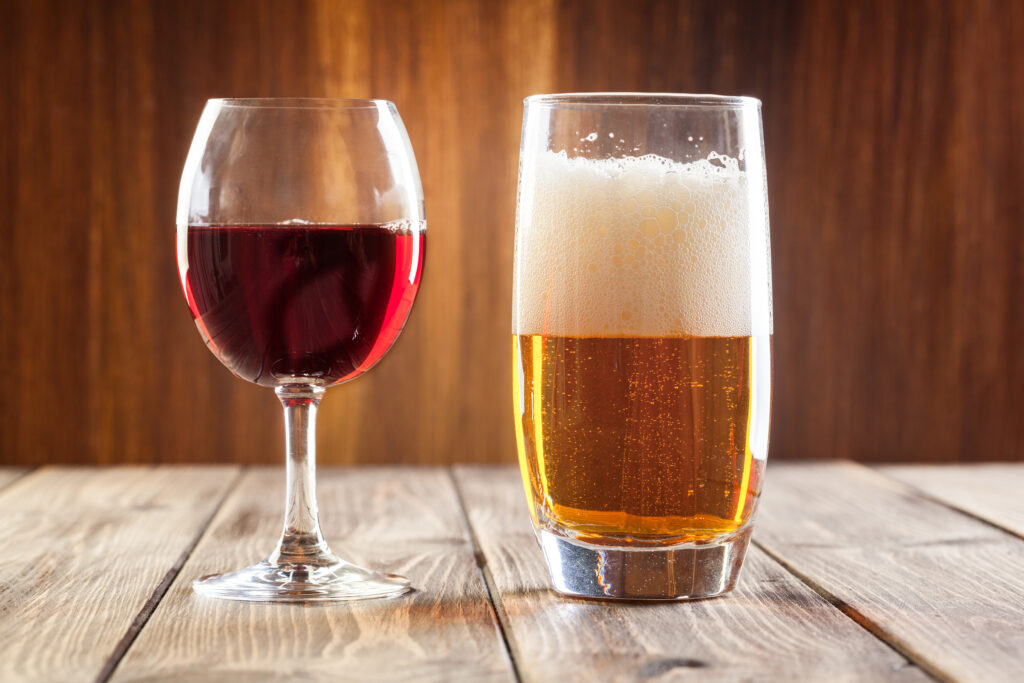
Red wine glass and glass of beer

Change may tend to move slowly in the wine world, but new research published this year on Canadian wine trends reveal some important shifts in consumer tastes and spending habits.

According to the London, UK-based Wine Intelligence 2019 Canada Landscapes report, Cana-dians are drinking less but spending more and branching out to explore new tastes and varie-ties from a wider range of wine growing regions.

There’s also increasing crossover between the wine and beer worlds. A growing number of wine drinkers now also report that they choose beer at least occasionally. Craft beer culture, specifically the sense of strongly identifying with locally produced brands, also seems to be influencing consumer attitudes towards wine, with more Canadians now seeking out high-quality domestic wine.

According to COO Richard Halstead, also Wine Intelligencer’s Canadian market expert, Ontar-io’s Niagara region remains the dominant source for Canadian wine. However, the Okanagan Valley in British Columbia is now becoming highly regarded for the quality of its wine and the strength of its vineyard tourism offerings, while Quebec is an emerging presence in the wine world as well.

Of the over 700 wineries listed in the Canadian Wine Directory, almost 300 were in B.C., 200 in Ontario, over 150 in Quebec, with a handful in Nova Scotia, New Brunswick and Prince Edward Island as well.

A 2017 economic impact study commissioned by the Canadian Vintners Association, the Win-ery & Grower Alliance of Ontario, the British Columbia Wine Institute and the Winery Associa-tion of Nova Scotia, the Ontario wine and grape industry generates about $4.4 billion in eco-nomic impact, while in British Columbia it was estimated at $2.8 billion, $1.1 billion in Quebec and $218 million in Nova Scotia. For every $1 spent on Canadian wine sold in Canada, the study estimates $3.42 in GDP is generated across the country.

Halstead said industry analysts are starting to speculate that the same zeitgeist propelling con-sumers to support local farmers’ markets and neighborhood microbreweries may be influenc-ing Canadians’ attitudes on domestic wine.

“We’re a wine research company, so we don’t really look at craft beer except to look at how it’s affecting our world,” Halstead said. “But there are parallels with the connection craft beer has made with local ingredients and making a local product for local people, and that’s seeped into the wine category and made buying local cool again.”

The divide between wine drinkers and beer-drinkers appears to be narrowing in Canada. The proportion of regular wine drinkers who also choose beer, both mass-market and craft, is growing. In 2014, 67% of wine drinkers said they also drank beer, with 29% drinking craft beer, but by 2018, 74% were also quaffing beer, and 40% drank craft beer.

Data released in May by Statistics Canada found beer remained the most popular choice for Canadians, with $9.1 billion in sales and representing 41% of total sales of alcoholic beverages in 2016/2017. However, the market share of other alcoholic beverages, notably wine, contin-ued to grow. Canadians spent $7.2 billion on wine during the same period, a year-over-year increase of 3%, or just over one-third of overall alcohol sales.

Beer, particularly craft beer, has been growing steadily in popularity in recent years. According to Wine Intelligence’s report, from 2014 to 2017, the number of breweries in Canada increased by 115%, mostly driven by a proliferation of microbreweries and regionally focused craft brewers.

Another reason locally produced wine is gaining in popularity is because local liquor boards have been doing more to spotlight local wines.

“The wine world doesn’t move very fast normally, because people’s habits are people’s habits, but the pendulum has swung slightly toward the domestic side,” Halstead said.

Almost three-quarters of English Canadians now say they have selected Canadian wine in the past year, compared to one-third of those in French Canada. While English-speaking Canadians are far more likely to drink Canadian wines, and Quebecers to choose European brands, the report found domestic wines are quickly gaining in popularity in la belle province.

Canadians are now reporting drinking less wine, yet are more willing to splurge on a good bot-tle, Halstead said. Spending on higher priced wine has increased, particularly when the higher price point is linked to a good story, as with many local producers.

The average price per bottle of wine for a relaxing drink at home has increased from $12.79 per bottle in 2014 to $13.44 in 2018, while the average price paid for a bottle selected as a gift for someone increased from $17.36 to $18.81.

“One of the differences today in Canada versus 20 years ago is that if Canadians wanted really nice wine then, it would either be France or the top end of California,” Halstead said. “Now they’ve also got Okanagan wine, which is selling at $40-50 CDN for some cabernets and char-donnays. It’s hitting a very similar market spot that California, or at least the Napa/Sonoma re-gion, used to own without much competition.”

The increase in average cost isn’t only due to consumer preferences, however. Increased regu-lation, taxes, and liquor board policies have made it difficult for many producers to charge less than $10 per bottle. Regional, government-run liquor boards have also been promoting higher-end brands to motivate consumers to spend more on better quality products, in the hopes that this will also encourage citizens to drink less alcohol overall.

“The LCBO (Liquor Control Board of Ontario) and SAQ (Société des alcools du Québec) have been trying to get people to spend more money and buy less because that fits with govern-ment social policy,” Halstead said. “It’s also good for business because you make more money from one higher-priced bottle than you would two lower-priced bottles.”

Four out of five Canadians surveyed drank wine within the past year, compared to seven in 10 who drank white. The most popular reds were merlot, cabernet sauvignon, pinot noir, shi-raz/syrah and malbec. White wine drinkers were attracted to chardonnay, sauvignon blanc, pi-not grigio/pinot gris, riesling and moscato. No matter what wines drinkers chose, they pre-ferred wines from California’s Napa Valley, Ontario’s Niagara Peninsula, the B.C. Okanagan, the Bordeaux area of France and Tuscany in Italy.

Consumption of rosé is going up, particularly among regular wine consumers in Quebec. While rosé used to be a seasonal beverage, rosé fans are now enjoying it throughout the year, not only in summer. The drink is particularly popular with young adults aged 19 to 34, women, and savvier wine drinkers.

Sparkling wine is also gaining, albeit from a small base, led by the popularity of Prosecco. The percentage of wine drinkers who consumed sparkling wine in the past year increased from just 12% in 2014 to 19% in 2018. Consumption of locally produced sparkling wine has decreased however, with most consumers choosing imports from France, Spain, and Italy—specifically Prosecco.

Halstead said many American brands are continuing to do well in the Canadian market, par-ticularly mainstream Californian brands like Barefoot, Gallo, Woodbridge and Apothic.

As you’d expect in a country where provincially run liquor boards maintain tight control over wine sales (with the exception of Alberta), three-quarters of wine consumers bought their wine from government-controlled liquor stores. Other notable sales channels (representing from one-fifth to one-quarter of consumers in each case) included grocery stores, wine stores at-tached to grocery stores, private liquor stores or dépanneurs (convenience stores).

Choosing a Mobile Bottler for Your Winery: Questions to Ask Before Hiring One

By: Alyssa Ochs

straight truck parked

Last year, we published an article about the pros and cons of mobile bottling and who’s been using this service in the wine industry. Now we’re taking that conversation one step further to discuss how to pick the right mobile bottler for your operations, the various options that mobile bottlers have to offer, and what questions to ask when you decide to package your wine this way. Mobile bottling options are helping wineries keep costs down, but costs can also skyrocket with a poor bottling plan in place.

Making the Decision to Go Mobile

Mobile bottling typically involves a specialized vendor coming onsite with a trailer, bottling unit, and hoses to pump wine from a winery’s tanks to the mobile bottler’s filling tanks. Wineries are usually responsible for providing the bottles, closures, and labels, as well as some onsite staff to ensure everything goes smoothly and to assist with the labor.

Wineries often choose mobile bottling to save space, time, and money, or they may go this route to entrust the job to someone with more experience and increase bottling speed. Companies specialize in this process to take the headaches out of onsite bottling, although wineries still need to meet certain requirements to ensure a successful bottling day. Before bottling day, for example, wineries need to complete the filtration process, ensure proper wine temperature, have the necessary equipment and staff available, and have labels that work with the bottler’s machinery.

When it comes to deciding whether or not to choose mobile bottling, key factors to consider are whether it is cost-effective to own your own bottling line and how many bottles and cases you are looking to produce per season.

“As a winery just starting out, it made sense for us to utilize the capital investment that would be required for a dedicated bottling line on other things that elevate wine quality,” said winemaker Ryan Prichard of Three Sticks Wines in Sonoma, California. “We were, and still are, a small winery so putting money towards equipment that we would only use a couple of days a year didn’t make sense when there were high-quality mobile bottling options available.”

Charlie Fauroat, winemaker for Pellegrini Wine Co. in Santa Rosa, California, told The Grapevine Magazine that his winery uses Peregrine Mobile Bottling for their bottling needs.

Pellegrini Wine chose this bottler because of the “excellent dissolved oxygen management, positive pressure filler to help minimize carbon dioxide loss, and a troubleshooting staff who care immensely about customer service and performance within their jobs,” Fauroat said.

Fauroat went on to share that mobile bottling has affected the way his winery operates because it “allows us not to have to truck wine offsite to bottle, further beating up the wine in this already hectic period for the wine.”

Differences Between Mobile Bottlers

While on the surface it may seem that mobile bottlers are all one and the same, there are actually quite a few differences in their capabilities and what they offer.

Bill Kreck, the founder of Mill Creek Vineyards & Winery and Mill Creek Mobile Bottling Services who spent 17 years in this segment of the wine industry, told The Grapevine that mobile bottlers can be classified as petite, small, and “big dogs” with regard to capacity. He said petite bottlers have a capacity that usually tops out at about 75 cases of wine per hour and uses hand-bottling equipment mounted on a small trailer. Small bottlers can produce around 150 to 250 cases per hour with automatic equipment in a large trailer that is equipped with conveyors to allow bottles to move without manual assistance. “Big dogs” can produce up to 100 bottles per minute so that a winery could expect to get up to 3,000 cases in an eight-hour day. These large vendors typically operate in 40- to 50-foot semi-truck trailers and offer advanced services, such as onboard nitrogen generators and bottle coding. While large bottling lines require more personnel to operate, they run very fast so there is a lower per-case labor cost than for smaller lines.

Some mobile bottlers stick to either just caps or just corks for wine closures, while others offer multiple options for wineries to choose from. Mill Creek Mobile Bottling first went into business in 2001, and Kreck said, “At that time, screw cap wines were reserved exclusively for low-end, low quality, mass produced wines and not at all appropriate for quality products from Sonoma County vintners.”

However, attitudes have changed about screw caps, and there are now many more mobile bottlers in the industry competing for winery clients.

“Many wineries have retained cork finish for reds but have converted to screw cap finish for their white wines, so if a bottler cannot do both, the winery is likely to find one that can,” Kreck said. “It would not be wise now to be a mobile bottler unless that dual closure option was available.”

In addition to screw cap or cork options, other custom options provided by mobile bottlers include PVC, polylam, or tin capsules and also bottles in 750ml, 500ml, and 375ml sizes.

Meanwhile, Mary McLaughlin of Ryan Mobile Bottling in Napa, California said that what sets her company apart from its competition is its people. This is another major difference among mobile bottlers.

“We have dedicated, talented staff who stay with us for the long-term, which enables them to be stronger operators who are familiar with our customers and their packages,” she said. “Also, our management team is actively engaged in field operations and are prepping, planning, and bottling on a daily basis.”

McLaughlin also told The Grapevine Magazine that all four, soon to be five, of Ryan Mobile Bottling’s trucks insert corks.

“We have two trucks that can apply screw caps – one of which can also apply LUX closures,” she added.

Mobile Bottling Costs

Costs can vary significantly between mobile bottlers, depending on the services offered and the region of the country. For example, East Coast Mobile Bottling charges a setup fee and minimum service charge of $1,500 and $2.75 per case for sterile filtration, bottle rinse, bottle sparging, filling, closure, capsule, and label. Other fees apply for bottle changes requiring complete reconfiguration of the entire line and when it’s necessary to change the wine or bottle height. Additionally, each change can reduce daily production by about 75 cases.

Old Woolam Custom Bottling estimated that a winery producing 10,000 gallons or 4,100 cases annually would need to commit to a $75,000 total investment and at least a $25,420 total annual cost to own its own bottling line. However, the total annual cost to have a mobile bottler come to this size of a winery would be more like $17,064, with no up-front investment for equipment.

Kreck of Mill Creek told us that there is generally a slight premium per case bottled for using a petite or small mobile bottler over a faster line and that labor is a significant factor in determining cost. However, he said that mobile bottlers usually have a fee structure that includes the following, with the cost of supplies, such as filters, sealing tape, and nitrogen or argon being extra:

In/out and spot the trailer and

hook up utilities……………………………….$300 – $600

Initial package setup for the

first wine of the day…………………………$100 – $200

A fee for package changeovers

(i.e. Bordeaux > Burgundy)………………..$100 – $200

Wine change fee

(after first three wines of the day)……..$100 – $200

Per case bottling and/or

labeling charge………………………………$2.10 – $3.00

Kreck also said that the most significant variable in the mobile bottling cost is speed and that important factors to consider when choosing a bottler are features, name recognition, and service. He estimates that a petite mobile bottling line that can produce up to 100 to 120 cases per hour would cost $100,000 to $175,000, a small line for around 100 to 250 cases per hour at $250,000 to $500,000, and a large line for around 250 to 350 cases per hour at $500,000 to $1.3 million. All of those costs increase if a trailer needs to be custom made, plumbed and wired, and a tow vehicle supplied to move it and support the equipment.

Questions to Ask a Mobile Bottler

Wineries looking to try mobile bottling for the first time can benefit from asking lots of pertinent questions up-front. Cost is always a top concern, so you’ll want to get a breakdown of mobile bottling charges and fees for your winery’s specific situation. You will also want to fully understand the services and equipment that a mobile bottler offers, such as screw-capping, to ensure the vendor meets your winery’s needs.

Bottle-filling speed is very important when you choose a mobile bottler, so ask vendors how many cases they can process in a day. However, you’ll need to know how much you want to bottle beforehand to ensure that the company can meet your case-per-day requirements. Also, ask about the bottle-per-minute speed because this can vary from one company to the next based upon the technology and equipment used.

Ask mobile bottlers about the size of their bottling trailer to make sure it will fit comfortably at your winery’s location. You should also have discussions early-on about a mobile bottler’s ability to work with your current mechanical and electrical capabilities. Other questions to ask include how many staff members should be onsite for bottling day, what preparations need to be done in advance, what the sanitation process entails, and how the bottler checks the line to ensure everything is going according to planned. If possible, try to see the mobile bottler at work to better understand what the process entails from start to finish.

Mobile Bottling Tips and Advice

There are many things that can go wrong in the bottling process if a winery and mobile bottler aren’t on the same page, including lost time, inefficiency, and broken equipment. This is why Kreck of Mill Creek says that communication is so important from the very first conversations about scheduling. A work order should be submitted weeks before bottling day to outline exactly what the winery needs to accomplish and list the number of cases of each wine along with details about the glass, cork or cap, foil, and labels to be used.

“If winemakers detest bottling, they often do not properly pay attention to details and that becomes the responsibility of the mobile bottler,” Kreck said. “An example might be that the winemaker wants the whites to be sterile filtered, then most of the reds to be unfiltered, but the last wine sterile filtered again. The bottler knows that once a sterile filter is removed, the line is no longer considered sterile and just putting a sterile filter back in the filter housings could disastrous. The bottler knows that according to the work order, they will come to the end of the day with a partially filled tank. Does the winemaker want to work overtime to finish the tank, be comfortable with an unfilled tank overnight, or rearrange the bottling sequence to finish tanks by the end of the day?  These are just a few of the issues that a mobile bottler would address and communicate options back to the winemaker.”

Meanwhile, David Crawford, vice president of Napa’s Top It Off Bottling emphasizes the need to plan ahead well in advance and start communicating with a mobile bottler over a year before your next anticipated bottling date. Consulting your mobile bottler about packaging decisions is also recommended to reduce hassles and save money.

“I always ask my customers to put me in direct contact with their suppliers so we can talk out what they have going on because I know how to ask the right questions and we deal with these people all the time,” Crawford said. “There is no advantage to hiding the ball on troublesome packaging issues. If you have a cap that doesn’t fit but you want to try it anyway, tell us ahead of time so we can plan for it.”

McLaughlin of Ryan Mobile Bottling agrees that communication is the key to a successful working relationship between a winery and a mobile bottling company.

“Make sure that all work orders are complete and accurate, and notify your bottler when there are changes,” McLaughlin advises. “Also, inventory raw materials to ensure you have received what you expected. Our time may be tightly scheduled and may not allow for us to wait while vendors make corrections.”

End Of Line Packaging Helps Wineries Reach Business Goals

By: Gerald Dlubala

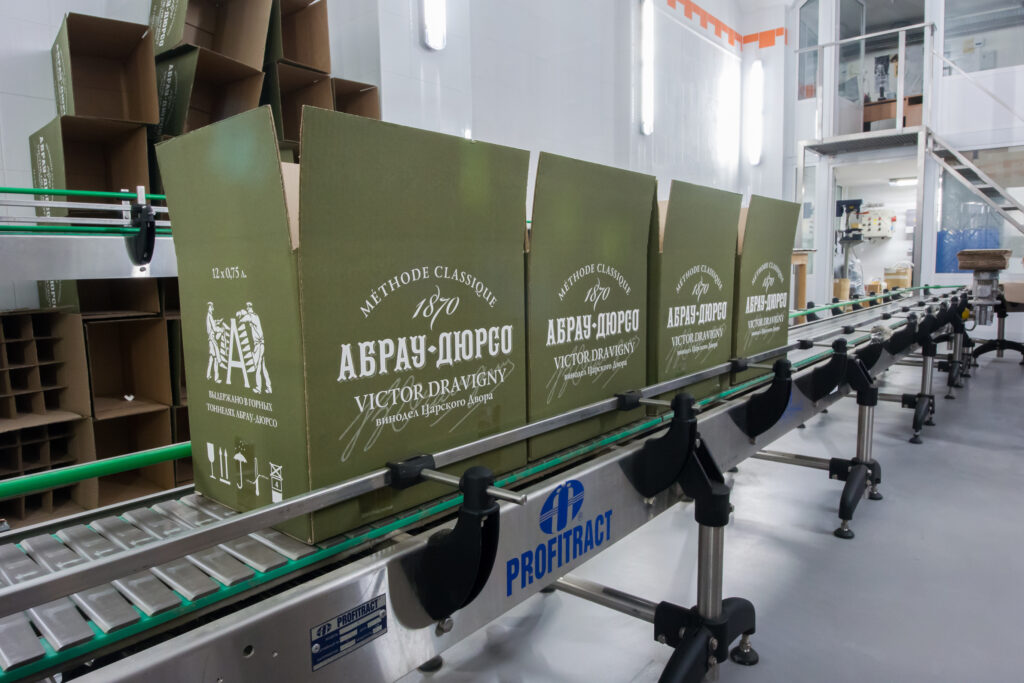
4 packages of sparkling wines
ABRAY-DURSO, RUSSIA – SEPTEMBER, 15: Production line for the packaging of sparkling wines. Factory wine house “Abrau-Durso” has the latest equipment for production and packaging of sparkling wines on 15 september 2014

You’ve spent a lot of time, effort and money to produce a great tasting, quality wine that you’re proud of and can’t wait to share with consumers. When it’s finally time to package and ship your wine, there are many options on the table. It’s up to you to make the decisions that will move your company in the desired direction.

Functional End Of Line Efficiency For Trending Canned Wines

“If it has a seam or a ridge, we can put a handle on it,” said Mike Seestadt, PakTech’s Territory Sales Manager for North America and Central Canada. “Because of the surge in packaging wine in cans, it is a major focus of our business right now. Canned wine offers a huge opportunity because we can make and put handles on all can formats, from standard to sleek to slim.”

PakTech produces can-handle packaging solutions   that are manufactured totally from post-consumer recyclables, namely clear milk jugs. The can-handles not only make it easy to carry packs of canned wine, but they are also built to nest, creating an optimal way to stack and store can packs. Once used, the handles are recyclable again. In fact, PakTech is partnering with its clients in maintaining a closed-loop recycling program that has an ultimate goal of recycling used can-handle into more of the same.

“PakTech also makes and sells the can-handle applicators, making us a one-stop shop,” said Seestadt. “Our available applicators are a standalone system, but they are also conveyorized, allowing them to be inserted directly in-line within a company’s packaging process.”

PakTech sells can-handle application machinery based on the clients packaging needs, starting with the CCA 120/180. This unit applies quad-, six- or eight-pack PakTech can-handles onto filled beverage containers at a rate of thirty cycles, or 180 cans per minute. The CCA 440+ applicator is recommended for larger producers but is also a popular item in co-packing environments. PakTech also manufactures higher speed units customized for the unique needs of their clients, with application speeds of up to and including 1600 cans per minute.

“We’re not just a seller though,” said Seestadt. “We are a partner with our clients rather than a component supplier. We stay with the company throughout the install and provide training on site for the operation, maintenance and cleaning of the applicators. We have service teams that travel the globe providing installs and physical upgrades. Software upgrades are applied remotely.”

Seestadt told The Grapevine Magazine that PakTech’s systems typically are placed last on the packaging line and work well with the systems already installed.

“We work with the currently installed line configurations and filler spaces. Our can handles all nest, providing easy shipping and pallet building without the need for trays for stability. Although our systems are 100% in-line capable, they can be run as a standalone unit if needed.”

Needs and Goals Drive Packaging Automation Choices

Bryan Sinicrope, Vice President of Sales and Marketing for A-B-C Packaging Machine Corporation, is all in when matching end-of-line packaging options with a winery’s business needs and goals.

“Typically, once a winery reaches line speeds of around 120 to 150 bpm, automation in their packaging process can be justified,” said Sinicrope. “Then, they need to look at their goals. Do they need to increase speed, want to reduce labor, need a dedicated line, or want to run multiple sizes and configurations? What are their space limitations? All of these answers will impact the type and amount of machinery needed. For example, to accommodate a large increase in sales, it may be worthwhile to transition, when feasible, from reshipper cases to bulk bottle delivery. Original equipment manufacturers are well equipped to help with machinery decisions once concrete goals are established. Our equipment recommendations lean towards simple, straightforward and uncomplicated machinery that still offers modern, updated sophistication with features and equipment design that give the winery plant personnel the flexibility and control they need.”

Sinicrope told The Grapevine Magazine there isn’t an industry standard for packaging automation, because different options are available depending on the winery’s priorities. Some wineries, for example, may want to automate at lower speeds if it provides other advantages such as improved quality control for their products or to address concerns over potential liability and insurance costs related to hand labor.

“Machinery choices also vary based on how the winery purchases their bottles,” said Sinicrope. “They will either use reshippers, where the bottles are delivered in corrugated cases, or purchase bottles in bulk, getting them on bulk shipping pallets. For reshipper handling, the winery needs an uncaser to remove those bottles from the reshipper case, then a packer to repack the finished bottles after filling, labeling and closure application. They’ll need a top sealer to seal the top case flaps and a palletizer to load the cases onto the shipping pallets. If using bulk glass handling, the winery needs a depalletizer to unload the bottles from the bulk pallets, then a case erector to set up the new cases, a partition inserter if the case will have partitions (dividers to keep the bottles apart), a packer to pack the bottles into the case, a sealer to seal the top case flaps, and finally that palletizer to load the shipping pallets.”

On first glance, all of this may seem like a significant investment, Sinicrope said, but there are different options for each step that offer both cost and space savings. For example, A-B-C Packaging manufactures a bottle unpacker/packer that simultaneously handles both uncasing and packing in one machine, saving floor space while reducing upfront, capital equipment expense. All the equipment can be used with previously installed lines or on a standalone basis. Palletizers typically come preprogrammed with common pallet patterns for easy selection, but if necessary, the palletizers come equipped with an intuitive custom configuration builder on the control panel.

A-B-C Packaging offers training following the Packaging Machinery Manufacturers Institute standardized program. They recommend monthly lubrication and cleaning schedules and offer lubrication systems on some of their machinery, making the task easier. They also supply full service for the life of their equipment, including training, remote diagnostics, in-plant service calls, factory spare and repair parts, machine upgrades and rebuilds. To reduce a winery’s need for service staff, they A-B-C Packaging offer service contracts that provide regular inspection and maintenance.

Adaptable and Flexible Packaging Options Fit Industry Needs

“End-of-line packaging can be a bigger concern for the wine industry simply because of the price point of the product,” said Ryan Broughton, Sales Manager for Delkor Systems.“How the finished product presents itself to the end user is important.”

Delkor Systems offers pick-and-place case packing systems rather than drop pack systems. Pick-and-place case loaders are better at handling fragile components while also addressing potential integrity issues of the filled bottles.

“Bottle integrity, label integrity and closure integrity are all important aspects to consider when packaging, shipping and showcasing the wine for the end user, and we’re always looking at how to better address these issues,” said Broughton. “Bottle integrity is increasingly important with the increased use of thinner and lighter weight glass bottles. Labels are obviously important for branding, consumer recognition and loyalty, and no one wants to see scuffed or scraped labels on their finished product. It presents a diminished perception of the product inside. With more wines being bottled using screw caps, it’s imperative that the skirt directly below the cap enclosure remain intact and undamaged.”

Broughton told The Grapevine Magazine that some packaging automation is generally recommended once a winery approaches an annual production rate of approximately 200,000 cases. “Automation saves money on different levels. Basic machinery includes an automated case packer and palletizer. By having a case packer available to run when needed, a winery can pack and prepare shipments faster and more efficiently. It also eliminates the need to hire temporary workers as some wineries have to do to get the product packed and shipped. The time and money saved can be better used elsewhere, increasing efficiency and uptime in other areas. To avoid the repetitive lifting, twisting and stacking, a palletizer is also recommended to take those filled and sealed cases and ready them for shipment.”

Delkor Systems’ machinery can be used as a standalone machine when needed and can be fed by hand or by conveyor. The machines can be adjusted to different bottle sizes and shapes, cans or any rigid container types. Additionally, the systems readily adapt to new case counts or configurations.

Delkor also manufacturers machines optimized for packing flexible primary products as well, such as bag-in-box or pouches. Delkor’s machines were derived and built based on the needs of the food and beverage industry, and because of that experience, Delkor Systems bring additional functionality and flexibility to wine packaging that previously never existed.

“We’ve perfected our machines through decades of hard work and listening to our customer base,” said Broughton. “For a long time, wineries were a very stable and static industry regarding bottles, generally using only four basic types. Other food and beverage containers, however, were always changing due to the needs and wants of consumers, or because of new products coming to market, so Delkor Systems made it a priority to be flexible and adaptable with its equipment lines. We pride ourselves on the flexibility and adaptability of our equipment lines to help our clients react and adapt to the market as needed, whether it’s a different style or shape of the bottle or can, or the desire to package the finished product differently.”

Delkor Systems provides installation, service and training programs for the end users of their equipment. Their overall goal, however, is to provide their customers with the quality training and knowledge that will allow them to confidently service and maintain the equipment on their own.

“If and when a client needs our help, we’re always here for them with 24-hour live phone support and availability of on-site service and training,” said Broughton.

Priming Your Irrigation Systems for the Season (Part 2)

By: Tracey L. Kelley

In the May-June issue of The Grapevine Magazine, a savvy group of experts provided detailed information about irrigation system maintenance. That article outlined seasonal start-up and troubleshooting tips. For part two of this topic, we’ll move on to ongoing system checks, typical problems often overlooked, monitoring water flow and quality and critter control.

Once again, our experts are:

  • Guy Fipps, Ph.D., P.E., professor and extension specialist of irrigation and water management at Texas A&M University, College Station, Texas; in collaboration with Charles Swanson, extension program specialist, Texas A&M University.
  • Jacob Hernandez, CCA, owner, JH Ag Consulting, Santa Margarita, California; in collaboration with James Anshutz, AGH20, irrigation engineer with Netafim USA in Fresno, California; and the Cal Poly SLO Irrigation Training and Resource Center, San Luis Obispo, California.
  • Mark Hewitt, district sales manager, Rain Bird Corporation Ag Products Division, in Azusa, California.
  • Steve Purvins, owner, The Vineyard at Lawton Hall in Bushwood, Maryland, which produces Vidal Blanc and Chambourcin grapes.

Checks and Balances

Continual process management is the key to a fine-tuned irrigation system. During the rush of season preparation, however, some aspects might inadvertently go by the wayside.

Hewitt pointed out numerous required fixes this time of year. For example, field zone valves might have broken or damaged wires because of animals, or as a result of “tractor blight”—nicks and punctures caused by machinery, which happens to vines, too.

“There might also be stuck plungers in the solenoids,” he said. “Pull coils and plungers. If the coils are swollen, replace them. Use emery cloth on plungers if they’re only slightly rusted.”

If you’ve noticed a torn or deformed diaphragm, Hewitt said, sometimes simply turning it around works, depending on the valve type, or replacing it. “Same with any springs located in the bonnet of a valve. Springs and diaphragms wear out or develop a new ‘memory,’ especially pressure-reducing valves that are always partially open throughout irrigation season,” he said.

For growers with low-volume micro sprinklers, which are similar to drip emitters, Hewitt advised clearing nozzles of debris and “checking that any fixed spray plates or rotating spinners are providing the correct patterns, distance of throw, and uniform coverage.” LFS and LFX high-performance sprinklers often don’t require much maintenance, he said, but it’s still important to check periodically for proper rotation, nozzle clogs and “insects building in deflectors.”

Hernandez offered a reminder about flushing mainlines, submains and laterals. “This isn’t done enough by growers. Most growers flush once or twice a year—either at the beginning or end of the season,” he said. “In-season flushing should be done after fertigation events with thick materials. Flushing velocities should be greater than two fps. Have your irrigation professional develop a proper flushing routine.”

What is lurking in your system? “The moist, dark interiors of drip hoses and emission devices can be ideal environments for biological slimes and chemical precipitates to form,” Hernandez said. “Various chemical solutions exist to shock and treat these issues. Irrigation professionals should test water quality throughout the season and provide treatment plans to rehabilitate dirty lines and emitters and implement continuous treatment to maintain the lines after cleaning up.”

Fipps added that if growers don’t already have flow meters and pressure gauges, now’s the time to install them.

“Monitoring system pressure and flow rate are crucial for managing operation and scheduling. Unfortunately, many vineyard drip systems lack either a flow meter or pressure gauge—or both—on their system,” Fipps said. “Observing situations of increased flow or decreased pressure can often be signs of leaks in the system, whereas situations of decreased flow and increased pressure can be signs of clogging of the drip emitters.”

Pay Attention to Pumps

“Attention to pump controls should always be given,” Fipps told The Grapevine Magazine. “Pump controls should be in manufacturer-recommended housings that prevent moisture accumulation, or pests like ants and wasps from building nests in or above the components.” He added that “if injection pumps are used for fertilizers or chemicals, hoses should be inspected and replaced if there are any signs of cracking or dry rotting to prevent chemical spills and waste.”

Hewitt said you might have to check impellers if pressure is lower than before, indicating they might need replacing. Packing leaks might mean replacement, but also a need to refill oil cups and install mechanical seals.

Also, Hernandez suggested adding a variable frequency drive (VFD). “Adding a VFD to your pumping station allows for a soft start of pumping motors, reducing wear and tear. If growers have multiple irrigation methods, various plant and row spacings, different size irrigation sets or sets on slopes, VFDs allow for one pump to operate on a number of different pressure and flow settings. This permits a grower only to use the amount of energy they need for the particular set they’re irrigating,” he said.

Managing Water Effectively

Fipps said one aspect often overlooked by growers is monitoring water quality. “Annual analysis of water quality, whether it’s from groundwater or surface water, should be conducted to check salinity and mineral composition, which can affect both the irrigation system as well as plant health,” he said. “Knowing the water quality helps guide growers on how much water to apply at irrigation, as well as prevent any negative reactions from injecting chemicals or fertilizers into the system.”

He also strongly recommends soil moisture sensors—a technological tool that works to your advantage. Soil moisture sensors might initially seem expensive, averaging $300-$500 per unit, plus the cost of telemetry devices for data transmission across the vineyard, but, Fipps said, “they take the guesswork out of deciding when it’s time to irrigate.” If you can’t afford to populate the vineyard with multiple sensors, some experts recommend having one or two in an irrigation block representative of the overall field profile.

Hernandez also recommends expert analysis. His consultancy tries to bridge the gap.

“Certified crop advisors and other irrigation professionals can help vineyard managers maintain and service their irrigation systems with analysis, implementation and ongoing monitoring to aid in the reduction of energy use; and improving crop performance through better distribution uniformity (DU).”

As a method of irrigation application efficiency, Hernandez offered two tips.

The first is setting up proper scheduling for both duration and amount of water to replace soil moisture used by the vines. “Improper scheduling can result in runoff, deep percolation, crop stress and even crop damage,” he said.

His second tip is to “use monitoring technologies to give virtual pump test and DU evaluation data every 15 minutes. These sensors give insight into the impact of changes in practice and hardware,” Hernandez said. “For example, if a DU evaluation finds extensive plugging, we’ll want to rehabilitate the lines with chemical treatment and flushing. Pressure sensors installed at strategic locations in the field can tell us almost immediately if we’ve improved the pressure in the drip hoses and provide a ‘heads-up’ during the irrigation season that we’re beginning to have a problem that can be addressed before it becomes serious.”

Purvins suggested growers ease inadequate volume issues with proper emitter spacing. “During extreme drought conditions, my system doesn’t supply enough water. Fortunately, I’ve only experienced one such year out of 20. I would spec the next system with twice the number of emitters—48” spacing vs. 96”—and adjust zones accordingly.”

He also pointed out the value of developing partnerships with equipment vendors who understand what you’re trying to accomplish. “When I purchased my system, the rep was knowledgeable about sizing the system but had no experience with vineyards. Such experience would have been useful.”

Hewitt said his company is trying to assist vineyard operators with water management through technology products, such as Rain Bird IQ Water. “Real-time sensors and remote web-access allow growers to monitor every aspect of their irrigation system from the water source to the emission device. They can focus in on a single irrigation system part, or see the big picture across every system they manage,” he said.

What About Those Critters?

Since we don’t grow in a biosphere, there will always be wildlife control issues. Often, our experts said, it’s easier to anticipate their actions with some preventative measures.

Purvins of The Vineyard at Lawton Hall has had a critter or two chew tubing, but since that damage is easy to spot and repair—and the vines and grapes aren’t bothered—he feels he doesn’t need to control wildlife.

Hernandez of JH Ag Consulting said, “As we install more sensors and monitoring technology, we’re seeing that animals like to chew on sensor wire and electronic cables. Wrap monitoring systems with a wire screen to protect them from animals and passing farming equipment.”

He also recommended that growers “bury five-gallon buckets at the downstream ends of some of the hoses and allow water from emitters to keep the buckets full during the summer to provide an easy water source.”

Hewitt told The Grapevine Magazine that setting out water is a good idea, plus using more natural control methods. “For larger animals—such as coyotes and foxes—simply put a large 2” high pan under your drip tubing. The water will overflow and still get water to your plants, and the critters can get the drink of water they want without chewing on the drip tubing.”

“It’s a bit tougher to combat gophers and ground squirrels, especially with buried hose systems,” Hewitt said. “One grower I know uses trained falcons that he releases into the area to help control these pesky critters.”