Exploring New Practices for Managing Trunk Disease

hand grabbing an infested leaf

By: Becky Garrison

During the Oregon Wine Symposium, held virtually from February 15-17, 2022, Akif Eskalen, Professor of Cooperative Extension, UC Davis, offered his insights into the identification, biology, epidemiology and current management strategies of grapevine trunk diseases.

  In Eskalen’s estimation, GTDs are considered one of the most significant challenges for viticulture across the globe. These harmful diseases can be found on the spurs, cordon, trunk and rootstock of the grapevine and gain entry primarily via pruning wounds. GTDs are caused by a broad range of permanent, wood-colonizing fungal pathogens. They are also present as part of normal grapevine microbiota, with environmental factors triggering them to switch from normal to pathogenic.

  When examining the fungal pathogens responsible for creating GTDs, Eskalen found that most of these pathogens produce overwintering fruiting structures containing infectious spores. These overwintering structures are found in old pruning wounds, harvesting debris, the bark surface of infected vines and other woody perennial crops such as nut and fruit trees.

  Researchers have identified more than 130 different fungal species associated with GTDs. Commonly found in both young and mature vines was Black Foot disease, and Petri disease was found predominant in young vines. Researchers found Esca (black measles), Botryosphaeria dieback, Eutypa and Phomopsis dieback in mature vines. These are called canker diseases because they cause characteristic perennial cankers in the vines. The word canker comes from the Greek word “cancer,” which describes dead tissue in living organisms. Perennial cankers cause spur, cordon, and trunk dieback, ultimately resulting in the death of the entire vine. Other significant symptoms of the presence of GTDS in vines include poor vigor, stunted shoots, leaf chlorosis and stripe, berry specks and shoot and tendril dieback.

  In analyzing the lifestyle of this disease, Eskalen said that if the infection cannot be controlled in the cordon, it’s going to move into the main trunk. Once it settles there, the trouble starts. As the main trunk is the essential part of the plant, the pathogen will move faster because more woody tissues and nutrition are in that area.

  Should the pathogen reach the graft union, then it is too late to do anything about managing GTDs. In some cases, black foot and charcoal rot diseases are caused by a soil-borne pathogen complex. Once they colonize the roots and lower level of the trunk, nothing much can be done to save the vines.

  Through Eskalen’s research at the UC Cooperative Extension Eskalen Lab, he’s discovered that pruning wounds are the primary entry point for these fungal pathogens.

  “Some of them could be entering the plant without the pruning wounds, but the major entry point is the pruning wounds because…there is no defense mechanism,” Eskalen said. As soon as the fungal spores land on the tip of the wound, sap provides enough nutrients to the fungi for them to colonize.

  Another infection method is latent infection, occurring when the fungal pathogens release from their source and land on the tissue without causing further problems until the right conditions come, such as when the vine is stressed by factors like nutrition, climate change and irrigation.

  According to Eskalen Lab’s research, conducted with California-based farmers, most spores appear to be released during precipitation events from December to February. Since this time overlaps with pruning season, there’s a window for the fruiting bodies (i.e., overwintering spore structures) to release fungal spores onto exposed pruning wounds and cause infection. Eskalen estimates that pruning wounds could be susceptible for several months and that pruning wound protection is essential in vineyards during this time.

Mitigating Grapevine Trunk Disease

  GTDs are vascular diseases, which means they can colonize the wood part of the plant. As the symptoms above are caused by mycotoxin, or toxins produced by the fungus in the vascular tissue, applying fungicide, or anything from outside, to control it will not work because these pathogens are present inside the wood.

  Pruning wound protection strategies alongside cultural practices are the best strategies to mitigate GTDs. Cultural practices focus on sanitation, including using clean material when establishing a new vineyard, removing pruned and infected material, and pruning dead shoots, spurs, and cordons below the symptomatic tissue.

  In Eskalen’s estimation, the most effective way to protect pruning wounds from airborne fungal spores of GTDs is to apply registered fungicides or biological pruning wound protectants annually. These treatments should be sprayed the same day if applying synthetic chemicals. To avoid inclement weather from washing the solution away, apply these protectants after pruning and during a dry weather window. If beneficial fungal species, known as biocontrol agents, are used, Eskalen said it could be better to have sap accumulation on the wound so they can colonize and compete with the pathogens.

  In their research, Eskalen Lab found that delayed pruning after the high disease pressure period was another option for mitigating GTD infection. Eskalen said some of the powdery mildew fungicides might control some of the GTD pathogens, but the lab doesn’t spray powdery mildew fungicides during the dormant season.

  Commercial chemical protectants shown to be effective in controlling GTDs include a combination of Rally and Topsin-M. Currently, Eskalen Labs is researching biological wound protectants that are more sustainable.

  Assessing the Economic Impact of GTDs

According to the data collected by Eskalen dating back twenty years, if a grower did not do any preventative practices for GTDs when initially planting the vines, the vineyard will start to see GTDs within the first five to 15 years. By then, the vineyard has matured, and removal becomes far more difficult than if the recommended treatments had been applied from the beginning.

  Those looking for a more in-depth analysis of the work of Eskalen Lab and the latest research on treatments for GTDs, go to https://ucanr.edu/sites/eskalenlab.

  Eskalen Lab’s website offers these suggestions for managing GTDs in the nursery and vineyard.

Preventative Management in Nursery

•   Treat pruning wounds on mother plants to prevent new infections.

•   Sanitation in mother fields and during the entire nursery process.

•   Disinfect grafting machines regularly.

•   Reduction of the cutting hydration period.

•   Apply control products (chemicals or biologicals) as a dip after grafting, before storage and/or before dispatch.

•   Hot water treatment of dormant nursery plants prior to dispatch.

Preventative Management in Vineyards

•   Use the cleanest plant material available when establish new vineyards.

•   Protection of pruning wounds with effective registered chemicals and/or biological control agents is the most effective way to prevent new infections from air-borne spores of GTD fungal pathogens. More than one application may be necessary to protect the pruning wound during its susceptible time period.

•   Minimize stress conditions on young vines after planting.

•   In applicable, In VSP systems, double pruning has shown to facilitate late pruning of large acreage vineyards and thus, reduce infection.

•   Prune dead shoots, spurs and cordons below the symptomatic tissue (at least a few inches past the last symptomatic wood).

•   Make a clean and smooth pruning cut to speed up the callusing process at the pruning wound.

•   Sanitation is very important in the vineyard. Remove pruned and infected plant materials away to prevent the development and increase of GTD fungi overwintering structures in the vineyard.

•   Remedial surgery, where visible infected parts of the vine (spurs, cordons and/or trunk) are removed, can be an effective strategy to remove the pathogen from the vine (primarily when cuts are done 7” to 10” below the visual canker tissue) and thus, prolong the lifespan of vineyards.

Preventative Management in Vineyards

•   Protect pruning wounds.

•   Use disease free, clean plant materials when establish new vineyards.

•   Apply good cultural practices to minimize stress on young and mature vines.

•   Delay dormant pruning to avoid potential pathogen dissemination during winter precipitation and to reduce the susceptibility.

•   If applicable, consider doing double pruning to reduce fungal spore infection during winter moths.

•   Prune dead shoots, spurs and cordons below the symptomatic tissue (at least a few inches below).

•   Make a clean and smooth pruning cut to speed up the callusing process at the pruning wound.

•   Remove pruned plant materials away from the vineyard to prevent fungi to form pycnidia and perithecia.

AMPHORA: Bringing the Past Into the Present

cave for fermentation

By: Nan McCreary

Wine fermented, aged and stored in clay amphora, a practice that originated in Georgia 6,000-8,000 years ago, is experiencing a renaissance around the globe as winemakers realize that this ancient technique brings new opportunities to viniculture.

  An amphora is “an ancient Greek or Roman jar or vase with a large oval body, narrow cylindrical neck and two handles that rise almost to the level of the mouth.” In ancient times, amphorae were the principal means for transporting and storing grapes, olive oil, wine, oil, olives, grain, fish and other supplies. Georgia was the center of amphora winemaking, where the vessels were known as “qvevris.” The technique is still practiced throughout the country today. In fact, qvevri-winemaking is so integral to their culture that this winemaking technique has been added to the UNESCO World Heritage list.

  Today, partially inspired by the popularity of Georgia’s qvevri-aged orange wine, winemakers in Old World countries that once used and abandoned the ancient practice are now using amphorae to bring their wines back to ancient roots. Others, including New World winemakers who have no history of using amphorae, such as Chile, South Africa, Australia, Argentina and the U.S., are also using the age-old method to make new and original wines. So far, the reviews have been positive. According to proponents, modern use of this technique allows for slow micro-oxygenation, naturally-controlled temperatures, pure expression of the fruit and softening of the acidity – or, if fired at a very high temperature, preservation of acidity.

  These benefits of fermenting and aging in amphora are due to the unique properties of the vessel, just as winemaking in oak barrels and stainless steel offer their own distinctive characteristics. Oak barrels are porous and allow exposure to oxygen but also contribute flavors from the wood’s tannins. Stainless steel tanks are hermetically sealed and provide an oxygen-free environment, resulting in fresh, crisp wines. Clay amphorae fall somewhere in the middle. Because clay is porous, the vessel allows oxygen exposure as wines age, which helps soften tannins and flavors. Also, since clay is a neutral material, the presence of oxygen enables wines to develop without imparting any additional flavors. In addition, clay is an excellent thermal conductor, which releases the heat from fermentation, so there is no need for temperature control, especially if the vessel is buried in the ground according to Georgian tradition. The wine evolves slowly, preserving the fresh and fruity aromas.

  In the early days of winemaking, amphora size was generally around 30 liters. Today, amphorae may range from 320 liters to 1600 liters. The winemaking process begins when the pressed must is placed into the amphora, which is then sealed. Fermentation is spontaneous due to the presence of indigenous yeast in the fruit. During fermentation, the curved nature of the pots creates a swirling motion that gently extracts flavors and some tannins from the grapes and forces solids to settle at the bottom, leaving a clear, bright wine. There is little or no need to filter. Natural tannins found in grape skins, pips and stalks provide a natural preservative, so adding sulfur is unnecessary.

  Amphorae are generally free-standing, but some winemakers bury their vessels according to Georgian customs. Fermentation and maturation times will vary depending on the winemaker’s goals. In Georgia, they leave the qvevri underground to ferment for at least five months before being decanted and bottled. According to some experts, fermentation in amphora can take longer, resulting in a higher extraction level. Wines aged in amphora tend to mature faster, too, because of the micro-oxygenation. Both red and white wines can be vinified in amphora, with whole grapes stemmed or destemmed.

  Amphora wines are especially popular among proponents of biodynamic winemaking, who prefer minimal intervention and a natural approach to viticulture and viniculture. Since these wines are unfiltered, the process appeals to fans of natural wine and winemaking. Also, the sustainability of the amphora, compared to wood or steel tanks, offers an environmentally and financially advantage: On average, wood barrels must be replaced every four to five years, but clay amphora can last decades, if not centuries.

  So how do these wines taste? Because the wines fermented and aged in amphora are exposed to more air, they have a deep, rich texture. The presence of oxygen also softens tannins and accelerates tertiary aromas of nuts, baked fruit and chocolate. Clay is a neutral container, so wines show less oxidation than their oak-aged counterparts. They also show less reduction than wines aged in stainless steel. Generally, tasters say wines have an elevated expression of fruit, open with a bright quality and close with a long and rich finish.

  While we are seeing a quiet revolution of fermenting and aging in amphora, there is no “one size fits all” to the containers because of regional and historical differences. The vessels come in a wide range of sizes and shapes. Most are made with clay, including terracotta. Others may be made with sandstone and concrete, but they are usually not referred to as “amphora.” Traditionally, amphorae were hand-made, and most still are today, either by the winemakers themselves or through specific amphorae producers.

  The unifying thread is that these wines prioritize extended skin contact, regardless of the composition. In Georgia and Armenia — where amphorae-based wine production has its origins — the vessels are called “qvevri” and “karas,” respectively. The amphorae are large, egg-shaped pots and, for hygienic reasons, are lined with beeswax. Ancient Romans used a large oval clay vessel called a “dolium,” which had a large opening at the top and a rounded body attached to a flat or rounded bottom. The dolia, often six feet in height with a 2500-liter capacity, were kept underground with a constant temperature all year. The Spanish used a massive clay vessel called a “tinaja,” which tapers at the top and the bottom like an egg. Tinaja are used by some contemporary winemakers in La Mancha, Valdepeñas and Montilla-Moriles. In Portugal’s Alentejo region, many winemakers are reviving the country’s tradition of fermenting in amphorae called a “talha.” The talhas are massive and can produce 1000 liters of wine. The region even has the world’s only appellation dedicated to wines made in amphora, Vinho de Talha. Italians use the terms “anfore,” “orci” or “giare” for amphorae. Tuscany has been the center of clay vessel production for generations.

  The revival of amphorae is leading innovative producers to experiment with improvements in the vessels, specifically in the areas of oxygen transfer rates, porosity, effects of different firing temperatures, testing of elements released by amphorae, durability and ease of cleaning/improved sanitation, among other areas. Many of today’s amphorae are far from those used 6,000 years ago, with producers offering hermetically-sealed ceramic lids that minimize temperature fluctuations and add-ons such as doors, drain holes, valves and sample taps to facilitate fermenting, aging and cleaning. Some have produced vessels with varying porosity, within limits, due to high-temperature firing techniques, amphorae that limit contact with yeast by their design, and larger-sized amphorae that can maintain original reliability performance. It’s also possible to use vineyard soil in the clay to form an amphora with a local footprint.

  Today’s amphorae are not inexpensive: Generally, prices begin at around $3,000. A stainless steel tank starts at $1,000, and an oak barrel can range in price from $900 to $2,000, depending on whether it’s American or French Oak. Concrete tanks, which offer benefits similar to amphorae, may cost as much as $14,000 for a 470-gallon capacity vessel. While amphora and concrete represent a significant investment, those who use them say the benefits are worth the expense. Not only do the vessels last for decades, but they also yield competitive wines of all varieties.

  With amphorae technology continuing to evolve, winemakers considering vinification with this method should research their options seriously. First of all, confirm that the amphorae selected are specifically made for wine and have been tested and certified to ensure there is no risk of contamination. Potential buyers should also consider how much oxygen the wine needs, ease of sanitation and cleaning, thermal insulation properties, the safety of materials and durability of the vessel.

  Amphorae are taking us back to the future. Winemakers, who by nature are continually looking for innovative ways to produce wines, are embracing this old technology with enthusiasm. For them, opportunities with amphorae abound.

SMS Marketing Performance in the U.S. Wine Industry – 2022

man clicking on a screen

After 20 years of researching and reporting on the best practices of email wine marketing, it’s an honor to share VinterActive’s first VinQuest™ Wine Marketing Report on the benchmarks and best practices of SMS marketing in the wine industry. This preliminary analysis draws on five independent wine marketing data sets and confidential interviews with wine marketers using text messaging in 2021.

  Our inaugural report is based on the performance of 88 SMS wine marketing campaigns sent to over 25,000 opt-in consumers in 2021 and 2022. And for comparison, this analysis also incorporates the results of millions of wine marketing emails sent to consumers in 2020 and 2021. 

The results we found were astonishing:

Table showing SMS Marketing Performance in the US Wine Industry

SMS WINE MARKETING BENCHMARKS

  Compared to email benchmarks in the wine industry, SMS marketers averaged 32-times more customer engagement for each text message they sent.

  To put it another way, a list of 300 SMS contacts can outperform a list of 10,000 email addresses.

Compared to email, the text messages sent by wine marketers were 4.3-times more likely to be opened and 7.4-times more likely to be clicked.

  And SMS marketers who kept track of sales conversion reported 100-times more wine sales for each text message they sent.

SMS WINE MARKETING ANALYSIS

  These results compare favorably with industry-wide estimates that report a 20-to-1 advantage for text marketing compared to email. The results reported by wine marketers in this analysis may indicate consumers are more amenable to text messaging from their favorite wine brands.

Or, since the wine industry is new to SMS messaging, initial results could be tempered over time as more wineries adopt text messaging and the wine industry looks more like other retail segments.

But whether text messaging drives 20-times or 30-times more customer engagement than current industry practices, this analysis means that savvy wine businesses would be foolish to ignore this game-changing DTC marketing breakthrough.

BEST PRACTICES OF SMS WINE MARKETING IN 2022

  For the innovators using text messaging in the wine industry, best practices are beginning to emerge for the three pillars of SMS marketing success:

1)  Growing text marketing lists.

2)  Sending text marketing campaigns.

3)  Managing 2-way text conversations with

     consumers.

BEST PRACTICES FOR LIST GROWTH

  To grow their text marketing lists in 2021, the wine marketers we interviewed found success using:

•  Keywords that consumers can text wineries to join their SMS lists.

•  Web-Based Signup Forms that website visitors can complete to join a winery’s text marketing list.

•  Email Marketing that offered existing customers an opportunity to connect via text.

BEST PRACTICES FOR OUTBOUND CAMPAIGNS

  As wineries grew their text marketing lists in 2021, some of the most successful campaigns we measured were:

•   Transactional Texts triggered by customer behavior to send order and shipping confirmation messages.

•   Preference-Based Content Streams that use keywords to deliver weekly or bi-weekly content, like upcoming winery events.

•   Predictive Sales Offers that use purchase history and customer tags to target sales offers personalized for each consumer.

BEST PRACTICES FOR MANAGING 2-WAY TEXT CONVERSATIONS

  In addition to sending outbound marketing messages to many consumers at once, text marketers in the wine industry are also finding immense success in engaging their customers with 2-way text conversations.

  Entire hospitality teams are turning to text messaging to conveniently communicate with customers, answer questions in real-time, delight their visitors with personalized service, and sell more wine as a result.

  In 2021, the best practices we observed for managing 2-way text conversations were:

•   Assigning Trained Staff responsible for each customer conversation.

•   Automated Away Messages that instantly reply to customer requests.

•   Deploying Mobile Apps so winery staff can message their customers wherever they are.

REACHING BABY BOOMERS WITH TEXT MESSAGING

  The wine industry has a Baby Boomer problem, according to some observers.

  The thinking goes that since “older, more affluent consumers drive the U.S. wine market,” today’s vintners are helplessly watching their best customers die off slowly. Perhaps that’s true for some.

But for U.S. wineries currently engaging their customers with text messaging, older consumers – Baby Boomers and Gen X – are driving record DTC sales.

  Why? The latest research on generational marketing (SendGrid, 2021) shows that email, text messaging, and social media are the top-3 business marketing channels for adult consumers of all ages.

While it’s true that older consumers as a group engage in email marketing more often than text messaging, the older your customers are, the more likely they’ll engage your brand using text messaging.

  It might not seem that way when consumers are challenged by technology in the tasting room. But not all Boomers are the same. So, your opportunity lies in reaching older consumers who enjoy text messaging.

  If your goal is to engage older customers and you already use email, SMS marketing is the next best thing you can do. Even better than social media, according to the latest research.

graph showing top-5 business marketing channels used by older US Consumers (Age 51-65)

  And remember, you don’t need to convert many customers to SMS marketing to profit.

  Even if you only persuade 3% of your consumers to join your SMS list, you’ll still succeed in creating a new digital sales channel that generates as much revenue as the other 97% combined.

A RARE GIFT FOR SMALLER WINERIES

  Most of the time, the odds are stacked against small wineries.

  But for a brief moment in time, the power of SMS wine marketing is now available to help even the smallest wineries achieve DTC sales results that would make larger wineries jealous.

  With text messaging generating 32-times more customer engagement than email, growing a list of just 300 SMS contacts can outperform a list of 10,000 email addresses – giving small wineries a rare chance to outcompete larger vintners.

Think about it for a minute.

  Do your customers use their phones when they taste your wine? How hard would it be to print a simple QR code inviting wine tasters to join your SMS list?

  And as in-person wine tasting regains momentum, do you think you might be able to build a small text marketing list that doesn’t require any awkward conversations or deciphering poor handwriting?

  Then, congratulations! You’re ready to leapfrog the competition using SMS marketing.

  Across wineries of all sizes, the average email list of 10,000 names generates about the same DTC wine sales as 300 SMS subscribers. And with 1000 SMS subscribers, you’re going to need a bigger warehouse.

  While big businesses expend more and more resources squeezing the last remaining revenue from their old email lists, savvy wine marketers focusing on text marketing now can outperform vastly larger competitors by the end of summer.

And wait until the holiday season arrives…

If you start building your SMS wine marketing list now, you’ll have one of the most effective marketing tools any winery can use to maximize holiday sales.

  According to wine industry expert Lewis Perdue, the DTC sales boost driven by marketing messages delivered to mobile devices is particularly apparent during the holiday season. The research he shared shows “mobile and desktop about evenly divided for e-purchases, but that changes big-time with the upcoming holidays,” when online sales driven through mobile devices dwarfs the sales generated through desktop or tablet computers.

THE FUTURE OF TEXT MARKETING IN THE WINE INDUSTRY

  In the future, as text marketing continues to mature in the wine industry, benchmarks and best practices will surely mature too.

  Forward-thinking wineries are already experimenting with QR codes in tasting rooms to grow their text marketing lists, leveraging social media for SMS content, and creating new ways to serve customers with personalized 2-way text messaging.

  In 2022, innovation in the use of SMS messaging will give wine marketers even more tools to grow their text marketing lists, manage conversational sales, automate personalized text messages, and harness SMS messaging for B2B sales and employee communication.

  Even though wine marketing is one of history’s oldest professions, it’s finally moving at such a rapid pace we can all look forward to what the future holds.

THE BOTTOM LINE ON SMS WINE MARKETING

  SMS wine marketing is much like email marketing 20 years ago, with innovative vintners reporting outrageous results that were hard to believe at first but finally fueled the wine industry’s first wave of digital marketing success.

  In a world where 90% of online consumers want text messages from their favorite brands, but only 9% of U.S. wineries text their customers, this epic mismatch between consumer preference and industry practice spells nothing but opportunity for wineries focused on growth.

And unless you think text messaging is going away soon, the only choice you have to make is whether you let your competition profit from text messaging before you.

  With consumers hungry for brands that engage them with text messaging — and wine marketers hungry for continued success – we hope the benchmarks and best practices we’ve shared in this report can help any winery profit from SMS messaging in 2022.

ABOUT THE AUTHOR

  Founder & CEO of VinterActive, Bryan St. Amant, is a pioneer in developing preference-based direct marketing and its successful application in the wine industry. His advice has helped hundreds of wineries across the U.S. grow sales and customer satisfaction by leveraging the best practices of DTC wine marketing.

  St. Amant holds an MS from M.I.T. and a BS from U.C. Berkeley. His award-winning work has been featured in books, magazines, and seminars, including CFO Magazine, Inc., CNN Money, eMarketing Magazine, Integrated Direct Marketing, Direct Marketing Association, Wine Marketing Report, and the Wine Industry Network.

From the Vineyard to the Bottle: What to Consider When Choosing Filling Equipment

wine filling machine

By: Cheryl Gray

When harvest ends, when fermentation and aging are over, it is time to bottle the wine. While it may seem like a simple thing, how those bottles get filled truly matters. When choosing the right filling equipment for a winery, key factors to consider include capacity, functionality and, of course, cost.  

  XpressFill, headquartered in San Luis Obispo, California, has neighbors that include wine regions near Santa Barbara, Paso Robles, Edna Valley and Santa Maria Valley. The company, founded in 2007, provides a wide range of filling machines that fit virtually any need for wineries of any size.  

  One of the company’s specializations is the development of compact, affordable, easy-to-operate table-top fillers. Rod Silver is in charge of marketing and sales for the company.

  “XpressFill offers both a volumetric and a level fill machine,” he said. “Both fillers have self-priming pumps, do not require gravity or a reservoir, are made of food-grade [materials], and are capable of filling 450 bottles per hour. We also offer two-spout versions of each, capable of filling 240 bottles per hour.” 

  Silver told The Grapevine Magazine that XpressFill designs its machines for product protection and efficiency.

  “The fillers can be equipped with an inert gas – CO2 or Nitrogen – purge option to extend the shelf life of your product. Either configuration weighs less than 25 lbs, with a physical size similar to a case of wine,” he said. “By using an efficient flow path, there is very little waste due to priming for the initial fills or left-over wine in the system at completion.”  

  Ease of use is an essential feature in any new piece of equipment. XpressFill fillers provide a user-friendly experience.  

  “Operation is simple. Set up and cleaning require little time, allowing larger wineries to use our fillers to avoid large production setup costs or mobile canning minimum fees. The volumetric filler provides an adjustable shelf and offers the most flexibility when filling a broad range of bottle sizes. The variations in bottle fill volumes are within a consistent range in order to comply with the regulations set by the TTB,” said Silver. 

  “The level filler is designed with a sensor probe that shuts off the fill at the desired height. Simply adjust the shelf to the desired height, then place the bottle on the shelf to set the fill level wanted. The flow is triggered by resting a bottle on the snap switch. The fill will shut off when the sensor detects the liquid hitting the correct level in the bottle. [These machines are] perfect for use with hand-blown and other specialty bottles that have slight variations in bottle wall thicknesses, punt size, diameter of the bottle, and neck height, among other inconsistencies. They are most popular in industries requiring bottles to be filled to consistent levels even when volumes may vary.”

  Silver described how digital technology plays a vital role in product operations.  

  “Volumes are controlled by use of the digital timer. The user simply inputs the amount of time necessary to fill the bottle. For example, a two oz bottle might take four seconds to fill, a 275 ml bottle 13 seconds, and a 750 ml bottle 25 seconds (based on water). Times will vary according to the viscosity of the product. The digital timer is precise and adjustable down to .01 seconds, and the time is stored in the memory until changed by the user.” 

  Silver told The Grapevine Magazine that XpressFill provides wineries with affordable options.

  “Our fillers are extremely cost-effective, ranging from $2,395 to under $4,000 for a fully equipped filler capable of gas purge and 450 bottles filled in one hour…They are ideal for the small-to-medium production artisan craft person.   

  An investment in equipment now will inevitably lead to the question of when to upgrade later. Silver said wineries should consider several factors when moving into a faster, larger capacity bottle-filling product.  

  “For deciding when it is time to upgrade, the advice would be to perform a cost-benefit analysis based on the down-time, maintenance and hourly operating cost of the current system versus the replacement. Although a new system may have much greater production throughput, the time for setup, configuring for filling and cleaning after filling may be much more labor-intensive and result in a net reduction in cost-effectiveness.” 

  The Vintner’s Vault is another California-based company that sells bottle-filling products. With locations in Paso Robles and Temecula and a third in the Texas hill country, the company has a client base that stretches across the United States as well as in Mexico, Canada, Costa Rica, China, Nova Scotia and Indonesia. It works with several manufacturers to provide wineries with a range of choices.  

  Andrew Berg, Vice President of The Vintner’s Vault,  said that innovation and introducing new products are priorities.  

  “Over the past years, we have provided the fastest-growing segment of the bottling industry due to our ability to produce affordable and extremely effective machines that are easy for clients to operate,” said Berg. “We offer fully automatic bottling lines and semi-automatic bottle fillers. Gravity fillers are used for still wines and isobaric fillers for sparkling wines. We also offer vacuum filling machines for olive oil and vinegar, as well as some craft breweries. 

  “For our automated systems, we run from 16,000 bottles per hour to as low as 1000 bottles per hour and for semi-automatic systems from 1000 to 200 bottles per hour. 

  “All systems we offer are very easy for the clients to use. Protecting the wines from oxygen pickup during bottling is the top priority, followed by consistent, accurate fill levels. Gravity fillers and the vacuum filling units, both automatic and semi-automatic, are much more economical compared to isobaric fillers, which are also offered in automatic or semi-automatic.” 

  Wineries can sometimes be limited in their equipment choices because of location and cost. The Vintner’s Vault works to help solve both problems.  

  “Many of these smaller and medium facilities are in rural areas where their options for bottling are more limited, so the investment must come as part of the equipment budget,” Berg said. “We are able to provide highly professional and easy-to-use systems that can fit that budget.  

  “For the larger facilities, we have combinations of Borelli and NewTec, along with a variety of other options for off-packing, automatic palletizing, carton erecting, carton sealing, case packing and much more. In all sizes, we work directly with the client to determine their exact needs. [We then] build a system accordingly with all drawings and needed details for the client to ensure that it not only fits their needs and budget but the space allocated for the system.” 

  Wineries have multiple factors to consider when choosing filling equipment. Careful planning is the first step.

  “Small producers usually start with a semi-automatic bottle filler due to their small productions and their budget. Medium and large-sized wineries go with automatic bottling lines because their larger production makes it more affordable to invest in an automatic bottling line and reduces the labor involved in bottling their wines,” said Berg.

  “It is also important for many producers to have the added luxury of bottling on their schedule as opposed to medium and larger wineries having to hire a mobile bottling truck service, which in turn locks them into dates which can create logistical timing issues for the winery,” he said. “Not all the wines may be ready for the bottling date, they may not have the tank capacity to bottle all their wines together, and it also can be a challenge if the bottling products like labels, corks or capsules, etcetera, are not on sight on time.

  “That being said, we also have produced several full bottling trucks and trailers for clients who provide bottling services to a number of producers. These are our mobile bottling trailers, and we can build the entire system from scratch to customer specification or install it in a client’s existing truck or trailer.” 

  Among the companies specializing in bottle filling machines for sparkling wine is Della Toffola Group, established in the 1960s and headquartered in Italy. The company has a global presence with branch offices on six continents, including Della Toffola USA in Santa Rosa, California.  

  The company has manufactured and installed winemaking equipment for more than half a century. In addition to isobaric bottle filling machines, the company also provides wineries with a varied selection of bottle filling equipment, including volumetric, electric and gravity filling machines.  

  Industry experts agree that time spent carefully researching options can save money in the long run. Partnering with a bottle-filling manufacturer that prioritizes the winery’s needs for immediate and future production is part of that sound research.

Wine Production Methods & Business Needs Drive Pump Choice

wine pumping machine


By: Gerald Dlubala

Pumps are an important and core piece in winemaking. A productive and successful cellar operation requires pumps to be tolerant of solids and sediment, easy to clean and maintain and efficient at keeping oxygen out of the wine. Additionally, the winemaker needs the support of a manufacturer that offers constructive advice, critical support and available replacement parts and training when required.

What That Pump Can And Can’t Do Are Both Important

  “When it comes to pumps for a winemaker to choose from, there are really only six basic types,” said Jon Johnson, Service and Sales Representative for Carlsen and Associates, an industry leader in providing the ultimate functional, quality winemaking equipment. “Each can be functional in a wine-producing environment, and each has distinct advantages, disadvantages, and corresponding price point.”

  Johnson explained the assortment of pumps Carlsen and Associates provides to customers.

•    Positive Displacement Pumps “These are the most versatile pumps for a winemaker to have in their facility,” said Johnson. “Positive displacement pumps are great for moving solids and must but are versatile enough for other cellar applications, including bottling, juice transfer, pump overs, and barrel work. They also operate with minimal destruction of solids. Although running the pumps equipped with rubber impellers dry is a recipe for quick pump damage, when equipped with stainless rotors, they can be run dry without that worry. Positive displacement pumps cannot be shut off because the pressure continues building and will potentially damage the weakest link involved, usually meaning a burst hose. The positive displacement pump’s versatility and reliability come with a price tag in the $17,000 range.”

•    Progressive Cavity Pumps “These pumps are gentler on the product and won’t squish or damage things as much as other pump varieties,” said Johnson. “They will sometimes break the grape seeds and, like other pumps, cannot be run dry without damaging the pump mechanics. Progressive cavity pumps can run the winemaker $10,000.”

•    Rubber Impeller/Rotor Pumps “These are the typical low-cost starter pump,” said Johnson. “They’re not usually the first choice because they cannot be run dry, can cause damage to the contents they are moving, and contain parts mostly made overseas, potentially affecting availability and ultimately causing extended downtime. On the low end of the price spectrum, a winemaker can expect to spend around $5,000 on a rubber impeller pump.”

•    Peristaltic or Hose Pumps “Considered an expensive, single-use piece of equipment that uses large rotors and rollers and takes up a large amount of space, peristaltic pumps simply do not offer the versatility of other pump choices,” said Johnson. “Additionally, they are the most expensive pump on this list with around a $30,000 price tag.”

•    Centrifugal Pumps “Centrifugal pumps are generally only good for juices or liquids,” said Johnson. “Any solids get macerated in use, so they are common for waste and end-of-line uses. Large-scale centrifugal pumps are best for large-scale events like tanker-truck loading and unloading or large-scale wine blending. However, they aren’t made to be run dry without causing damage, and a winemaker can expect to spend around $7,000 for the pump, necessary fittings and hardware.”

•    Air Diaphragm Pumps “This is the gentlest of the pump choices,” said Johnson. “They are low maintenance and low cost, in the $5,000 range. Air diaphragm pumps can provide a lot of pressure and can be run dry. An additional feature is the ability to shut off against the pump without damaging any components or equipment. The drawback of these pumps is that they can be tougher to clean.”

  Johnson told The Grapevine Magazine that there are applications where each type of pump can be successful. “The key to choosing the right pump for any cellar application is for the winemaker to make decisions and have a clear path about their winemaking methods before selecting a pump system.

  “It’s critical to know if they are pumping must, what type of fermentation they will be using, if they are planning to screen or not, etcetera. These answers will narrow down the options. Narrow them down more by knowing the distance you’ll want your pumps to move product, including any bends and inclines. For example, long traveling liquids aren’t suited to be pushed with a rubber impeller pump because there won’t be enough pressure to perform the required movement. They also will likely not produce enough pressure to be available for filtration applications. Know your methods, so you know what type of pump system will work and, just as importantly, won’t work. Once you know your methods, you’ll know your pump needs, and then you’ll want to find and work with a trusted, experienced manufacturer that offers parts and service availability to decrease downtime and keep the juices flowing.”

After The Loving: Reliable Pumps To Help With Waste

  After the detailed love and day-to-day dedication that a winemaker puts into their product, there is still waste removal. Gorman-Rupp has been manufacturing pumps and pumping systems since 1933, with many of their designs becoming industry standards. For the wine industry, Gorman-Rupp typically provides pumps for the waste side of the production process.

  “We manufacture solids handling, self-priming centrifugal pumps that are great for pumping stems, skins, seeds and all other types of waste,” said Jeff Hannan, Product Manager for centrifugal pumps with Gorman-Rupp. Additionally, Gorman-Rupp offers their exclusive Eradicator Solids Management System for moving and clearing waste. It includes a lightweight inspection cover featuring an innovative, accessibility-driven backplate that incorporates an obstruction-free flow path and an aggressive self-cleaning wear plate designed to constantly and effectively clear the eye of the impeller.

  “Equip our Super-T Series centrifugal pumps with the Eradicator Solids Management System, and you have the best and most popular choice for pumping clog-prone waste like seeds, stems, skins, and any other stringy type of solid waste,” Hannan said. “In addition, upgrade kits are available for existing Super T or Ultra V pumps already in service out in the field to reach that same level of self-cleaning technology.”

  Hannan told The Grapevine Magazine that his Super T Series pumps can pass up to three inches of spherical solids, so they’re designed to eliminate clogging and effectively increase uptime. The technology was introduced in 2015 by Gorman-Rupp and has proved to be highly reliable in handling all stringy, clog-prone material. With over 4,000 units in operation, it’s not uncommon to have Super T Series pumps with more than 25 years of in-field service. That reliability factor is one of the things that a winemaker should consider when choosing a pump manufacturer.

  “When selecting a pump for any waste application, consideration must be given to the manufacturer’s reliability, reputation and service, along with the total cost of ownership and overall uptime that the pump offers,” said Hannan. “It’s always best to select pumps that are easy to maintain and are specifically designed to prevent clogging. Externally adjustable clearances between the impeller and wear plate, in combination with the new lightweight inspection covers, are just a couple of the features that make routine maintenance of our pumps easier than ever and a favorite for maintenance personnel. Additionally, depending on what is being moved, construction materials can be a huge factor in the pump’s lifespan. Typically, cast iron and ductile iron components are most common in general waste pumping. But if the pumped product has a lot of sand, grit or other abrasives, hardened materials like Austempered Ductile Iron for the wearing surfaces would extend the pump life. If moving caustic products, various grades of stainless steel, such as 316 SST or CD4MCu, can be incorporated into the pump to extend the lifespan.”

  Gorman-Rupp also manufactures a full line of submersibles, rotary gear, and standard centrifugal pumps to handle waste, sump and fluid handling applications. Unlike submersibles installed in the sump, self-priming pumps are mounted high and dry above the waste sump making maintenance easier to perform and eliminating confined space dangers. In addition, Gorman-Rupp’s Super T Series pumps are simple to work on, with the maintenance usually performed by winery personnel.

  “Overall, winemakers should look for the same things that wine drinkers seek in their products, namely reliability, reputation and service,” said Hannan. “If something would happen to go wrong, and it invariably will, I would want to know that I can trust the pump supplier to work with me to resolve the situation. That’s specifically what Gorman-Rupp has been doing for almost 90 years.”

Fixed Base Pumps Help Counter Labor Woes

  There may not be a lot of new movement on existing pump technology,” said Eric Kiser, Equipment and Machinery Sales at Carlsen and Associates. “But the current use of that technology is shifting. There is wider use of fixed base automatic pumps for pump-overs throughout the industry, driven by the ongoing lack of available staff, increased process efficiency and the resulting overall savings for the winery.”

  Fixed base pumps are permanently attached to the tank and mainly used while the juices are breaking down to help maintain consistent color extraction and keep the cap of the tank containing tannins and tartrates moist.

  “The technology has been around for probably three to five years,” said Kiser. “But it was always considered a luxury that carried a price tag of around $7,000. Now, with the ongoing labor shortages and fewer wine cellar workers, it’s become a viable option that allows a winemaker to recover their investment in as little as a year and a half. Some winemakers like to do three pump-overs a day with 20 minutes for each one, and others do multiple pump-overs a day lasting just a few minutes. Either way, pump-overs quickly become a time and labor-consuming practice. A portable pump is brought in, set up, used for a short time, and then has to be broken down, sanitized and readied for the next pump-over session. That’s a lot of labor and time invested for a predictable, repetitive process. Fixed base systems, sealed in an all-in-one unit, eliminate the repetitive labor involved and free up that labor and time for other cellar tasks.”

  Located under the tank with a fixed base pump-over system, it draws in at times set by an automatic timer. Once activated, juices are drawn upwards to an irrigator and sprayed over the tank top, or cap, for moisture retention. All colors, tannins and tartrates are blended and treated as one instead of having the solids sink and the mixture separate. A sealed, automatic system eliminates the setup, break down, clean and sanitize cycle. Additionally, an automated system helps eliminate the human errors that can potentially occur from rushed or overworked employees, including cross-contamination or incorrect tank usage.   “It is an expensive luxury up front,” said Kiser. “A complete setup with pump, drain, controls, devices and fittings can require an initial investment of $7,000. But it becomes worth the upfront cost when you consider the quick return on investment and the ongoing labor issues. The labor shortage is real and likely isn’t going away. The marijuana harvest will only grow, and that’s important because it coincides with the wine harvest. The result is that the two agricultural industries will always be fighting for the same seasonal field workers.


Springtime Expert Advice for Vineyard Wildlife Control

deer standing still in a vineyard

By: Alyssa L. Ochs

Discussions about pest control in the vineyard often revolve around small insects that eat away at plants, but there are much larger animals that cause damage among the rows as well. Instead of chemical deterrents commonly used for small pests, wildlife control in the vineyard is often best pursued through fencing, traps, nets and certain plants that naturally deter problematic animals.

  In this article, industry experts from companies specializing in vineyard wildlife control weigh in on the best ways to keep animals away from your precious grapevines this spring season.

Vineyard Wildlife Problems and Solutions

  Many animals can create problems for vineyard owners, including deer, gophers, rabbits and mice. Other animals that commonly find their way to grapevines are voles, foxes, woodchucks and raccoons. However, one of the most significant wildlife issues affecting vineyards today is birds.

  Sutton Agricultural Enterprises is a Salinas, California-based company and pioneer in pest bird control and precision seed planting. Sutton is also a source for transplanters, harvesters, mulchers and custom farm equipment.

  Bob Sutton, General Manager at Sutton Agricultural, told The Grapevine Magazine that one of the keys to an effective wildlife control program is variety.

  “Using a single style of bird control will help achieve a level of control,” Sutton said. “Using two, three or four different methods will help the vineyard manager get to higher and higher levels of control.”

  Avian Enterprises also specializes in bird control and serves numerous industries, including agriculture, dairy barns, commercial, residential and airports. Based in Sylvan Lake, Michigan, it offers three bird repellent products to protect crops from pest birds.

  “Birds can be incredibly destructive to grape growing. From pecking holes to eating the grapes outright, grape-growers are constantly in battle with the birds. If mitigation measures aren’t taken early enough, the grape-grower runs a real risk of losing a significant portion of the grapes,” Avian’s President, Jon Stone, told The Grapevine Magazine,

  Established as a livestock fencing installation company in 1984, Trident Enterprises has a warehouse in Waynesboro, Pennsylvania, stocked with high-quality fence materials for various industries. Trident’s Chris Shriver said that his company’s two best products for wildlife control for vineyards are an eight-foot-tall, PVC-coated welded wire fence with two-inch by four-inch mesh openings and a metal eight-foot fixed knot fence.

  “These products provide protection from any animal that wants to get in and snack on grapes, leaves and other crops,” Shriver said. “They are nearly invisible from past 20 feet, so you can maintain the natural look of your vineyard.”

Effective Wildlife Control Strategies

  Depending on a vineyard’s location and the types of wildlife in the area, fencing, traps, netting and certain plants can be placed around the grapes. Sutton said that some of the most commonly used bird control products are visual, such as reflective tape, decoy birds of prey and eye spot balloons. Sonic products include Zon propane cannons and pyrotechnics, while exclusion products are netting and spikes.

  “Each of the available bird-scaring classes, visual, sonic and exclusion, can be used together and separately to achieve a different effect and can also be used in different ways throughout the vineyard,” Sutton said. “An example of this is an area where power lines cross a portion of the vineyard. Zon propane cannons can be positioned to reduce damage in that specific area. Likewise, a hillside with mammals and bird habitats can also be the focus of a specific control. Bird control products are only a part of a program. The way they are managed is the other.”

  However, there are pros and cons to the various wildlife control strategies used in vineyards today. Any bird and wildlife control situation depends on balancing the damage, or potential damage, with cost. A vineyard could experience a 5% to 40% loss of fruit if no controls are put into place.

  “Knowing the history of the vineyard, weather conditions, and the overall environment of the vineyard are all factors that contribute to the amount of loss that will be incurred,” Sutton said. “The lower the expected loss, the lower the input cost. Visual bird control, at the low-cost end, may be enough to minimize damage. If history shows damage can be very high for a particular vineyard, the other end of the cost scale is netting, which can run as high as $800 per acre.”

  “We like to tell our customers that when it comes to protecting against the birds, every tool in your toolbox is the way to go,” said Stone from Avian. “That said, there are some strategies that work temporarily and then don’t seem to affect the birds going forward. Avian Control Bird Repellent, fortunately, is a product that birds cannot get used to; they can’t acclimate to it. It’s a constant annoyance for them, and if used early enough, it can ‘convince’ the whole flock to stay away for the season. The key is to start spraying it early before the ‘scout’ birds arrive.”

  Shriver from Trident Enterprises said that, in general, the pros of his company’s fencing are that it keeps deer and other animals out without compromising the look of the field.

  “Our fences are also harmless to animals, unlike how trapping and netting can sometimes be,” Shriver said. “There is nowhere for the animals to get caught or trapped, so it makes it a perfect wildlife deterrent for vineyards.”

  In addition to these control strategies, some vineyards experiment with placing certain plants around grapes to deter pest mammals and birds. For example, planting marigolds at the ends of grapevine rows deters rabbits. As a general rule, plants with a strong scent help discourage wildlife, including herbs used for cooking like sage, rosemary and oregano. Meanwhile, remove plants that pest animals love, such as tulips, lilies and azaleas.

  Shriver said that there are a lot of different plants you can use to deter deer, in particular.

  “You can plant lamb’s ear, marigolds, rosemary, asparagus, mint, fountain grass, lavender, sage, basil, lily of the valley and even sunflowers,” Shriver said. “Anything with spikey or fuzzy leaves will discourage deer. All of these options will help keep deer out and add a splash of color to any space.”

Wildlife Tips for the Spring Season

  When it comes to wildlife control, spring is unique because it is nesting season and the most likely time for pest birds, rodents and other wildlife to take up residence in and around a vineyard.

  “Migratory birds come and go, but birds who live in a particular area will need to find food and water sources throughout the year,” said Sutton. “Discouraging them in the spring may reduce populations in the area when the grapes become a target for a food source. Owl boxes are also a good example of a way to help control the gopher population year-round.”

  Shriver told The Grapevine Magazine about the importance of fortifying protection in the spring.

  “Everything is starting to bloom, which means more things for animals to eat,” Shriver said. “The best tip is to get some wildlife fencing. This is the most surefire way to protect a vineyard from the very hungry animals that are more active once the weather starts getting warmer. If you already have some sort of wildlife protection, it is important to make sure it is still secure by checking for holes and weak points and reinforcing anything that needs it.”

  When it comes to spraying, Stone recommends waiting a little longer.

  “Because the birds only seem to want the grapes around just the time before verasion, we recommend only using Avian Control Bird Repellent at that time or just before,” said Stone. “It doesn’t make sense from a strategic standpoint to spray any earlier.”

  Using some of these helpful tips, vineyards around the country can better handle their wildlife pest problems and enjoy more thriving grapes this season. Every wine-growing region is unique when it comes to wildlife protection. Fortunately, there are products and strategies available today to address potential issues before substantial damage occurs.

The Okanagan: British Columbia’s Vine Valley

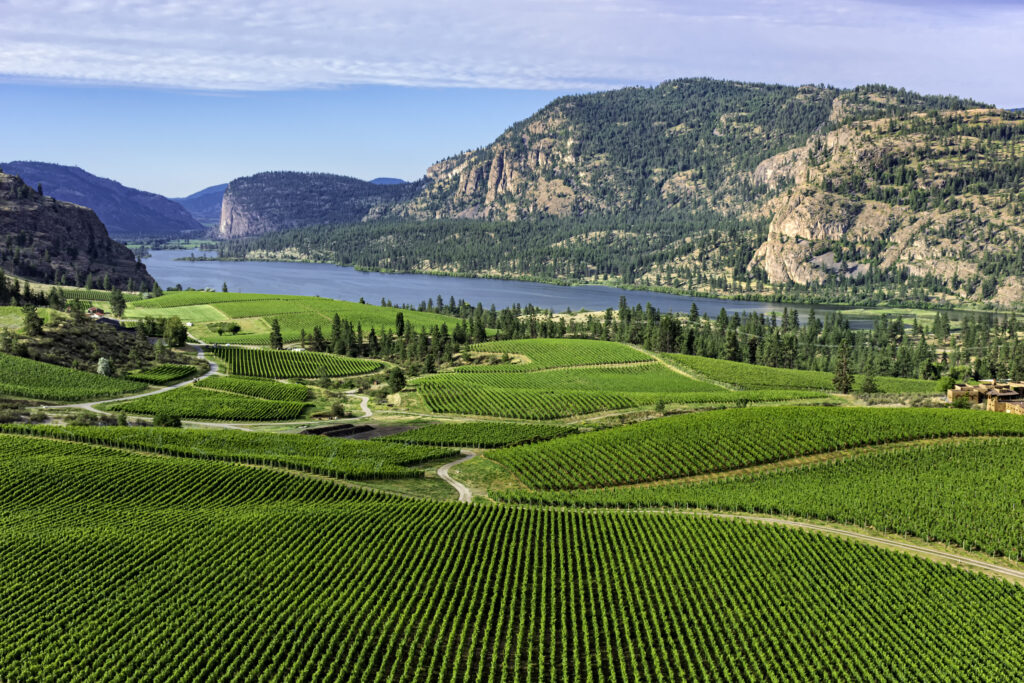
a vast vine valley

By: Tod Stewart

Man, did I need this,” was the thought that went through my mind as I opened the blinds and took in the morning view from my luxurious suite at Spirit Ridge Resort. Under an azure, late fall sky, vineyards stretched down to the sun-sparkled cobalt surface of southern Osoyoos Lake, whose waters stretched towards the hills in the distance. Though late in November, the Okanagan Valley in the British Columbia interior was experiencing a glorious, prolonged fall, with temperatures in the mid-50s. As I’d been in a COVID-induced semi-lockdown seemingly forever, a chance to escape my Toronto condo was just what the doctor ordered (along with face masks, vaccines, tests, social distancing, and an “abundance of caution”).

  This was my second visit to Spirit Ridge. The first time was back in 2005 on my first trip to Brit-ish Columbia. At that time, the resort had yet to be fully completed (doors officially opened in 2006), but the evidence of what was yet to come was apparent. Today, Spirit Ridge offers a range of stunning accommodations, activities, fine dining and the Indigenous-owned Nk’Mip (In-ka-meep) Cellars winery mere steps away. It also serves as the perfect base for exploring the numerous wineries that pepper the landscape, from the town of Osoyoos in the south to Salm-on Arm in the north.

  This time, what brought me to the Okanagan was an invitation to visit the stunning Phantom Creek Estates winery, tour the facility, taste some wines, and dine in its acclaimed restaurant. While there, I could also spend some of my own time checking out a few other establishments in the area.

  Nestled between the Cascade and Columbia mountain ranges and meandering on a roughly north to south tack for some 124 miles, the Okanagan Valley was forged by glacial activity about 10,000 years ago. The landscape is as rugged as it is beautiful. I’ve toured a few wine regions in my travels, and, as far as scenery goes, the Okanagan ranks up there with the best of them. Though undoubtedly appreciative of their daily view, Winemakers in the area face a few challenges – some familiar, some not so much.

  To begin with, there’s the climate. To call it extreme would be an understatement. For example, the summer of 2021 saw temperatures in south Okanagan hit upwards of 120 degrees Fahren-heit. In the midst of this was a twelve-day stretch where some vineyards experienced tempera-tures over 100 degrees Fahrenheit for more than 12 hours each day. Come January, the mer-cury plummeted to a bone-chilling -13 degrees Fahrenheit.

  The region is also very dry. The southern part of the valley – where I was stationed – is Cana-da’s only desert and the second driest climate in the country outside of the Arctic. Irrigation in the vineyards is a must. A bit of a pain, but not something to stop dedicated vineyard manag-ers. What could stop a dedicated vineyard manager is some of the local wildlife.

  If, as a winemaker, you think birds are a problem, tending vineyards in the Okanagan could prove to be somewhat unnerving. Bears, cougars, wolves, rattlesnakes and Black Widow spi-ders are all present to varying degrees and can be more than a tad annoying. With their insa-tiable appetite for ripe berries, the bears will gladly decimate row after row of vines (and are probably indifferent to the nuances of Cabernet Sauvignon and Merlot). This can have some unfortunate economic consequences for a vineyard owner. Still, there’s not much that can be done outside of letting them have their fill, given that they can also decimate those interfering with their dinner. Encounters with the other beasties are rare but not unheard of. As an aside, I asked a local Bordeaux-trained winemaker if he faced similar challenges from wildlife while working in France. “Well, there were French people,” he said.

  If you can deal with these challenges, the south Okanagan is, by all accounts, a truly remarka-ble place to craft world-class wines.

  Vancouver-based businessman Richter Bai, whose background involved mining in China, thought so, too. He saw the south Okanagan as the perfect place to craft the Bordeaux-inspired blends that he personally favored. And so, armed with nothing more than a dream and about $100 million (Canadian, I’ll assume), Bai secured some prime wine-growing real estate and set to work.

  Fortunately, the land he bought came with a trifecta of highly-acclaimed vineyards: Phantom Creek Vineyard, planted in 1996; Becker Vineyard, planted in 1977; and the Kobau Vineyard, planted in 2005. The Evernden Springs vineyard – planted after Bai’s purchase – in the neigh-boring Similkameen Valley added a fourth vineyard to the estate’s holdings. The region’s dry climate ensured that utilizing organic and biodynamic vineyard practices was more than doa-ble. To alleviate any possible hiccups along the way to organic and biodynamic certification, the talents of Olivier Humbrecht were enlisted. Humbrecht, owner and winemaker at Domaine Zind-Humbrecht in Alsace, was brought on as Consulting Winemaker. France’s first Master of Wine, Humbrecht is known as a leading proponent of biodynamic winemaking.

  The 78,884 square foot winery Bai built has a 35,000 case capacity and is at once a showcase for art, architecture, gastronomy and, of course, wine. It sports a 500-seat amphitheater, a first-class restaurant, and numerous objets d’art, including a Dale Chihuly-designed chandelier hanging over the Founder’s Cellar tasting table.

  I was shown around the place by the very hospitable Andrew Young, Phantom Creek’s Hospi-tality Manager. He also took me through a thorough tasting of the winery’s vinous treasures. The Bordeaux blends and house cuvées (that often saw both Bordeaux and Rhone varieties in the mix) certainly displayed both power and elegance, as well as complexity, as did a very solid Syrah. The whites – including Riesling, Pinot Gris and Viognier – were immaculately balanced and varietally true to character. Even the Viognier, a grape that tends to veer off into blowsi-ness in the wrong hands, was elegant and restrained.

  An additional benefit when visiting Phantom Creek is partaking in some of the winery’s other assets, of which there are plenty.

  Over a superb, multi-course dinner at the winery’s on-site restaurant, creatively prepared by Chef Alessa Valdez, I was poured a number of additional Phantom Creek wines that married perfectly with the various dishes. Poached Lingcod with crispy grilled saffron polenta, grilled green cabbage, ‘nduja beurre blanc, and almond gremolata…O.M.G. And things were just get-ting started.

  It was a bit of a change of pace going from the opulent lavishness of Phantom Creek Estates to the elevated vineyards of Osoyoos Larose. I admired the view of the Okanagan Valley stretched out about 1,300 feet below me as I looked over the nearly 80 acres of vines. I was in the vineyard because it wasn’t possible to visit the winery, mainly because, at the time of visit-ing, Osoyoos Larose didn’t have a winery.

  Since its inception in 1998, the estate has availed itself of various “borrowed” facilities. This should be changing over the next couple of years as a permanent production home has finally been secured. Yet, despite what many might see as a definite setback, Osoyoos Larose has managed – vintage after vintage – to craft red wines based on the classic Bordeaux blend that have been hailed by connoisseurs and critics as among the best in Canada.

  Owned by France’s Groupe Taillan (owner of Chateau Gruaud-Larose in Saint-Julien, among others), Osoyoos Larose, like most Bordeaux estates, makes but two wines (both red); its Le Grand Vin flagship, and Pétales d’Osoyoos. However, the estate is in the process of planting white varietals for a Bordeaux-inspired white counterpart. About two and a half acres have been planted to date, with an additional 20 acres slated for planting next year. Until then, con-sumers will have to content themselves with the Osoyoos Larose reds. A vertical tasting of vin-tages 2009 through to 2018 went a long way in convincing me that there’s plenty with which to be content.

  It should be exciting times ahead for a winery that, without hype, without a huge advertising and promotional budget, and without even an actual winery, has managed to secure a top spot in the echelon of the world’s great wines.

  Before catching a morning flight back to Toronto, my final meal was at the whimsically named The Bear, The Fish, The Root & The Berry restaurant at Spirit Ridge. The name derives from a story told by the Syilx People of the Okanagan Nation describing the Four Food Chiefs, each representing above-ground animals, water-dwellers, underground edibles and above-ground plants. I settled on the Bring Me Hasenpfeffer, mostly because it sounded (and, in fact, was) delicious, and also because “hasenpfeffer” was a word etched into my brain since my Bugs Bunny cartoon days. It paired nicely with the ripe, densely-structured, slightly smoky Nk’Mip 2018 Syrah from the adjacent winery.

  For wine markers south of the border looking for stunning scenery, fantastic hospitality, and some pretty incredible wines, a visit to British Columbia’s Okanagan Valley will prove to be en-tertaining, educational and eye-opening.

Is Wine Culture Nature’s Saving Grace?

woman holding a wine glass

By: Hanifa Sekandi

If the vines could speak, they would tell stories of the scorching sun burning the skin of grapes, winter’s frigid temperatures and frost forcing them to surrender to the elements. At any given time, the vines in vineyards neatly planted around the globe have to adjust to mother nature; sur-vival depends on adaptation. There is no better teacher than nature.

  If you understand viticulture and viniculture, you know there is always something to learn – from the moment the seed is planted to the time the vines grow, and the grapes are harvested. Just like vines, we are students of nature. And, to grow, we must pay attention. As one immerses them-selves into wine culture, they quickly learn that there is more to a bottle of wine than finding a splendid pairing. We cannot simply live in blissful ignorance all that time. When we do, life shocks us back to reality. The reality is, as much as we are sovereign beings, we are also a part of a larger ecosystem. One that we love to enjoy yet, at times, fail to understand.     

  Viticulture could be that saving grace since the thing we love reveals what has always been right before us.

  It seems like viniculture and viticulture are experiencing a backward renaissance. The renais-sance was a period when change and innovation fueled both old and new industries. Out with the old and in with the new; the common consensus. Wine cultivation during this time saw great leaps. Tradition needed to be forgotten to open doors for new production methods that yielded more fruit and profits. The modern revolution, the golden age of wine, left no stone unturned. Change is good, they believed. Even disruptive change met with a “yes we can” ideology. Somewhere along the way, the relationship between nature and winemaking ruptured. Although deeply interconnected, the two, at times, became separate in modern winemaking. Recently, however, the resurgence of biodynamic wineries and organic wines is making a wave in viticul-ture. This circular leap to the past, yet still firmly planted in present-day winemaking, is a rebirth needed for nature and viticulture. Wine is a beverage that has endured many turbulent times and has reached its tipping point. It is time to turn back.

Is Organic Wine Farming New?

  Sometimes we borrow things from the past and forget to give credit where it is due. We cannot discredit organic winemakers. They have shown the wine industry that perhaps it has gone too far with innovation and reminded it that wine is dependent on nature. Soil quality, respect for the habitat, and all organisms living in it are components one must not ignore. Organic wine is not a niche sector. It is the culture. Biodynamic farmers are not reinventing the wheel; they are ex-panding on traditional wine practices.

  So what is organic grape farming? How does it nurture nature and wine culture? For starters, it is about quality above anything else. Therefore smaller batches are the norm. Crafting these wines requires patience and an understanding of the land. It includes pesticide-free vines growing on nutrient-dense soils. It gives a home to different animal species and organisms. It brings together components that foster an enriching habitat and encourage the growth of rich grapes in nutrient-dense soils. It is a life-sustaining ecosystem where the sum of its parts completes the whole.

  Most people do not think of the little intricacies that make up a bottle of Chardonnay. Nor do they question if one sip contributes to the detriment of viticulture. Even imbibing wine slowly and with ease has lost its way. Does this mean we cannot enjoy ourselves? Of course not! But we must be mindful. And in turn, we challenge ourselves to do more than exist. So when we look at the science of wine and how this can shape a better future. We must return to its roots. It is the same viewpoint that people are taking in sustainable farming. Although tedious, the old way of working the land respected culture and nature. We do not need to consume more simply because we can. We certainly do not need to cut corners for more low-quality wine because of better technology. Drinking wine was never meant to be a sport.

Does Conventional Farming Need A Shake-up?

  Conventional farming practices grow vines with the help of pesticides which we now know are not beneficial to your health. Alas, we cannot blame wine growers who deal with unpredictable terrains, weather conditions, pests, and plant diseases for looking for remedies. Who would not jump on something that could help their vines grow? Owning a vineyard is hard work and re-quires a lot of mental strength to adapt to the unpredictability encountered at any given time.

  The routinization of farming has found its way into winemaking, perhaps due to people’s desire for consistency in their favorite wine. Therefore, now is not a time to point fingers or argue about what is right or wrong. Nature speaks louder and determines what must be done. For example, when Phylloxera ravaged vines in the late 19th century, French winemakers’ solution of planting American disease-resistant vines, which led to grape hybrids, proved successful. There is flexi-bility in change. It is okay to take a few steps back without significantly altering your operations to preserve both nature and viticulture.

  Monocropping, a farming practice where high yields of one plant varietal are grown, has found its way into winemaking. This method is commonly used in corn, soybean and wheat farming. The problem, however, is that growing limited grape varietals reduces plant diversity within an ecosystem. To make matters worse, an influx of toxic pesticides and fertilizers is necessary to increase and sustain the growth of desired staples. Once met with praise, the negative impact this practice has on the environment, animals and organisms is now evident.

  For vineyards, plant biodiversity is an adjustment that can slowly be incorporated into small or large vineyards lacking in diversity. Creating a healthy and robust ecosystem within a vineyard does not require giant leaps. Nor will it impact the bottom line. Steps can be as small as adding a few new plant species close to where vines grow. As a result, the ecosystem blooms and other species thrive within this environment. Birds, microorganisms, bees and other insects, for exam-ple, contribute to a robust ecosystem. Every animal and organism in nature is perfectly placed so that the entire system functions accordingly.

  Producing more of what we desire should not kill what we essentially need. A reliance on toxic fertilizers and pesticides while favoring mass consumption and lucrative simple production prac-tices will only cause the wine industry to suffer in the long run.

For The Grace Of Wine

  The beginnings of wine were biblical and mythical. The lineage of wine has long roots starting in the Mesopotamian Era. Wine has also symbolized togetherness. There was a time when families would spend their Saturday with their feet planted in a larger barrel grape-treading. Owning a vineyard was a family and a community affair in some wine regions. Harsh weather conditions or vine disease that ravaged a season would truly break hearts. Wine represents not just liveli-hood but a dream brought into existence after the perfect harvest, demonstrating that hard work yields great things. Centuries past, wine also opened a pathway to the New World when it was traded for coffee. Wine is unifying and polarizing at the same time.

  There is more to a wine tasting than just sipping and spitting. It is an art in and of itself. Here, sommeliers worldwide can tell you stories of the vineyards where grapes grow. How a bottle of wine is best served and why it should be slow sipped or appreciated with grilled fish. Wine is meant to be enjoyed over stories with those we love. Wine is the gatekeeper of legends waiting to be told.

  The seeds that have been planted around the world have traveled miles. How did a French oak barrel make its way to South Africa? What makes a local Moroccan wine different than a Bordeaux in France? Think of the perseverance of a German winemaker who could not let frost ruin his harvest. They complete the story. Wine is the hands of the people that make every bottle possible.

  So when we drink wine, we touch the hearts of the people and the region a bottle originates. We experience mother nature in her diversity and what she gives us, from the mineral-rich soils and terrain in Africa to the sweeping valleys of Germany. We share a beverage once used for medicinal purposes when freshwater was scarce in the Middle Ages. Indeed, wine culture is worth nurturing and preserving. To do so, we mustn’t run too far away from the past. Instead, a little time travel could restore all that is good, so we can experience it for years to come.

Alcohol Testing

By: Thomas Payette, Winemaking Consultant

alcohol testing set

 Ebulliometer: This science principal of testing alcohol has been around for decades it is still widely used by small and large wineries alike.  Based on the boiling point of water, calibrated against atmospheric pressure, this test is an excellent tool for most, if not all, dry wines.  If attempting to test wine with residual sugar be sure to understand this test has its limits.  Other more expensive testing units do exist but typically at a much larger price.

Tools and Chemicals

•    Ebulliometer kit complete.

•    Distilled water.

•    Ethanol for burner lamp (Everclear ™ or equivalent).

•    Matches or lighter to light wick.

•    Dry wines to test.

•    Lab sink or other.

•    Ice cold water for condenser.

•    Good eyesight and protective eyewear.

•    MSDS sheets and other protective gear for handling the unit and reagents.

  When: Most winemakers run their alcohols just after fermentation to validate success of their calculated predictions and then once again after blending and/or about three months before bottling to confirm their label printing will be in compliance with all regulatory agencies such as the Tax and Trade Bureau.   Obviously testing anytime one suspects a change in their alcohols is recommended.

Calibration With Distilled Water

  After you have properly set the unit up you must calibrate the unit using distilled water.  Once we have determined the boiling point of distilled water we can start the process of measuring a wines alcohol. 

1.  Using the supplied glass cylinder fill the small cylinder to the line labeled “eaux: with distilled water. (This is roughly 15 milliliters.)

2.  Place this amount in the lower boiling chamber via the opening the thermometer is placed in.  Make sure the lower stopcock to the boiling chamber is closed.

3.  Replace the thermometer in the appropriate orifice so you may read the markings on the thermometer.

4.  Light the wick on the burner and place under the chimney to initiate boiling of the water.  {Be careful with the flame positioning to make sure the plastic stopcock does not melt.}

5.  Wait about 2 to 4 minutes to hear a steady rumble inside the unit and to watch the mercury rise in the thermometer.

6.  Once the thermometer reading has stabilized you may reflect the reading from the thermometer at the zeroing point on the round “slide rule” chart.  (This is included in your ebulliometer kit)

7.  Double check the readings and double check where you have calibrated the unit chart to.

8.  Empty the distilled water from the boiling chamber, by opening the stopcock, (careful this is hot) and flush the chamber out with about 60 milliliters of the upcoming sample of wine about to be tested.  (This is the only time the author flushes the chamber due to the fact water, at zero percent alcohol, could cause interference to the first wine sample run). 

9.  The above may be done without cool water in the condenser chamber but having water in that chamber will cause no harm with this reading

10.      Now you are ready to move on to measuring alcohols.

Procedure for Wine

1.  We have calibrated the unit and have wines ready to test.

2.  Make sure the upper condenser is filled with cool water.

3.  Fill the glass cylinder supplied to the line “vin” (roughly 50 milliliters) with the wine you plan to test.

4.  Place this amount of wine in the boiling chamber once again through the thermometer orifice.

5.  Replace the thermometer in that orifice immediately.

6.  Light and place the burner under the chimney to heat the wine sample.

7.  Wait about 3 to 5 minutes to hear the similar rumble in the unit as noted previously above in step 5 under the distilled water calibration section.

8.  Watch the mercury rise and wait patiently for it to steady on a reading.  It will be jumpy at first but allow it to remain on one reading, steady, for about 30 seconds. 

9.  Record that boiling point.

10.      Remove the burner and blow it out.

11.      Carefully look on the calibration circular slide rule for that temperature reading. 

12.      Follow the chart carefully to see what alcohol level that reflects.

13.      Record that alcohol reading in the proper places for your records.

14.      Carefully dump the boiled wine sample in a lab sink or other container.  Recall this is very hot and know that you may need to gently tilt the unit toward the stopcock opening to get the entire sample out.

15.      Close the stopcock and repeat steps 3 through 14 above.

16.      From experience the operator will easily be able to run about 5 tests with these units before the cool water in the upper condenser needs to be refreshed and the alcohol burner needs to be filled with ethyl alcohol.  (Be careful as alcohol is flammable).

Calculation

As you can see there is no real calculation here.  Just using the slide rule circular chart and making sure to use a steady hand while making future readings.  Make sure not to accidently move the inside circle on the “slide rule” as readings will be affected.  If this does happen you will need to relocate the chart to the recorded distilled water boiling point or actually re-establish that data point via the steps under calibration above. 

Other Helpful Tips

Residual sugar :  The boiling point of a wine is raised if the wine has a perceivable residual sugar.  The raising of the boiling point temperature gives a false low alcohol reading for the wine.  A wine higher in alcohol will boil at a lower temperature due to the fact alcohol has a low boiling point.  Sugar will interfere with the readings

Reproducible results :  If this is your first time using one of these units be sure to run several tests on the same wine to make sure you can achieve similar results with each test.  If you can’t achieve the same results dig deeper to look for errors.

Spot check your results from time to time with a competent outside lab to see if results are within ranges expected.  If not – look for sources of error.

While performing the test make sure to calibrate the unit with distilled water if you notice atmospheric changes taking place outside.  At a minimum it may be best to calibrate the unit every three hours or so.  Recall to flush the chamber out with upcoming wine sample after calibrating with distilled water to avoid false / water diluted readings.

Typically these units are very foolproof and last for centuries if handled with care.  Handle with care and keep clean as you should do with all lab equipment.  Most operators find storing them in their box, when not in use, is prudent.

Recall the operator can run about 5 wine sample tests before replacing the chilled cooling water in the upper condenser chamber and take time to refuel the alcohol burner with ethyl alcohol.

In the event you break the supplied glass cylinder the ”eaux” line reading is at 15 milliliters and the “vin” line is at 50 Milliliters.

Summary

These simple units are an excellent investment for most any sized winery that is fermenting their wines dry.  To date these units cost near $1000.00 but outside labs charge between $15.00 and $25.00 for samples run.  The actual costs to run each test adds up to pennies in terms of burner alcohol, water, ice, matches etc.  Certainly a winery testing 20 wines per year will pay for their purchase in 5 years or less.

Short Course:

•   Calibrate using distilled water (Be aware of atmospheric changes).

•   Make sure the condenser cooling water is refreshed every 5 tests.

•   Be gentle with the circular slide rule and thermometer.

•   Run tests after alcoholic fermentation and 3 months before bottling.

•   Spot check your results with another trusted outside lab.

Tom Payette, Winemaking Consultant, has over 30 years’ experience with winery start-ups and assisting wineries already established in the industry.

How is Your Crop Insurance?  

By: Trevor Troyer, VP, Agricultural Risk Management

crop with ice cubes

How does your crop insurance policy work? What type of policy is Grape Crop Insurance? How much do you need to know? I mentioned a little about grape crop insurance in the last article in the Grape Vine. I am going to go into the policy information and how it is set up in this one.

  Grape crop insurance is an Actual Production History (APH) policy. This means it uses a vineyard’s historical production to determine how much is covered. Basically, you are covering an average of your tons per variety. Since crop insurance is subsidized the insurable varieties, prices per ton, premiums are set by the USDA. This also means that there is no difference from one insurance company to the next. If anyone represents that they can get you a lower premium for the same coverage, it is false.

  Your agent will work with you to set up individual databases for each variety. If you have vineyards in different locations, you can often times set them up separately. This can be good when you have a claim. You might have a loss in one location but not the other. You don’t want your production co-mingled, as you may not have a payable loss at that point.

  The databases can go back up to 10 years, if you have the production. Minimally 4 years is needed to set up an APH database. If the vines have just become insurable then a Transitional Yield (T-Yield), based on the county and variety, can be used to fill in up to three years. If you purchase a vineyard that has been producing you can transfer that production history. You must have records or some way to prove that history though. The database can only be set up as far as you have production records to prove the yields. Production records are not required at the time you sign up for crop insurance or at production or acreage reporting times. But it can come up during a claim or a review.

  Here’s what the 2022 Crop Insurance Handbook says about grape production records:

“Settlement sheets, sales receipts, machine harvest records, certified scale records, pick records and final or year-end statements from a winery, cannery or processor must indicate net paid tons of Grapes delivered by variety. Converting gallons of wine to tons of grapes does not qualify as acceptable records.”

  It is especially important to keep good records if the grower is “vertically integrated.” “A producer is vertically integrated when all stages of production of a crop, from acquisition of materials to the retailing or use of the final product, are controlled by one person, or by different persons that are related.”– CIH If the entity that owns the vineyard is a winery, then they would be vertically integrated. Even if they sell some of the grapes to other wineries. If you own a vineyard and are partners in a winery and you sell the grapes to that winery you could be vertically integrated as well.

  Let’s move on to insurability of the grapes. Vines need to be in their 4th growing season for the grapes to be insurable. A minimum of 4 years is needed to do the average, if the grapes have just become insurable then a T-Yield, as mentioned before, is used in place of any missing years.

  Usually, the third growing season after being grafted is considered insurable. The vines must have produced an average of at least two tons per acre in at least one of the three preceding crop years. There can be exceptions to this rule. Sometimes there are other requirements located in the “Special Provisions” for that particular county. In California the USDA Davis Regional Office (DRO) puts out Informational Memorandums that lay out specific requirements for the state of California. These differ from other growing regions in the US. You are able to make higher yield requests that can be approved by the DRO.

  Grape crop insurance is available in the following states; Arkansas, California, Colorado, Connecticut, Idaho, Maryland, Massachusetts, Michigan, Minnesota, Mississippi, Missouri, Nebraska, New Jersey, New York, North Carolina, Ohio, Oregon, Pennsylvania, Rhode Island, Texas, Virginia and Washington. Crop insurance is not available for grapes in all counties in each state though. For a list of insurable counties, you can look at the RMA’s website at rma.usda.gov or contact your agent. Even though there may be differences between AVAs in a given county, the insurability, prices, premiums are set by county not AVA.

  Insurable varieties are also different between states and counties. The varieties are usually set by what has been being grown in that county or what a particular climate in a state/county allows for. Even if a particular variety is not listed it can be insured. There are Types/Practices for each county that list out specific varieties and also make allowance for others. For example, it may list Cabernet Sauvignon, Chenin Blanc, Gewurztraminer, Grenache, Cabernet Franc and so on. If a particular variety is not listed it can be most often insured under “Other Varieties”, “Other White Varieties” or “Other Red/Pink Varieties.”

  Having a lot of varieties that are not specifically listed causes these different varieties to be lumped together in the database. This can cause problems if you have varieties that yield differently. But this is still better than not having any coverage at all. Any coverage is better than no coverage as can be attested by many growers in California a couple years ago during the wildfires.

  It may happen that your production is low in particular year. You might have had a claim paid or not, but what about your database and average going down? This isn’t good. You may elect an optional endorsement when you sign up called Yield Adjustment. “For APH yield calculation purposes, insureds may elect to substitute 60 percent of the applicable T-Yield for actual yields (does not apply to assigned and temporary yields) that are less than 60 percent of the applicable T-Yield to mitigate the effect of catastrophic year(s). Insureds may elect the APH YA and substitute 60 percent of the applicable T-Yield for low actual yields caused by drought, flood, or other natural disasters.” – 2022 Crop Insurance Handbook. This can make a big difference; you want your yields to stay up so that your average does. This makes it more likely to have a claim paid at the time of a loss.

  You cannot cover 100% of your average production. You can choose coverage levels from 50% to 85%. There is a built-in production deductible. Coverage levels are in 5% increments. Coverage levels are relative to premium, the lower the coverage the lower the premium, the more coverage you buy the higher the premium. What the correct coverage for your needs is something your crop insurance agent can help you with.

  If you would like more information on crop insurance, please feel free to contact me. We also offer free second opinions on grower’s existing policies. Sometimes we find mistakes or the policy is structured in a way, to cause claims to not be paid or reduced.

  Crop insurance is subsidized through the Federal Government. The USDA Risk Management Agency oversees crop insurance. The RMA’s website is www.rma.usda.gov.

For more information please contact…Trevor Troyer: VP Operations, Agricultural Risk Management, LLC. Call: (239) 810-0138