Solutions to Pump Dilemmas

How Tradition and Technology Blend to Fill Winery Needs for Pumps

pumps in a facility

By: Cheryl Gray

Pumps are as essential as grapes when it comes to a functioning winery. Their overall purpose is, of course, to protect the quality of wine, whether it is managing must, treating wastewater or guarding against oxidation. Both traditional pumps and advanced alternatives are on the market, giving wineries a choice when it comes to selecting that all-important piece of equipment for a specific task. In all cases, experts with decades of industry experience help wineries make pump selections designed to improve their operations.

  When Vijay and Meera Singh started their New Jersey winery in 2013, it prompted them to come up with ways, they say, to work smarter. Meera Singh is a winemaker, WSET level 3 and a sommelier. Dr. Vijay Singh has more than 40 years in the biotechnology industry, with some 20 patents to his credit in multiple fields, such as biotechnology, gun sights, hydroponics, mixing and, of course, winemaking.

  Together, the couple founded GOfermentor the namesake of one of their signature products, the GOfermentor®, an eco-friendly, automated wine fermentor. What followed was SmartBarrel®, offering advanced wine storage options. Then came GOblend, an electronic wine blender. All three products are marketed worldwide.

  The company’s latest market entry is GOpump. Dr. Singh explains how the product was created.

“Several years ago, I had made a flow-controlled pump to handle operations in our own winery. A GOfermentor customer asked me in 2022 if I could make something for him. The result of this prototype work is now the commercially available GOpump – the first wine pump with precision flowmeter based batch capability.”

  Transferring wine is routine in winery operations, whether done in racking, blending or filling. And while there are pumps on the market that facilitate these tasks, Dr. Singh says something is missing.

  “What is lacking in the industry are pumps with accurate flow metering and the ability to automatically dispense user-preset amounts of wine. I wanted the ability to set a wine volume, say 110 gallons, start the pump and walk away to do other things. The pump would transfer the 110 gallons and stop. This saves time and allows me to perform other tasks.”

  Market response to GOpump, Singh says, has been good. “The response has been overwhelmingly positive. The typical comment is that it is a marvel of human-machine engineering with all of the functions logically and ergonomically laid out. Users are enthused by the time they can save by not having to monitor the pumping process.

  The portable, lightweight, splash-proof design is well-liked. The fact that it can be operated remotely using a smartphone app is appreciated, as the pump can be switched on or off from high up on the barrel rack if needed.

  Even flow rate and batch volume can be adjusted. User applications are wine racking and blending. The preset batching feature makes these operations efficient and easy.”

  GOpump and the other products developed by Singh are backed by his in-depth knowledge of the device and pump design.

  “I have a Ph.D. in chemical engineering, and have worked with all kinds of pumps and flowmeters for over 40 years with over 20 patents. I have developed hardware and software for controllers used in pharmaceutical and beverage processing. The GOfermentor fermentation controller design and manufacture was done by me in 2016 and has been refined constantly since then. Hundreds of these are in service worldwide. Some of the flowmeter and pumping concepts used in the GOpump originated in the GOblend device I developed in 2020. GOblend is a laboratory machine for quickly generating wine blend samples for evaluation. It pioneered the precision flow totalization techniques used in GOpump.

  The GOpump is shipping now at a list price of $2,200, which includes a sight-glass and strainer, along with a choice of inlet/outlet fitting. Users can select 1 ½-inch triclamp, 2-inch triclamp, HFC12 quick-connect or just bare female ½-inch NPT. The Android Bluetooth app is included.”

  Industry leader Gorman-Rupp Pumps has been manufacturing pumps since 1933. Based in Ohio, the company enjoys a global presence with 20 locations, 11 subsidiaries and sales in 135 countries. Gorman-Rupp is known for pumps used in waste-handling applications for multiple industries, including wineries. It specializes in self-priming centrifugal pumps, which it says are ideal for pumping stems, skins, seeds and other types of waste that wineries have to manage. Jeff Hannan is the product manager for centrifugal pumps at Gorman-Rupp. He uses his 29 years of experience in the pumping industry to help wineries large and small.

  “With pumps ranging in size from 1-inch to 16-inch discharge and flow rates up to 15,000 gallons per minute, Gorman-Rupp can work with almost any size of winery in the market. Our reliability, reputation and service set us apart from the competition. Gorman-Rupp has been manufacturing pumps in the United States since 1933 and has the strongest network of factory trained distributors in the industry. This allows for the local distributor to offer support around the clock right where the pumps are being used.”

  Hannan adds that the company’s range of products is designed to optimize production time, manage costs and enhance wines. He gives some examples of Gorman-Rupp pumps that fill that checklist.

  “Super T Series® pumps equipped with the Eradicator™ Solids Management System are the best choice for pumping clog-prone waste. 

  Gorman-Rupp’s Super T Series pumps, equipped with the Eradicator solids management system, are the best pumps for handling waste materials, such as seeds, stems, skins and all other types of stringy solids. With the ability to pass up to 3-inch spherical solids, Super T Series pumps are designed to eliminate clogging and increase uptime. With over 4,000 installations in the toughest applications you can find, these pumps have a proven track record. 

  The Eradicator’s three-part solids management system. The system consists of a new, lightweight inspection cover, an innovative back plate incorporating an obstruction-free flow path and an aggressive, self-cleaning wear plate with integral, laser-cut notches and grooves in combination with a revolutionary ‘tooth’ designed to clear the eye of the impeller constantly and effectively. Upgrade kits are available for existing Super T or Ultra V pumps in the field. The upgrade kits provide everything you need to put the best self-cleaning pump technology in the industry to work for you.”

  When it comes to waste handling pumps, Hannan says the dependability can’t be compromised.

  “When selecting a pump for any waste application, consideration must be given to reliability, low total cost of ownership and overall uptime. It is best to select pumps that are easy to maintain and are designed to prevent clogging. Gorman-Rupp Super T and Ultra V Series pumps, equipped with the Eradicator solids management system, are the best choices for self-priming, solids-handling pumps for any maintenance department. Externally adjustable clearances between the impeller and wear plate, in combination with the new lightweight inspection covers, are just a couple of the features that make routine maintenance on these pumps easier than ever.”

  Hannan describes a recent addition to the Gorman-Rupp Pumps solid handling pumps product line.

  “Eradicator PlusTM, Gorman-Rupp’s most aggressive solids handling pump to date, is specifically designed for installations where nuisance clogging is affecting uptime and costly maintenance. Eradicator Plus’ innovative design is currently available for 3-inch, 4-inch and 6-inch Super T Series® pumps. For those extreme-duty applications where municipal waste, wipes, industrial by-products, agricultural wastes and other organic solids are present, Eradicator Plus cuts and tears the solids, allowing them to pass through the pump.”

  In business for nearly 40 years, Milwaukee Instruments provides clients from multiple industries with instruments to use in their analytical requirements. For wineries, the product line includes T.A mini-Titrators, V.A. Mini-Titrators, Dissolved Oxygen meters, Turbidity Meters and pH meters in portable (field) or bench (lab) applications in the wineries and BRIX meters for field analysis.

  The global company, based in Rocky Mount, North Carolina, works with wineries of all sizes. Its president, Carl Silvaggio, talks about what he believes makes the products offered by Milwaukee Instruments stand out from competitors. 

  “Our Mini-Titrators for T.A. and V.A. are very cost effective, easy-to-use, accurate and repeatable. Our Portable and Bench top meters offer up to five-point pH calibrations with two Custom buffers allowed as well. Our meters have data-logging features up to 1,000 points and are USB downloading, with built-in GLP (Good Lab Practice) features, all at very cost-effective prices. Our technical service and after-market service all have the human element, as we answer phones, emails and chats accurately and quickly. We have no bots.”

  Silvaggio adds that new product launches are already underway.

  “Our MW106 Portable Waterproof  Data Logging MAX pH Meter has up to five points of pH calibration, two custom buffers, 1,000 data logging points, USB download, automatic calibration and temperature compensation.”

  Experts agree that post-sale service should accompany any pump purchase or an ancillary piece of equipment. As Hannan explains, this spotlight on customer service understanding is critical.

  “If something would ever happen to go wrong, and something invariably does, I would want to know that I can trust the pump supplier to work with me to get the situation resolved.”

Grapevine Leafroll Disease Management & Control in Vineyards

close-up of grape trees

By: Judit Monis, Ph.D. – Vineyard and Plant Health Consultant

Transmission and spread of leafroll viruses have been documented in all grape growing areas worldwide.  Specifically, leafroll disease has been reported spread in Australia, Argentina, Europe, New Zealand, South Africa, USA, and other important viticulture areas in the world. Different types of mealybugs and soft scale insects can transmit some species of leafroll virus and Vitiviruses. However, long distance dispersion of viruses (as well as other pathogens) is most effective by producing cuttings and grafting.  If you follow my work, you know that I recommend that you plant healthy vines to prevent virus infection in the vineyard.

Grapevine Leafroll Disease

  The most important effect of leafroll disease is the production of small grape clusters with uneven ripeness.  The grapes have lower sugar content (reduced brix values). Foliar symptoms include downward rolling, reddening or yellowing of leaves and vary depending on the grapevine variety or winegrowing area. The leaf veins may remain green or take many other colors (yellow, purple, red, etc.).   Sadly, some wine and tourist magazines use photos of infected vineyards to promote their wine regions.  Although all leafroll associated viruses belong to the Closteroviridae (Greek, clostero: thread-like) family, the only species known to be transmitted by insects are found in the Ampelovirus genus (Greek, ampelos: grapevine). Ampeloviruses include the majority of Grapevine leafroll associated viruses (GLRaV-1, -3, and -4). So far, no vector has been reported for GLRaV -2 or GLRaV-7 (but as other viruses are propagated by cuttings). Research has shown that leafroll viruses are able to recombine in mixed infections, generating many variants of similar viruses that scientists define as a quasispecies (i.e., almost a species). These genomic changes have serious implications on virus detection as standard methods may miss infection. Transmission by mealybug and soft scale insects has been reported for GLRaV-1, -3, and -4. Different mealibugs such as the grape (Pseudococcus maritimus), citrus (Planococcus citri), long-tailed (Pseudococcus longispinus), obscure (Pseudococcus viburni) and vine (Planococcus ficus) are able to transmit Ampeloviruses and Vitiviruses non-specifically. Furthermore, work in South Africa has shown that a single individual of vine or long-tailed mealybug is capable of starting a GLRaV-3 infection.

Sampling in The Vineyard

  The correct identification of the disease causal agent is critical for devising a control strategy. Regular visual inspections and sampling of grapevines should be performed to monitor the disease status of a vineyard. It might not always be possible to correlate the presence of virus infection with symptoms, especially with new viral infections. Complicating matters, other viruses, fungi, or nutritional deficiencies can cause similar symptoms in grapevines. Furthermore, vines planted on their own roots do not develop typical symptoms. Symptoms may appear two or more years after top-working a vineyard with a new variety. Viruses associated with leafroll move slowly in the vine and may remain undetected by laboratory testing, unless sampling is done correctly. Collection of representative samples will allow the laboratory to detect the presence of viruses associated with leafroll. The season for testing is important and samples should be collected from vines late in the summer throughout dormancy.

Virus Testing

  Two methods can be used for the detection of leafroll-associated viruses: ELISA and RT-PCR.  Each method is designed to detect different portions of the virus. ELISA detects the capsid protein (coat or protective cover), and RT-PCR detects the viral genomic RNA (genetic information).  Therefore, ELISA and RT-PCR complement each other on the detection of virus and virus variants. ELISA stands for enzyme-linked immuno-sorbent assay, and consists of trapping the virus protective protein on a plastic test plate containing specific viral antibodies.  The detection is done through a colorimetric enzymatic reaction (positive samples yield a yellow color). The method is limited to the amount of virus present in the sample (i.e., there is not amplification or danger of laboratory contamination). RT-PCR, is the abbreviation for reverse transcription-polymerase chain reaction.  The method involves the amplification or multiplication of viral RNA present in the vine. The process is specific, and utilizes a couple of primers to start the amplification process.  Primers are essentially artificial copies of a portion of the viral genome. The amplification is repeated many times, each step or cycle continues to makes more copies of the viral segment. Consequently, RT-PCR is a sensitive technique for the detection of plant viruses. As mentioned above, the sensitivity and specificity of the detection of viruses associated with leafroll is dependent on the method used for diagnostics.  However, detection it is also influenced by the season and part of the vine from which samples were collected as well as the quality of reagents used. While ELISA is known to be less sensitive than RT-PCR, the ELISA has a broader spectrum of detection (i.e., it detects virus variants). On the other hand, RT-PCR (especially Taqman PCR) may be too specific, and could miss the detection of a virus with small changes due to mutation or recombination (e.g., variant species). Lately, fewer quality ELISA reagents are being developed as designing PCR primers is less time consuming. My recommendation is to use ELISA initially (commercial reagents work well for GLRaV-1 to -4) and RT-PCR to confirm infection (or lack of infection).  When mapping infection in a white fruited grape block such as Chardonnay or Sauvignon Blanc, ELISA may be the only economical way of determining the leafroll disease status of specific vines as many samples must be tested in a yearly basis. 

Leafroll Disease Management & Control Strategies

  To manage leafroll disease, it is important to develop a map of virus infected vines. The map will provide information of virus spread and determine the pattern of infection.  A random distribution of symptomatic vines would generally be associated with planting infected vines. While symptomatic vines aggregated or clustered in one area of the vineyard block is an indication of virus spread.  The initial assessment must be done using a testing lab to determine the presence of a virus species capable of being transmitted.  Once the vineyard manager is familiar with symptoms, the mapping could be done by visual observation.  It is much easier to determine the characteristic leaf roll disease symptoms in red fruited varieties.  In white varieties it may be possible to train eyes to determine the presence of infection but likely will rely on the confirmation of the presence of virus by testing vines.

  Effective disease control requires the availability of clean planting stock (i.e., certified disease-free tested). However, to ensure that the vineyard remains disease free, the grower must be aware of the presence of virus infection in neighboring vineyards. It is important to devise procedures to protect a healthy vineyard from potential disease introduction. The presence of insect vectors and ants should be routinely monitored and controlled. Unfortunately, mealybugs are not always easy to observe in the vineyard, however the presence of ants are usually associated with the presence of mealybugs. Special traps (including pheromone traps) are available to monitor the presence of mealybug infestation. The dispersal of mealybugs by birds, wind, field equipment, and/or workers are responsible for long distance spread of virus. Sanitary practices such as fallow periods, sanitation of equipment, and sanitation of field worker’s clothing are recommended to avoid moving disease vectors from one vineyard block to another.  I always recommend to start work in the non-infected blocks and move workers to infected blocks at the later part of the day.

  Controlling the spread of viruses requires strict protocols for handling vines and performing cultural practices in the vineyard and nursery. Hot water treatment of vine cuttings and grafted vines are effective controlling the movement of mealybugs

from one site to another. Other recommended practices include establishing wind traps, planting insecticidal cover or border crops, using site dedicated clothing and/or shoes for workers, and avoiding the use of potentially contaminated equipment in the vineyard.

  Ultimately, the removal of infected vines or entire blocks will be key to reducing the source of infection.  Guidelines call for rouging (removal of individual infected vines) if there is less than 25% disease incidence and entire blocks (greater than 25% disease incidence). A common mistake is the removal of a portion of the infected vineyard block (see photo 2).  This decision is made to avoid production losses at the vineyard. However, in no time, the newly planted vines will become infected by the same virus present in the other portion of the vineyard.

  The control of leafroll spread needs to be based on a concerted effort among growers. In California the development of a network of neighboring growers has allowed open discussion of infection status of blocks and applied control measures. The use of cultural practices (especially sanitation and insect control applications) should be coordinated and scheduled to include area-wide treatments as grapevine viruses and their vectors do not know or respect neighboring borders

  Judit Monis, Ph.D. provides specialized services to help growers, vineyard managers, and nursery personnel avoid the propagation and transmission of disease caused by bacteria, fungi, and viruses in their vineyard blocks.   Judit (based in California) is fluent in Spanish and is available to consult in all wine grape growing regions of the word.  Please visit juditmonis.com for information or contact juditmonis@yahoo.com to request a consulting session at your vineyard.

Exploring the Diversity of European Grenache Wine  

grenache planted signage

By: Becky Garrison

Grenache has the distinction of being one of the world’s most widely planted wine grapes. Additionally, this versatile wine pairs very effectively with food. Grenache wines have diverse levels of texture and depth with a slight spiciness that work well with a wide range of braised, grilled and stewed meats, as well as the milder styles of Asian cuisine. 

  As part of Feast Portland 2019, a regional food and drink festival with international appeal, Hoke Harden, SWE Certified Spirits Educator, offered an industry presentation into European Grenache wine. He focused on those wines that range in cost from $10 to $20. At this reasonable price point, Harden describes the wines as “not wine you take home and save, but wine you take home and drink.”

  Although lower priced Grenache may not be the sort of wine one ages in a cellar, these wines have a distinguished history that belies their price tag. Carbon dating of seeds and leaves discovered at archeological sites indicate Grenache was planted as early as 153 BCE. Most likely, Grenache originated in the region of Spain now known as Aragon, where it goes by the name Garnacha. However, some have speculated the grape originated in Sardinia, where the grape is called Cannonau.

  As these vines flourish best in hot, sunny and dry conditions, the Mediterranean climate proved to be ideal for growing them. Grenache vines were then planted in Catalonia and then in places outside of Spain that were under the Crown of Aragon, such as France, Corsica, Southern Italy, Sicily, Croatia and Greece.

  The old vines currently growing in the region can be over one hundred years old. They tend to produce a finer and more complex wine than Grenache produced in areas where the vines are much younger.

  The grape comes primarily in three versions: red—Grenache Noir, white—Grenache Blanc, and a version of white known as Grenache Gris. The Grenache Noir is round and smooth with notes of prunes, cherries and other red-pitted fruits. Conversely, Grenache Blanc has a combination of floral, fruity and herbaceous notes and fresh aniseed licorice flavors for a fleshy, mellow wine of medium intensity, a medium to high acidity and high levels of alcohol. The Grenache Gris produces pale rosés and mineral-driven whites with copper hues and citrus notes that are fleshy, round and elegant.

  Additionally, there are two less common Grenache grapes—the Lledoner Pelut (black) and Garnacha Peluda (hairy). The Lledoner Pelut, which is a cousin to the Grenache Noir, is very similar but has more structure and a bluer color. Garnacha Peluda, which gets its name from its hairy leaves, has a lower alcohol content, medium acidity, aromas of red fruits, and rapid oxidation.

  From these varieties of grapes, winemakers can produce a vast array of wines ranging from light- to full-bodied red or white wines, as well as rosé wines, fortified wines, natural wines and sparkling wines. Each of these varieties is highly sensitive to the growing conditions of a particular region. Depending on the soil, climate and elevation, wines produced from these grapes can vary dramatically from one appellation to another. For example, one appellation may yield full-bodied, black-fruited wines, while a nearby region produces a more light-bodied wine made with red fruits. 

  While Grenache can grow in a diverse range of soils, the vines respond best to the schist, limestone and clay soils abundantly found in Northeastern Spain and the Roussillon in southern France. Here the grapes’ tight clusters make it a perfect choice for these hot and dry soils. However, the same tight grape clusters make Grenache prone to downy mildew and bunch rot when grown in humid or rainy locations. Also, as the grapes ripen relatively late, they work best in very warm regions.

  Another positive attribute of these hardy and vigorous Grenache vines is that they use less natural resources than many other vines. In fact, Grenache could be seen as the world’s most eco-friendly and sustainable grape. As this grape adapts to arid weather conditions, it can be grown using environmentally friendly vineyard practices. For instance, these vines are not dependent on rainwater because their roots can delve deep into subterranean water tables. In addition, the plant has a robust wooden frame that is drought and disease resistant. Often Grenache is grown as a free-standing bush with its strong, sturdy trunk able to survive in strong winds. In consideration of all these attributes, in 2011, the World Climate Change and Wine Conference with Kofi Annan in Marbella, Spain recognized Grenache as a product well prepared for climate change.

  Currently, over 90 percent of Grenache grows in Spain and France. The regions have been certified in two European Union quality schemes: PGI (Protected Geographical Indication) and PDO (Protected Designation of Origin). The EU established these schemes in 2012 for agricultural commodities to ensure that the products originated in this particular region. Also, these schemes ensure that the product has been produced in accordance with European agricultural production methods that focus on nutrition and health, food safety, traceability, authenticity and labeling.

  Five PDO vineyards in Spain specialize in the Grenache grape variety: Somontano, Terra Alta, Cariñena, Calatayud, and Campo de Borja. Within these regions exists 5,500 wine growers and 144 wineries, with Grenache repenting about 40% of their vineyards. (Other varieties are Tempranillo, Cabernet Sauvignon, and Syrah). Rosé and White Grenache is grown in the Terra Alta PDO, while Red Grenache is the main variety grown in the other four PDOs.

  Roussillon in France houses 2,200 winemaker families, 25 co-ops and 350 private cellars. The varied topography of this region produces a wide variety of Grenache grapes that can create a range of wine styles, including dry still wines and fortified sweet wines.  

  Most of the reviews about Grenache wines tend to focus on blends such as the Châteauneuf-du-Pape wine blend from France’s southern Rhône Valley. French winemakers discovered this variety in their search for a grape that would add alcohol, body and fruity flavors to their existing wines. Other noted blends made using Grenache can be found in Gigondas, and in the Priorat reds produced in the Priorat county, situated in the southwest of Catalonia in the province of Tarragona. Many of these wines tend to carry a significantly higher price tag than the moderately priced wines highlighted by Harden, with select bottles garnering a price as high as $800. 

  Harden noted throughout his talk that while winemakers continue to blend Grenache with other grapes, some producers have begun to make wines with 100% Grenache. Of the 10 wines Harden selected for his presentation, six wines were made with 100% Grenache. These wines ranged from light- to full-bodied reds.

  On its own, Grenache has historically tended to be a light red with very light tannins, fruity aromas, medium body, a low to medium acidity and high alcohol. But Harden spoke about a generation of winemakers who have begun a new approach to growing Grenache grapes. About twenty years ago, these winemakers discovered that by cultivating the older gnarled vines, limiting yields and seeking out the right terroir, they could grow Grenache grapes that possess a fuller, more robust flavor.

  Along those lines, some growers find that when they experiment with growing these older vines at higher elevations in colder climates, they can produce wines that are more complex, elegant and concentrated. These wines often benefit from bottle aging. When these vintages mature, winemakers will be able to compare the properties of the wines with those grown in hotter, drier climates where Grenache grapes have grown for centuries.

  Moving forward, some wineries are experimenting with growing organic and biodynamic Grenache wines, which favor the environment by limiting the use of chemicals. In a similar vein, some producers are experimenting with making Grenache wines without sulfites. All these developments appear to be creating a wine that is sustainable from both an environmental and an economic standpoint while also producing a wine that remains in line with EU quality standards.

  From an industry standpoint, Grenache wines—the single-varietal styles in particular—remain unknown to most U.S. consumers. Hence, many of these wines stay at an affordable price point even as the quality rises.

Women in Wine: Fermenting Change in Oregon

people inside a winery

By: Becky Garrison

The genesis for Women in Wine Oregon began in 2015 after Susan Sokol Blosser, founder and garden advisor for Sokol Blosser Winery, participated in a U.S.-based wine conference attended by 500 men and women. While serving on a conference panel, she spoke about the Oregon wine culture through the lens of a family business and generational planning.

  During the informal conversation that ensued following her comments, Blosser and others realized that even though the Oregon community hosted many collaborative events, these gatherings did not highlight women winemakers. Given Oregon’s history in forging new paths, such as putting wine in a can, becoming a leader in biodynamic farming practices and the farm-to-table movement, they felt the timing was right to launch an organization devoted to highlighting the contributions of women in this industry.

  As per the Women in Wine Oregon website, the organization’s mission is to “provide a platform of inclusion for the advancement of female leadership in the wine and beverage industry.” Its mission statement continues with, “We provide opportunities for personal and professional development through an annual conference, community engagement events and a mentorship program. As a membership-based nonprofit, we catalyze ‘fermenting change’ through empowerment, engagement, diversity and accountability.”    

Launching Women in Wine 

  The year 2019 marked the launch of Women in Wine: Fermenting Change, which was Oregon’s first event dedicated to empowering and advancing women in the wine industry. While this sold-out event had to be held virtually in 2020 and 2021 due to the ongoing global pandemic, it returned for a hybrid conference on July 19, 2022. By allowing people to participate virtually or in person, they could attract those who could not travel to Willamette Valley Vineyards in Turner, Oregon, where the conference was held.

  This hybrid conference attracted 240 in-person and 85 virtual participants for a day of educational programming led by 18 leaders within the wine industry, along with networking opportunities. Those gathered ranged from industry veterans who have been working in the wine industry since the 1970s to women looking to enter this industry. 

The Challenges of Diversity Within the Wine Industry

  A virtual session with the McBride Sisters highlighted the association’s commitment to diversity and inclusion, which they describe on their website as recognizing the rich diversity of voices in the region’s wine community, with a focus on opening doors for the many individuals who have been historically underrepresented or excluded.

  Raised among the vines of Marlborough, New Zealand and Monterey, California, respectively, Robin McBride and Andréa McBride never knew each other until they connected later in life. They discovered how their mutual familial love of wine stretched across two continents. In 2005, they found themselves in California, where they decided to shake up the industry with their unique blend of new-world finesse and old-world elegance. Thus, the McBride Sisters Wine Company was born in Oakland, California.

  Since then, this sisterly enterprise has grown into the largest Black-owned wine company in the United States and is one of the most inclusive, accessible, socially aware and sustainable U.S.-based wineries. Also, through their SHE CAN Professional Development Fund, they invest in the professional advancement and career growth of high-potential, professional women, with a particular focus on women of color working in leadership positions in the wine and spirits, hospitality and finance industries.

  Among their biggest challenges was the mistaken assumption that Black women don’t drink wine or they only drink certain types of wine. According to Robin, they addressed this bias by focusing on the aforementioned vision they’ve maintained from the beginning. “Our tenacity and our unrealistic optimism help because we see them as bumps in the road and not big game changers,” she notes.

  In a panel titled Connecting through Generations, Tiquette Bramlett, CEO of Our Legacy Harvested (Newberg, OR), and Ximena Orrego, Co-Owner and Winemaker of Atticus Wine (Yamhill, OR), spoke to how the power of community in enabling women of color to enter and succeed in the wine industry. For example, Bramblett founded Our Legacy Harvested with Diana Riggs in 2020 to educate, advance and empower the BIPOC community in the wine industry. In their exploration of how to keep people safe during the pandemic while also amplifying BIPOC businesses, they hosted a block party in McMinnville, Oregon. They knew they were on to something when a woman in her eighties came to them and said she had been waiting for an event like her entire life. “It just broke us to pieces,” Bramlett reflected.

  Since that inaugural event, Our Legacy Harvest launched an intern program in 2022 intending to help BIPOC people make connections within the Oregon wine community. Also, they created Diversity & Inclusion Training (DEI) via a partnership with Assemblage, which is an Oregon-based 501(c)(3) nonprofit organization aimed at addressing disparities within the global wine industry. A winery needs to have completed this DEI training to apply to host one of their interns.

  Along those lines, Orrego cited how connecting with Carla Rodriguez, Founder of Beacon Hill Winery & Vineyard (Gaston, Oregon), led to the launch of Celebrating Hispanic Roots. This small group of Oregon winery owners and winemakers who share a Hispanic background came together to celebrate Hispanic Heritage Month (September 15 to October 15). After hosting this event virtually in 2020 and 2021, they hosted their first in-person event in 2022.

  Jeri Andrews, founding partner of XOBC Cellars (Seattle, Washington), spoke to this winery’s unique role as one of the few LGBT wineries in the United States. The idea was never about money when this winery was founded in 2019. Instead, founders multi-Grammy-winning artist Brandi Carlile, her wife Catherine and their friends, Jeri and Amy Andrews, wanted to make epic wines out of Washington and Oregon that were representative of the terroir and to connect people who historically haven’t been welcomed at the table. “We want to bring other people to the table who maybe felt unwelcome. We’ve got this group of misfits that are part of our community of collectors, and we love it.”

  They weave activism into their winery with an organization called The Looking Out Foundation, founded in 2008 by Carlile, along with Tim and Phil Hanseroth. This organization seeks to amplify the impact of music by empowering those without a voice. From neighborhood to nation, they help fund causes and organizations that often go unnoticed.

  In Andrews’ estimation, if you want to create change, all you need is a small group operating on the same wavelength. “You’ve got to go where the players are and know how to bring people to the table.” As one example of bringing people together through wine, Andrews cites Brandi Carlile’s Seattle house parties, where music and wine connect people.

Moving from Talking about Diversity to Taking Action

  Maryam Ahmed, the owner of Maryam + Company and co-founder of the Diversity in Wine Leadership Forum, spoke about the practicalities of implementing diversity in the wineries. She stresses how it’s a privilege to talk about diversity, equity, inclusion and belonging rather than experiencing why these conversations are necessary. “We cannot aim to improve our professional environments without also improving the personal environment within which we live, including our bodies and minds,” she notes.

  According to Ahmed, what this privilege means from a hospitality perspective is the need to fight this notion that we have to check our stuff at the door. She opines, “As we serve other people, how could we possibly not bring our personhood into the service that we offer?” At a minimum, she feels when we make these changes, we open the door for more creativity, growth and innovation. That leads to higher retention, innovation and a better bottom line.

  She summarized her work to help create more diversity with the ACT (Accountability, Communication, Transparency) framework. The first step is accountability, which means taking ownership of our thoughts, beliefs and actions. We acknowledge there’s an issue and seek out how to fix it.

  The answers can be found in communication that can help us align our words with our actions, as well as welcoming the needs of others and sharing our needs with those around us. In our communication, we need to strive for transparency, which puts us in a place of honesty. In this place, we can be positioned to be effective and get the resources we need.

  In Ahmed’s experience, this ACT framework functions as a cycle, not a checklist. “This work is an ongoing, lifelong journey and commitment,” she says.

  This conversation will continue at Women in Wine Oregon’s fifth annual Fermenting for Change Conference, which will be held on July 18, 2023, at Stoller Family Estates in Dayton, Oregon. More information can be found on their website at…

https://www.womeninwineoregon.com

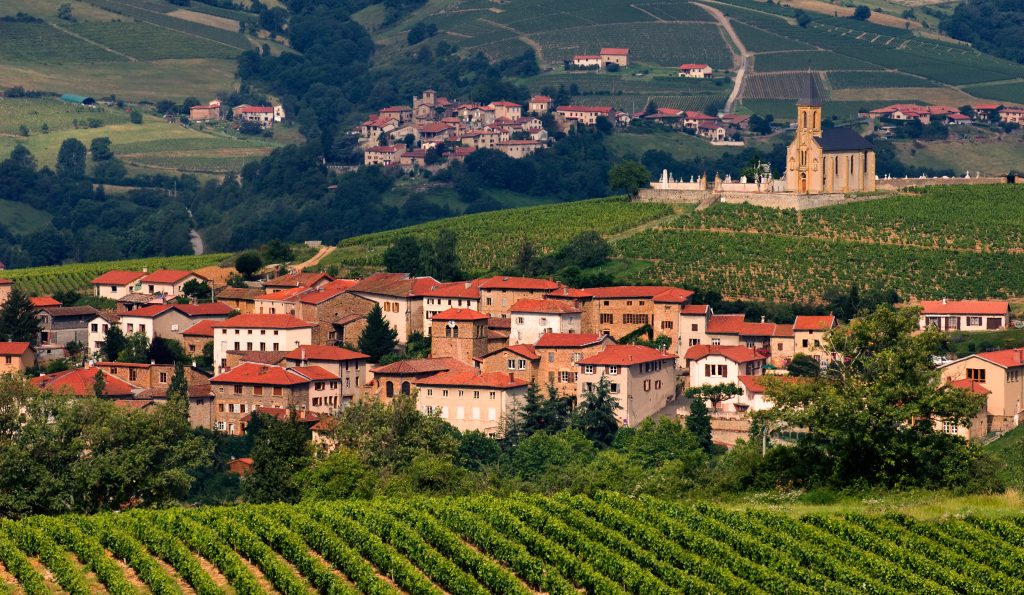
The Beaujolais “Nouvelle” Generation

overlooking village surrounding a wine field

By: Tod Stewart

Le Beaujolais Nouveau est arrivé! Readers of a certain vintage may recall the pandemonium at the local wine purveyor upon the unleashing of that phrase. It was the official annual call for wine lovers to storm the shelves and grab as many bottles (or cases) of the year’s first ferment.

Beaujolais nouveau was never (and still isn’t) a particularly great wine, but then again, it wasn’t meant to be. The wine itself was simply “a means to an event,” for lack of a better way to state it. Originally meant to celebrate the vintage and slake the thirst of the French workers who’d been toiling in the vineyards, Beaujolais nouveau morphed into an international phenomenon, spawning a plethora of fun, fruity, fast-fermented wines around the globe – and also spawning global parties.

A major bonus of the nouveau craze, insofar as the region’s winemakers were concerned, was the spreading of the word Beaujolais far and wide. The downside may have been that all Beaujolais started to become lumped together in the minds of consumers, leading to the incorrect assumption that, in spite of the wine’s (subtle) diversity, it was all fun, fruity, light, and inconsequential.

“I would agree on the fun and fruity description. Light not so sure,” contends Phillippe Marx, Commercial Director for Vinescence, a 350-producer-strong cooperative established in 1929. With growers spread over 2,970 acres across the region, Vinescence is able to offer selections from every Beaujolais category. 

  “With the recent climate evolution, we have wines with 13 per cent alcohol that I would not describe as light,” he suggests [Indeed, I recently had one that was 14 per cent]. “If you are speaking about the structure, yes, we have less structure and body than wines made from Cabernet or Zinfandel, but what we do have is elegance -– something that a larger share of the consumers are looking for.”

  The profile of Beaujolais wines as being “elegant” rather than “opulent” stems from a couple factors. The first is the grape variety used. The second has to do with what’s done with it.

  The Gamay grape (Gamay Noir à Jus Blanc if you want to be precise) is the Beaujolais grape. Sure, there are plantings in other parts of France (notably the Loire Valley), and in pockets scattered around the globe (it does quite well in Ontario’s Niagara region), but in no other region is it as dominant as in Beaujolais. In fact, about 98 per cent of all vines planted in the region are Gamay. Thin-skinned, early-ripening, and moderately vigorous, Gamay more often than not yields red wines relatively high in acid, low in tannin, and eminently fruity -– both on the nose and in the mouth. The grape’s qualities are enhanced via a semi-carbontic fermentation process, where whole grape clusters (including stems) are, in the words of Jancis Robinson, MW, “…fermented whole, fast and relatively warm, with some pumping over and a high proportion of added press wine….” This can last for as little as three days (in the case of nouveau) and up to 16 for the more top-level cru Beaujolais.

  “The typical carbonic maceration of full grapes enables us to express all the aromatic potential of the Gamay grape,” Marx confirms. “In the last decade, we rediscovered the possibilities offered by using oak and some longer maceration time. For some of our crus like Morgon and Moulin à Vent, or some single vineyard wines, we are also working in a more Burgundian style of vinification, with destemming and longer skin contact. This adds more structure to the wine, and with soft oak aging, enables us to smooth the tannins and reveal the full depth of the wine. This approach enables us to take advantage of the versatility of Gamay, and give [it] the chance to show all [its] potential, from the soft juicy Chiroubles, to the earthy Côte de Brouilly, and the soft bodied Morgon,” he explains.

  Of course, the supple, easy-drinking nature of Beaujolais wines might have the Napa Cab crowd dismissing them as less than “serious.” Marx responds to such criticism in a way that leaves me nodding (rather enthusiastically) in agreement. “Regarding serious; who said wine has to be serious? Wine is about sharing pleasure and good vibes. Serious is such an old way of approaching wine; a time when it was reserved for serious [air quotes] people. Beaujolais is a wine that speaks to all consumers – young and old – who are looking just to enjoy a nice glass, or discover the complexity that a mature Gamay wine can offer.”

  Delving a bit more deeply into what differentiates the styles of various Beaujolais wines -– from Beaujolais, to Beaujolais-Villages, to the ten crus de Beaujolais -– Marx notes that a winemaker aims for different outcomes depending on the pedigree of the wine being produced.

  “We at Vinescence have the chance to produce all the wines from Beaujolais, from Beaujolais Nouveau to each of the single crus. When producing Beaujolais and Beaujolais Villages, you are trying to extract something different than when you produce, for example, a single vineyard Morgon. For the first ones, you look to keep the fruit, and the freshness. For the other one you are trying to have more extraction and reveal all the potential. This potential is the combination of the soil, the exposure, the altitude. So yes, nature gives you a different potential, and with your specific vinification style, you try to express the best of this potential. For instance, we age some of our crus in oak barrels to underline the structure … we decided that this is not an option for our Beaujolais Villages. This is not what we are looking for in a villages-level wine. In Beaujolais we are fortunate to have a whole spectrum of different profiles due to that combination of natural elements – our role is to express them in the best possible way.”

  Speaking of different profiles, there’s also been increased interest in Beaujolais Rosé and especially Beaujolais Blanc.

  Beaujolais Rosé remains, in my opinion a niche market. We are not competitive on prices because of our limited yield,” admits Cathy Lathuiliere, Export & Winemaking for Domaine de Lathuiliere-Gravallon, an estate that dates back to 1875. “On the other hand, it is another story for Beaujolais Blanc, which is becoming more and more in demand. Indeed it is a Chardonnay similar to Bourgogne wine, which is becoming more and more inaccessible in terms of price. Some customers who previously bought a generic white Burgundy at a reasonable price have switched to Beaujolais Blanc, which can be an excellent alternative.”

  In fact, one of the tenants of “Beaujolais Nouvelle Generation” -– the ten-year roadmap developed by Inter Beaujolais (the Beaujolais wine council) is to diversify the region’s wine portfolio by placing additional emphasis on rosé (short-term goal) and white wines (mid- to long-term goal).

  Of course, one element the winemakers of Beaujolais have had to contend with (touched on earlier in the story) -– and one with which they have no control over -– is the effect of climate change. Interestingly, winemakers in the region are not necessarily seeing this as a bad thing for them, understanding, of course, that it’s not the ideal situation globally.

  “We have observed during the decade a global warming, [that it] is totally beneficial for Beaujolais,” says Lathuiliere-Gravallon. “Now we make more balanced wines, with a little less acidity. Unfortunately, this warming has reduced the yield due to frost and hail,” not to mention drought conditions.

  Marx points out that when he came to Beaujolais 35 years ago, harvest started in mid- to late-September. The past vintage harvest started in mid-August. While he concedes the extra warmth ultimately leads to wines with more structure, there are some new challenges to deal with. “We need to work harder during vinification to maintain the balance between freshness and body, fruit and structure,” he notes.

  While Beaujolais producers can’t directly alter the effects of climate change, they can work together to ensure the byproducts of their profession contribute as little environmental impact as possible. In fact, winemarkers in the region have taken an active role in developing and encouraging sustainable practises on their own, initially with no government encouragement or support. Today they are leaders in promoting positive environmental, economic, and social aspects relating to their industry.

  Marx made some good points a few paragraphs back about the “serious” nature of wine. At the risk of going off on a personal opinion tangent (but since I’m the writer, why not?)… when you consider the rather “serious” state of the world these days, maybe what we could all use is a large glass (or three) of a wine that has been fermented for one reason only: to bring pleasure. It’s not meant to be analyzed, collected, cellared or, (shudder) scored. A few good, fruity gulps of Beaujolais Nouveau (sightly chilled) might be just what the doctor ordered. Of course this year le Beaujolais Nouveau n’est pas arrivé! -– at least here in Ontario (due to supply chain/due to inflation/due to Putin/due to COVID – pick one…or all). But thankfully there’s plenty of Beaujolais, Beaujolais Villages, and crus de Beaujolais to keep the party rolling.

NAPA’s Regenerative Vineyards

napa valley vineyard

By Igor Sill

Napa Valley is world renowned for its fine wines, and Napa’s wine appellation that surpasses all others is its famed Atlas Peak, Napa’s volcanic mountain wine growing region. Atlas Peak is the highest point in Napa at 2263′ above sea level. Our vineyards rest atop a plateau off of Atlas Peak Road, the main artery that leads you to stunning vistas with purity of air, serenity and diverse wildlife transporting one back in time.

The curvy, windy road remains lined with burnt oak trees and blackened rocks, a reminder of the 2017 Napa wildfires. In between the trees are modest looking estates and pristine vineyards spared from the fire’s devastation. Thankfully, vineyards act as a natural firebreak and prevented further destruction. Even though it’s just minutes from the hustle and bustle of tourist-rich Napa, Atlas Peak remains a quiet oasis, wine country’s hidden gem. Farming these soils is immensely challenging, but well worth the effort as vintners continue Atlas Peak’s reputation for consistently producing the finest wines since 1870.

We are now well into Napa’s deep winter season, a vine’s dormant period and a time when our mountain vineyards generally experiences that quiet tranquility of cold temperatures. This season’s snow and lots of it, froze Atlas Peak’s vineyard soils and halted all farming activity.

The late winter freeze swathed cover crop and vines with snow, six inches of it! With continued forecasts of more freezing rain in March, Atlas Peak is off to a prolonged series of winter storms that should continue to drench vineyards till Spring! All this much needed rain will also preclude irrigation until late summer, which is good for vineyards and good for our planet..

The goal of sustainably regenerative farming is to build healthy soils in harmony with a nature-based approach to decreasing carbon emissions and increasing carbon uptake and storage. This is accomplished primarily through the use of cover crops which can sequester up to two additional tons of carbon per acre while improving soil microbe diversity and increasing water absorption. Planting cover crops such as mustard, legumes, oats and clover significantly improve soil quality by enriching organic matter with nutrients, increasing microbial activity and attracting beneficial arthropods by providing a healthy ecosystem during the dormant season. The regenerative approach strengthens the health of vineyard soil, and yields tastier fruit while reversing the effects of climate change.

As Franklin Delano Roosevelt once noted, “The nation that destroys its soil, destroys itself.

From the UC Davis CARC and the CITRIS Climate Initiative’s co-Director, Michele Barbato:

“Extreme weather events are increasing in frequency and intensity due to climate change, which impacts soil and growth conditions of vineyard crops. Regenerative agriculture looks to not only stop damaging our ecosystem but actually improves soil health by moving carbon from our atmosphere back into our soils using a variety of agricultural management practices that work in alignment with natural systems. I’m delighted to know that Napa is on the leading edge of environmental awareness and action.” says Professor Michele Barbato, co-director of the UC Davis Climate Adaptation Research Center (CARC) and director of the CITRIS Climate Initiative. “Regenerative farming is a vital solution to both mitigating the emissions of greenhouse gases from the agriculture industry and to limit the damaging impacts of climate change to crops and ensure a resilient and sustainable food system. The UC Davis Climate Adaptation Research Center is looking forward to working with local farmers to quantify the benefits of regenerative farming.” says Professor Erwan Monier, Co-Director of the UC Davis CARC.

vineyard with volcanic basalt rock terrain

In a natural process called “weathering”, Atlas Peak’s volcanic basalt rock terrain naturally absorbs carbon dioxide from the atmosphere.  Some Atlas Peak growers have added additional exposed volcanic basalt rock to this natural weathering process by relocating large amounts of stacked rocks where they surround vineyards and absorb carbon dioxide.

The 2017 Atlas Peak fires, and several more recent Napa and Sonoma fires, confirmed the need for reforestation to keep carbon absorbed and stored.  Post fires, many Atlas Peak growers planted new oak trees and carbon sequestering coyote shrubs in their vineyards to restore and capture carbon dioxide. Turns out that while Atlas Peak vines, trees, and shrubs capture carbon dioxide as they grow, they also provide a natural fuel source in a process called “bioenergy generation,” absorbing and holding carbon for a longer time.

It all starts with the burning of biomass, such as vine cuttings left over from pruning, to produce Biochar, a charcoal-like substance that stores carbon. Biochar is then raked into the soil to keep carbon out of the atmosphere for longer periods while it improves our soil’s health and sustainability. A recent Columbia Climate School scientific report highlighted both positive and negative impacts of climate change on plant growth. By proactively building soil health, growers are preparing their vineyards for changing climatic conditions, so that they can minimize negative impacts and capitalize on a potential CO2 fertilization effect.

Another component of responsible farming is that one honors farm workers fairly by paying a livable wage, which tends to be much higher than the national average, given Napa’s higher cost of living. Of course, nearly every aspect of this regenerative farming costs more than conventional farming and using organic compost preparations with natural nutrients versus chemical-based fertilizers, manual weed removal rather than spraying herbicide, all drive up the total costs. The economics matter, and Napa’s grape growers have had a tough time of it lately given Napa’s rigorously regulated agricultural compliance. Over these last year’s though, Napa growers have embraced their responsibility, and the fiscal requirements that come with it, to preserve their soil’s health for our generation and the many generations to come. The payoff of regenerative farming extends well beyond the benefits of establishing a climate-friendly farm to the rising awareness of our environment, protecting our water sources, storing carbon, reducing greenhouse gas emissions and maintaining soil health.

We all agree that we must dramatically cut our carbon dioxide emissions to limit global warming and avoid future climate catastrophes. The wonderful thing is that cutting carbon emissions and redirecting carbon into the soil significantly benefits the quality and health of Napa’s vines, ultimately the crafting of exquisite wines while continually adopting low-cost ways to operate more sustainably.

About the Author:

Igor Sill is living his dream pursuing his passion for regenerative farming on Atlas Peak Mountain in Napa. He’s a commonsense environmentalist, wine lover, winemaker, vintner, writer, Court of Master Sommeliers, attended UC Davis’ winemaking program, a Judge for the International Wine Challenge, London, UK; and holds his masters from Oxford University. Many thanks to Derek Irwin, Sill Family Vineyards’ Agronomist & Enologist, and UC Davis Climate Adaptation Research Center (CARC) and director of the CITRIS Climate Initiative, Michele Barbato.

Top-5 Automated Text Campaigns for Wine Merchants

chat box on screen

By:  Bryan St. Amant, Founder & CEO of VinterActive

If you’re like many wine marketers, your to-do list is a mile long. You need to post on social media, update your blog, manage your next event, and launch a new vintage of wine. And that’s only on the marketing side.

  With so many hats to wear, today’s wine merchants need any help they can get.

  That’s where automated SMS workflows can save the day with personalized messaging sent to the right customers at precisely the right time to generate game-changing results.

What are Automated SMS Workflows?

  In an ideal world, your best sales rep would stay in touch with every customer and reach out instantly when your winery can offer them something they value.

  Automated SMS workflows offer this same service by monitoring consumer behavior 24/7, then sending personalized text messages whenever your business can help individual consumers enjoy your brand.

  Fundamentally different from one-off ‘blasts’ sent to everyone on your list, automated SMS workflows are triggered when customers take a specific action, like asking for more information, ordering products, or joining your club.

  By using automated workflows, any wine merchant can offer their customers an increasingly rare experience simply by paying attention and catering to their unique needs. The result is a virtuous cycle of happier customers leading to more sales — without requiring more labor.

Ranking the Top-5 Automated SMS Campaigns Available for Wineries in 2023

  With wine merchants reporting 32 times better results using text messaging instead of email to reach their customers, the race is on to identify which SMS campaigns drive the most sales.

  So, our friends at Listrak analyzed 1.1 billion marketing texts sent across all industry segments to conclude that automated SMS messages triggered by customer behavior consistently outperform marketing blasts — generating 2-to-20 times more sales per text than typical broadcast messages.

  In their landmark report “2022 Benchmarks: Text Message Marketing,” Listrak identified the top 5 automated campaigns available to today’s wine merchants:

1.  Welcome Series

2.  Transactional Updates

3.  Shopping Cart Abandonment

4.  Browse Abandonment

5.  Post-Purchase Sequence

  The revenue generated by these campaigns averaged eight times more than the sales produced by typical text marketing blasts.

  Of course, these results shouldn’t surprise most wine marketers. Automated email campaigns also maximize sales compared to email blasts. It turns out that timing and relevance still plays a vital role in the success of direct marketing.

  So that’s why we’ve been advising our friends for years: “it’s time to get past the blast…”

Automated SMS Workflow #1: Welcome Series

  A welcome text is your chance to make a great first impression with new subscribers, wine club members, and recent guests.

  Research on human behavior shows consumers are most engaged when they first sign up to receive your messages. That’s why their experience in the first few weeks of your relationship can often determine the outcome.

  If you offer consumers many ways to engage your brand, sending a series of messages might make sense instead of a single text. New subscribers to your list might enjoy…

•  A link to your winery’s social media pages

•  Info on what new subscribers can expect

•  A thank-you gift for joining your text list

  A similar welcome sequence can work for new wine club members and retail customers by using autoresponders to send your SMS messages at specific intervals.

  However you harness the power of an automated welcome sequence, you’ll be profiting from one of the most productive marketing techniques available to today’s wine merchants.

Automated SMS Workflow #2: Transactional Texts

  While many wineries work with commerce systems that can trigger personalized text messages whenever customers place orders, make reservations, or expect a wine shipment, most wine merchants have yet to profit from transactional text messaging.

  Transactional messages like order confirmations, shipping notices, and appointment reminders are among the most popular texts sent to consumers by their favorite brands.

  For wine marketers looking to deliver a world-class customer experience, enabling your commerce system to trigger text messages opens a new channel of communication that works 24/7 to engage your best customers without adding to your workload.

  And for U.S. retailers, the sales revenue generated by transactional SMS messages averaged $1.16 for each text sent.

Automated SMS Workflow #3: Cart Recovery

  Savvy wine marketers know that repeat customers like wine club members and mailing list subscribers place most online wine orders.

  Yet, for every ten successful orders placed by repeat buyers, another seven orders are lost due to cart abandonment – when customers fill their cart but don’t complete the checkout process.

  Of course, consumers have many reasons to abandon the purchase process before completing their order. Extra costs like shipping, a frustrating checkout process, or even a slow website can send thirsty shoppers away before purchasing your wine.

  But did you know that 20-40% of these customers can be lured back with a thoughtful automated cart abandonment campaign?

  To put these results in perspective, a typical winery experiencing 70% cart abandonment and a 30% cart recovery rate will generate 20% more online sales than wineries that don’t use automated cart recovery techniques.

  For U.S. retailers, Listrak’s latest report shows that abandoned cart campaigns generate an average of $1.04 of incremental revenue for every text sent, nearly six times more than a typical SMS blast.

Automated SMS Workflow #4: Browse Abandonment

  Like shopping cart abandonment campaigns, automated texts sent to shoppers who spent time browsing your products, but didn’t add them to their carts, can also boost online sales by turning “window shoppers” into happy customers.

  Both offline and online, browse abandonment is often just a natural part of the purchasing process.

  According to sales conversion experts, for every customer adding a product to their online shopping cart, three more prospects view your products without taking further action.

  So, if your website can identify opt-in SMS subscribers who viewed your products without purchasing, browse abandonment campaigns offer wine marketers another opportunity to nudge them to buy.

  Some of the most productive browse abandonment campaigns reinforce consumer interest by featuring popular offers like…

•  product reviews

•  related products/services

•  special time-limited promotions

  And for U.S. retailers, the latest research on SMS marketing shows that browse abandonment campaigns generate an average of $0.56 of incremental revenue for every text sent, three times more than a typical SMS blast.

SMS Workflow #5: Post Purchase Sequence

  Since market research shows consumer interest peaks at the time of purchase, direct marketers can leverage this honeymoon period to build long-lasting relationships by launching an automated post-purchase campaign.

  After customers receive their wine, successful marketers often use personalized messages seeking customer feedback on the purchase process, suggesting food & wine pairings, asking for product reviews, or offering a chance to order more wine.

  While many post-purchase messages don’t focus directly on incremental sales, the latest research still shows that post-purchase campaigns generate an average of $0.51 of sales revenue for every text sent, 3-times more than an average SMS blast.

The Bottom Line on Automated SMS Wine Marketing Campaigns

  Most wine marketers face the same problem: balancing a long to-do list against limited time.

  Devoting resources to SMS messaging — the wine industry’s most productive DTC marketing channel — is an intelligent business decision. But setting up automated SMS campaigns is even better.

  For wine merchants looking to delight their customers with personalized service, engage more consumers without doing more work, and grow their business using the best practices of SMS wine marketing, automated text messaging is a proven path to success.

  By generating 2-to-20 times more sales revenue than typical text blasts, the five automated campaigns outlined in this article can help any wine merchant maximize their profits with SMS wine marketing.

About the Author

  Founder & CEO of VinterActive, Bryan St. Amant, is a pioneer in developing preference-based direct marketing and its successful application in the wine industry. His award-winning work has been featured in books, magazines, and seminars, including CFO Magazine, Inc., CNN Money, eMarketing Magazine, Integrated Direct Marketing, Direct Marketing Association, Wine Marketing Report, The Grapevine Magazine, and the Wine Industry Network. VinterActive is located in Windsor, California at 707-836-7295 or vinteractive.com

The Art of Blending

wine glasses formed in pattern

By: Tom Payette – Winemaking Consultant  

Blending is an excellent resource to make improvements in wines.  To do it properly takes time, work and organization. Standing in the cellar and walking from wine vessel to wine vessel roughly pouring the quantities from glass to glass in estimation of what a blend will be like is not acceptable.  Beyond the practical applications it is a great time to review overall winemaking quality and to plan the upcoming winemaking schedule for the year.  Following these steps will result in better quality wines, more cellar organization and fluid production parameters for any winery whether making 2000 cases or 40,000 cases and beyond.  These sessions give the winemaker long-term direction and will keep others in the winery better informed and involved with what is happening in the cellar.

  In this article, I will go into detail with a step-by- step analysis how a blending session can be performed.  This process gives a platform to taste and review all of the winery’s products and make blends in a systematic session outside of the cellar. One should be dedicated to this process.  The first blending session may have some disjointed moments but don’t let that discourage the process.  By the third session one should be on top of all aspects of this process and ready to build on it to make it an even better operation for their winery.  Take the time to follow this process from sampling on through to the follow-up report.  It works!

1)  First, establish a set of goals for the blending session.  Most of the time the goal will be to meet a certain style of wines that have the consistency of previous vintages or better.  One can establish other goals as needed to fit the particular set of circumstances in the cellar.  Goals such as blending a reserve style blend for a particular wine variety and then making subsequent blends is a perfect start.  Always taste past vintages of these same wines from the wine library. This will give great information as to how wines are holding up in the bottle and help remember the earlier wines and how they were crafted.  Collect winemaking data of these past vintages for review should that be necessary.  If one marvels over a competitor’s wine, then purchase some of that wine and put it into the initial blind tasting.  It may help move your wine style in the direction desired.  Try to answer this question before, during and after the blending session: “Do we know where we are with our wines and where we are trying to go”? Asking yourself and the others this question will help the winery move the wines forward.

2)  The Next step in a successful blending session is collecting the samples early.  Go into the cellar, at least one week prior to the scheduled blending day, and pull all the samples needed in sufficient quantities.  Usually at least one 750 ml sample of each large lot will be sufficient for a two person blending session.  Perhaps a 375 ml sample of the smaller lots will suffice.  When in doubt – collect multiple 750 milliliter samples of one lot.  (If using this article, as a client of mine, lets please touch base to discuss sample sizes and participants in the blending session)  Make sure these samples represent the lot of wine.  If twenty barrels are in the lot – try and pull the sample from at least 10 representative barrels to make sure it is uniform.  If a certain wine is in two distinct sets of wine storage conditions, take samples of each and indicate the differences.  If the sample does not represent the wine it is supposed to, a successful blending session can not be performed.  If older lots of a certain wine remain in the cellar, sample them as well. It may help to round out the newer vintage blend.  Take samples of anything that does not already have a direction in your winemaking plan and that may even remotely have a chance of adding to the blend.  All the way down to carboys if you have them. If looking to purchase wines in bulk, have those samples sent to you well ahead of time with their respective chemistries.

3)  Pull the wine samples in the same style glass bottle to eliminate the influence of preference, or lack thereof.  The wines will be tasted blind and one would not want to influence the tasters by having the glass bottle, color or style tip the taster’s hand. (It happens!)  Using a t-top closure is the best for these samples to save time.  This will make it easier to remove the cork at the blending table and prevent fumbling clumsily through the opening of each bottle while pulling a cork.

4)  Mark each bottle with the lot code, vintage year, variety, quantity and any other data deemed important – for example “new French oak” or “malo-lactic”. Place the bottles into brown bags or wine bottle bags all of the same style.  This action, will again, prevent any bias resulting from remembering what wine went into which bag.  Randomly move the bottles around to facilitate the blind tasting process for yourself (optional).  After shuffling the wines around sufficiently, label them in a number or letter sequence and place, in flights, into boxes.  This process should be completed one week prior to the actual blending session and the wines should be stored upright to allow any sediment to form on the bottom of the bottle.

5)  Collect background data on each of the wines to be presented at the blending table.  This information should include harvest data, fermentation data (yeast, temp, enzymes etc), a full chemistry panel (ph, TA, so2, VA, malic, alcohol etc.)  Record this data on a spreadsheet for copies to be distributed to every member of the tasting panel at the appropriate time.  Speak with the owner or sales department to get information on sales data for each product.  This will help determine how much of a given blend that should be made.  Collect current inventories, on hand, in both case storage and bulk wine – if more of a current blend is to be bottled.

6)  With the above information in hand make a “wish list”, independent of what known volumes you have on hand, for all wines to be blended.  Make this wish list up with volumes needed for the business goals.  So :: each varietal, each vintage and how much of each to make.  This is very important to make the blending day run smooth.

7)  When all of the wines and information are collected for the blending session, take time to remind the other members on the blending team of the date, time and location of the blending session.  Remind them not to wear smelly colognes or perfumes that day and to dress comfortably.  (There is no need to wear a tie as it may only drag through a glass of wine as one reaches across the table).

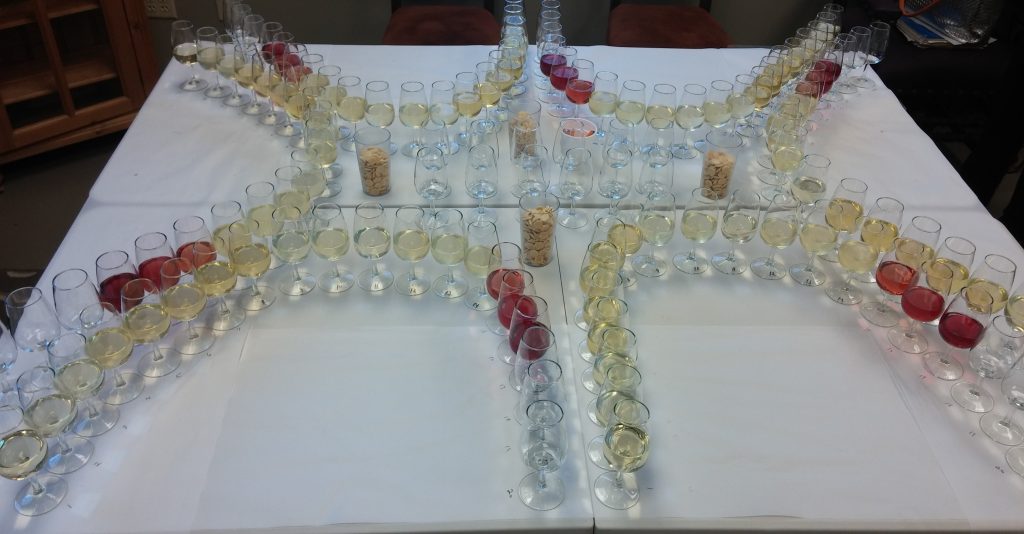
8)  The day prior to the blending session collect the other items necessary in the room to be used.  Check the wine glasses for potential cardboard dust odors or other off smells and wash them if necessary.  Check the actual room for off odors, paint smells, or other odors that may interfere with aroma evaluation.  Place a white table cloth on the table to be used.  For all the items to be used try to eliminate any colors to have mostly white and clear objects present.  For each sitting area have the wine glasses fanned out, in a semi-circle, in the quantity necessary to accommodate the largest flight of wines.  Have room to add about four more glasses to evaluate blends as they are made.  At these place settings have a water glass, pencils, paper, cracker dish and a spit cup.  At one end of the table have several graduated cylinders, beakers, and pipettes all of varying quantities.  Place several calculators on the table for use as mathematical questions may arise.  If your tap water has an off flavor, or a slight odor, use distilled water or bottled water for the sessions rinse water and drinking water.  Gather several clean 5 gallon buckets and place them in the room to assist dumping the glasses of wine after each session.

Okay! Now we are set up and ready for our blending day.

9)  The morning of the blending session have everyone gather in the room and take their place setting.  Give them an overview of what they will be doing but be careful not to reveal any information on the wines that are bagged and to be tasted blind.  Start with the first blind flight of wine.  This most often will be a primary focus wine flight of past vintages that have been made by the winery.  Older vintages help one understand what the consumer has been purchasing, how the lots are aging and what characteristic one may want to enhance or refine for future vintages.  Try to evaluate at least three vintages.  It is best to have six, seven or more if the winery has that many years under its belt.  This is a good time to slip in a competitors bottle that the winery has discussed trying to emulate.  Perhaps slip in a well known brand to see how your wine compares.  Pour the wines from left to right and make sure that everyone has them in the same order.  This will eliminate confusion when speaking and critiquing the wines.  Taste through each wine and take notes.  Indicate the positive and negative attributes of each wine on paper.  Allow as much time as necessary to thoroughly go through each wine and do it with complete silence and no discussion.

10)  After ample tasting time, have each member that feels comfortable doing so, talk briefly about each wine.  Perhaps have them rank the wines or select their favorites and mention why.  Keep a rough tally of the table’s favorites.  Is there a consensus?  Do most people have a favorite or dislike?  Zero in on the positive attributes of those favorite wines and mentally lock in those flavors and aromas.

11)  Unveil the wines and reveal their labels or contents.  Keep them in the order that the glasses are on the table so each one can record what wine goes with his or her notes.  Speak a little about each wine as it is unveiled and then allow some time after all the wines are exposed for light discussion and possible surprises that people have commented on.  Collectively agree with the rest of the table what three or four wines may be needed to evaluate the next blend, refresh the pours into the glasses and ask them to put them aside.  Mark their glasses with a pen or simply have some white paper in front of them and label the place setting for that particular wine.  Clear the table of the left over glasses of wine by dumping the contents into the dump buckets.  Cork the remaining bottles for potential future evaluation and remove them from the table.  Rinse all the glasses lightly and take a small break.

12)  During or shortly after the break, start to pour the next blind flight.  This flight will be all the bulk wines and blends from the cellar that will be possible candidates to help make the next vintage of the previous wines just evaluated.  Be sure to include any older lots of wine that have been left behind in the cellar for one reason or another.  If an older wine is being blended perhaps taste and reach out for a newer vintage that may increase the fruitiness and freshness of the wine.  Taste and evaluate silently all of the potential components for the next blend.  Take notes and express the positive and negative attributes of each wine.  Rank them and discuss them after everyone has had time to evaluate them.  Reveal the bottles’ contents to the panel of tasters and perhaps have some light discussion about the wines, what vineyard blocks they came from and other possible factors that may add to the table. 

13)  After discussion, take a look at the quantities and chemistries you have of each wine in the cellar that is represented at the table.  Express those quantities to the rest of the table so they can help with the formulation of potential blends.  Have a pre-made spreadsheet with all the information needed and simply pass that out to the members to save time.  Now we have all of the information on the table to make our first blend!  (Whew – yes this is a task that takes time, energy and focus!) 

14)  First, formulate a blend on paper that may guide your new wine in the direction that you would like to see it go.  Take a look at the wines that will add the most to the new blend.  Start with several “paper blends” and make them at the table. [This may be done blind with the other tasting members excused.] Use the graduated cylinders, beaker, pipettes and other measuring devices to make the blends in the quantities that will fit the volume needed.  If the quality will allow more and the sales of the winery will allow it – make more.  If the quality will not allow a reserve blend, review the potential of not making one.  After the table blends are made, make sure to mix them well and then pour a portion of those blends for each person at the table. Pull the previously tagged glasses from the prior flight forward and taste the new blend up against the older vintages.

15)  Take time, with silence, for each member to evaluate the wines and select one or two that reflects an improvement on the previous vintages.  Discuss the wines and potentially make more sample blends, for the same wine, while refining and focusing the desired qualities.  Keep doing this process until an agreement can be reached as to which blend is the best.  Once that is done, subtract the volumes used for that blend from the spreadsheet and indicate the quantities that are remaining to work with.

  Dump and rinse the glasses that will no longer be used for the next blending flight.  Any glasses one decides to keep, be sure and mark accordingly and keep off to ones side.

16)  Now prepare for the next flight to be tasted blind.  Pull the next flight of library wines to the table to make the next level of quality for that style.  For example if the first flight was to make a “Meritage style blend” perhaps the next level will be a Reserve style or Premium blend.  Be careful not to use a descriptor such as “Regular Cabernet” because there should be nothing regular about it!  It also gets many in the winery referring to a blend in a non premium fashion. Taste just as we did before {blind and in silence} the next flight of library wines that correlates to the next wine that will be focused on and blended.  Once the tasting is completed discuss the wines with the table and start to focus on the next blend to be made.  This process can be repeated as often as necessary until all the wines have been made.  Once you are finished with the primary focus wines you can move into another quality tier.  Depending on the size of the winery one can work on reds one day and whites the second.  If some red wine will be needed to enhance a blush or rose, remember to hold that back during the previous sessions. 

17)  Once the process is complete be sure to compile all the information and double check the quantities assigned during the blending session.  Do this the next day if possible.  Make copies of the spreadsheet and pass them out to the participants and others at the winery.  If a mistake has been made it is much easier to regroup and find alternatives while the information is still fresh on the minds of the team.  Sit back and look at the complete picture the blending session has drawn for the cellar. Make sure new product lines were not left out or that the session will fulfill the year’s sales goals as best as possible.

18)  This process can be very daunting at first but once a system is in place it becomes second nature like anything else.  I like this process because it enhances the wine quality and it gives the cellar long-term direction.  One blend isn’t jeopardized because another one was made.  The winemaking team can move the wines forward, cohesively, in the cellar at a pace that should not be rushed.  Dry goods needs such as labels, corks, capsules and bottles can all be investigated and set up to arrive at the winery as needed.  The winery has a summary of the wine compositions and the exact blend percentages can be calculated.  This helps one put together a bottling schedule well into the next 6 months or longer.

19)  If many wines are remaining, at the end of the sessions, with “no home” discuss what some of the potential options are for those wines.  Will they get better?  Should they be offered for bulk sale? What is the future of the left overs?  Will there be enough cellar space to carry them over the next harvest?  Will it hamper the quality of the next harvest through “forced blending” due to cellar space issues?

Summary:

  Once this process has been performed several times it will become very systematic.  One can perform this process twice a year.  Perform the first blending session in the winter and another just prior to harvest.  This will help “shore up” loose ends in the cellar and prepare the cellar for the upcoming harvest.  The preharvest blending session is a great time to review fining trials on wines that may need refinement.  One can prepare these wines well in advance and taste them with others, blind, to get a true perspective to the best fining agents for a particular refinement.

  The success of a blending session is based on tasting the representative wine samples blind.  Getting the wines out of the cellar and evaluating them blind will help assemble blends without bias.  Try this process and give it at least three sessions over the next two years.  You will find the quality of the wines will improve, the cellar team will be better informed and focused and the complete winery team will all be aware as to the status of the wines.  It is the final touch to the winemaking art form.

Wine Blending Checklist

Objective:  To make the best possible blend(s) from the components of wine available in the cellar or off premise bulk wine.

Material Checklist:

4Wine bottles 4Wine bottle bags 4T-tops

4Magic markers – permanent (can be removed with ethyl alcohol) 4Adhesive labels for bottles

4Wine glasses – the small Viticole 7.25 oz glass is a nice “average” glass for this. 4Water glasses 4Pencils 4Paper 4Crackers 4Cracker dish

4Graduated Cylinders (multiple sizes) – 25 mil, 50 mil, 100 mil, 250 mil, 500 mil •Beakers – 500 milliliters 4Pipettes – [ 2 ] serological 10 milliliter

4White tablecloth – optional but nice. Large white paper is best. 4Spit cups 4Dump buckets (3) 4Distilled water

•  Be sure to collect samples from all lots in the cellar.

•  Recent data on wines to be tasted – organized and ready to answer questions.

•  Data on quantities to make – firm volumes known ahead of the day.

•  Sales data and current bulk wine data – more for your internal needs – not mine.

•  Current bottled wine data – again – to help you understand sales rates and needs.

4Calculators

4Past vintage wines and / or competitor’s wines

4Cork screw

4Quiet room

4An open mind and a great tasting team (….. but not too many people )

Cover Crops are a Powerful Tool for Vineyards

field of red flowers

By: Annie Klodd, University of Minnesota Extension Educator

Under-vine cover crops are managed plants grown underneath the rows of vines. Vineyard managers grow them on purpose to help achieve certain goals in the vineyard. I find them fascinating to talk about because their benefits and challenges are complex and never guaranteed.

  Grape growers working with overgrown vines might bring in competitive cover crops to slow their vigor. Organic-leaning vineyards often use cover crops to suppress weeds in place of herbicides. Those on steep hillsides should think about installing cover crops to stop erosion. If the cover crop is selected and managed well, vineyard managers should find success with these goals for at least several years.

  Other benefits are less straightforward. In some cases, cover crops might help increase soil organic matter and retain nitrogen, but the effects are often less that one might expect. Grasses tend to re-capture the nitrogen they put back into the soil after decomposition, so it may never reach the grapevines. Flowering cover crops will help attract pollinators like bees to the vineyard. This is wonderful as long as you are avoiding insecticides, which can kill those bees congregating around your flowering cover crop.

  Growers considering cover crops should first decide what goals you want to accomplish. Then, learn which types of cover crops to plant based on what will help achieve those goals. For example, a simple perennial fescue mix works wonders for most goals – vigorous fescues can easily outcompete most weeds, slow excess vine growth for several years, and support soil structure while requiring minimal mowing. Flowering species can be incorporated if desired. Vineyards hilling up graft unions each winter should consider annual cover crop species because the soil is frequently disturbed.

Slow Down Overly-ambitious Grapevines

  Is excessive vigor a problem in your vineyard? Are you constantly hedging and thinning to keep them under control? A strong, thick stand of under-vine cover crops might help slow the growth of overly-vigorous grapevines. Plants with dense root systems like perennial grasses compete with grapevines for water, nutrients, and space in the soil. When those roots get established, they tend to take up so much space in the soil that the grapevine roots avoid the top several inches of soil. The top few inches of soil are often the richest in nutrients and organic matter. So, when the grapevine roots are forced out of this area of soil, it can cause the vines to grow more slowly as they have limited access to the buffet of top soil resources.

  To use cover crops for vine vigor management, select a short, densely-growing perennial grass such as fine fescue. Wait to plant it until the vines are at least 3 years old, so that the grass competition does not stunt their early growth.

  There are many fine fescue species to choose from. The species that I have personally worked with is creeping red fescue. Fine fescues are short, only growing about 8 inches tall, and only need to be mowed 1-2 times per season. These grasses are also effective weed suppressors because they form a thick thatch of grass blades along the soil surface, blocking sunlight from hitting the soil surface. During my graduate research on fine fescues in vineyards, creeping red fescue formed a dense tangle of roots in the top 10 cm of soil, forcing the grapevine roots to avoid that area and grow deeper into the soil.

  To plant this cover crop, spread the seeds on lightly cultivated soil under the vine rows. Fescues are cool-season grasses that germinate best in cool, rainy weather. So, plant them in the spring after snow-melt for best results.

Say No to Weeds

  To suppress weeds, the stand of cover crops should be dense enough that it prevents direct sunlight from hitting the soil. Perennial fescues, described above, achieve this well. Clovers do a relatively poor job of densely covering the soil unless they are planted at very high seeding rates. If you want weed suppression but also insect attraction and nitrogen fixing, mix clover in with a fescue seed mix rather than planting it alone.

  Annual cover crops generally germinate and establish much faster than perennial species. They will do a better job of fighting weeds in the three months after planting. The obvious tradeoff is that they must be re-seeded each year. Perennial cover crops are less likely to provide effective weed management in the first year but will perform better long-term if managed well.

  Many annual species can be used for weed suppression if planted at high seeding rates. It is wise to include grasses in an annual cover crop mix if weed suppression is a goal, because they will help cover the soil more densely. Hairy vetch has also been shown to have good weed suppression but can become weedy. Whatever you do, just be sure to select low-growing species.

Cover Crops for Soil Health

  Cover crops improve healthy soil by adding organic matter, reducing erosion, and improving soil structure. Reducing erosion and improving soil structure are always good things in vineyards. But those considering cover crops for organic matter and nitrogen additions should ask themselves two questions first:  1) Will my cover crop add enough organic matter to make a difference? And 2) Does my vineyard actually need higher organic matter and nitrogen, or is my soil already ideal for grapevines?

  Sometimes certain cover crops can help retain or increase soil nitrogen, but this effect does not necessarily benefit the grapevines. If the soil and foliar tests indicate that the vines have sufficient nitrogen already, adding more is not beneficial. Most vineyards I know in the Midwest do not need to increase nitrogen.

  Secondly, even though grass cover crops put nitrogen back into the soil when they break down, their roots tend to take this nitrogen back up rather than releasing it into the soil for the grapevine roots to use. A 16-year study at a Cornell University vineyard found that bark mulch under the rows contributed more nitrogen to the soil than grass or herbicide treatments.

  This same 16-year study also found that bark mulch contributed more organic matter to the soil than cover crops, along with a 10-fold increase in phosphorous. While all plant matter contributes organic matter to the soil, the amount of matter added via cover crops is generally less than large outside inputs like mulch, compost, or manure.

  The ideal soil organic matter content for grapevines is 2-3%. Adding organic matter beyond that may not actually benefit your crop and can lead to excess vine vigor. Therefore, it is OK if a cover crop’s organic matter contribution is small.

  If, after reading this, you think that your vineyard’s soil could use more organic matter and nitrogen, consider cover crops, compost, or wood-based mulch accordingly.

Flower Power or Flower Downer?

  Flowering cover crops attract beneficial pollinators like bees. I am a full supporter of bees. That said, when deciding to add flowering cover crops to your vineyard, consider whether or not you plan to use insecticides going forward. Many broad-spectrum insecticides, including some organic ones, are highly toxic to bees.

  Because flowers attract these beneficial and sensitive insects to the vineyard, pollinator experts at Michigan State University and University of Minnesota have advised against spraying insecticides if flowers are in bloom. If you do use insecticides throughout the season, opt to plant flowering plants outside the vineyard rather than in the rows. Alternatively, you could try growing flowering plants and mow off the flowers before spraying insecticides.

Planting a Vineyard? Hold that Thought

  Just like weeds, thick stands of cover crops in the rows will slow the growth of newly planted vines, causing a delay in yield. In general, I advise waiting to plant cover crops under vine rows after Year 3, or until the grapevines have both cordons established (you should still plant grasses in the aisles during this time).

  The exception to this 3-year rule would be if the vines are excessively vigorous during establishment – in that case, a cover crop could help manage their rate of growth and suppress bull canes. I have seen this occur in a Minnesota vineyard with over 5% organic matter. Due to the extreme vine vigor during Years 2 and 3, I broke my rule and recommended planting an under-vine cover crop during vineyard establishment.

  If cover crops seem like the right choice for you after reading this far, give them a try! Reach out to your local seed representatives and ask for some samples to try in small areas of the vineyard. If it works for you, let your neighbors know!

Sources: 

•    turf.umn.edu

•    Atuche et al.  2011.  Long-term effects of four groundcover management systems in an apple orchard. 

•    HortScience 46(8)

•    Klodd et al. 2016 Coping with cover crop competition in mature grapevines.  Plant and Soil 400: 391-402

•   MSU webinar recording – April 8th, 2021

Crop Insurance is a Valuable Tool for Growers

vineyard with an overlooking lightning strike

By: Trevor Troyer, Agricultural Risk Management

I am not sure how many of you made it to Unified in Sacramento this January.  I did, it was my first time back since the pandemic.  I had a good time catching up with friends and making new ones.  The company was good and so was the wine. 

  If you had a chance to go to any the sessions you might have come across ones dealing with climate and weather conditions in the vineyard.  I attended some of these and they were very informative.  One was dealing with how to mitigate cold damage in grapevines.  Another one talked about how to deal with drought in the vineyard. It is interesting how we adapt to the conditions around us and how we adapt those plants and animals we have domesticated. 

  One thing I have learned over the years is that, things do not stay the same.  Change is inevitable.  This is especially true in farming.   You cannot expect to have the same growing conditions every year nor can you expect have the “right” crop every year.  Times change and so do tastes and desires in food and wine.  I know of plenty of vineyards that have pulled out one variety and planted another as trends changed.  As a grower you have to mitigate these risks and stay relevant. 

  Growers that adapt and learn new techniques are able to get by in tough times.  Things are not getting easier; input costs are still extremely high compared to years past.  Water regulations in some states are problematic. And climate and weather factors make it difficult, to say the least. Grape crop insurance can be a useful tool to help you continue making a living.

  With all that being said I have heard growers say that they can’t afford crop insurance.  With margins getting tighter, crop insurance is a tool, in my opinion, that you should not forego.   In the sessions I went to they discussed methods of handling the vineyard to mitigate damage. But what about those instances when you don’t make a crop or do not make much of one?  This is when crop insurance is important.  If you don’t have money to grow a crop the following year, you are out of business.

  Crop insurance is designed to help a grower get enough money to be able to produce a crop the following year.  It is not set up to replace profits lost.  I have had winery owners complain to me that it doesn’t cover the cost of how much their wine is worth.  While I can totally understand this, it is the growing costs that are being insured against. Crop insurance does not cover the production costs of making wine or juice etc. 

  Here are the Causes of Loss for Grapes out of a National Fact Sheet from the USDA:

Causes of Loss

You are protected against the following:

•   Adverse weather conditions, including natural perils such as hail, frost, freeze, wind, drought, and excess precipitation.

•   Earthquake

•   Failure of the irrigation water supply, if caused by an insured peril during the insurance period.

•   Fire

•   Insects and plant disease, except for insufficient or improper application of pest or disease control measures.

•   Wildlife or

•   Volcanic eruption

     Additionally, we will not insure against:

•   Phylloxera, regardless of cause; or

•   Inability to market the grapes for any reason other than actual physical damage for an insurable cause of loss.

  Risks are different depending on growing regions throughout the US.  Regional issues play a large part in decisions on whether or not crop insurance is right for you.  And then how much coverage is needed for the risks involved in making a profitable crop.  Are you concerned with late frost or freezes?  Have there been issues with wildfires?  Do you have a wildlife problem in certain areas of your vineyard? 

  Grape crop insurance is an Actual Production History (APH) policy. This means it uses the vineyard’s historical production per variety to determine how much is covered. Basically, you are covering an average of your tons per variety. Since crop insurance is subsidized the insurable varieties, prices per ton, premiums are set by the USDA. This also means that there is no difference from one insurance company to the next. Essentially you are insuring your future crop not your vines.

  You can cover your historical production from 50% to 85% in 5% increments.  You cannot cover 100% of your production.  Because of this there is a built in “deductible”.  For example, if you chose to cover 75% of your production then you would have a 25% production deductible.  If your average is 5 tons per acre, at 75% you would be covered for 3.75 tons per acre.  Your deductible would be 1.25.  If you harvest less than 3.75 tons per acre you would have a payable loss. 

  The states where grape crop insurance is available are Arkansas, California, Colorado, Connecticut, Idaho, Maryland, Massachusetts, Michigan, Minnesota, Mississippi, Missouri, Nebraska, New Jersey, New York, North Carolina, Ohio, Oregon, Pennsylvania, Rhode Island, Texas, Virginia and Washington.  Grape Crop insurance is not available in all counties in the above states though. 

  Crop insurance premiums are partially subsidized through the USDA Risk Management Agency.  Take advantage of this valuable tool to keep yourself in business.