B Cellars Embraces AI to Understand the Emotional Connection Between Brand and Consumers

Photo of B Cellars front entrance to their building

In the ever-evolving landscape of the wine industry, innovation is not just about viticulture and winemaking techniques; the new frontier is understanding the emotional bond between brand and customers. B Cellars, a trailblazer in the Napa Valley wine scene, took an early leap into the future by integrating artificial intelligence into its marketing and sales strategies. The results have allowed the company to carve out an enviable niche in the direct-to-consumer channel, which is the focus of their business model.

  In 2018, B Cellars distinguished itself as a pioneer in the winery-meets-AI space by employing Metis, a cutting-edge, AI-powered behavioral research program developed by a San Francisco-based company, Richey International. This move marked

B Cellars as among the first in the wine industry to seek consumer feedback through AI, with a focus on emotional connection to the brand.

  Metis, named for the Greek goddess of wisdom, was designed to delve deeper than traditional market research methods. It analyzes vast amounts of data, including social media and online review sites like TripAdvisor and Google Reviews, to provide insights into the emotional resonance a brand has with its customers and find best practices within specific industry segments. The AI searched for what consumers were saying about their experiences at B Cellars in comparison to a subset of other well-respected Napa Valley wine brands. It went a step further by also analyzing data from select non-winery businesses such as restaurants, hotels, and even retail stores; surprisingly, some of the most valuable insights for B Cellars came from analyzing the customer experience at Filson, the 130+-year-old Seattle-based outdoor clothing company.

  The next step was to invite past B Cellars guests to answer questions in writing. The instructions were clear and were meant to solicit thoughtful responses by noting respondents should “take as much time as you need to develop your response…we are listening carefully.” Participation in the survey was well above industry research norms.

  What Metis’ process revealed to B Cellars unlocked the essence of the relationships between B Cellars and their customers. Why did customers like the winery (apart from good wine)? What drove them to maintain a multi-year relationship? How could such a relationship endure when the customer was thousands of miles away?

  The answers became clear as Metis honed in on the core differentiators that consumers perceived about B Cellars: the “soul” of the brand was rooted in craftsmanship, terroir, and the idea of a lifestyle grounded in authenticity (as opposed glamour or floridity), plus appreciation of great quality wine, food, and entertaining in a manner that was elevated yet approachable. Metis found that while these elements were amply apparent to visitors to the B Cellars estate in Oakville, these factors were not highlighted effectively on the company’s website and online user experience. Simplifying and streamlining the website made it more inviting and accessible to potential customers and aligned better with the superior elements of the B Cellars brand. Once executed, the website simplification translated into a refined pre-visit experience between guests and the winery’s concierge team, which gave way to a unique arrival experience for guests.

  The insights B Cellars gained from the AI analysis of its in-person experience were also eye-opening. From Metis’ data analysis, the winery learned that their wine tastings were undervalued. So, they increased prices by an unprecedented 30%; this adjustment aligned the perceived value of their offerings with the high quality of their wines and curated food pairing experiences. The price increase also heighted the perceived luxury of the experience, which led to increased bookings to visit the estate.

  Furthermore, Metis’ insights led to a reimagining of B Society, an offering that encourages ongoing purchases of its wines. Before Metis, B Society wines were predetermined for its subscribers based on previous purchases; however, AI recommended a totally customizable wine purchase approach that allowed consumers more control over choosing selections for each shipment. Metis also challenged the B Cellars approach to Society gatherings. Today, gatherings are designed to encourage deeper connections between the B Cellars team and their clients by having more intimate gatherings and allocating visiting hours exclusively for returning guests. These changes have not only improved customer relationships but also reduced attrition rates, which now sit well below industry norms.

  The results of incorporating AI into the winery’s strategy have been remarkable. B Cellars enjoyed a 7% increase in annual winery visits with in the first year of implementing the Metis findings, plus a notable improvement in customer engagement, loyalty, and referrals. These changes underscore the potential of AI in transforming not just marketing strategies but the very fabric of the customer relationship. The key was deeply analyzing a comparable set of businesses and listening carefully to its customers, just as B Cellars had promised to do. In the final analysis, Metis showed that B Cellars customers wanted to believe in the winery’s ethos of integrity and authenticity. While most wineries market themselves based on what’s in the bottle, their scores, or a continuous stream of marketing campaigns,

B Cellars sought substance, which has translated into a durable emotional connection with its customers.

  The success of the B Cellars story provides a roadmap for other wineries to follow as AI inevitably becomes more integrated into all of our lives. The implications of the winery’s pioneering use of AI extend beyond their own success; it opens up a realm of possibilities for other wineries and vineyards. The wine industry, traditionally reliant on conventional marketing and customer relationship techniques, is already starting to think of AI as a viable tool for enhancing business models, especially in the DTC segment, which has grown significantly during and since the Covid-19 pandemic began in 2020.

  Moreover, the adaptability of AI tools like Metis means they can be tailored to different business needs, whether it’s refining product offerings, enhancing customer experiences, or developing more effective marketing strategies.

  The innovative approach of Be Cellars incorporating AI into their marketing and customer relationship strategies sets a new benchmark in the wine industry. As the industry continues to evolve, AI will undoubtedly play a significant role in shaping the future of winery and vineyard operations, not only in the sales and marketing spaces, but also in optimizing elements of the wine business like farming practices, supply chain, and even winemaking techniques. The experience of B Cellars using novel AI tools demonstrates that the fusion of technology and tradition can lead to unparalleled success in the wine world.

Exploring Accommodation Options at Wineries

Picture of front of a winery building entrance connected to 3 metal silos

By: Becky Garrison  

Wineries looking to provide their guests with elevated wine-tasting experiences might want to explore the option of offering accommodations at their winery or vineyard. Kristen Baxter, operations manager for Abbey Road Farm in Carlton, Oregon, said, “Our lodging is integral to our business model, as it allows winery guests and event guests to stay overnight while they are here enjoying wine or celebrating with us.”

  Carrie Bonney, general manager for Youngberg Hill (McMinnville, Oregon), concurs, adding, “Lodging contributes to our reputation for exceptional hospitality and helping to sustain and grow our overall operation.” In addition, their lodging serves as a revenue stream that supports their broader mission and allows them to invest in the enhancement and maintenance of their property.

  In Bonney’s estimations, this is just one piece of the experience they aim to provide our guests, and it complements their primary focus, wine. “By offering a range of comfortable and thoughtfully designed accommodations, we aim to create a welcoming environment where guests can relax, unwind and fully immerse themselves in a unique experience. This, in turn, enhances their overall visit and encourages return visits and positive word-of-mouth referrals,” Bonney adds.

Lodging Options Available at Wineries

  As noted by the following examples, the types of accommodations available at a given winery vary from a rustic cabin cozy for two to a luxury country-style mansion replete with five-star amenities.

  Lumos Wines’ (Philomath, Oregon) vineyard is situated on what was the H Bar H Dude Ranch back in the 1940s and 1950s. The one-bedroom cabin with indoor plumbing was one of the original guest cabins built in 1938 and can accommodate up to two people. They maintain this little cabin to keep the historical feel of the place. In another historical touch, their tasting room is in the old dude ranch’s dance hall barn.

  Colter’s Creek Winery & Vineyards (Moscow, Idaho) began offering lodging at their tasting room because they had an open space that needed remodeling, and they saw a hole in the Moscow lodging market to fulfill. They have four boutique rooms above their tasting room in Moscow available via self-check-in, with bookings that can be made through their website.  Different packages are offered, each room comes with a complimentary wine tasting and with enough planning, guests can visit the vineyard and production facility 45 minutes away in Juliaetta.

  Abbey Road Farm’s (Carlton, Oregon) Silo Suites B&B is housed in three-grain silos. Two of the silos were built in 2003 when the property was a grass seed farm. The third was added to complete the project the winery opened in 2019. The silos boast a grand entry and sitting area with a wet bar. Their five suites feature foam-topped beds, Jacuzzi tubs, luxurious bedding and ambient floor heating. Stays include a bounteous Oregon breakfast prepared by on-site chef/innkeeper Will Preisch.

  Youngberg Hill had already been functioning as an inn since 1989, when they planted their oldest blocks, the Natasha and Jordan blocks. They chose to maintain this inn as a nine-room bed and breakfast offering comfortable rooms and suites, an open-air deck, spectacular views for sunsets and stargazing, and a fireplace beside which to relax with a glass of wine. A two-course breakfast keeps guests fueled up for a day sightseeing around the Willamette Valley.

  In a similar vein, Hummingbird Estate (Central Point, Oregon) converted a historic private home and former orchard into a vineyard and tasting room, event space and inn. Renovating the home’s bedrooms into suites made the most sense for the space. Here, guests can enjoy a glass of chardonnay, syrah or pinot noir while taking in the view of grapevines from their windows. In addition, they have a vineyard cottage available for rent.

  Also, when Grosgrain Vineyards (Walla Walla, Washington) acquired their winery/vineyard property via a bankruptcy auction in 2017, the only structure on the property at the time was a house where the previous owner had made his wine in the garage.  They needed a significantly larger winery space, so they built their current winery and tasting room in an adjacent area. They considered moving into the house themselves but decided that it was better suited to use as a short-term rental, which would be a great way for them to provide a more immersive experience. The house has four bedrooms and four baths, all of which are en-suite, with the house rented as a single unit on a nightly basis.

  So far, the house has been a great way to host new customers who experience their winery for the first time, as well as their wine club members who can book further in advance and at a discounted rate. Also, this house provides a great way for them to host their national distributors and further educate them about their winery. While the revenue it generates has been significant, more importantly, staying at this home helps guests build a deeper connection with the winery.

  The Joy on the Anahata (which translates to the heart chakra in Sanskrit) Vineyard (Salem, Oregon) is a luxury wine country retreat and 6,500-square-foot home with seven bedrooms (four suites, two queen rooms and one twin room in the basement for a nanny or younger children.) This house sits on top of the vineyard at 550 feet with views in every direction, and the gated 30-acre property is fenced in for deer. Other amenities include a chef’s kitchen, living room, dining/family room and outdoor heated swimming pool and hot tub, as well as a basement with a wine cellar and ping pong and pool tables. This property is rented as a “hospitality home” designed for family retreats, work retreats, YPO retreats and, in some cases, smaller than 100-person weddings. As they don’t have a tasting room built yet with their wines poured at Carlton Winemakers Studio, this house provides an opportunity for guests to taste their products as they collect their information.

  Bianchi Vineyards (East Wenatchee, Washington) chose to rent the two-bedroom house on their property as a short-term Airbnb experience. In addition, they have two RV spots with power and water. Some guests visit the tasting room for their complimentary tasting. Others enjoy hiking, skiing and concerts at the Gorge Amphitheater.

Recommendations for Designing Lodging at a Winery 

  Bonney stresses that offering lodging is not for the faint of heart. “This can be a significant undertaking, but it is also an excellent enhancement to your guest experience and can put your winery on the map as a unique destination. While it can eventually enhance your overall revenue streams, a great deal of investment is involved.”

  Meghann Walk, general manager for Hummingbird Estate, reminds those looking to invest in lodging that while lodging is an extension of their long-standing tradition of hospitality, it is not passive income. She reflects, “The inn is our most stable but also, in many ways, the most constantly demanding aspect of our business. There is no such thing as only answering phone calls during open hours. Make sure you are prepared for this.”

  Before launching a lodging program, Bonney recommends conducting market research for your area, determining lodging demands and assessing the type of accommodations guests will want. Along those lines, familiarize yourself with zoning and permitting regulations for your area before you start any work.

  Also, Baxter notes that conducting market research into other lodging options in your area can enable you to curate a unique experience from competitors to help you stand out. “Consider putting together packages unique to your property and potential discounts for loyal wine club members for additional benefits,” she says.

  In designing the lodging, Bonney recommends ensuring that the overall design provides a comfortable and memorable experience for your guests. Think about room options and various views, private patios and accommodating children or pets, as well as sustainable practices, such as energy-efficient appliances, water conservation, composting and eco-friendly amenities. In addition, consider if you want to offer wine tasting and breakfast as part of the lodging experience or if those will be separate options for purchase.

  Don’t neglect security and safety. Consider outdoor lighting, security cameras and post-emergency exit procedures for guests to see.

  Also, Bonney stresses that wineries need to ensure they have the appropriate trained staff. In addition to scheduling and maintaining guest reservations, they must know local restaurants, tour operators, spa services and other area happenings. “Anyone from the front desk staff to the housekeepers who will be interacting with guests must excel in customer relations,” she said. Baxter offers this cautionary reminder, “Your housekeeper will be your most valuable and least replaceable employee.”

  A CRM (customer relationship management) staff member will be needed to help maintain contact with guests, book rooms and provide an online booking option. Along those lines, online travel agencies like Expedia and Tripadvisor can help expand exposure.

  Finally, Bonney recommends that those seeking to add lodging as a service, embrace it fully. She proclaims, “You and your staff can create a holistic and integrated experience, develop new ambassadors for your brand and most importantly, sell more wine!”

New Technology Affecting Your Marketing Right Now

By: Susan DeMatei, Founder of WineGlass Marketing

At the DTC Symposium last month, there was a session about new technology trends and their application for wine marketing. We spoke with a panel about big data-driven advertising, NFTs, and their use for marketing and augmented reality. Each speaker had a case study on wine, and the Q&A session explored everything from costs to legal ramifications. These new tools only scratch the service of all the exciting trends in marketing wines. This blog highlights three trends affecting our marketing planning right now and in the near future.

AI:  Artificial intelligence and machine learning are becoming increasingly important in the online marketing arena. These technologies allow marketers to analyze data and take that analysis to automate routine processes, make decisions based on behaviors, anticipate responses and improve customer experiences. It can have applications in websites, emails, online ads, and offline content development.

  In design, AI tells us which content will most likely engage a specific tagged customer. This capability allows us to create dynamic (changing) websites and emails personalized to individual customer preferences. We are not quite to the level in the movie Minority Report, where biometric-tailored ads talk to us wherever we go, but websites that offer personalized experiences, such as customized content and recommendations, are already in high demand. With AI constantly learning, this trend will only get more precise.

  One of the fastest-growing uses of AI is long and short-form writing. Chat GPT, Jasper, and Copymatic advertise well-researched and relevant blogs in seconds, negating any excuse not to deliver new content to your winery followers. Ironically, just as fast as these new AI tools to create AI content pop up, they are followed closely by another stream of tools to identify artificially generated copy (e.g. Originaltiy.ai, Content at Scale, etc.). AI writing has a certain “canned” quality, so just pumping out AI-generated content without personalization isn’t recommended. But it is interesting how efficient marketing is becoming. It will be interesting to track the results and see if consumers find AI content as engaging as messages from the heart.

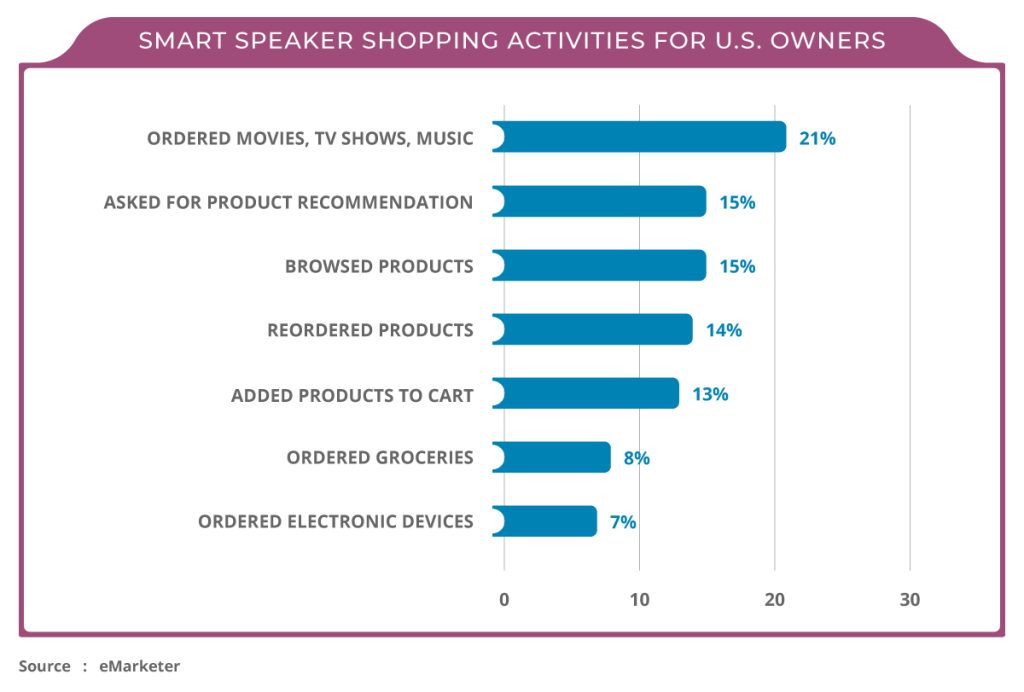
Voice:  Keeping an eye on voice search and voice user interface (VUI) are increasingly essential thanks to the rise of virtual assistants like Amazon’s Alexa and Apple’s Siri, and Google Home. In 2022, InsiderIntelligence estimated that 142.0 million people in the US, or 42.1% of the population, used a voice assistant.

graph for smart speaker shopping activities for US owners

  Why is this significant for marketing? Because people don’t type the way they speak. When people use voice search, they are more likely to use natural language and ask longer, more complex questions. So, when optimizing for voice search, it’s important to use conversational language or long-tail keywords that match how people speak to help content appear in voice search results.

  In addition, if you want your website to appear when people voice search, your website must include the correct schema markup in the code. Schema markup is a type of structured data that helps search engines understand the content of a web page. By including schema markup for voice in your website code, you can make it easier for search engines to understand your content and display it in voice search results.

Influencer or Peer Marketing:  As we witness the shift in values from Boomers to Millennials, the power of persuasion sways away from the press or pundit toward the peer or friend. To people under the age of 40 with foundational experience with the internet, ratings, peer comments, and social media content by others about a product are among the most persuasive reasons to buy. It is no wonder why Forester reported 73% of companies are increasing their social media budget for 2023.

bar graph for social commerce sales

  “Wait,” you say, “social media is hardly a new technology.” True. The focus on the increase in social media budget is significant when paired with the growth of social commerce or selling products directly on social media platforms. This capability is relatively new but expected to grow 30.8% in 2023 to hit $1.3 trillion in sales. Finally, we can show management a direct ROI tied to the social media budget.

  Social commerce is so effective because it happens in a supported peer environment and offers an easy, convenient, and seamless shopping experience for customers, which can lead to increased sales and customer loyalty. It’s an effective sales strategy because it removes friction from online shopping experiences that start on social platforms. Many people discover products they like while browsing social media.

  Influencer marketing, buying something you saw on Instagram and peer review sites like Yelp, are familiar, but we can expect more brands to focus on these partnerships to promote their products and services in the future. This will drive prices up, create clutter, increase the need to pay for views, and heighten the importance of developing engaging content to break through to new customers.

  There are certainly more trends to discuss, as this is only a partial list. The importance of dark mode design, augmented reality, interactive and immersive design, and the new Google Analytics are also at the forefront of our conversations and will be the subject of future posts. What is clear is that technology is evolving our ability to plan and execute marketing far beyond what was done even in the last ten years.

  Susan DeMatei is the founder of WineGlass Marketing, a full-service direct marketing firm working within the wine industry in Napa, California. Now in its 10th year, the agency offers domestic and international clients assistance with strategy and execution. WineGlass Marketing is located in Napa, California at 707-927-3334 or wineglassmarketing.com    

Could the Wine Industry Benefit from Virtual Assistants?

what can i help you with
AI Chatbot smart digital customer service application concept. Computer or mobile device application using artificial intelligence chat bot automatic reply online message to help customers instantly.

By: Craig Goodliffe, Founder & CEO — Cyberbacker

Digital innovations within the workplace are nothing new these days. With more and more people working from home, employees are becoming accustomed to relying on technology to help with work-related tasks that used to be completed in person.

  Today, virtual assistants (VAs) are changing the way companies interact with and engage customers, get their name out into the market, and improve overall profits. VAs are part of the digital revolution that has reinvented the landscape of modern work, and business leaders across a wide array of industries are leveraging the skills these professionals offer to help scale their businesses, manage tasks, and free up their time.

  When one thinks about viniculture and the wine industry, it may bring to mind images of vast fields of grapevines, wineries with knowledgeable sommeliers giving in-person recommendations, and an age-old, often family-based company structure. One’s mind typically will not jump to a tech-heavy culture.

  However, according to a recent article in Forbes, many wine companies have not only adapted to changes in technology, but debuted some wine industry-specific innovations. For instance, some companies have outfitted their wine labels with QR codes that give consumers greater insight into the wine’s origins. The company Sparflex has developed a wine foil that allows the consumer to access animations straight from the label, and WineCab is a robotic, AI-powered sommelier; some wineries are even using drones and satellites to collect data on their vineyards.

  Although the viniculture industry may not seem one “ripe for the picking” for help from virtual assistants, the wine industry has a history of adaptation to new technologies and innovations. This could make them the perfect industry to adopt the use of VAs. 

What Value can VAs Bring to Winemakers and Viniculture?

  Virtual assistants are remote workers who can help companies with a number of tasks, and their role has taken on new meaning as remote work has grown in popularity. Once used for mainly administrative tasks, VAs are now heading up social media campaigns, handling the entire accounting or customer service department of companies, and — in some cases — even stepping into C-suite leadership roles.

  Throughout the past several years, the wine industry has faced the same challenges that many other industries have run across, including customer service concerns, supply chain issues, and a focus on employee retention in the wake of the Great Resignation. Virtual assistants can help winemakers navigate these challenges as well as many others.

  One of the biggest benefits a VA can bring to the wine industry is their ability to take on tasks that may not be in the wheelhouse of a business owner, CEO, or other leaders. VAs can also be instrumental in helping leaders better focus on the tasks where they excel. Attempting to scale a business on one’s own is remarkably difficult, especially in an industry as inherently collaborative as viniculture, where different teams are responsible for harvesting the grapes, making, selling, and marketing the final product.

  Studies have shown that taking on a VA can improve productivity overall in one’s business, including the wine industry, where overall productivity could make or break a winery. VAs can also help lower overall operating costs by up to 78%, which could provide crucial savings for a startup in the wine industry.

  Virtual assistants can give an owner more time to focus on what they really want to do: building their businesses. Winemakers may be surprised at how adaptable and multi-faceted VAs are, and what they can do to help a winery, vineyard, or wine store scale.

  Running and managing social media accounts

It can be difficult — if not completely impossible — to run a successful business these days without using social media effectively. Many people may not know how to leverage social media for their wine business, but there are VAs who are highly skilled in areas of social media marketing and engagement that can help one uplevel their business.

  Social media is largely about visuals, and one may wonder how someone who may work halfway around the world can help with the visual marketing of a business that is in, say, Napa Valley. Yet, because so many aspects of the modern workplace have been digitized, it’s extremely easy for a VA to take images or videos from a winery’s events — or even its wine-making process itself — and use those on social media sites to further establish its brand presence.

  VAs can also handle the engagement side of social media, which can be one of the most time-consuming aspects of digital marketing. After all, customers who are interested in your product because they saw some compelling images online will want to engage with your brand by liking, following, and sharing your content on social media.

Facebook

  According to research, 70% of adults use Facebook, many of whom use their connections to brands on social media to make purchase decisions. When a brand actively engages with followers online, it increases the likelihood that the person with whom they are engaged will return to make a purchase.

  In this regard, VAs can also handle the involved job of social media advertising. Running social media ads is highly effective. In fact, that same research shows that 49% of people will be more apt to purchase an item if they see an ad for it on social media. However, running, organizing, and keeping on top of social media ads can be tricky — even for social media-savvy CEOs. Having a person whose top priority is to run and track social media ads can greatly improve a company’s reach and revenue.

Instagram

  Instagram is where social media users go for imagery, and where a winery’s brand presence could easily entice customers with beautiful pictures and engaging video content. Instagram is all about meeting wine enthusiasts where they are, as these consumers are the ones sharing their own pictures of vineyards, bottles, and glasses of their favorite wines.

  Instagram posts that tend to garner the most engagement are those that highlight the human element of the business behind the screen. A great example is Tank Winery, which has harnessed the power of Instagram with personal, informative, and entertaining stories and posts that grab attention. Virtual assistants that are well-versed in the visual-heavy Instagram approach can help uplevel a business’ presence on the platform by consistently posting engaging content.

Tiktok

  As of September 2022, TikTok is the most downloaded social media app in the US for the third year in a row. Many VAs are also TikTok experts and can help a winery or vineyard get its head around what is likely to “go viral” on the popular platform. TikTok can be a great platform for robust marketing strategies and interesting dives into wine-related content, be they virtual tastings, or informative videos about a particular wine or brand.

  Consistency is key with all social media platform posting. Some studies show that businesses should post 1-4 times a day to have a chance of reaching viral status, but most winemakers simply do not have the time to consistently post on platforms for maximum engagement. This is where hiring a VA can help their business achieve the consistency they need to best leverage social media.

Customer Service

  If there is anything that can make or break a business, it’s customer service. No matter how great a winery’s product may be or how skilled its wine experts are, its entire operation can steadily dry up if its customer service is lacking.

  Customer service needs to be top-notch with not only consumers, but suppliers and the stores that carry one’s product. Even when they are positioned halfway around the world, VAs can field phone calls, respond to emails in a timely manner, manage chatbot functionality on your website, and provide assistance with issues that may arise. If a company is looking to expand on a global scale, having a VA in a different time zone could prove to be a massive asset.

  Additionally, as online shopping has become the norm since the pandemic, it is now even more crucial that the wine industry master omnichannel marketing tactics and remain able to pivot alongside changes in consumers’ purchasing habits. Wineries, vineyards, and other businesses in the industry need their customers to be informed and taken care of during every stop in the engagement and purchasing process. VAs can help cover the omnichannel bases, assisting with social media channels, mobile communication, and customer support online.

  By utilizing VAs on the customer support end, customers will feel heard and vendors will feel secure in knowing someone is on top of their needs. Founders and CEOs cannot possibly be everywhere at once, but allowing a VA to help with some of the ongoing customer service tasks allows them to concentrate more on the crucial aspects of their wine business requiring their attention.

  Establishing and building an online presence

A skilled VA can handle a business’s entire online presence, from website design, to updates, to running its online e-commerce store. They can spearhead the time-consuming tasks such as uploading images and information for each product that you sell, writing blog posts that further engage clients and customers, or stepping in at a moment’s notice if one’s website experiences issues and goes down. VAs experienced in event management can even host online events, such as virtual tastings or wine workshops.

  The last few years have been instrumental in building online sales innovation for the wine industry. One study showed that online wine sales skyrocketed during the pandemic and held steadily above pre-pandemic levels, even as in-person tasting rooms reopened.

  Overall, wineries stepped up their online offerings during the pandemic, with 44% of them offering online tastings and other incentives to engage online shoppers; only 22% of wineries neglected their online presence during the pandemic. The online shopping capabilities of a wine business are important for attracting and retaining loyal customers, as well as maintaining their position amid heavy competition.

  Virtual assistants can help with a number of other tasks outside of those mentioned here. Other tasks that are essential to a business, but that leaders may need a VA’s support with, run the gamut from accounting to HR, to SEO and admin. As the wine industry increasingly adapts digital tools and technologies, virtual assistants will take their place as some of the industry’s most invaluable employees.

  As a leader in your wine business, no one is expecting you to be an expert in everything. But by utilizing virtual assistants, you can outsource the expertise necessary to keep your wine business thriving and growing year after year.

Craig Goodliffe is the Founder and CEO of Cyberbacker, an innovative, mission-driven company that connects small to medium-sized businesses with the top-flight support staff that they need in order to grow. Cyberbacker is the leading provider of world-class administrative support and virtual assistant services from anywhere in the world to anyone in the world.

Top-5 Automated Text Campaigns for Wine Merchants

chat box on screen

By:  Bryan St. Amant, Founder & CEO of VinterActive

If you’re like many wine marketers, your to-do list is a mile long. You need to post on social media, update your blog, manage your next event, and launch a new vintage of wine. And that’s only on the marketing side.

  With so many hats to wear, today’s wine merchants need any help they can get.

  That’s where automated SMS workflows can save the day with personalized messaging sent to the right customers at precisely the right time to generate game-changing results.

What are Automated SMS Workflows?

  In an ideal world, your best sales rep would stay in touch with every customer and reach out instantly when your winery can offer them something they value.

  Automated SMS workflows offer this same service by monitoring consumer behavior 24/7, then sending personalized text messages whenever your business can help individual consumers enjoy your brand.

  Fundamentally different from one-off ‘blasts’ sent to everyone on your list, automated SMS workflows are triggered when customers take a specific action, like asking for more information, ordering products, or joining your club.

  By using automated workflows, any wine merchant can offer their customers an increasingly rare experience simply by paying attention and catering to their unique needs. The result is a virtuous cycle of happier customers leading to more sales — without requiring more labor.

Ranking the Top-5 Automated SMS Campaigns Available for Wineries in 2023

  With wine merchants reporting 32 times better results using text messaging instead of email to reach their customers, the race is on to identify which SMS campaigns drive the most sales.

  So, our friends at Listrak analyzed 1.1 billion marketing texts sent across all industry segments to conclude that automated SMS messages triggered by customer behavior consistently outperform marketing blasts — generating 2-to-20 times more sales per text than typical broadcast messages.

  In their landmark report “2022 Benchmarks: Text Message Marketing,” Listrak identified the top 5 automated campaigns available to today’s wine merchants:

1.  Welcome Series

2.  Transactional Updates

3.  Shopping Cart Abandonment

4.  Browse Abandonment

5.  Post-Purchase Sequence

  The revenue generated by these campaigns averaged eight times more than the sales produced by typical text marketing blasts.

  Of course, these results shouldn’t surprise most wine marketers. Automated email campaigns also maximize sales compared to email blasts. It turns out that timing and relevance still plays a vital role in the success of direct marketing.

  So that’s why we’ve been advising our friends for years: “it’s time to get past the blast…”

Automated SMS Workflow #1: Welcome Series

  A welcome text is your chance to make a great first impression with new subscribers, wine club members, and recent guests.

  Research on human behavior shows consumers are most engaged when they first sign up to receive your messages. That’s why their experience in the first few weeks of your relationship can often determine the outcome.

  If you offer consumers many ways to engage your brand, sending a series of messages might make sense instead of a single text. New subscribers to your list might enjoy…

•  A link to your winery’s social media pages

•  Info on what new subscribers can expect

•  A thank-you gift for joining your text list

  A similar welcome sequence can work for new wine club members and retail customers by using autoresponders to send your SMS messages at specific intervals.

  However you harness the power of an automated welcome sequence, you’ll be profiting from one of the most productive marketing techniques available to today’s wine merchants.

Automated SMS Workflow #2: Transactional Texts

  While many wineries work with commerce systems that can trigger personalized text messages whenever customers place orders, make reservations, or expect a wine shipment, most wine merchants have yet to profit from transactional text messaging.

  Transactional messages like order confirmations, shipping notices, and appointment reminders are among the most popular texts sent to consumers by their favorite brands.

  For wine marketers looking to deliver a world-class customer experience, enabling your commerce system to trigger text messages opens a new channel of communication that works 24/7 to engage your best customers without adding to your workload.

  And for U.S. retailers, the sales revenue generated by transactional SMS messages averaged $1.16 for each text sent.

Automated SMS Workflow #3: Cart Recovery

  Savvy wine marketers know that repeat customers like wine club members and mailing list subscribers place most online wine orders.

  Yet, for every ten successful orders placed by repeat buyers, another seven orders are lost due to cart abandonment – when customers fill their cart but don’t complete the checkout process.

  Of course, consumers have many reasons to abandon the purchase process before completing their order. Extra costs like shipping, a frustrating checkout process, or even a slow website can send thirsty shoppers away before purchasing your wine.

  But did you know that 20-40% of these customers can be lured back with a thoughtful automated cart abandonment campaign?

  To put these results in perspective, a typical winery experiencing 70% cart abandonment and a 30% cart recovery rate will generate 20% more online sales than wineries that don’t use automated cart recovery techniques.

  For U.S. retailers, Listrak’s latest report shows that abandoned cart campaigns generate an average of $1.04 of incremental revenue for every text sent, nearly six times more than a typical SMS blast.

Automated SMS Workflow #4: Browse Abandonment

  Like shopping cart abandonment campaigns, automated texts sent to shoppers who spent time browsing your products, but didn’t add them to their carts, can also boost online sales by turning “window shoppers” into happy customers.

  Both offline and online, browse abandonment is often just a natural part of the purchasing process.

  According to sales conversion experts, for every customer adding a product to their online shopping cart, three more prospects view your products without taking further action.

  So, if your website can identify opt-in SMS subscribers who viewed your products without purchasing, browse abandonment campaigns offer wine marketers another opportunity to nudge them to buy.

  Some of the most productive browse abandonment campaigns reinforce consumer interest by featuring popular offers like…

•  product reviews

•  related products/services

•  special time-limited promotions

  And for U.S. retailers, the latest research on SMS marketing shows that browse abandonment campaigns generate an average of $0.56 of incremental revenue for every text sent, three times more than a typical SMS blast.

SMS Workflow #5: Post Purchase Sequence

  Since market research shows consumer interest peaks at the time of purchase, direct marketers can leverage this honeymoon period to build long-lasting relationships by launching an automated post-purchase campaign.

  After customers receive their wine, successful marketers often use personalized messages seeking customer feedback on the purchase process, suggesting food & wine pairings, asking for product reviews, or offering a chance to order more wine.

  While many post-purchase messages don’t focus directly on incremental sales, the latest research still shows that post-purchase campaigns generate an average of $0.51 of sales revenue for every text sent, 3-times more than an average SMS blast.

The Bottom Line on Automated SMS Wine Marketing Campaigns

  Most wine marketers face the same problem: balancing a long to-do list against limited time.

  Devoting resources to SMS messaging — the wine industry’s most productive DTC marketing channel — is an intelligent business decision. But setting up automated SMS campaigns is even better.

  For wine merchants looking to delight their customers with personalized service, engage more consumers without doing more work, and grow their business using the best practices of SMS wine marketing, automated text messaging is a proven path to success.

  By generating 2-to-20 times more sales revenue than typical text blasts, the five automated campaigns outlined in this article can help any wine merchant maximize their profits with SMS wine marketing.

About the Author

  Founder & CEO of VinterActive, Bryan St. Amant, is a pioneer in developing preference-based direct marketing and its successful application in the wine industry. His award-winning work has been featured in books, magazines, and seminars, including CFO Magazine, Inc., CNN Money, eMarketing Magazine, Integrated Direct Marketing, Direct Marketing Association, Wine Marketing Report, The Grapevine Magazine, and the Wine Industry Network. VinterActive is located in Windsor, California at 707-836-7295 or vinteractive.com

Trends in Email Effectiveness

A Five-year Historical Review of Performance Metrics

finger pointing towards a mail icon

By: Susan DeMatei, Founder of WineGlass Marketing

Since 2018, WineGlass Marketing has monitored email responses to help plan and inform our campaigns. (You can find the 2022 report at wineglassmarketing.com/2022-email-benchmark-report.) For this year, we included a look back at five years of data because it is a fantastic opportunity to track the impact of COVID on our email responses. The behavior changes of planned campaigns by wineries and customers’ reactions during COVID and Shelter in Place should be evident by looking for anomalies. This article will review the historical data to compare to 2022 data and trends.

INCREASED FOCUS ON DATABASE GROWTH

  A byproduct of COVID is that we learned that keeping in touch with our customers is essential to our business survival. When the steady stream of new customers off the freeway to our tasting rooms stopped, we found ways to talk to existing customers in our database. We remembered what we learned when that freeway opened again in 2021. We kept adding names and coveting that connection, swearing we would never leave ourselves that vulnerable again. Between 2020 and 2021, the average database size jumped 37% to over 6.5k.

graph showing the email campaigns and list size

  But, we took our feet off the gas because, in 2022, we saw it fall to the lowest point since 2018. Let’s hope that in next year’s benchmark study, we see increased attention in this area and that our databases grow again.

THE AVERAGE MONTHLY CAMPAIGNS PER WINERY ALSO FLUCTUATED

  We interpret this increase as wineries finally started segmenting during COVID because they had the time and resources to look at their data. So, when 2021 came along, it was game on with A/B splits, automated drip campaigns, and segmented offers.

graph showing the average number of email campaigns by month

  We also noted a great deal more “resends” in the data from 2022, showing that more wineries are comfortable with reminding non-openers or non-responders that they’re missing out on a great deal. In 2022, the wineries surveyed reported an average of 5.27 campaigns per month – either completely new campaigns or resends or different segments.

SEASONALITY IS STARTING TO CHANGE

  If we split out volume by month for these five years, we get an idea of the increase in campaigns in 2022 and the seasonal trends. Wineries cluster emails around club shipment times in March and fall harvest and load more holiday emails into the fourth quarter. This trend has been consistent throughout all five years.

  However, in 2022 we saw more emails during the summer. Perhaps this is because of the increased adoption of summer “cold” shipping, or segmentation and testing are planned in the summer months to minimize the impact on crucial selling seasons. But we can say that going “dark” in the hot months is no longer a common practice.

graph showing the open, click, conversion, and bounce rates

OPEN RATE DECREASED, BUT CTR INCREASED

  Open rates have been on a steady decline for the past three years. But don’t worry; this is consistent with any industry trends and has been this way year after year since somebody sent the first email in the early 1990s. Why? Two reasons. First, as consumers, we’re tired of emails. As any of you know, you work hard on that subject line and content to get attention. We must overcome considerable inbox clutter.

  And secondly, there is an inverse relationship with volume. As marketers, emails are cheap, so the ROI is worth it to send a lot of them. When consumers don’t open them, we resend reminders. We get a few more opens, but typically these emails perform worse than the initial email launch, which brings down the overall campaign open rate.

  Sadly, although they clicked to go to the website, the conversion went down (shown on the cart with the orange line and right-hand secondary axis.) This decline is the fault of the website page, not the email. Click-through rates have increased. The emails enticed potential customers to open, read and click, but something happened. Google Analytics provides this data from the website. If wineries are not looking at their visitors’ paths and creating custom landing pages for each email, the most compelling email in wine country may not end with a sale.

  The common question is, “how frequently should we email our customers.” The answer is to send emails as often as possible as long as you can offer compelling content. Customers will tell you when they don’t value your email – they’ll leave.

  Looking at the bounce rates, with all the campaign increases in the past five years, wineries did an excellent job of keeping the segmenting tight and the content on point, as evidenced by the decrease in bounce rate.

graph showing the average email open rates by month

  In sync with our tendency to send more emails in Q1 and Q4 – open rates by month show the inverse. Our customers are more likely to open our emails in Q1, Q2, and Q3 when there is less clutter in their inboxes. Open rates are the lowest in the fourth quarter when the email frequency is highest.

graph showing the click through rates by month

  Click-through rates follow a similar seasonality to our frequency and show a higher CTR with more campaigns. Looking at wineries’ sales, we can confirm that Q1 and Q4 is the online buying season.

AOV AND AVERAGE ORDERS PER CAMPAIGN ARE BACK TO NORMAL

  So, did all this convert to dollars? Sort of. This chart shows the Average Order Value in the blue bars, and the orange line is the average number of orders per campaign. It makes sense that during COVID, we saw a spike in orders (because there was no other way to order) yet a dive in AOV (due to discounts.)

graph showing the orders 5 year trends

  If you combine the relatively equal AOV and average orders per campaign for the past two years with the previous chart that demonstrates a decrease in conversion rate for 2021 and 2022, we see more frequent campaigns and higher prices to counteract the lower conversion. That is one way to compensate but imagine the impact if that conversion rate went up.

  The summary? Email is far from dead or a bad investment, but to combat lowering open and click-through rates, there is little to do about maturing channel fatigue except write the best subject lines you can and create compelling content your targets want to read. We say better content and not better offers because the click-through rate went down when everyone slashed prices and offered steep discounts in 2020. So if you focus on good content and segmentation, your emails will continue to bring you sales.

  Susan DeMatei is the founder of WineGlass Marketing, a full-service direct marketing firm working within the wine industry in Napa, California. Now in its 10th year, the agency offers domestic and international clients assistance with strategy and execution. WineGlass Marketing is located in Napa, California at 707-927-3334 or wineglassmarketing.com   

Celebrating Oregon’s Alternative Wines

crowd outside a winery

By: Becky Garrison

Even though Oregon’s pinot noir wines tend to grab the bulk of the headlines, this region produces over 80 grape varieties. Among the most popular grapes grown include chardonnay, gamay noir, pinot gris, riesling, rosé, sauvignon blanc, syrah, tempranillo and zinfandel.

The Launch of the Alt. Wine Fest

  In 2019, Mallory Smith and Martin Skegg launched the Alt. Wine Fest in Oregon’s Willamette Valley as a vehicle to showcase the full range of Oregon’s bounty. Described as “Oregon’s Other Wine Festival,” the forthcoming 2023 festival has expanded to include 35 winemakers pouring over a hundred wines. Other offerings include tacos, lawn games and a DJ. 

  The inspiration for this festival stemmed from Smith’s work at a bottle shop in northeast Portland, Oregon. She found that those customers asking for Oregon pinot noir were mostly from out of town. When she introduced non-pinot noir varieties to locals, they would be excited and surprised that those things even existed. On a similar note, they noticed that even people who worked in the wine industry in Oregon didn’t know that there were a lot of other grapes grown right in their backyard.

  As Smith reflects, “We knew of many producers making ‘alt’ wines, but because we ran in those circles we didn’t realize how much it was an untapped market. So, the Alt. Wine Fest was not only an opportunity to highlight a lot of smaller producers and showcase underdog grapes, but also to give people the firsthand opportunity to discover, taste and explore these wines.”

  They first launched the festival at the Old Schoolhouse, a wedding venue located in the heart of the Willamette Valley wine region in Newberg, Oregon. The owner and her family helped them get this festival off the ground, and this sold-out event exceeded their expectations.

  When reflecting on the success of their inaugural festival, Smith points to a shift in the consumer market for Oregon wines. “Even though there are some corners of the industry that still believe anything other than pinot is a sideshow, there has been a shift in the last few years. People are more interested in the possibilities of these other grapes and the production of non-pinot wines has been slowly increasing. Generally, we had good support from the industry, and the likes of the Willamette Valley Wineries Association were enthusiastic about the event.”

  Following a two-year pause due to COVID, they re-launched this festival. As they knew they needed to expand to accommodate the growing interest in non-pinot wines, they sought a larger venue. So, they moved to Abbey Road Farm, a winery, bed & breakfast and event space in Oregon’s Yamhill Valley. They kept the same formula but had more people and winemakers. This event sold out again. “It was good to see that people still had the same enthusiasm for the wines as before the pandemic,” Smith noted.

  Moving forward, they hope to keep growing the event as best they can. However, they’re taking it slow to maintain the festival’s heart and soul. Smith notes, “This year, we may have a couple more winemakers, but the attendance will be about the same, as we don’t want it to get too crowded. We’re looking at the possibility of smaller side events. Maybe something educational, as that is one thing people have asked for, or dinners with winemakers or a tasting party.”

Winemakers Speak to Their Experience at the Alt. Wine Festival

  For Brianne Day, owner and winemaker of Day Wines (Dundee, Oregon), participating in the Alt. Wine Festival was a natural fit, given she produces 24 varieties of wine along with two pinot blends and two single vineyard pinot noirs. In addition to highlighting the range and bounty of what Oregon is capable of, she appreciates that most of the producers there have fun with their wines and brands with a more adventurous and creative take on winemaking and wine business creation. “It’s a fun and exciting subset of the industry to be a part of, and I enjoy being with peers who see it that way as well,” she states.

  Day does not grow any fruits and sources from vineyards in the Columbia River Gorge, around the Willamette Valley and the Applegate Valley. Most of the varieties she purchases were planted years ago by growers who wanted to see other kinds of wine made in Oregon. Sometimes growers asked her what she would like to have grown for her. So far, she’s asked for more Italian varieties in southern Oregon. One grower planted the first Oregon Nero d’Avola, and another planted the first Oregon Zibibbo.

  In her experience, these wines are pretty easy to make and bring to market. “The varieties grow well and ripen well in Oregon and in many ways are less challenging than making pinot.”

  As non-pinot fruits are not as readily available to her as pinots, she cannot produce as many of these wines, as she can to meet the demands of the U.S. wine-buying market that appreciates adventurous and creative wines. Some of her wines are only available for sale in the winery because they are in such high demand, and she cannot make large quantities of them. “My biggest challenge is just keeping my distributors happy with what I can supply and having consumers be a little disappointed when we sell out of one of their favorites,” Day observes.

  Among the non-pinots wines Melaney Schmidt and Malia Myers of Landmass Wines (Cascade Locks, Oregon) produce include chenin blanc, tempranillo, grenache and gruner veltliner. They head to the Rogue Valley for their warm-climate fruit, and for cool-climate fruit, they source from the Columbia River Gorge. Since their brand is still young, they feel they have the flexibility to work with whatever fruit interests them.

  They find freedom in making a wine that hasn’t been examined to the point of exhaustion. As Schmidt observes, “You can work with another varietal and steer it in any direction that suits you. If I want to make a juicy, fruit-forward rosé of tempranillo, there is an openness from the consumer because there aren’t any preconceived thoughts about what winemaking style I ‘should’ adhere to.” 

  In their estimation, the  Alt. Wine Fest provided them with a great forum to see and taste how others approach these esoteric varietals. “The event was a huge success and seeing so many people there eager to try new wines was incredible. I’m looking forward to doing it again!” Schmidt exclaims.

The Future of Alt. Wines in the Willamette Valley

  In particular, Oregon’s famed Willamette Valley has seen a rise in vineyards planting non-pinot grapes. According to Smith, producers have run into pinot fatigue when trying to sell into the broader U.S. market, and buyers are interested in different varieties. “It’s not controversial to say that the market is saturated with pinot, and there are already too many mediocre $50 pinots kicking around,” she adds.

  Also, not every site is ideally suited for growing pinot noir grapes. As Smith states, “The valley is big, and there should be more exploration of what else works. There are plenty of winemakers who are vehement that trying to imitate Burgundy was a misstep and that the region has far more potential with other grapes.”

  Furthermore, Smith predicts that climate change will make a difference. “Predictions show that within the next couple of decades, things will become very uncomfortable for pinot in the valley, so winemakers will have to look to other grapes. There are perhaps 90ish different varieties grown in Oregon, but many thousands more are available. Why not give some of those a try?”

  The 2023 Alt. Wine Fest will be held on July 16, 2023, with information available on their website at www.altwinefest.com.

Coppola‘s Domain de Broglie Bests All in 30th annual McMinnville Wine Competition

Media Contact: Carl Giavanti Consulting, Carl@CarlGiavantiConsulting.com 971.221.4212


FOR IMMEDIATE RELEASE


Coppola‘s Domain de Broglie Bests All in 30th annual McMinnville Wine Competition
Diverse panel of professional judges endorse quality of Oregon Wines

Competition Submissions increase 25% with high profile entries from Willamette Valley

Submissions from non-festival wineries again surpasses expectations

McMinnville, OR January 16, 2023: The McMinnville Wine Classic Competition completed its 30th annual
professional judging on Saturday 1/7/23. All eight out-of-state judges arrived unfettered and ready to help elevate the competition. The wine competition has not missed an event including through the peak Covid years and is a dedicated fundraiser for McMinnville’s St. James School. It raises thousands of dollars for programs benefiting the school’s children. Organized by Rolland Toevs, Carl Giavanti and Jon Johnson and staffed by volunteers, the Mac Classic competition is one of the largest Oregon Only wine competitions in the state. Visit https://www.mcminnvillewinecompetition.com/

The competition draws professional judges from across the U.S. This year’s panel represents the full
spectrum of the wine industry, including future MW Samantha Cole Johnson of Janice Robinson.com,
Sommeliers like Fred Swan and Ellen Landis, Buyer Jusden Aumand from Tri-Vin Imports, and Wine Writers such as Clive Pursehouse the U.S. Editor for Decanter Magazine, Eric Degerman of Great Northwest Wine, Deborah Parker-Wong the U.S. Editor Slow Wine Guide, James Melendez aka James the Wine Guy, and Michael Apstein of Wine Review Online and Terroir Sense. See 2023 Judges Panel and bios on the website.

Wines were showing well, with distribution of Double Gold and Gold awards was across the state. Taking home top honors in 2023 was Domaine de Broglie, whose 2019 Dundee Hills Pinot Noir claimed Best of Show, Best Pinot Noir and Best Red Varietal, a first time ever for any winery in the state.

Cardwell Hill Cellars won Best Chardonnay again this year, a record fourth time, for their 2021 The Bard
Chard, as well as Best White Varietal. Pike Road Winery won Best Dessert Wine for their Yamhill-Carlton
AVA Route 47 Late Harvest white. Rounding out the awards was Durant Vineyards who gained the top
spot in the Best Sparkling Wine category for their 2019 Brut sparkling wine. All Double Gold and Gold
Medals are listed at the bottom of this page: https://www.mcminnvillewinecompetition.com/awards.

ADDITIONAL RESOURCES
List of 2023 Winery Awards: https://www.mcminnvillewinecompetition.com/awards
Photos: https://www.mcminnvillewinecompetition.com/gallery
Sponsors: https://www.mcminnvillewinecompetition.com/sponsors

How to Avoid the Top-10 SMS Wine Marketing Mistakes

By:  Bryan St. Amant, Founder & CEO of VinterActive

Wineries that get text marketing right see incredibly high ROI. That’s why we spend so much time talking about the best practices of SMS wine marketing. Successful wine marketers can optimize their messages in many ways: from writing texts subscribers want to read to better analytics and testing.

  It’s also helpful to know what not to do. Because a few common SMS marketing mistakes can stand in the way of your success.

  To help you avoid them, we’ve compiled a list of the top ten mistakes that can hurt your performance, along with proven solutions.

1.   Sending Without Consent

2.   Texting Outside of Business Hours

3.   Not Sending a Welcome Message

4.   Not Identifying Yourself

5.   Not Staying On Brand

6.   Forgetting to Include a Call-to-Action

7.   Sending Repetitive Texts

8.   Sending More Messages Than Expected

9.   Ignoring List Growth

10. Being too Sales Focused

Sending Without Consent

  Of all the text marketing mistakes you can make, this one is the most serious. Under the Telephone Consumer Protection Act (TCPA), when you send automated SMS marketing messages, you must first secure express written consent from all your recipients. And since wine is a regulated product, you can’t obtain the consent of anyone under 21 years of age.

  So you can’t simply upload your contact list or even a list of wine club members until they’ve opted-in to receive texts from you and you’ve put appropriate safeguards in place to not text minors.

If you don’t secure written consent before sending a bulk message or your winery sends text messages to minors, you may expose yourself to significant legal liability.

SOLUTION: Wine marketers can use SMS keywords, mobile sign-up widgets, web forms, and tasting room signs to help you obtain express written consent. Using FCC-approved disclaimers, automated age gates, and collecting your customers’ DOB can help you legally text your winery’s followers.

  Please note that this advice is for informational purposes only and is neither intended nor should be substituted for consultation with appropriate legal counsel and/or your organization’s regulatory compliance team.

Texting Outside of Business Hours

  Texting outside of business hours is like receiving a call from a telemarketer right when you’re about to sit down for dinner. It’s not very pleasant and won’t win you any goodwill.

Unless it’s contextually appropriate — think transactional messages like order confirmation texts — it’s best to keep your marketing messages within the confines of regular business hours.

SOLUTION: Using a professional text marketing platform, you can schedule your texts in advance to avoid reaching customers when they don’t want to be bothered.

Not Sending a Welcome Text

  If someone signs up to receive your text messages but doesn’t hear from you right away when you eventually get around to texting them, they might not remember why they signed up in the first place, then unsubscribe.

SOLUTION: Take advantage of your ability to send an automated response to every new subscriber. Use a welcome text to say thanks for signing up and remind them why they subscribed, like this: “Thanks for joining our text club. Soon you’ll receive regular updates from our tasting room about special events and wine deals available exclusively to our text club members.”

Not Identifying Yourself

  One of the differences between personal and promotional texts sent by businesses is that most telecom carriers don’t offer businesses the opportunity to personalize their SenderID. Personal texts often include a picture or a name identifying you as the sender, while business texts only see a number. So unless customers recognize your phone number, they might not know who sent your message.

  This situation will be resolved in the future when telecom carriers adopt a new technology known as Custom Sender IDs. But until then, it’s important to identify yourself clearly when sending messages to your customers.

SOLUTION: The first message you send to new subscribers can prominently highlight your company name like this: “CHATEAU FELICE: Don’t miss our live entertainment at this weekend’s wine club pick-up party. Saturday & Sunday noon to 4 pm.”

Not Staying On Brand

  Texting is an intimate way to connect with customers — it’s how people communicate with family and friends. Don’t be afraid to let your brand’s personality shine through in your texts so your message won’t appear awkward. The fear of meeting a character count can make you sound robotic.

SOLUTION: What’s most important is authenticity. If you’re a bubbly, energetic winery, make sure that comes across in your messages. On the other hand, if you’re more formal and highbrow, don’t feel pressure to stray from that. It’s all about meeting your customers’ expectations.

Forgetting to Include a Call-to-Action (CTA)

How you wrap up your texts will determine whether or not your prospects take the next step.

Not including a clear CTA in each message means subscribers are less likely to know what to do next. The result is fewer sales and more unsubscribes.

SOLUTION: Include links in your text messages that lead to landing pages promoting your upcoming events or special offers.

Sending Repetitive Texts

  When someone opts in to receive your text messages, they expect your messages to be worthwhile. So, sending a text just because the calendar said so or repeatedly sending the same offer can give your audience a case of “subscriber’s remorse.”

SOLUTION: Like social media, you must keep your marketing content fresh. But if you’re already sending promotional emails or posting on social media, you already have a perfect source of new content for your SMS campaigns.

Sending More Messages Than Expected

  While some might advise that texting “too much” is a mistake. Instead, we urge you to avoid texting more often than your subscribers expect. For example, some wineries send weekly TGIF messages to their text subscribers. No one is offended because the invitation to join their list clearly states it’s a weekly update. Since the #1 reason consumers unsubscribe to text messaging is that they’re getting “too many texts,” it’s essential to be clear about what texts you’ll send and how often you’ll send them.

SOLUTION: One way to provide maximum value is to offer consumers a choice of regular updates about upcoming events, new wine releases, or wine club news. This approach allows consumers to control how often they’ll hear from you.

Not Focusing on SMS List Growth

  One of the most common mistakes in text marketing is not focusing on list growth. If you’re new to text marketing, your first step is to build a list of subscribers who want to hear from you. Like any direct marketing list, the more contacts you have, the more success you’ll achieve, whether it’s wine sales or brand loyalty.

  Over the years, wine marketers have already learned the value of email marketing, so most winery websites prominently feature an email sign-up form. And many wineries even pay a bonus for each email address collected by winery staff.

SOLUTION: Now that DTC wineries have learned that text messaging generates 32 times more customer engagement than email, savvy wine marketers should prioritize SMS list growth above just about anything else.

Being Too Sales Focused

  SMS is a marketing channel we’ve seen our customers use to maximize wine sales. The only problem is that nobody wants to feel like they’re constantly being told to buy something.

  Successful tasting room managers know that story-telling is critical. So take a tip from your sales team, and don’t always sell bottles when you can also profit from selling your story.

  While your primary goal may be to generate sales, you must avoid being too salesy.

SOLUTION: Your customers are human, so talk to them in a conversational, friendly tone. Try enriching your strategy by offering customers a chance to receive lifestyle content like recipes, educational articles about wine, or images from their favorite winery.

The Wrap on SMS Marketing Mistakes

  The great thing about SMS marketing is how simple it is to execute. Thankfully, this also means most pitfalls are easy to avoid.  Like email, SMS marketing has its share of new vocabulary, but the concepts should be familiar: comply with the law and treat your SMS subscribers like any other valued guest. By learning from the mistakes of others, SMS marketing can quickly grow to become your most profitable communication channel.

ABOUT THE AUTHOR

  Founder & CEO of VinterActive, Bryan St. Amant, is a pioneer in developing preference-based direct marketing and its successful application in the wine industry.

  His award-winning work has been featured in books, magazines, and seminars, including CFO Magazine, Inc., CNN Money, eMarketing Magazine, Integrated Direct Marketing, Direct Marketing Association, Wine Marketing Report, and the Wine Industry Network.

VinterActive is located in Windsor, California, at 707-836-7295 or vinteractive.com

Is Meta a Mistake?

What to Make of the Online Advertising Crash

facebook appearing on smartphone with Meta logo at background

By: Susan DeMatei, Founder of WineGlass Marketing

As we’re planning with our clients for 2023, one question frequently popping up is the viability of Meta and Google as advertising platforms.

  We understand the scrutiny, as 2022 has not been kind to the tech sector. The stock market saw seven years of gains erased in 10 months this year. The headlines are brutal, calling Meta a “risk,” a “looser,” or in what CNBC named a “death spiral.” Every other day there is news of another large marketer pulling out of the platform. Meta’s meltdown is shocking but not singular. Google is down 40% this year, Amazon 45%, and Snap 80%. Add the absolute insanity with Twitter, and even the boldest marketer is wondering how much budget to attach to social media in 2023.

  We must break down the causes of these market shifts to answer those questions and apply them to the wine business.

Just the Facts, Please

Keeping politics out of it, let’s fact-check some of the claims being thrown around for the current social media advertising crisis.

graph showing snap, meta, and google stock performance for the past 2 years

It’s the Economy’s Fault: When Google, Meta, Amazon, and Snap missed their quarterly revenue goals, their response to shareholders was a chorus of “it’s not our fault.”

  Sounds reasonable. When people buy less stuff, there are fewer sales of stuff, meaning fewer advertising dollars for the people who make the stuff.

  But are we buying less? I know you will be shocked to hear that sometimes the news sensationalizes the truth. If you investigate, it doesn’t appear that we are buying less. The U.S. consumer spending increased, and the U.S. GDP grew 2.6% last quarter. So while we’re not killing it as a country, we aren’t exactly falling apart, either. At least not enough to cause the apocalyptic tumble we’ve seen this year with Meta, Google, and Snap.

In addition, how do you explain other tech companies like Apple beating earning projections in the same “terrible” market as Google, Meta, and Snap?

So we’re not buying the economic argument.

It’s the Advertisers’ Fault: Another consistent whimper and whine propagated by news headlines are that advertisers aren’t advertising. This headline freaks out our clients and keeps them up at night. If Frito-Lay and Budweiser are pulling advertising, shouldn’t we as well?

  Let’s start with the foundation, and great generalization, that there are two kinds of advertising: Ads for awareness (we exist) and ads for response (buy this, sign up for this, attend this). If we continue the generalization, you will target these ads differently. Awareness ads should focus on people who don’t know your brand yet, and response ads should target people who are already aware of your brand or product. You also typically spend more and advertise more frequently to the awareness target. This concept is the basics of the marketing funnel.

  We’re seeing the more prominent clients and budgets with awareness goals shifting budgets to other platforms that provide broad coverage better than Meta. In particular, TikTok has taken off like a rocket, and we’ve seen quotes from large advertisers that they’re moving up to 10%-15% of their Meta budget from Meta to TikTok. TikTok has dethroned Facebook and Instagram as the go-to medium for efficiently reaching a broad range of people.

  In sum, advertising hasn’t stopped. It’s shifted.

line graph showing the advertising revenue growth year over year

It’s Apple’s Fault:  One hotly discussed topic this past year has been Apple’s new iOS requirements. This upgrade forced apps like Meta to ask users for permission to track their data. This requirement was supposedly going to be a knockout punch to platforms that cater to response-driven advertisers. No data, no targeting. No targeting, no ads. The Apple requirement must be why Meta is down 36% this year, right? 

  Nope. This doomsday has not come to pass. After a year of the new iOS, Apple reports only about 16% of users choose to block their data. So Meta ads might be less efficient, costing you roughly 16% more to reach your target audience, but it is a long way from being a wasted endeavor.

  Another reason we know this isn’t the reason for ad revenue falling? Because Google is down 40% this year, and they have their own data. You’d expect them to be cruising right along with ad sales if the data tracking was this issue.

It’s Meta’s Fault, Users are Jumping Ship, The company is Failing: Today’s daily active users of Meta are 1.93 billion vs. 1.95 billion expected by analysts in Q3 of this year. (StreetAccount) This seemingly slight dip is significant because it is the first down quarter in the company’s history.

  We don’t think this is a strong argument, though. Even with a 36% drop in net income in the latest quarter, Meta generated $6.7 billion in profit and ended the period with over $40 billion in cash and marketable securities. (CNBC) And user numbers are up about 10% globally and are expected to increase by 3% annually through 2024. (FactSet)

  While the press is enjoying their Zuckerberg punching bag, no one suggests that Facebook is going out of business.

  And Google is just in the news because they have been the press darling for so long. Even though they missed their earnings, Google’s digital ad revenue grew 2.5%, mostly citing poor ad sales on YouTube. The Motley Fool analyzed the company and noted that the stock decline was an “over-reaction” and still list the company as a “buy”.

What We Do Think is Happening

A shift in awareness ad dollars: As mentioned above, 2022 has seen a shift in advertising dollars where Meta and Google are no longer the dynamic duo in the awareness “mass reach” area.

Meta doesn’t care about advertisers: The company is putting all its eggs in the Metaverse basket, with Zuckerberg saying they’re shooting for a billion users and focusing almost all development into making that a new ad platform. (The problem is there is very little support or information for companies that can’t employ a development firm on how to get involved.) Regardless, it is clear that Meta and Twitter are not catering to advertisers currently. They have other agendas at play.

Meta is not courting the new generation: Facebook struggles with video and has been a follower versus a leader in this space. They openly report that more users go to Reels, which is a lower profit for the company than Feeds and Stories. Last year Facebook internal documents said that their teen users had declined by 19% since 2019, with a projected decline of 45% by 2025.

  Where are they going? TikTok. This year, TikTok will gain more Gen Z users than Instagram and more total users than Snap by 2023, according to eMarketer.

What Does that Mean for the Wine Market?

  We are still recommending Instagram, Facebook, and Google to our clients for the following reasons.

1.   Meta and Google are still the best platforms available to target response-driven ads. It may cost you a little more or be less efficient, but it’s still the best place to be.

2.   Meta is the least costly channel to reach a target (outside of emailing or texting.) Any other advertising channel, digital or otherwise, will cost more.

3.   Meta and Google are immediately responsive, allowing testing and refinement. With routine tweaking of new audience profiles, we have successfully gotten our average cost per signup on Meta down to less than $6/name.

4.   Video is more time-consuming to produce than a Meta ad, and the consumption rate of videos is manic. TikTok recommends advertisers post 1-4 times a day! If you’re Coca-Cola and have a TikTok team, that’s great, but I don’t know many wineries that can afford that volume and frequency of content production.

5.   Advertising alcohol on TikTok is prohibited. So, there’s that.

6.   We aren’t targeting teenagers. So, when you hear of large groups leaving Meta, know it is mostly Generation Z who can’t get enough of dance moves, make-up tutorials, or pet antics on other platforms.

  So, consider Meta “maturing” for now, and Google having a bad hair day. But stick with it. For 2023 they are both still strong placements for your ad dollars.

About the Author

  Susan DeMatei is the founder of WineGlass Marketing, a full-service direct marketing firm working within the wine industry in Napa, California.  WineGlass Marketing is located in Napa, California at 707-927-3334 or wineglassmarketing.com