Exploring Accommodation Options at Wineries

Picture of front of a winery building entrance connected to 3 metal silos

By: Becky Garrison  

Wineries looking to provide their guests with elevated wine-tasting experiences might want to explore the option of offering accommodations at their winery or vineyard. Kristen Baxter, operations manager for Abbey Road Farm in Carlton, Oregon, said, “Our lodging is integral to our business model, as it allows winery guests and event guests to stay overnight while they are here enjoying wine or celebrating with us.”

  Carrie Bonney, general manager for Youngberg Hill (McMinnville, Oregon), concurs, adding, “Lodging contributes to our reputation for exceptional hospitality and helping to sustain and grow our overall operation.” In addition, their lodging serves as a revenue stream that supports their broader mission and allows them to invest in the enhancement and maintenance of their property.

  In Bonney’s estimations, this is just one piece of the experience they aim to provide our guests, and it complements their primary focus, wine. “By offering a range of comfortable and thoughtfully designed accommodations, we aim to create a welcoming environment where guests can relax, unwind and fully immerse themselves in a unique experience. This, in turn, enhances their overall visit and encourages return visits and positive word-of-mouth referrals,” Bonney adds.

Lodging Options Available at Wineries

  As noted by the following examples, the types of accommodations available at a given winery vary from a rustic cabin cozy for two to a luxury country-style mansion replete with five-star amenities.

  Lumos Wines’ (Philomath, Oregon) vineyard is situated on what was the H Bar H Dude Ranch back in the 1940s and 1950s. The one-bedroom cabin with indoor plumbing was one of the original guest cabins built in 1938 and can accommodate up to two people. They maintain this little cabin to keep the historical feel of the place. In another historical touch, their tasting room is in the old dude ranch’s dance hall barn.

  Colter’s Creek Winery & Vineyards (Moscow, Idaho) began offering lodging at their tasting room because they had an open space that needed remodeling, and they saw a hole in the Moscow lodging market to fulfill. They have four boutique rooms above their tasting room in Moscow available via self-check-in, with bookings that can be made through their website.  Different packages are offered, each room comes with a complimentary wine tasting and with enough planning, guests can visit the vineyard and production facility 45 minutes away in Juliaetta.

  Abbey Road Farm’s (Carlton, Oregon) Silo Suites B&B is housed in three-grain silos. Two of the silos were built in 2003 when the property was a grass seed farm. The third was added to complete the project the winery opened in 2019. The silos boast a grand entry and sitting area with a wet bar. Their five suites feature foam-topped beds, Jacuzzi tubs, luxurious bedding and ambient floor heating. Stays include a bounteous Oregon breakfast prepared by on-site chef/innkeeper Will Preisch.

  Youngberg Hill had already been functioning as an inn since 1989, when they planted their oldest blocks, the Natasha and Jordan blocks. They chose to maintain this inn as a nine-room bed and breakfast offering comfortable rooms and suites, an open-air deck, spectacular views for sunsets and stargazing, and a fireplace beside which to relax with a glass of wine. A two-course breakfast keeps guests fueled up for a day sightseeing around the Willamette Valley.

  In a similar vein, Hummingbird Estate (Central Point, Oregon) converted a historic private home and former orchard into a vineyard and tasting room, event space and inn. Renovating the home’s bedrooms into suites made the most sense for the space. Here, guests can enjoy a glass of chardonnay, syrah or pinot noir while taking in the view of grapevines from their windows. In addition, they have a vineyard cottage available for rent.

  Also, when Grosgrain Vineyards (Walla Walla, Washington) acquired their winery/vineyard property via a bankruptcy auction in 2017, the only structure on the property at the time was a house where the previous owner had made his wine in the garage.  They needed a significantly larger winery space, so they built their current winery and tasting room in an adjacent area. They considered moving into the house themselves but decided that it was better suited to use as a short-term rental, which would be a great way for them to provide a more immersive experience. The house has four bedrooms and four baths, all of which are en-suite, with the house rented as a single unit on a nightly basis.

  So far, the house has been a great way to host new customers who experience their winery for the first time, as well as their wine club members who can book further in advance and at a discounted rate. Also, this house provides a great way for them to host their national distributors and further educate them about their winery. While the revenue it generates has been significant, more importantly, staying at this home helps guests build a deeper connection with the winery.

  The Joy on the Anahata (which translates to the heart chakra in Sanskrit) Vineyard (Salem, Oregon) is a luxury wine country retreat and 6,500-square-foot home with seven bedrooms (four suites, two queen rooms and one twin room in the basement for a nanny or younger children.) This house sits on top of the vineyard at 550 feet with views in every direction, and the gated 30-acre property is fenced in for deer. Other amenities include a chef’s kitchen, living room, dining/family room and outdoor heated swimming pool and hot tub, as well as a basement with a wine cellar and ping pong and pool tables. This property is rented as a “hospitality home” designed for family retreats, work retreats, YPO retreats and, in some cases, smaller than 100-person weddings. As they don’t have a tasting room built yet with their wines poured at Carlton Winemakers Studio, this house provides an opportunity for guests to taste their products as they collect their information.

  Bianchi Vineyards (East Wenatchee, Washington) chose to rent the two-bedroom house on their property as a short-term Airbnb experience. In addition, they have two RV spots with power and water. Some guests visit the tasting room for their complimentary tasting. Others enjoy hiking, skiing and concerts at the Gorge Amphitheater.

Recommendations for Designing Lodging at a Winery 

  Bonney stresses that offering lodging is not for the faint of heart. “This can be a significant undertaking, but it is also an excellent enhancement to your guest experience and can put your winery on the map as a unique destination. While it can eventually enhance your overall revenue streams, a great deal of investment is involved.”

  Meghann Walk, general manager for Hummingbird Estate, reminds those looking to invest in lodging that while lodging is an extension of their long-standing tradition of hospitality, it is not passive income. She reflects, “The inn is our most stable but also, in many ways, the most constantly demanding aspect of our business. There is no such thing as only answering phone calls during open hours. Make sure you are prepared for this.”

  Before launching a lodging program, Bonney recommends conducting market research for your area, determining lodging demands and assessing the type of accommodations guests will want. Along those lines, familiarize yourself with zoning and permitting regulations for your area before you start any work.

  Also, Baxter notes that conducting market research into other lodging options in your area can enable you to curate a unique experience from competitors to help you stand out. “Consider putting together packages unique to your property and potential discounts for loyal wine club members for additional benefits,” she says.

  In designing the lodging, Bonney recommends ensuring that the overall design provides a comfortable and memorable experience for your guests. Think about room options and various views, private patios and accommodating children or pets, as well as sustainable practices, such as energy-efficient appliances, water conservation, composting and eco-friendly amenities. In addition, consider if you want to offer wine tasting and breakfast as part of the lodging experience or if those will be separate options for purchase.

  Don’t neglect security and safety. Consider outdoor lighting, security cameras and post-emergency exit procedures for guests to see.

  Also, Bonney stresses that wineries need to ensure they have the appropriate trained staff. In addition to scheduling and maintaining guest reservations, they must know local restaurants, tour operators, spa services and other area happenings. “Anyone from the front desk staff to the housekeepers who will be interacting with guests must excel in customer relations,” she said. Baxter offers this cautionary reminder, “Your housekeeper will be your most valuable and least replaceable employee.”

  A CRM (customer relationship management) staff member will be needed to help maintain contact with guests, book rooms and provide an online booking option. Along those lines, online travel agencies like Expedia and Tripadvisor can help expand exposure.

  Finally, Bonney recommends that those seeking to add lodging as a service, embrace it fully. She proclaims, “You and your staff can create a holistic and integrated experience, develop new ambassadors for your brand and most importantly, sell more wine!”

The Producers’ Blind Spot

The Role of the Municipality and Local Ordinances and the Producers’ Operational Goals

picture entitled zoning ordinance zoning and land use planning

By:  Louis J. Terminello, Esq. and Bradley Berkman, Esq.

Let’s face it, many of us, likely including the writer(s) and readers alike, find the making of wine, beer, and spirits not only to be a labor of love that allows oneself to create artistic expressions in bottles, but we also find the trade and its finished products to be pretty darn exciting. It’s very much a lifestyle industry, that, simply put, is fun.

  Even in the arena that this writer operates in – that is, alcohol beverage law – the romance of the trade is far from lost. There is, however, one especially important regulatory area that is often overlooked by beverage alcohol producers and even legal practitioners in the field: the role of municipal ordinances and zoning regulations and its impact on beverage alcohol sales, service, and for the purposes of this article, production. It is doubtful that many winemakers, distillers, and brewers find this topic engrossing but without proper guidance and planning, a misstep at the local level could lead to disastrous consequences.

  Briefly, most in the trade understand the role of the federal and state governments, particularly those who produce beverages. Licensing schemes, reporting requirements, excise taxing structures, and trade practice issues (as in tied house) are all federal and state concerns. In fact, some local jurisdictions, namely cities and counties, do enforce local alcohol licensure and regulatory schemes that some readers may be aware of, but that is not the focus of this article. The issues that require parsing out in the limited space here are land use concerns and the various local administrative processes and procedures that affect all actors in the alcohol industry. Put another way, package stores, bars, restaurants, wineries, breweries, and distilleries alike must comport themselves and comply with local ordinances and zoning regulations.

Advent of Craft

  And along came the craft producer, and the spider sat down beside her. The rise of craft wineries, distilleries, and breweries has brought about a nuanced set of local challenges, encompassing aspects such as production facilities, warehousing for potential distribution, and the popular tasting room –often referred to as the bar. Not to be overlooked at the craft venue, are food sales in the various forms that they could take, including a restaurant on the premises or the ubiquitous food truck.

Zoning Districts-What are they?

  With the municipal jurisdiction in mind, i.e., a city or county, one must carefully analyze the zoning district within the city or county that is the site of the proposed operation, prior to commencing any real investment in building out the facility. Of course, an essential part of this process is having a detailed business plan that outlines all operational issues of the facility. A full understanding of the contemplated uses is essential. In land use terms, a use can be best described as the economic activity permitted in the zoning district. Sticking to our theme, as applied to a typical craft operation, “uses” may include activities such as “manufacturing” and “retail” operations, as examples.

  With the above in mind, many counties and cities are delineated into zoning districts. A zoning district, in simplified terms, is a local subdivision of a municipality where certain activities or uses are permitted within the subdivision, and by extension, some activities or uses may be precluded. Staying with the craft production analysis, some zoning districts may permit manufacturing uses and not retail, while in others, retail may be permitted but not manufacturing and, in some districts, neither may be permitted at all. By now, the prospective manufacturer should realize that aligning all desired operational uses with the zoning district is essential before build-out. Imagine investing significantly in a wine production facility where the contemplated revenue stream is to come from tasting room sampling and sales, only to discover late in the build-out process that the retail sales of alcohol are not permitted within the zoning district. Someone is about to lose their job!

  Other considerations that the readers are likely familiar with, as applied to alcohol, are distance requirements. Virtually every municipality and the zoning district within has distance separation requirements from alcohol businesses and certain other types of venues such as schools, religious establishments, and other alcohol beverage licensees. Being aware of these requirements is mandatory prior to commencing any construction on a sort of alcohol facility. As stated, lack of knowledge of the foregoing will lead to problems.

Available Remedies to Certain Land Use Problems

  In certain instances, contemplated producer operational uses are not permitted by right. That is to say, and using this as one example, the retail sales of alcohol from a tasting room may not be automatically permitted in a zoning district. However, certain administrative procedures may be available to the producer that will allow for specific uses within the zoning district only after process and approval.

  These exceptions generally take the form of conditional use permits or special exceptions. These administrative remedies may be available depending on local ordinances. These exceptions usually require an extensive application process and public hearings before zoning boards and city commissions where the public generally can attend and offer support, or criticism and objection, to a desired operation. These procedures are quasi-judicial in nature, where arguments are heard and made by the producer and the producer’s counsel to board members and the commission. As noted, the commission may approve the proposed operation and issue a conditional use permit. As the name suggests, these permits come with conditions affixed that must be complied with. If they are not, the holder then risks cancellation of the permit. Negotiating conditions is an integral part of the process between the local government and the producer. Clearly, the goal is to not include conditions that adversely affect operational objectives. It is worth noting that these are quasi-judicial proceedings. Records of the proceedings are established, and should the commission deny the issuance of a permit for a stated and unsubstantiated reason, the applicant has the ability to take the matter to state court and appeal the decision.

  Other remedies to zoning restrictions include perhaps the familiar “variance.” Back to our craft operation… imagine that you’ve located the perfect wine-making facility. All the stainless steel tanks fit nicely in the plant space, the layout allows for the contemplated bottling line, and just by chance, there’s a perfect space that can be the dedicated tasting room. The only problem is that the Church of the Sacred (pick your deity), is within 100 feet of the tasting room and as such, retail sales of alcohol are not ordinarily permitted. Well, if available, a variance could be the solution. In essence, a variance is a request to deviate from the specific zoning requirements within the zoning district. The process generally includes public notice and hearing but is a potential solution to all sorts of distance separation requirements.

  The above is merely a basic primer on zoning and land use issues that may affect wine, spirits, and beer production and sales issues. Municipal matters and zoning issues are complex areas of alcohol beverage law that are often overlooked by producers of beverage alcohol. In the contemporary production environment, particularly in the craft area with its complex and mixed-use environment, a producer would be well served by doing their land use homework or working with experienced counsel prior to groundbreaking. After all, the goal is to sell the drink produced, not to drink it to numb the pain of poor land use planning.

New Grapevine Insurance Program

By: Trevor Troyer

Grape crop insurance has been available for many years now.  You can protect an average of your historical tonnage per variety.   But there has not been an insurance program for grape vines.   There are subsidized insurance programs for apple trees, orange trees, avocado trees, mango trees etc. through the USDA Risk Management Agency.  But there has not been anything for vineyards, until now.

  AgriLogic Consulting, LLC is consulting company that develops crop insurance products for the USDA.  They do feasibility studies and evaluations of existing and potential programs.  AgriLogic Consulting, LLC has been working on a Grapevine insurance program.

  Here is what was just released on the AgriLogic website, agrilogicconsulting.com

  The Grapevine Insurance Program has been approved by the Federal Crop Insurance Corporation for implementation in the following states: California, Idaho, Michigan, New York, Ohio, Oregon, Pennsylvania, Texas, and Washington. Insurance industry representatives in key production regions requested a product to protect producers against perils that can destroy vines. The list of perils to be included are freeze, hail, flood, fire, and failure of the irrigation water supply (if caused by an unavoidable naturally occurring event during the insurance period). Claims will be limited to loss due to complete destruction or death of the vine. Losses for partial damage are not included under the program. While both programs are federally subsidized and administered by the USDA Risk Management Agency (RMA), the vine replacement program is different and separate from the existing Grape and Table Grape Crop Insurance Programs, which cover losses related to the production of the fruit itself. Producers will be able to purchase the vine insurance program through existing crop insurance agents once the program becomes available.

  I don’t have to tell you that this is a big deal.  I know vineyards that have wanted this for years and nothing has been available.  I have seen vineyards devasted by fire in California and Oregon in recent years. I have seen damage from early freezes in Pennsylvania and New York.  This program will give growers much needed protection for their vines.

  The policy documents are set to be released to the approved insurance providers by no later than August 31, 2023.  The sign-up deadline for the new Grapevine Insurance program will be November 1st, 2023.  Availability maps should be released at the end of August as well.

  At this point we do not have any information than the above.  I look forward to helping vineyards get coverage for their vines.

Crop Insurance is a Valuable Tool for Growers

vineyard with an overlooking lightning strike

By: Trevor Troyer, Agricultural Risk Management

I am not sure how many of you made it to Unified in Sacramento this January.  I did, it was my first time back since the pandemic.  I had a good time catching up with friends and making new ones.  The company was good and so was the wine. 

  If you had a chance to go to any the sessions you might have come across ones dealing with climate and weather conditions in the vineyard.  I attended some of these and they were very informative.  One was dealing with how to mitigate cold damage in grapevines.  Another one talked about how to deal with drought in the vineyard. It is interesting how we adapt to the conditions around us and how we adapt those plants and animals we have domesticated. 

  One thing I have learned over the years is that, things do not stay the same.  Change is inevitable.  This is especially true in farming.   You cannot expect to have the same growing conditions every year nor can you expect have the “right” crop every year.  Times change and so do tastes and desires in food and wine.  I know of plenty of vineyards that have pulled out one variety and planted another as trends changed.  As a grower you have to mitigate these risks and stay relevant. 

  Growers that adapt and learn new techniques are able to get by in tough times.  Things are not getting easier; input costs are still extremely high compared to years past.  Water regulations in some states are problematic. And climate and weather factors make it difficult, to say the least. Grape crop insurance can be a useful tool to help you continue making a living.

  With all that being said I have heard growers say that they can’t afford crop insurance.  With margins getting tighter, crop insurance is a tool, in my opinion, that you should not forego.   In the sessions I went to they discussed methods of handling the vineyard to mitigate damage. But what about those instances when you don’t make a crop or do not make much of one?  This is when crop insurance is important.  If you don’t have money to grow a crop the following year, you are out of business.

  Crop insurance is designed to help a grower get enough money to be able to produce a crop the following year.  It is not set up to replace profits lost.  I have had winery owners complain to me that it doesn’t cover the cost of how much their wine is worth.  While I can totally understand this, it is the growing costs that are being insured against. Crop insurance does not cover the production costs of making wine or juice etc. 

  Here are the Causes of Loss for Grapes out of a National Fact Sheet from the USDA:

Causes of Loss

You are protected against the following:

•   Adverse weather conditions, including natural perils such as hail, frost, freeze, wind, drought, and excess precipitation.

•   Earthquake

•   Failure of the irrigation water supply, if caused by an insured peril during the insurance period.

•   Fire

•   Insects and plant disease, except for insufficient or improper application of pest or disease control measures.

•   Wildlife or

•   Volcanic eruption

     Additionally, we will not insure against:

•   Phylloxera, regardless of cause; or

•   Inability to market the grapes for any reason other than actual physical damage for an insurable cause of loss.

  Risks are different depending on growing regions throughout the US.  Regional issues play a large part in decisions on whether or not crop insurance is right for you.  And then how much coverage is needed for the risks involved in making a profitable crop.  Are you concerned with late frost or freezes?  Have there been issues with wildfires?  Do you have a wildlife problem in certain areas of your vineyard? 

  Grape crop insurance is an Actual Production History (APH) policy. This means it uses the vineyard’s historical production per variety to determine how much is covered. Basically, you are covering an average of your tons per variety. Since crop insurance is subsidized the insurable varieties, prices per ton, premiums are set by the USDA. This also means that there is no difference from one insurance company to the next. Essentially you are insuring your future crop not your vines.

  You can cover your historical production from 50% to 85% in 5% increments.  You cannot cover 100% of your production.  Because of this there is a built in “deductible”.  For example, if you chose to cover 75% of your production then you would have a 25% production deductible.  If your average is 5 tons per acre, at 75% you would be covered for 3.75 tons per acre.  Your deductible would be 1.25.  If you harvest less than 3.75 tons per acre you would have a payable loss. 

  The states where grape crop insurance is available are Arkansas, California, Colorado, Connecticut, Idaho, Maryland, Massachusetts, Michigan, Minnesota, Mississippi, Missouri, Nebraska, New Jersey, New York, North Carolina, Ohio, Oregon, Pennsylvania, Rhode Island, Texas, Virginia and Washington.  Grape Crop insurance is not available in all counties in the above states though. 

  Crop insurance premiums are partially subsidized through the USDA Risk Management Agency.  Take advantage of this valuable tool to keep yourself in business.

Crop Insurance Sales Closing Dates

By: Trevor Troyer, Vice President Agricultural Risk Management, LLC

Crop Insurance is unique in the insurance world with its deadlines.  You can only sign up for crop insurance at certain times.  Since crop insurance is partially subsidized through the USDA these dates along with premiums are set by them. 

  All states where you can obtain grape crop insurance, with the exception of California, have the sign-up deadline or Sales Closing Date (SCD) of November 20.  The states where grape crop insurance is available are Arkansas, California, Colorado, Connecticut, Idaho, Maryland, Massachusetts, Michigan, Minnesota, Mississippi, Missouri, Nebraska, New Jersey, New York, North Carolina, Ohio, Oregon, Pennsylvania, Rhode Island, Texas, Virginia and Washington.  Grape Crop insurance is not available in all counties in the above states though.  That being said you may be able to obtain coverage through a special Written Agreement with the USDA in one of those counties where it isn’t.

  If you want to make changes to an existing policy it needs to be done by the Sales Closing Date.  For those growers in states other than California that time has passed.  Right now, there is still time for vineyards in California to sign up for coverage for 2023.  California has a SCD of January 31st. 

What changes might you want to make by the SCD? 

The obvious ones are:

1.   Add coverage

2.   Cancel coverage

3.   Increase coverage levels

4.   Decrease coverage levels

 What about other options that you might not realize are available? 

  While all crop insurance is the same from one insurance provider to the next, not all options may be added by your agent.  He or she might not have told you about certain ones or they themselves might be unaware of different endorsements that are available.  Contract Pricing and Yield Adjustment are a couple I think can be very important.  And what about price election or percentage, what’s that?

  Yield Adjustment is option that allows you to use a higher yield, in a disaster or in place of a really bad year. This would replace your actual yield, in the database that is used to calculate your average tons, with a higher one.

Here’s what the Crop Insurance Handbook, 2023 and Succeeding Years says:

For APH yield calculation purposes, insureds may elect to substitute 60 percent of the applicable T-Yield for actual yields (does not apply to assigned and temporary yields) that are less than 60 percent of the applicable T-Yield to mitigate the effect of catastrophic year(s). Insureds may elect the APH YA and substitute 60 percent of the applicable T-Yield for low actual yields caused by drought, flood, or other natural disasters.

  T-Yield is a transition yield. These are set by the USDA for each county and variety.  I will go into more detail on these in another article.  But the main point is that Yield Adjustment allows you to use a higher yield to calculate your average.  This can make a huge difference. 

  I saw many vineyards in California and Oregon a few years ago that had zero production due to fires and smoke taint.  Their averages would have been significantly worse moving forward without Yield Adjustment (YA).  This would in turn cause them to have less insured value and lessen the likelihood of future claims getting paid.

  Contract Pricing is another important tool that allows growers to increase their price per ton.  Prices per ton are set by the USDA Risk Management Agency per county and variety.  Some counties allow for Contract Pricing.  If you have a contract or contracts with a winery or processor you may be able to get a higher per ton price.  This endorsement – Contract Pricing (CP) needs to be elected at the Sales Closing Date.  Contracts are not due till the acreage reporting date which is later.  You can check with your agent on these dates and availability or visit rma.usda.gov.

  There were some changes in Contract Pricing a year ago.  It used to be that if CP was allowed in your county, then all the grapes in your vineyard had to be grown under contract.  If they weren’t, you could not get CP.  The change allows for vineyards to have some grapes grown under contract and some not.  A weighted average is used to determine the per ton price.

Here is an example out of the Crop Insurance Handbook:

  Production based contract for 290 total tons at $2,100 per ton = $609,000 total contract value. Non-contracted 72.5 tons at the price election of $1,622 per ton = $117,595. Total value of contracted and non-contracted tons = $726,595. Total value of $726,595 divided by the total expected production = $2,004 weighted average price.

  So, at the time of a claim in the above example any indemnity payment would use $2004 per ton instead of $1622.  Of course, using Contract Pricing means your premium will go up.  The higher the dollar value the more the premium will be.  I have seen growers choose not to use CP because of this.

  What is price election or percentage? Simply put it is a percentage of the price you are getting per ton.  For example, with CAT (Catastrophic Coverage) the level is 50% and the price percentage is 55%.  So, you are getting paid 55% of the value of the grapes.  If your price per ton is $2000 then at CAT coverage you would get 55% of that for every ton of loss. In other words, you would be paid $1100 a ton on a claim instead of $2000.

  Some of you are probably thinking that I am getting very complicated and getting down into the “weeds” on how crop insurance works.  Bear with me a little more.  You can select different price percentages for different coverage levels.    What if you choose a higher coverage level and then a lower price percentage?  Sometimes this makes more sense. 

  Here is an example let’s say you choose 65% coverage.  If your average is 5 tons per acre then you are covered for 3.25 tons per acre.  You have a 35% or 1.75 tons per acre deductible.  You have to harvest less than 3.25 tons an acre to have a loss.  Maybe you think 35% is too big a deductible.  You might have had a loss last year of 30% and didn’t get paid anything.  You have looked at 80% with a 20% deductible and that seems good, but the premium is too high for you at a 100% of the price.  You could instead choose 80% coverage and then decrease the price percentage.  That way you lower your deductible percentage making it more likely to have a claim paid while paying around the same premium.  Decreasing the price percentage lowers the dollar value of what is covered and therefore lowers the premium.  You will get less money per ton but you may get a claim payment, where in the past you would not have been paid as much or at all.

  This is all very relative to the grower, the state, the county or growing region and the main perils you are concerned with.  These are some tools you can use to mitigate your risks.  Hopefully this helps.

Does Crop Insurance Cover Losses to My Vines?

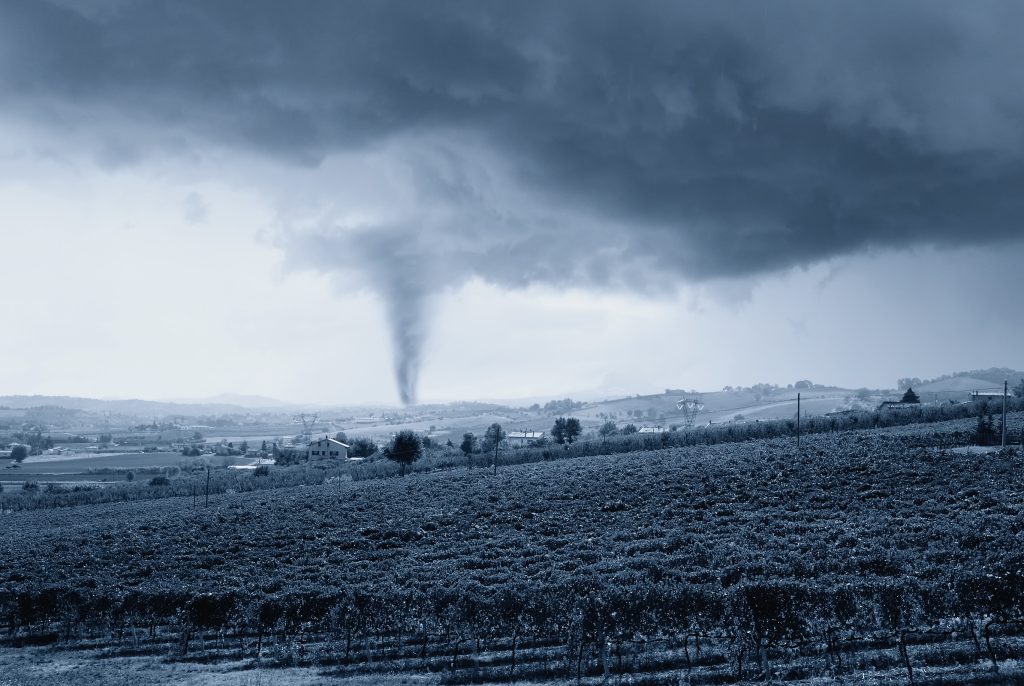
a nearby tornado from a vineyard

By: Trevor Troyer, 
Vice President 
Agricultural Risk Management, LLC

  Does crop insurance cover losses to my vines? What can I do about my vine loss? Half of my vineyard got burned down due to wildfires. I have major freeze damage on my Vitis vinifera my natives are fine though. What can you do? Crop insurance only covers losses to your grape crop not your vines. Is there any vine coverage or assistance for that?

  Yes there is! I get a lot of questions on this so thought to address it in this article.

  The Agricultural Act of 2014 (the 2014 Farm Bill) authorized the Tree Assistance Program (TAP) to provide financial assistance to qualifying orchardists and nursery tree growers to replant or rehabilitate eligible trees, bushes and vines damaged by natural disasters. – fsa.usda.gov. This is not administered through a crop insurance agent or agency. This is not an insurance product. It is disaster assistance administered through the USDA.

  There are limitations to this program on who can receive money. A lot of large vineyards will not be eligible. There is size limit of 1,000 acres. There is an income limit as well. In applying the limitation on average adjusted gross income (AGI), a person or legal entity is ineligible for payment under TAP if the AGI of the person or legal entity for the relevant tax years exceeds $900,000. – FSA Disaster Assistance Tree Assistance Program

Ok what is considered an eligible loss?

•    A requisite death loss must first be sustained; a stand of eligible trees, bushes, or vines must have suffered more than a 15 percent mortality loss (after normal mortality) due to a natural disaster;

•    Mortality loss on a stand of eligible trees, bushes, or vines is based on:

•    Each eligible disaster event, except for losses due to plant disease; and

•    For plant disease, the time period as determined by the FSA for which the stand is 
infected.

•    The loss must not have been preventable through reasonable and available measures;

•    The loss must be visible and obvious to the FSA representative; if the loss is no longer 
visible, FSA may accept other loss evidence and determine whether that other evidence 
substantiates that an eligible loss due to natural disaster occurred; and

•    FSA may require information from a qualified expert to determine extent of loss in the 
case of plant disease or insect infestation. – fsa.usda.gov 
Payments are calculated as follows: 
For tree, bush, or vine replacement, replanting and/or rehabilitation, the payment calculation is the lesser of the following:

•    65 percent of the actual cost of replanting, in
excess of 15 percent mortality (adjusted for normal mortality), and, where applicable, 50 percent of the actual cost of rehabilitation, in excess of 15 percent damage or mortality (adjusted for normal tree damage and normal mortality); or

•    The maximum eligible amount established for the practice by FSA. -fsa.usda.gov

  What you do as a farmer is important. Whether your grapes are going to make wine or juice it is something that feeds and nourishes us, both physically and spiritually. I sometimes hear from growers that they don’t want assistance whether it is crop insurance or disaster relief. I understand. Our farmers and ranchers are independent people that, most often, can handle what mother nature throws at them. Our tax dollars go into these USDA programs, to me, it’s alright to get help when needed. Why shouldn’t you get some of your tax dollars back to keep you growing. It might seem like a pain to fill in the applications etc. The FSA employees are dedicated to helping you. Take advantage of what is available, you paid for it.

  The Tree Assistance Program is administered through the USDA Farm Service Agency. To find your local FSA office, go to farmers.gov. You can also find more information at disaster.fsa.usda.gov.

Winery Owners Most Important Opportunity

Why So Many are Missing It

employee retention credit

By: Catherine Tindall

  The Employee Retention Tax Credit (ERTC) is one of the best ways for those in the beverage industry to regain their footing in a post-COVID age. Unfortunately, according to current estimates, many eligible businesses are missing out on this historic opportunity. For those who received or may otherwise be familiar with the Paycheck Protection Program, also known as the PPP, the concept is similar, but there are key differences that make the ERTC a much more generous program overall.  To understand why I will outline some of the key provisions and eligibility parameters, explain the process for claiming the credit, and answer some common questions I encounter in my own practice, such as “why haven’t I heard of this before?”

  The ERTC is a tax refund credit entitling employers to up to $26,000 per employee, depending on the number of quarters a business qualifies for. Eligibility is determined by either revenue disruptions or government orders on a quarterly basis. Many wineries are unaware that they are eligible for the ERTC due to the capacity and operation restrictions on their indoor dining and/or tasting rooms that occurred during the pandemic. Financial disruptions to that aspect of the business trigger ERTC eligibility for all the divisions of the winery, not just the restricted segment.  We routinely see businesses qualify for six or seven-figure credits under these parameters.

  There are a number of features that set this credit apart from other programs designed to aid businesses affected by the pandemic, like the PPP. Unlike the PPP, the credit itself comes back as paper checks from the IRS, and also unlike the PPP funds, which were restricted to certain uses, a business owner is free to use the ERTC however he or she sees fit. This is because the credit is actually a refund of wages and payroll taxes your organization has already paid. A consequence of this is that there is no overall program limit on the funds to be disbursed through the ERTC, in contrast to the PPP which had a limited fund pool. Businesses affected by government orders are entitled to every cent they qualify for. Taken together, all of these factors are what gives this program its power. The only limitation is time. This credit will begin to be phased out in April of 2023, meaning that business owners need to ensure they submit their claim as soon as possible. 

  Given the tremendous upsides, every business owner in the beverage space should try to see if their business qualifies, even if it seems doubtful. There is no need to become experts in the credit’s provisions, which can often be nuanced. The important thing is to find the right professional, and, to this point, one must be careful. There are unfortunately a lot of bad actors in this space looking to make a quick buck, and many of them are very good at seeming legitimate. 

  The following are some of the most asked questions associated with the ERTC.

  Should I get a second opinion? Because of the substantial nature of these credits, it’s often worth speaking to multiple providers for the credit to get a sense of the relative merits of each, and to look to the expertise and experience of those working on your case rather than fancy marketing or smooth sales tactics.

  Why haven’t I heard about this before? There are several reasons why many business owners have not heard of this important credit. One is that, in contrast to the PPP program, the ERTC has not been well advertised by the government (after all, since when did the IRS advertise refunds you’re entitled to). Another is that many tax practitioners are hesitant to pursue it given the sometimes complex nature of the claims if this isn’t their area of expertise. Finally, we commonly find that too many CPAs mistakenly believe that their clients do not qualify for the credit, and so never bring up the possibility of claiming it with them.

  I would encourage all winery owners to explore eligibility actively. The potential benefits of qualification, hundreds of thousands of dollars in obligation-free money from the IRS, is one of the highest value things you could do for your business in the current environment of economic uncertainty.

  There are certain pitfalls to avoid, such as dishonest companies operating in the space, but if you choose the right firm or professional to partner with, the process is remarkably painless. Just be mindful that this is an opportunity with a time limit attached. With less than a year before it begins to phase out, now is the time to claim the credit you’re entitled to.

About the Author

  Catherine Tindall is Partner & CPA, Dominion Enterprise Services (DES), a full-service CPA firm providing tax planning and consulting alongside specialty tax credit processing. The firm has more than 50 years of collective experience and recently announced the launch of its Employee Retention Tax Credit (ERC) Division to help restaurants assess their eligibility for the ERC and properly secure the maximum refund allowed. Learn more at https://dominiones.com

What Records Do You Need at the Time of a Claim?

By: Trevor Troyer, Vice President Agricultural Risk Management, LLC

So, you have opened up a claim in your vineyard due to freeze/frost damage. What’s next? When do you get paid? How much do you get? When is the adjuster going to come out? How does the claims process work? What do you need to provide to the adjuster that shows your loss?

  I wrote a month ago about when you should open up a claim. To summarize, you should open up a claim any time that you might have a loss. You should not wait to see if you have a loss but open the claim up right away. The loss has to be caused by an insurable trigger.

  The Causes of Loss per Grape crop provisions are:

1)   Adverse weather conditions;

2)   Fire, unless weeds and other forms of undergrowth have not been controlled or pruning debris has not been removed from the vineyard;

3)   Insects, except as excluded in 10(b)(1), but not damage due to insufficient or improper application of pest control measures;

4)   Plant disease, but not damage due to insufficient or improper application of disease control measures;

5)   Wildlife;

6)   Earthquake;

7)   Volcanic eruption; or

8)   Failure of irrigation water supply, if caused by an insured peril that occurs during the insurance period.

  Adverse weather conditions could be anything that could cause damage to your grapes. For example; drought, frost, freeze, excess moisture etc. Wildlife could be bird damage, deer etc. Fire would also include smoke taint as that is a result of a fire. Crop insurance does not cover, inability to sell your grapes because of a buyer’s refusal or contract breakage. It also doesn’t cover losses from boycotts or pandemics. Overspray or chemical damage from a neighboring farm is not covered either.

  An average of your historic production is being covered per acre per variety. You can cover 50% to 85% of your production average. Obviously, the premium for 50% is cheaper than the premium for 85%. If you chose 75% coverage then you have a 25% production deductible. If you have a 4 ton per acre average then you would be covered for 3 tons per acre. Your deductible would be 1 ton an acre. You would have to have a loss over 1 ton per acre to have a payable claim.

  At the time you sign up for crop insurance you report your past production per variety and vineyard location. We do not need any weigh tickets, pick records, or sales receipts from wineries at this time to verify your production. You will be asked to show this year crop year’s production records during a claim. The adjuster may want to verify past production records as well. It is important that when we set up your production database with your history that you have records to prove the data.

  Per the Common Crop Insurance Policy – Basic Provisions; Production record – A written record that documents your actual production reported on the production report. The record must be an acceptable verifiable record or an acceptable farm management record as authorized by FCIC procedures. FCIC is the Federal Crop Insurance Corporation.

  Here are some of the items that may be needed for a claim. A. Supporting Records Settlement sheets, sales receipts, machine harvest records, certified scale records, pick records and final or year-end statements from a winery, cannery or processor must indicate net paid tons of Grapes delivered by variety. Converting gallons of wine to tons of grapes does not qualify as acceptable records. – Crop Insurance Handbook (CIH) 2023. These records would also be needed to support your historical average.

  It is important to keep these items for the future as well. It is not enough that you have your tonnage written down. You need weigh tickets, receipts etc. These documents need to be verifiable, not in a spreadsheet on your desktop computer.

  It can get tricky if you are “vertically integrated” and grow grapes and make wine yourself. You might not have third party weigh tickets or sales receipts. Some wineries sell some of their grapes and make wine with the rest. Some of the records for the adjuster could be sales receipts and the rest would need to be certified scale weight records.

  The scale has to be certified though.

B. Certified Scale Weight Records  Certified scale weight records alone are considered to be acceptable production records, unless the CP requires a pre-harvest appraisal and/or records of sold production. Certified scale weight records must be legible and include all of the following to be acceptable.

1)   The insured’s name.

2)   The name of the crop.

3)   The date of harvest or the date weighed.

4)   The unit number or the location of the

      production.

5)   The practice, type, and crop year.

6)   The quantity/weighed production. For wineries that process their own grapes, the weight can be recorded on the form used for reporting to the Alcohol and Tobacco Tax and Trade Bureau. – Crop Insurance Handbook (CIH) 2023.

  There is a lot of information on what is an “acceptable verifiable record”, much more than I can put in one article. For the full information on what is acceptable you can look at the Crop Insurance Handbook, the Loss Adjustment Manual and the Grape Loss Adjustment Standards Handbook. You can find all of these at the USDA Risk Management Agency’s website at www.rma.usda.gov

  To run through the questions at the beginning. You have called your agent and opened up a claim. The adjuster will contact you in few days. They may want to see the damage right away or wait to see how much you harvested. I always recommend to vineyard owners to take pictures of the vineyard if the damage is visible. Once you harvest and production is verified by the adjuster, they will send the information in to be reviewed. Once approved you will be paid the difference of your guarantee (average of your historical production multiplied by your coverage level.)

  I cannot stress enough the importance of keeping good records.

When is the Correct Time to File for a Claim?

lone tree on a deserted area

By: Trevor Troyer, 
Vice President 
Agricultural Risk Management, LLC

When should I file for a claim? That’s a question I get a lot. Some growers think that they should wait until they know that they have a loss. They want to harvest to see if they have a loss. That is not the correct answer to me. You should turn in a claim as soon as there is a weather event or other cause of loss situation. This helps to document what is happening during your growing season as it unfolds.

  This spring in California there was a late frost/freeze event for several nights. Primary buds in many counties were killed. Some areas like Sonoma and Napa Counties had mild to moderate damage. Other counties in California had much worse damage. Oregon also had a lot of areas that were damaged. Some areas were quite severe with all the primaries frozen.

  Obviously if the buds were all frozen you should contact your crop insurance agent and have him open a claim up. But what about damage you are not sure about? You know that you will still make a crop but are not sure if it will reduce your tonnage by any large amount. Depending on your coverage level you may think that you won’t have a loss. At this point don’t worry about the deductible percentage of your crop insurance policy. Call your crop insurance agent and open up a claim.

  It is always better to have a claim open than not in this type of situation. There’s no way at this point in the season to determine how much your yield will be down. But if the claim is open and documented its better. This gives time to have an adjuster assigned, time to do an inspection and to document the damage. Damage done may not be as visible several months later. Damage can very well be cumulative as well. During the year you may have several weather events and other things that could reduce your yield.

  Here’s what it says in the Basic Provisions of the Common Crop Insurance Policy:

14. Duties in the Event of Damage, Loss, Abandonment, Destruction, or Alternative Use of Crop or Acreage

Your Duties -


(a) In the case of damage or loss of production or revenue to any insured crop, you must protect the crop from further damage by providing sufficient care.

(b) You must provide a notice of loss in accordance with this section. Notice provisions:

      (1) For a planted crop, when there is damage or loss of production, you must give us notice, by unit, within 72 hours of your initial discovery of damage or loss of production (but not later than 15 days after the end of the insurance period, even if you have not harvested the crop).

  Per the USDA Risk Management Agency you have from 72 hours of the original cause of loss or until you discovery it and up to 15 days after the end of insurance. I do not recommend waiting till 15 days after the insurance period. It does happen though and I am sure I will have growers do it again. I have had vineyard owners call me and say that their tons are down for a certain variety. Then we have to piece together what happened. What was the cause of loss? When was it? Was this the only thing or were there other weather events? Is the loss only showing up only on one variety?

  Losses will get paid but it is much easier on everyone if you report causes of loss right after they occur. That doesn’t mean you have to know for sure that you will have a loss, just that some event happened that may cause your crop to be reduced.

Here are the Causes of Loss out of the Grape Crop Provisions from the USDA RMA:

10. Causes of Loss.

(a) In accordance with the provisions of section 12 of the Basic Provisions, insurance is provided only against the following causes of loss that occurduring the insurance period:

(1) Adverse weather conditions;


(2) Fire, unless weeds and other forms of undergrowth have not been controlled or pruning debris has not been removed from the vineyard;


(3) Insects, except as excluded in 10(b)(1), but not damage due to insufficient or improper application of pest control measures;


(4) Plant disease, but not damage due to insufficient or improper application of disease control measures;


(5) Wildlife;


(6) Earthquake;


(7) Volcanic eruption; or


(8) Failure of irrigation water supply, if caused by an insured peril that occurs during the insurance period.

(b) In addition to the causes of loss excluded in section 12 (Causes of Loss) of the Basic Provisions, we will not insure against damage or loss of production due to:

(1) Phylloxera, regardless of cause; or


(2) Inability to market the grapes for any reason other than actual physical damage from an insurable cause specified in this section. For example, we will not pay you an indemnity if you are unable to market due to quarantine, boycott, or refusal of any person to accept production.

  Number 1 on the list is Adverse weather conditions. This could be just about anything, frost, freeze, drought, excess moisture, hail etc. Fire is listed as well and because of this there can be damage many miles away from the fire due to smoke. Insect and disease damage are covered but you must show that you have application records for spraying etc. Wildlife is another one that can cause problems – deer, raccoons, birds and so on. I have even had a claim turned in for a bear. Earthquake and Volcanic Eruption I have never seen a claim turned in for. I am sure, unfortunately, that there will be one for an earthquake. Number 8, Failure of irrigation water supply, is something that can be a big problem for growers. Certain areas in California and Washington State rely heavily on irrigation. If there is a drought and your well or reservoir dries up then that is a payable cause of loss.

  Don’t wait to contact your agent about a situation or adverse weather that may reduce your crop. That is what we are here for! For more information please contact Agricultural Risk Management LLC.

Office: (239) 789-4743

Email: info@agriskmgmt.com

Website: www.agriskmgmt.com