Update on Grapevine Leafroll and Red Blotch Viruses

By: Judit Monis, Ph.D.

As the fall season approaches, symptoms of virus infection become more pronounced in the vineyards.  Arguably, leafroll and red blotch are the most notorious and important viral diseases that manifest in late summer and the fall season.  Often, it is difficult to distinguish leafroll from red blotch disease symptoms in the vineyard.  This is especially true on red-fruited grapevine varieties.  In this article I will summarize and update information on the biology, symptoms, and transmission of the viruses responsible for these important diseases.  

The Viruses Responsible for Leafroll and Red Blotch Diseases

  There are four different virus species associated with grapevine leafroll disease.   The viruses belong to one taxonomic family (Closteroviridae) and are named Grapevine leafroll associated virus followed by a number (GLRaV-1 to -4).  Because it has not been possible – to date – to complete Koch’s postulates with GLRaVs, the word “associated” is added to the virus name.  With the exception of Grapevine fanleaf and red blotch, Koch’s postulates have not been completed with most of the disease-causing grapevine viruses.   The postulates state that a pathogen must be isolated in pure form from a diseased plant, later the pathogen (virus in this case) is introduced to a healthy plant, and the newly infected plant must show the same symptoms as the original infected one.  Clearly Koch’s postulates are important because they prove the cause and effect of a pathogen causing disease.  As I will describe below, researchers can tweak the definition of Koch’s postulates to prove that a virus causes a specific disease and drop the word “associated” from a particular virus name.   Within the Closteroviridae family, species of GLRaV are classified in three genera, Ampelovirus, Closterovirus, and Velarivirus. Grapevine leafroll associated virus -1, GLRaV-3, and GLRaV-4 belong to the Ampelovirus genus.  Grapevine leafroll associated virus -2 is a Closterovirus and GLRaV-7 is a member of the Velarivirus genus.  Some researchers claim that GLRaV-7 should not be considered a leafroll virus.   Recent research has shown that GLRaV-7 was isolated from a mixed leafroll infected vine and symptoms may have been due to the other leafroll virus present in the vine.  When found in single infections, GLRaV-7 does not appear to show typical leafroll symptoms.

  Grapevine red blotch virus (GRBV) is the second virus species discovered in grapevines that carries DNA instead of RNA as its genetic material.  Both its molecular and structural characterization has placed GRBV in a new genus, named Grablovirus, within the Geminiviridae family.   As stated above, it has been difficult to demonstrate Koch’s postulates, with grapevine-infecting viruses. There are many reasons for this.  Mainly, there are not many alternative hosts that are susceptible to most grapevine infecting viruses.  But most importantly, grapevine viruses cannot be mechanically transmitted onto grapevines.  These viruses need to be introduced to a vine via grafting (graft-transmission) and/or need a biological vector for successful transmission.   Dr. Marc Fuchs team at Cornell University was able to demonstrate that GRBV genetic material is responsible for red blotch foliar symptoms in red fruited grapevine varieties.  The work was done using sophisticated recombinant DNA technology to introduce the virus genetic material into tissue cultured grapevine plants.   Time will tell, after the plants grow, if the infected vines also display the detrimental effect of the virus in organoleptic qualities of the fruit (i.e., reduction of sugar).

close up of a grape tree
A close up view of a vine infected with Grapevine Leafroll associated virus-3 and Grapevine red blotch virus

Leafroll and Red Blotch Symptoms are Similar

  Vines infected with leafroll viruses produce smaller grape clusters that ripen unevenly with lower sugar content. Foliar symptoms include downward rolling, reddening or yellowing of leaves depending on the grapevine variety. Other foliar colors associated with leafroll virus infection include pink, purple, and orange speckles. The leaf veins may remain green or take many other colors (yellow, purple, or red). Grapevine red blotch virus infection displays different leaf discoloration which usually appear spotty or blotchy.  However, these symptoms are indistinguishable from leafroll, especially when rolling of leaves are absent in GLRaV- infected vines.  In red fruited varieties, GRBV infected vines can display red veins, but red veins have also been observed in non-infected vines, and many red-blotch infected vines do not display red veins.   In my opinion, red vein symptoms cannot be used as a diagnostic tool.   In white-fruited varieties red blotch disease displays yellow blotchy discoloration in leaves. While the symptoms of leafroll and red blotch can be confused, these diseases are caused by different types of viruses that can often be found in mixed infections, complicating the visual diagnosis.  Although, the change in colors of the leaves in the fall is a tale-tell of virus infection, the most important negative effect of both GLRaV and GRBV infection is the reduction of sugar in fruit resulting in reduced Brix values and delayed fruit maturity.

red veins in leaves
Symptoms of Grapevine red blotch virus – NOTE the red veins in the leaves

  Some GLRaVs and their strains are more aggressive than others.  Researchers have described the Alfie (Australia and New Zealand), BD (Italy), and Red Globe (U.S.A) strains of GLRaV-2. These strains are molecularly similar and have been associated with graft incompatibility, vine decline and death.  Some researchers report that GLRaV-1 and -3 induce more severe symptoms than GLRaV-4.  However, symptoms vary depending on the grape variety, rootstock, and climatic conditions.  At the moment, two different clades of GRBV have been reported but no differences in their biology or effect on symptoms in the vineyards have been observed so far.  Just as seen with leafroll, the symptom expression of GRBV infected vines is affected by climatic conditions and the author has noted differences in the effect on sugar reduction in sunnier and warmer areas (i.e., California coastal areas with more fog and lower sunshine yield fruit with lower sugar concentration than the same grape clones grown inland with more sun exposure).

Transmission and Spread of the Viruses

  Ampeloviruses (GLRaV-1, -3 and -4) are transmitted by sap-sucking insects (mealybugs and soft scale insects) in a non-specific manner.  This means, different mealybug and soft scale insect species are able to transmit any leafroll virus in the Ampelovirus genus.  Research has shown that the citrus (Planococcus citri), grape (Pseudococcus maritimus), long-tailed (Pseudococcus longispinus), obscure (Pseudococcus viburni) and vine (Planococcus ficus) mealybugs as well as the soft scale insects Pulvinaria vitis and Ceroplastes rusci are able to transmit GLRaVs. Mealybugs and soft scale insects feed on the vine’s sap by inserting their sucking mouthparts into the plant’s vascular system (phloem). The honeydew excreted during the feeding process attracts ants that nurse and aid mealybugs to be transported to different positions of the vine or a different vine in the row.  Mealybugs may be difficult to observe as they can hide beneath the bark.  In these cases, ant activity and the presence of sooty mold (a fungus) are good indicators of the presence of mealybug vectors in the vineyard.  No insects able to transmit GLRaV-2 or GLRaV -7 have been reported to date and their propagation (just like all other GLRaVs) is performed by humans who produce, graft, and distribute cuttings from infected vines.  

Work by researchers at Cornell University and the University of California reported that the three-cornered alfalfa hopper (Spissistilus festinus) can transmit the GRBV in greenhouse and laboratory conditions.  Although, the three-cornered alfalfa hopper has been found in vineyard blocks where red blotch disease has spread, transmission experiments in the field have not been completed to date.   It is interesting that grapevine is not the preferred host for Spissistilus festinus that prefers to feed on legumes, grasses, and shrubs.  Furthermore, the insect is not able to complete its reproductive cycle in grapevines.  While research continues to determine if other vectors are capable of transmitting GRBV it is clear that the rapid expansion of this virus in vineyards was due to propagation and grafting of cuttings from infected vines.  This also explains the arrival of GRBV to many countries in Asia, Europe, and South America where GRBV had not been previously reported.   In summary, both, GLRaVs and GRBV are graft transmissible and predominantly propagated by producing cuttings of infected rootstock and scion material. 

Diagnosis and Status of Foundation Plant Material

  The distribution and concentration (titer) of leafroll and red blotch viruses is different in infected plant material.  While leafroll detection appears to be seasonal (best detected late in the growing season), detection of red blotch virus can be performed any time of the year.   Further, work performed in my lab showed that red blotch virus can be detected in high titers in any part of the vine.  The work showed that red blotch virus can be detected in any tissue tested, new or mature leaves, petioles, green or lignified canes, as well as cordons and trunks.  In contrast, leafroll viruses are generally found in low concentrations and are best detected in mature leaves, canes, cordon, and trunk.  If a vine has been infected through cuttings, the older the plant material is, the easier it is to detect GLRaVs.  

  Keeping both leafroll and red blotch viruses out of the productive vineyards relies on clean planting stock programs.  Sadly, a few years ago the University of California at Davis Foundation Plant Services (FPS) scientists announced the finding of a few vines infected with GRBV in the Russell Ranch foundation block. The block was planted with vines produced with a tissue culture technique that is capable of eliminating potential harmful viruses.  The block was tested using the “Protocol 2010” that includes a list of viruses that are harmful to grapevines.  Initially, four vines were found to be infected with GRBV in 2017, in 2018 the number increased to 24 vines.  In 2019 the positive results were over 300 vines, while the results from 2020 testing showed that 788 are infected with GRBV. Consequently, FPS suspended the sale of vines from the Russell Ranch block until further notice.  To learn more about GRBV epidemiology, the GRBV-infected Russell Ranch block will be used as a research block to study the transmission and spread of the virus.  

Conclusions

  This author has been involved in applied research with the goal to determine the ideal process to protect clean planting grapevine stock and newly planted vineyards from infection of viruses and fungal pathogens.  Presently, information on what is the distance needed at the foundation and nursery blocks to avoid infection from diseased blocks is lacking. The results of the research will develop the best strategy to isolate and monitor clean planting stock.  Until we have this information my recommendation is that nurseries and growers determine the health status of grapevine stock prior to planting to avoid the propagation and/or introduction diseased vines to the vineyard.  Yet, it is very important to isolate and monitor newly planted vineyards to avoid the introduction of disease via insect vectors.  It is important to remember that lack of symptoms does not always correlate with a healthy diagnostic result (rootstock varieties as well as non-grafted vines are usually asymptomatic), so it is best to test a statistical sample of the nursery propagated material to be sure of its health status.

Judit Monis, Ph.D. is the Global Plant Pathology Director at Ball Horticultural Company.
The Vineyard Stewards’ Stewards

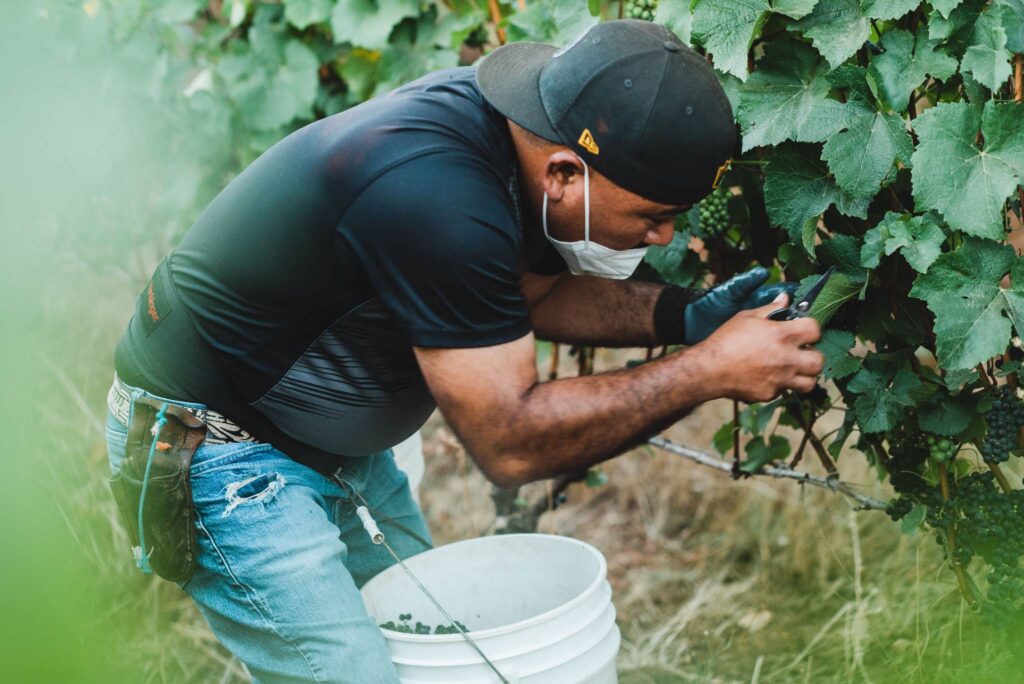
vineyard staff cutting leaves

By: Neal D. Hulkower

Two were born in Mexico and one in the US to parents from Oaxaca. Each had carved a path to success in Oregon’s wine industry and wanted to pay it forward by easing the way for those at the beginning of the winemaking process, the vineyard steward.  An association they created not that long ago has been fulfilling their vision.

The Trio of Founders 

  After obtaining a degree in Computer Systems Engineering in Chihuahua, Mexico, in 2002, Jesús Guillén came to the United States to learn English.  His father, Jesús senior, who then as now was managing the vineyards at White Rose Estate in Dayton, Oregon, put him to work. Blossoming under the guidance of mentors including White Rose’s owner Greg Sanders, consulting winemaker Mark Vlossak, who also owns St Innocent, and the late Gary Andrus, the younger Guillén quickly moved from the fields to the cellar. In 2008, he became the first Mexican head winemaker in Oregon. He also started his own brand, Guillén Family Wines.

  Mexico City native Sofía Torres McKay was working in the technology field when she met her husband, Ryan, in San Francisco in 2001.  After they married in 2005, they acquired 10-acres in the Dundee Hills American Viticultural Area and planted Cramoisi Vineyard. They bottle estate Pinot Noir, red and rosé, and Chardonnay under the Cramoisi label.

  Native Oregonian Miguel Lopez was born to immigrants from Oaxaca and raised in wine country. His resume includes positions at several wineries and a distributor.  He now dedicates his time to Red Dirt Vineyard Management and Winemaking, a venture he started with his sister, Eva Lopez, in 2018.

From Idea to Reality

  That same year, Guillén, Torres McKay, and Lopez went public with their plans to form an organization named the Asociación Hispana de la Industria del Vino en Oregon y Comunidad or AHIVOY (ahivoyoregon.org), which is Spanish for “there I go”.   Tragically, Guillén died at age 38 on November 5, 2018, after a short battle with an aggressive form of cancer.  His widow, Yuliana Cisneros-Guillén, took his place with the other founders and also maintains the family’s label.  She promotes the importance of those the group is dedicated to supporting: “AHÍVOY vineyard stewards are tending the vineyards that capture our Oregon wine region in every wine that is being produced.”

  The association adopted an ambitious and sharply focused mission statement: “AHIVOY strengthens the Oregon wine community by empowering Vineyard Stewards through education.” It collaborated with Chemeketa Community College’s Wine Studies program at the Eola campus in Salem to develop the Wine Industry Professional Training Program tailored to the constraints of full-time vineyard workers.  AHIVOY held its first public event in November 2019 to raise funds for this project and to announce that it had begun selecting members of the first cohort. The Oregon wine industry and supporters quickly rallied to the nascent organization. A major boost came from The Erath Family Foundation which covered the expenses for all students in the inaugural class.

The First Cohorts

  On January 15, 2020, a small group of vineyard stewards gathered in a Chemeketa classroom for the first time to expand their view of the wine industry.  Over the two 10-week terms, topics covered the entire process from vineyard to glass, incorporating the details of grape growing and vinification as well as tasting and marketing the final product. Along with the rest of the world, the program came to a sudden halt on March 13, one week shy of the end of the first term.

  During the forced hiatus, the now tax-exempt association, with officers, a volunteer board, and committee structure in place, continued to raise funds for a second cohort and to recruit students.  They successfully accumulated enough to fund the second cohort which started on January 13, 2021, one day after the first cohort returned to class.

On a cloudless March 3, 2021, the dream of the three founders commenced dreams coming true for eight men, the first to complete the program. The second cohort comprised of four women and six men celebrated its graduation on April 27.

Reactions, Initial Impact, and Follow On

  Jessica Sandrock, a member of the AHIVOY education committee and coordinator of programs and grants, was instrumental in designing the English-language curriculum for the program. She collected and shared feedback from students in both cohorts and their employers. “Overall, the reaction to the program has been really positive,” said Sandrock.   She added that, not surprisingly, the students overwhelmingly liked gaining more advanced technical knowledge on vineyard management.

  One wrote: “Vineyard management classes are very good. [It was c]hallenging and I learned new things that I am using at work already.” But as they got into winemaking topics, they got interested in those. One student in the first cohort is pursuing winemaking and his own label. Another valued “learning more about all of the things that go into growing grapes and making wine. I will use all of this in my work.”  Most enjoyed visiting different vineyards and wineries, learning different ways to train the vines and the work of the winery.  Three members of the second cohort really appreciated the WSET Level 1 training and certification which was added this year and will pursue the higher levels. Several plan to continue their education by taking classes to deepen their knowledge of vineyard management, to study enology, to learn English, or to get a General Educational Development (GED) certificate. The respondents unanimously plan to recommend the program to other vineyard stewards.

  Employer reaction was also strongly positive. All agreed that “the vineyard steward [is] showing increased eagerness to learn” while 80% affirmed that “the vineyard steward [is] demonstrating more versatility.”

  Jesse Lange of Lange Winery wrote “We’ve been fortunate to have two, very valued and experienced, employees participate in the AHIVOY program for each of the two years the program has been available.

  “Continuing education has a holistic [effect] on any student- one that has the potential to positively permeate many aspects of job performance. We’ve seen that [to] be the case here at Lange Estate- from the viticulture, wine-production, and even sales and marketing. Both Benjamin and Enrique have shown higher levels of enthusiasm, deeper levels of questioning, and general happiness with the opportunity to expand a knowledge base and skill set. Also, the chance to learn amongst peers allows for interactions that can [be] cohesive and collaborative- especially coming out of the pandemic. All of this is healthy indeed!  “We would definitely recommend this program to other folks in the industry- no doubt!”

  Sam Stetser of Atlas Vineyard Management sent one of his employees to the second cohort: “The great thing about AHIVOY is both myself and Roman were on board with doing it, it wouldn’t work if that wasn’t the case.” He hopes to “to transition Roman into a management role with more responsibility.”

  Sandrock said that they will track graduates and are trying formal and informal ways to keep them connected to the association as ambassadors or board members. She also stated that AHIVOY is working with Oregon State University to support graduates interested in pursuing a bachelor’s degree.  This can be an attractive option since the graduates accrued continuing education credits that can be used to place out of the 3 introductory courses at Chemeketa in its Wine Studies Program whose credits, in turn, readily transfer to OSU.  More immediate opportunities are with the OSU extension.  Discussions are underway with Prof. Patricia Skinkis, Viticulture Extension Specialist, about specific topics she can support such as pest management.

The Future

  Thus far, AHIVOY’s reach has only extended to the Willamette Valley, and mostly the north at that, but there has been outreach to Southern Oregon and The Rocks District.  But more involvement is needed to spread the word and do all of the other critical functions of the growing organization.

  Resources for the 2022 class have been secured and applications for membership in the third cohort are being accepted through November 15, 2021. Classes are scheduled from January 5 to April 27, 2022 on Wednesday from 9 am to 3 pm. In the meantime, fundraising continues to ensure classes can continue beyond next year and perhaps even expand to include larger numbers of students.

  In less than 3 years, the vision of the founding trio has taken hold, gathering widening support from an industry known for collaboration and concern for all of its members.  With momentum building, AHIVOY looks to be as successful as ¡Salud!, the organization that has been providing medical services to Oregon vineyard workers and their family for over 25 years.  While ¡Salud! maintains the health of the vineyard stewards, AHIVOY enriches their intellect and feeds their curiosity. As founder Torres McKay asserts: “The more we empower vineyard stewards through education, [the more] we will become the best wine growing community, making the best wines in the world.”

Balancing Budgets As Tasting Rooms Re-Open

By: Susan DeMatei

We’ve been waiting, and it’s finally here – tasting rooms can finally open for many of us. But 2021 began as 2020 ended, with much uncertainty as to when a significant revenue driver – tasting rooms — will open. And when they do open, how quickly will customers feel comfortable enough to visit in pre-COVID numbers?

  In the meantime, eCommerce and club sales are still growing exponentially. Please don’t walk away from this new channel but continue to invest in it.

  To take full advantage of all that you’ve achieved while your tasting rooms were closed, wineries should continue to use part of their tasting room marketing budgets to augment brand awareness, virtual experiences, and eCommerce marketing in the online space.

How Much?

  According to a survey done by cmosurvey.org last year, most companies budget between 6.5% and 10% of their revenue to marketing, making up about 12% of their total operating budget. In June of 2020, they revisited this survey to evaluate the impact of COVID. It showed that the 8.6% average marketing had jumped to 11.4%, reflecting the focus on maintaining brand awareness and retaining customers. (This figure fluctuates between B2C and B2B and by category, with consumer marketing in the service are being the highest. Wine would fall under consumer package goods at 9.1% in the survey.

graph showing marketing spending as percent of company revenues by industry

  Ok, so if your revenue goal is $1,000,000, you should expect to spend roughly $91,000 on marketing. But this is the entire category, including headcount. Plus, companies are not consistent with what they consider marketing. So, how do we break this down?

  You can find research like this CMO survey online from firms like Gartner, Forrester Research, and eMarketer, which poll various titles and industries to find averages. In general:

•    Roughly 26% of budgets are allocated to technology (platforms, CRM, Mailchimp, etc.)

•    16% of budgets are spent not selling but improving customer’s experience, either virtually or in person. This is expected to increase to 20.6% in the next three years.

•    Depending on the study you look at, anywhere from 26-62% of marketing budgets are dedicated to online channels, with search engine marketing (Google ads) being the largest share of that followed by social media advertising (which has increased 17% in the last five years)

•    And it is noted that while it doesn’t cost a lot, email marketing is the winner of the ROI question in every study.

  This chart, also from cmosurvey.org, shows how companies are shifting to digital growth and away from traditional (print and broadcast) channels. Since 2012, investment in conventional media has dropped by single digits, while investment in digital channels has increased by double digits.

changes in traditional vs digital marketing spend

But What About My Budget:

  It takes some math to calculate how much you should spend on digital media.

1.    First, look broadly over your eCommerce data in Google Analytics. Look at acquisition data to understand what is working best to drive traffic to your website. If you know-how, set up a funnel to your shopping cart so you can look at what is driving sales.

2.    Additionally, look at platforms you might not be using, but can quickly get your boss the data to support their value online, i.e., Google Search or Display ads.

3.    Decide your geo-targeting and geolocation. Costs per platform vary dependent on the specificity of your targeting and geolocation – gender, age, interest, occupation, education, geography.

4.    Project your return on investment based on your average click-through rate, conversion rate, and order value.


lead gen "join the mailing list" campaign

For example, we are running “sign up for the mailing list” ads on Facebook for this client. Based on our averages, we know that if we spend $175 in a month, we’ll reach out to 2500 targets and see a 2.8% conversion rate to add 70 names to the list.

By tracking our signups, we also know that it takes about 2-4 emails and 90 days for them to buys something. We also know that our conversion rate is 5%, and our average order value is $200. We can project 14 orders by month four with a return of $2800 (and a spend of $700). Plus, over time, the list and sales should grow exponentially.

table showing conversion sample

Conclusion

  Whether your tasting room is open or not, the future is digital, even for those wineries with an established local customer base.

  Some of the best practices of wineries successfully driving significant revenue online are:

•    Lead generation focus and follow up with personalized communication.

•    Analyze your data to map the customer journey for every new customer.

•    Use video to get attention.

•    Promote events and experiences (IRL or virtual) digitally to draw in new customers both locally and, more importantly, from broader geographic locations.

  So, put your tasting room budgets and efforts to good use this spring. But don’t forget about all you’ve achieved with your digital tests over the past year. Leverage the online investment and continue to nurture all channels, regardless of your tasting room opening.

Messina Hof Winery: Tapping Into Keg Wine

wine cellar in a winery
Photo Courtesy of Messina Hof

By: Nan McCreary

One of the hottest trends in the wine industry today is wines on tap. Far from its inauspicious beginnings in the 1970s when haphazard equipment and practices marked the keg wine debut, drinking wine on tap is now a totally different story. Dramatic improvement in equipment and a better understanding of operations have led to a boom in the market. Many bars, restaurants, and wineries now offer premium tapped wines by the glass and even the growler.

  One enthusiastic advocate of wine-on-tap is Paul M. Bonarrigo, CEO and winemaker at Messina Hof Winery, a pioneer in Texas wine and one of the oldest and the most awarded wineries in the state.

  “We’ve always kept our finger on the pulse of what’s happening nationally, and we saw that the trend of wine-on-tap was coming back,” Bonarrigo told The Grapevine Magazine. “In 2013, we decided to build a prototype at our Estate Winery in Bryan, which allowed us to learn the system and do small-batch kegging and get feedback from customers.” 

  The introduction was extraordinarily successful, Bonarrigo said, so Messina Hof started branching off into bars and restaurants. Today, the winery has wine on tap at all of its four winery locations: Nine in Bryan, four in the Hill Country, 18 in Grapevine and 24 at its newest location, Harvest Green Winery & Kitchen in Richmond, near Houston.

  For Bonarrigo and a host of wineries, bars and restaurants, wine-on-tap is the future. In a wine-on-tap system, wine is pushed out of stainless steel kegs and into plastic tap lines with inert gas, either argon or nitrogen or a blend of nitrogen and C02. Using stainless steel containers and inert gas prevents oxygen from getting into the system, maintaining the wine’s freshness. Tap wine is typically stored in 20-liter kegs, which yield 26.6 bottles of wine or 120 glasses. The wine will stay fresh for months — the last tap will be just as clean and bright as the first.

  “For the bar or restaurant, it’s a huge savings,” Bonarrigo said. “No matter how efficient you are, you will always have product go down the drain with bottles, whether it’s from oxidation or just a spoiled wine.”

  The retailer also saves costs related to bottles, corks and packaging that is no longer needed. Keg wine prices range from $150 to $250, which makes them cost-effective. Some experts say that keg wine saves about 50 cents a bottle or $6 a case. Keg wine is eco-friendly too. Kegs are reusable, reduce waste generated by commercial packaging, save trash from landfills and reduce an establishment’s overall carbon footprint. Over its lifespan, a keg will replace one ton of bottles.

  For the consumer, wine-on-tap offers guaranteed freshness in the product, plus more options to try a variety of wines. “We are now seeing more premium wines on tap,” Bonarrigo told The Grapevine Magazine. “When we first started, many wineries were selling house wines from the keg. Now we’re seeing wines at $12 to $15 a glass on tap.”

  Consumers also see more options in serving sizes, from small taste-size pours to liter-sized carafe servings. According to Bonarrigo, the most popular option at Messina Hof is wines by the growler, which customers can fill and bring back over and over again. “We sell a ton of growlers,” he said. “The growler concept drives the train on what kind of wines we keep on tap, which are wines that are very approachable and easy to drink, wines that people can enjoy with an everyday dinner.”

  Typically, kegs are for wines meant to be enjoyed young, which is 75% of the wines sold in America. Both red and white wines are available, although red wines may be barrel-aged before transferred to a keg. At their Harvest Green location, which features a restaurant, Messina Hof serves 12 products from 24 taps, including dry to sweet white and red wines and even a Port.

  “Harvest Green is a fun environment,” Bonarrigo said, “and people are just coming out to have a good time, so we sell more tap wines there than at our other locations.”

  Occasionally, Bonarrigo changes out wines, depending on what the vintage yields and how the wines are moving. If it’s a “hot mover,” he will keep it on tap. He also offers “niche” wines occasionally. For example, he’s now adding a Rosé wine, which will be on tap during the spring and summer season.

  The biggest challenge to keg wine, according to Bonarrigo, is ensuring the kegs are clean before refilling. “Optimally, we deplete and refill kegs every six months,” he said. “Anytime you keep wine for an extended amount of time, you could get spoilage without even realizing it. You could also get some oxygen seepage. I especially worry about my white wines, and I tap them often to make sure they’re still fresh.”

  While these keg systems are not difficult to clean — the operator uses the gases and pressure to run hot water and a chemical solution through the system — it’s important to be vigilant. If the tap lines are not cleaned properly, it can cause off-flavors and a diminished experience for the guest.

  Messina Hof’s tap systems vary by location, and with the recent opening of Harvest Green, the winery was able to take advantage of the newest advances in this rapidly developing technology. In this system, lines go through cold plates to cool the wines as it goes to the tap, offering more convenience than set-ups that require pre-chilling of the wine. In other words, the wine goes in warm and comes out cold. 

  “This system is easier to set up and manage,” Bonarrigo said. “When the keg is empty, we just put another keg on the line rather than have to wait to chill a new keg. This way, you always know what you’ve got, and it’s easy to switch kegs in mid-service.” 

  Bonarrigo also installed a nitrogen generator at the Harvest Green location. “It’s more expensive,” he said, “but we don’t have to manage nitrogen tanks. Plus, nitrogen does just as good a job as argon.”

  Occasionally, Bonarrigo will use a Guinness Blend — 75% nitrogen and 25% CO2.  “This is fun to do with wines like Moscato. It gives them a spritz of effervescence without carbonating it.”

  He has yet to try sparkling wine on tap since they require a dedicated system that uses 100% CO2 to preserve the kegs in the fizz.

  With the increasing popularity of wine-on-tap, many bars and restaurants are adding more wine taps to their handles. Some are even retrofitting existing beer taps into wine taps. Wine taps require a higher grade of stainless steel and special tubing—and use different gasses — but they are still a viable option that can reflect an establishment’s business goals.“

  It’s a very smart strategy for bars and restaurants, especially if they already have a tap for beer, to convert one or two of their handles to wine,” Bonarrigo said. “In the long term, this is going to be something that sticks. As logistics get better and keg wine gets easier to manage, wine-on-tap will continue to be a big trend.”

  Clearly, wine-on-tap is here to stay. Sure, you won’t be seeing a Grand Cru Burgundy wine or a First Growth Bordeaux on tap. And you may lament the ritual where a sommelier opens a bottle at your table and invites you to sniff the cork. But as wine-on-tap becomes more fashionable, the choices in your glass will follow. For the oenophile with an open mind, it’s an exciting time to be exploring the world of wine.

How Does Your Safety Program “PAIR” With Your Workers?

repairman at maintenance work

By: Michael Harding, Senior Risk Solution Specialist, Markel Specialty

With the intensity of the wine season gearing up and peak times just around the corner, how prepared are you to protect the health and safety of your workers? Protecting your employees is crucial to attaining your orchard and vineyard goals and having a successful operation. Having a solid and functioning safety plan in force results in better productivity, enables your workers to thrive and contribute to the performance of your business.  A good safety program is a win –win for everyone!

  Regardless of the size of your operation, it is your responsibility as an employer, to have a safety program in place.  Depending on the size of your operation, your safety program may be informal or it may need to be more formal in nature – every winery is different. You’ll obviously want to abide by any government safety regulations that apply but there are also several safety management practices that will help you better demonstrate your commitment to safety, provide a safer working environment for your workers and yield you more efficiencies within your business. 

  It is not uncommon for a winery to produce a safety manual from an online template, issue it to their workers, briefly review it during a new employee training session and in turn, believe they have an effective safety program. Even though doing this is important, there are additional ways to visibly support your safety program to the point where it actually becomes “operationalized” into your day-to-day activities.  Outlined below you will find some of the ways we have found to be very effective to visibly demonstrate your support of your safety program.

Effective Ways to Promote a Safety Program at a Winery Safety Policy and Program

1.  Draft a safety policy statement and sign it, better yet, have all of your supervisors sign it too.

2.  Make sure that your workers receive this policy statement either through an employee handbook, an employee bulletin board posting or through new employee orientations and meetings.

3.  Safety responsibilities should be formally assigned to a single individual to coordinate safety compliance efforts, accident investigation, and emergency procedures.

4.  Verify that appropriate safety responsibilities are also defined for everyone else.

5.  Work with either your insurance carrier or your insurance broker to establish an internal claims cost containment or return to work policy to reduce post-accident injury expenses.

6.  Hold supervisors accountable in annual performance reviews in part for safety objectives and/or the accident results of their workers.

Safety Rules and Standards

1.  Workers need to know how to safely do their job by having general work procedures and safety rules developed for your winery operation. High risk procedures like confined space entry, lockout / tagout, any work at heights, etc., need to be in writing.

2.  Safety rules are as important as any other part of your business. Write them so they are simple and easy to understand. Distribute them to all workers and have them sign an acknowledgment of understanding. Also post them in a common area as a reminder to everyone.

3.  Have a disciplinary system in place to deal with any safety rule violations.

4.  Develop a plan for winery emergencies like natural disasters and fires to make sure your workers know how to effectively respond in emergency situations.

Safety Training

1.  Make sure you have a safety orientation plan in place. Complete the orientation before workers begin a new job. Workers need hands on job training.

2.  Train your supervisory personnel so they can conduct safety inspections related to workplace safety hazards or applicable regulations in their area on a regular basis.

3.  Review your winery operations to determine the safety training needs for all work areas. This would include areas such as: emergency response to fire or injury, confined space, electrical safety, handling of chemicals, fall prevention and wearing of personal protective equipment, just to mention a few.

4.  Supervisory safety training sessions should be held regularly, addressing the following: accident investigation, conducting safety talks, understanding workers compensation, complying with government safety regulations, completing safety inspections, and controlling employee accident costs, as needed.

Safety Inspections

1.  Formal safety inspections should be conducted regularly by supervisors or other management staff. Document the results of these inspections.

2.  On a daily basis, supervisors should routinely conduct informal safety inspections with any negative findings documented and corrected.

3.  Consider developing customized safety inspection checklists for each area to ensure your inspections are thorough and consistent.

4.  Have a follow-up system in place to make sure that systematic corrective action is being taken on the deficiencies noted during safety inspections.

5.  Regularly update your safety inspection procedures and checklists by utilizing information generated in accident investigation reports so you can prevent recurring incidents.

Accident Investigation

1.  Have a supervisor (of the employee) investigate all injuries requiring medical treatment along with any “near misses” to make sure they don’t happen again.

2.  Maintain accident statistics about injuries that occur in your winery operation and review them regularly in management staff meetings. An accident occurring within your facility should be considered a significant winery operational deficiency and you should appropriately take corrective measures for each one.

3.  Focus on fact finding, not fault finding to avoid attributing accident causes to employee carelessness or possible fraud on accident investigation reports. Identify the underlying root cause(s) for each accident.

4.  Have a first aid treatment procedure in place to help effectively reduce the severity of work-related injuries. You should include:

a)  A properly stocked first aid kit. The American Red Cross recommends: https://www.redcross.org/get-help/how-to-prepare-for-emergencies/anatomy-of-a-first-aid-kit.html

b)  Eye wash station(s). Grainger has an article describing where eye wash stations should be placed: https://www.grainger.com/content/qt-emergency-shower-eye-wash-stn-req-120

c) Employees trained / certified in first aid. First aid training is often available through local organizations such as the Red Cross, local fire departments, EMS, etc. Check your local area listings.

Personal Protective Equipment (PPE)

1.  Conduct a hazard assessment of your winery operations to determine any personal protective needs and requirements for your workers. Make sure appropriate PPE is readily available to all workers, they are trained in its use and they follow all established requirements.

2.  Hold your supervisory personnel responsible for enforcing the use of PPE devices. This would include such items as safety glasses, proper footwear, gloves, and hearing protection, etc.

3.  On a periodic basis, review accident and inspection reports to evaluate the use or need for any additional personal protective equipment devices.

Motivation

1.  Demonstrate safety is a priority at your winery by holding regular meetings with your workers and supervisors to talk about any safety concerns. Keep minutes of each of these meetings with what was talked about and who attended.

2.  Have an “alternative duty” transitional work program in place to encourage injured workers to remain on the job in restricted capacity.

3.  Consider having a constructive policy in place to address workers who have had two more injuries or property damage accidents during any twelve-month period of time.

4.  Establish ideas and plans to motivate all workers to follow existing safety policies/procedures in an effort to achieve specific safety goals through such methods as personal recognition, bonuses, awards, etc.

Mechanical Safeguards

1.  Survey any high accident areas, materials, processes or buildings annually if you are having occurrences to specifically evaluate the adequacy of your equipment safeguards and/or OSHA machinery guarding compliance.

2.  Identify and provide appropriate signage where guarding is required. Develop procedures when guards are required to be removed for service or maintenance.

3.  If protected by interlocks or safety switch, inspect these systems regularly to verify that they have not been disabled or bypassed.

General Operating Conditions

1.   Maintain good housekeeping practices in all of your working areas so as to reduce slip, trip and fall hazards.

2.   Prohibit the climbing on racks in any storage or warehousing operations. Provide and encourage the use of sound, sturdy ladders.

3.   If forklifts are used, provide required training to all operators. Order pickers, if used, must work from an approved platform and wear appropriate fall protection.

4.   Tractors, mowers and other power equipment should be provided with appropriate rollover protective devices (ROPS).

Vehicle Safety

1.   Motor vehicle records should be routinely obtained for all new drivers and updated annually.

2.   Motor vehicle records should be evaluated using a defined point system for all drivers on an annual basis.

3.   A record of training should be maintained on file for all personnel who have access to and operate vehicles, farm equipment, vans or other powered equipment during the course of their employment.

4.   Accident reporting kits should be kept in all vehicle glove compartments.

5.   Drivers should conduct vehicle inspections daily.

Conclusion

  At the end of the day, safety doesn’t need to be complicated. You can keep your program simple so that it meets the needs of your winery. Remember that:

•    Safety doesn’t happen without the person in charge and everyone else standing up and taking responsibility.

•    No one single person can be responsible for safety – more people making safety a priority correlated to fewer people being injured.

•    Stay with it – safety isn’t about written rules and handbooks, it’s about thinking about the potential dangers and what needs to be done to keep everyone safe.

By “pairing” these safety program components with what you and your workers do, you’ll be better prepared to meet the busy times ahead with safer and fewer injured employees. You, your employees and your business will all benefit!

  The information provided in this article is intended for general informational purposes only and should not be considered as all encompassing, or suitable for all situations, conditions, and environments.  Please contact us or your insurance professional if you have any questions. Products and services are offered through Markel Specialty, a business division of Markel Service Incorporated (national producer number 27585).  Policies are written by one or more Markel insurance companies. Terms and conditions for rate and coverage may vary.

For More Information Please Call Us At: 800-814-6773 Or Visit Our Website: markelinsurance.com/winery

Post-Pandemic: How Small Wineries & Vintners Can Get Back to Business, Better!

people toasting with wine glasses

By: Rod Hughes

Wildfires, faulty tanks, flooding, a pandemic, lockdowns, water shortages, tornados, tropical storms – the past two years have been, in a word, biblical in terms of challenges faced by vintners and winemakers.

  However, like the rest of the U.S. economy, there are signs of positivity on the horizon. Pandemic restrictions are loosening, and Americans seem eager to travel and resume their former leisure activities. This includes touring wineries as well as resuming their search for those great bottles to share with friends.

  This reality presents both opportunities and challenges to those in the winemaking industry.

  The challenges are not inconsequential: Northern California wineries faced savage wildfires in 2017, 2019 and 2020, leaving many around the country with the impression California wineries were irreparably harmed. In parts of Maryland, some wineries are still trying to put the pieces back together after Tropical Storm Isaias last summer. And let’s not forget the pandemic shutdowns, limited capacity re-openings and economic pain felt universally across all wineries. 

  However, the opportunities for those that made it through may be just as powerful.

EAST COAST SOLUTION

  One example is Old York Cellars Winery in Ringoes, New Jersey. Shutdown in March 2020 like much of the country due to COVID-19, owner David Wolin — a former attorney — gathered his staff and brainstormed.  (Photo: David is 3rd on the left)

  “We knew what we couldn’t do, and it was a lot,” Wolin explained. “The question was what could we do in this new environment?”

  Wolin and his team quickly turned to one of the major challenges for independent wineries: direct shipping to consumers.

  Winery direct-to-consumer shipping is legal in 47 U.S. states, each of which regulates its own system. Regulations, taxes and various packaging requirements can vary. However, Wolin and his team had time on their hands (they would reopen, albeit under strict New Jersey Department of Health restrictions, with limited capacity in June 2020). So Wolin put his legal training to work and secured approval to ship his Old York Cellar wines to 15 other states as well as Washington, D.C.

  In short order, he found a niche market and started shipping wine as far as California and Oregon. Much of the direct shipment was coupled with virtual wine tastings as customers reached out from all over the U.S. looking for creative ways to stay connected with friends and family through virtual activities. By the end of 2020, Old York Cellars experienced a 545 percent increase in online sales and swung from an early 2020 revenue loss of more than 70 percent to end the year up by 13 percent overall.

  For this New Jersey winery, its pandemic recovery began when it took on one of an independent winery’s biggest sales obstacles and found a way to turn it into a success.

WEST COAST SOLUTION

  Another example of finding opportunity amid challenge is Healdsburg’s Longboard Vineyards in California’s famous Sonoma wine region. Like Wolin in New Jersey, Longboard’s Head of Hospitality Heidi Dittloff and Oded Shakked, the owner and winemaker, had to reinvent the business following the March 2020 shutdowns.

  “We were at a stand-still, like a lot of businesses at that point, trying to figure out how to stop hemorrhaging cash while also looking for new revenue sources,” explained Dittloff. Like many pre-pandemic wineries, Longboard’s online sales were only between 1 and 3 percent of its annual revenue.

  “Of course, looking back, ecommerce seems like the default route. Just take your sales online. Simple, right? Um, no,” said Dittloff.

  Like many small wineries, outdated software and robust websites tailored for ecommerce sales had not been a priority. Before COVID-19, it could take shoppers up to 10 clicks to purchase a bottle of wine on a typical small winery’s website. In the age of Amazon’s One-Click mindset, that’s nine clicks too many.

  Dittloff’s solution was to re-examine the sales funnels for Longboard.

  The majority (more than 70 percent) of sales for most wineries before the pandemic came from three areas: tasting rooms, wine clubs and wholesale. The shutdowns and later limited capacity requirements of 2020 effectively took in-person sales off the table, as wholesale transactions dipped temporarily. Pivoting to touchless curbside pick-up and leveraging their wine clubs helped, but the key to surviving was replacing the lost tasting room sales funnel. Longboard accomplished this through what Dittloff called “data hygiene.”

  This meant closely examining all consumer data available, understanding new buyers versus pre-COVID buyers, and designing offers that matched buyers’ needs. To do this well, Longboard also had to reinvent its website as well as completely overhaul its shopping cart to create a more user-friendly environment that limited clicks, provided buyers with their order history and created stunning visuals. This also meant updating the winery’s Point-of-Purchase system.

  “None of this was cheap,” Shakked noted. “But it was either invest or vanish because no one knew back then how long the pandemic shutdowns would last.”

  With improved customer reach and systems tied to aggressive outreach on social media to bloggers and area businesses, Longboard grew its online sales from 1 to 30 percent of its revenue, replacing nearly all of its lost tasting room sales. The key to growth in 2021 and beyond, said Dittloff, is to maintain those online sales as restrictions ease and the tasting room business returns.

  “There’s a lot of opportunity for wineries like ours to come out of this pandemic stronger than when it began,” said Shakked. “Pursuing those new sales funnels and making better, smarter use of data will be critical to that future growth.”

ONGOING SOLUTIONS

  For many independent wineries and vintners, undertaking the paperwork headaches, sales tax collection and reporting, as well as the logistics of shipping wine to dozens of other states, is too heavy of a lift. For some, so is a complete overhaul of its web, ecommerce and POS systems.

  This is where a solid communications strategy can play an integral role in helping independent wineries rebound from both the pandemic and all that came before it.

REINVENTION

  One early and likely ongoing solution that will continue to be needed is the reinvention of outdoor spaces. Despite re-openings, some customers aren’t going to be completely comfortable going back indoors. This means, especially for the purposes of enticing wine club and other regional customers, developing seasonal or quarterly “makeovers” of outdoor spaces. While the upfront costs and sweat equity can be considerable, they can be recouped through a thoughtful email and social media campaign promoting the spaces. Done well, these reinvented spaces can present customers with something new or different to see several times per year while also purchasing your wines.

  Old York Cellars has done this successfully, creating a Winter Wine Village on its 28-acre property in late 2020 and early 2021, complete with decorative cabanas, high-end fire pits and posh outdoor furniture. A tented “Spring Wine Village” offers a similar vibe at Old York Cellars with a focus on new views, a dining menu and a return of outdoor entertainment, as well. Cana Vineyards & Winery in Middleburg, Virginia took a similar approach, creating 10 cozy fire pit areas on the lawn overlooking its 43-acre property and nearby mountains. Patio heaters on the winery’s outdoor decks and front porch created warm winter spaces along with ceiling heaters and an outdoor pavilion with stunning stone fireplace. S’more kits were also available for purchase.

  By mixing up the outdoor experience for customers, small wineries can offer something fresh and new for regional customers, road-trippers and wine club members to bring them back. These outdoor makeovers also present opportunities for email marketing and public relations to introduce customers to a remodeled venue as well as special offers.

A COLLECTIVE VOICE

  Additionally, small wineries should closely examine working with their local grower’s associations and/or chambers of commerce to come together with a single voice on their industry. Consumers are likely to remain unsure of what is and isn’t possible with travel and tourism businesses for some time. Using a collective voice to let travelers know that area wineries are open for business is key.

  Partnering with other business or marketing associations can also reveal additional opportunities for wineries to grow their way out of the pandemic and its economic challenges. A great example of this type of partnership is the collaboration of the Napa and Sonoma wineries working with LuxeSF, a B2B partner network comprised of sales and marketing professionals focused on luxury marketing in the Bay Area. As recently as April 2021, LuxeSF hosted a panel of small wine producers to talk about what happened in their industry in 2020 and offer tips and best marketing practices going forward for independent vintners.

MAINTAINING THE PULSE

  Surveys, of course, are an ideal way to stay connected to winery customers. They have the added value of not being seen as an overt sales tactic. Not only can these surveys help to keep small wineries top-of-mind, but they can also be great tools for gauging customer sentiment and crowdsourcing ideas as the country reopens. For instance, a survey about how customers might feel about a “garden party event” this summer or fall is a great way to gauge how to best address the potential use of masks as well as possible turn-out.

  Surveys about continued virtual tastings, satisfaction with prior wine shipments and ecommerce experiences can also provide vital insights into the continued strength and likelihood of these pandemic-induced sales channels.

BECOMING PUBLISHERS

  Finally, and this is a recommendation that should not be dismissed out of hand, wineries need to become content publishers.

  The world has changed, and we’re now in the experience economy. A consumer’s personal experience with a brand, service or winery can drive sales. And in a world where smartphones are ubiquitous and even grandparents are mostly on one form of social media or another, wineries need to feed consumers’ insatiable appetite for content.

  If wineries produce no other form of content (and they should produce a variety, just like their wines), it must be video. Video content should run the gamut, including tours of the vineyards, the first crush of the season, 3 to 5-minute video winemaker interviews on topics for aficionados, as well as casual tasting room tourists, 30-second event update videos and more. These videos should be shared across all the winery’s social platforms and promoted via email marketing and the website. Consumers are 37 times more likely to engage with a piece of video content than a newsletter, blog or long-form article.

  But that video needs to be brief and packed with good, non-sales information. They also need not be slickly produced. In fact, millennials and Gen Z consumers find simple smartphone videos to be “more authentic.”

  The pandemic is just the latest in a string of challenges to wineries, but it’s also likely to have one of the most profound and lasting effects on the industry. The good news is all wineries will have ample opportunities to rebound from this latest challenge, but it won’t be a return to normal or even a “new normal.” Rather, what comes next must be a new approach to how the business of wineries and vineyards are conducted and how they engage with their customers.

ABOUT THE AUTHOR  Rod Hughes is vice president and principal with Kimball Hughes Public Relations. A former journalist and frequent public speaker, he can be reached via email at rhughes@kimballpr.com or by phone at (610) 559-758

Royal Slope Designated as Washington State’s Newest American Viticultural Area

a vast green vineyard

By: Becky Garrison

In September 12, 2020, the Alcohol and Tobacco Tax and Trade Bureau published the final rul-ing for Royal Slope American Viticultural Area, making it Washington State’s 15th AVA, de-fined by variation in elevation, slopes and aspect. A month after the publication of the ruling, wineries within this new AVA were eligible to submit a Certificate of Label Approval request to the TTB using the Royal Slope AVA as an appellation of origin.

  Royal Slope AVA, contained wholly within the Columbia Valley AVA, consists of 156,389 acres, with the majority of the area’s soils formed of windblown silts, or loess, from the Ice Age Missoula Floods. The AVA includes Frenchman Hills, a 30-mile long east-west trending ridge with a gentle to medium steep southfacing slope. Situated between Wenatchee and Tri Cities and about two and half hours from Seattle, Royal Slope AVA has the potential to become a tour-ist destination within the growing agritourism industry.

  About 90% of Royal Slope’s area consists of gently to somewhat steeply south-facing slopes. These southern slopes represent the best aspect for wine grapes in the Pacific Northwest due to the northerly latitude. According to lore, this gentle south aspect led to the origin of the name. Apparently, a pair of Scotsmen climbed the Saddle Mountains in the 1880s and drank in the view to the north of the south-canted topography and exclaimed, “Now that’s a Royal Slope!’

  Along those lines, the name “Royal Slope” has been printed on USGS topographic maps of vari-ous scales as far back as the 1950s to indicate the general area. The term has been in common usage for more than 50 years to describe this rich agricultural district of tree fruit orchards, row and field crops, and, increasingly since the 1980s, wine grapes.

  Dr. Alan Busacca, Ph.D., Vinetas Consulting, LLC and a certified soil scientist, co-wrote the royal Slope AVA petition with Richard Rupp, Ph.D., on behalf of the Royal Slope Wine Grower’s Association. The petition was delivered to the TTB on February 23, 2017. This approximately four-year delay from filing to approval was attributed to a TTB backlog exacerbated by COVID-19.

  In a press release issued by the Washington State Wine Commission, Busacca described the Royal Slope AVA as something of an island geographically, surrounded on all sides by very different lands.

  “North of the AVA are generally flat lands of the Quincy Valley with soils on shifting dune sands. To the east and south of the AVA, the landscape falls away into the harsh, basalt bedrock-dominated cliffs of Crab Creek Coulee gouged out by Missoula Floods, and on the west, the bedrock cliffs fall away steeply to the Columbia River.”

  Overall, this AVA has an average elevation of 1,300 feet, compared to the Wahluke Slope AVA, about 15 miles to the south, which has an elevation of about 600 feet. In the Royal Slope AVA, the 10-year average heat units, or growing degree days, is 2,900, whereas the average heat units of the three hottest AVAs in eastern Washington is over 3,300.

  The difference in elevation allows for slightly cooler growing conditions, which, in turn, produces wines somewhat more refined than those grown in the hottest areas of the state.

  The first grapes were not planted in Royal Oak until 1983 when federal irrigation water first be-came available to farm these soils. From the first 40 acre vineyard in 1998, the AVA has grown to more than 1,900 acres of wine grapes in 2020.

Producing Award Winning Wines Within the Royal Slope AVA

  Within the Royal Slope AVA, one can find more than 20 varieties of wine, including Cabernet Sauvignon, Syrah and Chardonnay. Pinot Noir grapes have been planted more recently and ap-pear to have potential in certain locations. Some of the AVA’s vineyards, such as Stillwater Creek, Stoneridge and Lawrence, have become nationally and internationally known.

  Despite the hyper-fast growth of vineyard acreage, the Royal Slope area is not growing anonymous grapes for bulk wines. In fact, the opposite is true: References to wines from Royal Slope grapes are commonly associated with scores as high as 100 points by national and international wine publications such as Wine Spectator, Wine Enthusiast, Robert Parker and Vinous.

Josh Lawrence, owner of Lawrence Vineyards, points to the value in designating some of his vineyards as part of the Royal Slope AVA. “We’re one of the northernmost red producers in the state, as well as being known as a great food and wine pairing location.”

  The higher elevations lead to the production of more structured and pronounced reds and rosés. Also, white wine production has been on the rise within the AVA, with the high elevations re-sulting in a more angular feel to their white wine grapes.

Establishing the Candy Mountain AVA

  On September 25, 2020, the TTB also published the final rule for the Candy Mountain American Viticultural Area, thus making this 815 acre AVA the Washington State’s 16th AVA and the smallest AVA in the state. This AVA, southeast of Red Mountain, lies within the Yakima Valley AVA and the larger Columbia Valley AVA. To fully encompass the Candy Mountain AVA, the TTB expanded the existing Yakima Valley AVA boundary by 72 acres.

  Kevin Pogue, Ph.D., Professor of Geology at Whitman College, who wrote the AVA petition for Candy Mountain, offers a summary of the AVA. “Candy Mountain is distinct from the surrounding lowlands that are also within the Columbia Valley and Yakima Valley AVAs. It has a longer growing season due to very good cold air drainage, and its south-facing slopes allow the soils to warm more quickly and to higher temperatures. It also has higher average wind speeds and shal-lower soils, particularly on the upper slopes, than the surrounding lowlands. The soils, especially on the upper slopes, are composed of wind deposited silt and sand that overlies silt, sand and gravel deposited by ice age floods on the lower slopes of the mountain, and basalt bedrock on the upper slope. These factors, many of which are shared with the nearby Red Mountain AVA, can contribute to grapes that are riper and more stressed, which can produce lower yields of smaller berries with thicker skins, producing full-bodied, robust wines.”

  Currently, 110 acres of vineyards grow in Candy Mountain, almost all red varieties. Seth Kitzke of Kitzke Family Vineyards points to the unique attributes of this AVA. “Candy Mountain is distinctive, having a lot of deposited old granite in the soils and then your fractured basalt in places. It is one of the warmer AVAs that brings a big fruit profile to the wines that we love.”

  While winemakers Lawrence and Kitzke feel the Columbia AVA is known for producing quality wine, both believe that diversification within the Columbia Valley AVA is needed to show why their respective AVAs shine. In Kitzke’s estimation, having both Royal Slope and Candy Moun-tain designated as separate AVAs provides an opportunity to educate consumers about why their wines taste the way they do.

  “As a connoisseur or professional in the business, you want to be able to associate distinctive wine profiles with a place. Without AVAs in place, it makes this tough,” he said.

  Lawrence concurs, “A consumer can’t just buy a Columbia Valley AVA wine and expect this bottle to have similar characteristics to other vines from the region because of the massive area of the Columbia Valley. Hence, having smaller AVAs is very valuable for both the consumer and us.”

End-of-Line Packaging Solutions

rendered bottle packaging machine
Photo Courtesy of A-B-C Packaging

By: Alyssa L. Ochs

Much of the winemaking process focuses on growing and harvesting grapes and turning raw materials into the amazing beverage that is loved worldwide. But once those bottles, cans, pouches or boxes get filled, some essential work is still to be done.

  End-of-line packaging is an integral part of getting wine into the hands of consumers and establishing a brand image. Therefore, it’s good to know all the details that go into the packaging process to make it as efficient, safe and cost-effective as possible.

Machinery and Materials for End-of-Line Packaging

  Various machinery exists for end-of-line packaging solutions, including depalletizers, decasers, case erectors, packers, partitioners and case sealers. Some wineries use an automatic process, while others rely on old-fashioned manual labor to package their wine.

  Automation is typically implemented when a winery’s line speeds get to at least 120 bpm as a way of reducing labor, producing more product or adding diversity to packaging sizes and configurations. While automation requires a significant up-front investment, it can help keep winery employees safe and take production to the next level.

  Pallets, cartons, shrink wrap, Styrofoam and Tetra Paks are commonly used to ship wine. Ensuring that wine is protected from damage is the top priority during shipping, but the aesthetic appeal of the packaging is also a consideration for wineries to keep in mind.

End-of-Line Recommendations from Industry Experts

  The best way to learn about end-of-line packaging solutions is to talk to companies specializing in this part of the winemaking process.

  Bryan Sinicrope, Vice President of Sales and Marketing for A-B-C Packaging Machine Corporation in Tarpon Springs, Florida, told The Grapevine Magazine that his company offers several options for packing, including robotic and pick-and-place machines for bottled wines. He said that these robotic and pick-and-place machines have features to protect both the closure and label during packing to preserve package integrity. For pouch-packaged and cartoned wine, robot packers provide maximum flexibility to pack into cases or trays with servo-powered product feed, gentle robotic packing and quick changeover at the operator station.

  “We also offer a semi-automatic carton packer for smaller operations that package wine in cartons with speeds up to 10 cases per minute,” Sinicrope said. “This packer uses one attendant to supply cases to the packing section, while the packer automatically orients and stacks the cartons. The packed cases feed to a case sealer.”

  A-B-C Packaging has been providing packaging solutions since 1940 and serves a variety of industries, including beverage, automotive, electronics, chemical, pharmaceutical and more. The company offers machines that close and seal the top case flaps with adhesive or tape and square the case as it is sealed for maximum stability on the pallet.

  They also sell low-level, robot and semi-automatic palletizers to accommodate wineries’ budgets, space, flexibility requirements, speed and personal preference. Sinicrope said that the low-level machines are easy to install and help keep operating costs low due to the floor-level control and simple maintenance.

  “These palletizers convey cases into layers with complete flexibility for pallet patterns,” Sinicrope said. “The patterns are programmed into the HMI, and new pallet configurations can be set on the plant floor. Also available are empty pallet feed, slip sheet insertion and full pallet discharge. These palletizers are a good solution for most wineries.”

  Meanwhile, A-B-C Packaging’s robot palletizers can handle multiple product types with minimal hardware because these machines stack cases on pallets in preset configurations with the option to easily program new patterns. A-B-C Packaging’s semi-automatic palletizers can be converted to full automation for small wineries looking to upgrade their equipment.

  “They require one full-time operator who creates the pallet patterns by orienting cases from the line,” Sinicrope said. “The palletizer lifts and stacks the pallet layers. Completed pallets are removed by a forklift driver who also positions the next empty pallet.”

  ABE Beverage Equipment, a company based in Lincoln, Nebraska, also serves the winery market and has expanded its equipment solutions to address rapid growth in canning and ready-to-drink packaging options. In fact, the company changed its name from American Beer Equipment to ABE Beverage Equipment in 2020 to better reflect its all-encompassing lineup of equipment solutions for nearly every beverage market. Amanda Podwinski handles sales and marketing for ABE Beverage Equipment. She told The Grapevine Magazine that in addition to canning lines for carbonated and still beverages, ABE offers the AutoPak Can Carrier Applicator, an end-of-line automatic carrier applicator for six- or four-packs of cans.

  “This labor-saving system offers a minimal footprint and is adjustable to accommodate a variety of cans and configurations,” Podwinski said. “Carrier applicators are an excellent choice for marketing multi-packs of wine in cans. As competition heats up in the canned wine marketplace, ABE also offers a 12- and 24-pack case wrapping system, perfect for wineries looking for ways to minimize their canned wine packaging costs. The ABE ShrinkPak is designed to shrink-wrap cases of cans when selling bulk, rather than by way carrier packs. Case costs can be reduced by as much as 60% when compared to corrugated packaging.”

Mistakes Wineries Often Make with End-of-Line Packaging

  Every winery has its own preferences and processes for packaging wine, but some common mistakes seem to repeat themselves throughout the industry. One example?  Assuming all packaging options are equal. There is no one-size-fits-all solution for packaging wine.

  “Everyone’s space, budget and resources differ,” Podwinski said. “In the highly competitive beverage industry, there are plenty of suppliers offering one-off parts or equipment. To ensure you receive the most reliable solution, ABE Beverage Equipment provides a comprehensive approach to your beverage equipment line. At ABE, we design and engineer your equipment from the ground up, ensuring you receive the highest quality product. And we don’t stop there: Our world-class team of engineers, manufacturers, customer service techs and support staff are by your side to help you plan, launch, build and maintain your beverage business. We promise our dedicated partnership will extend beyond just providing your equipment.”

  Not considering future flexibility is another common mistake that wineries make with their packaging.

  “While a winery may be packaging only 12-packed cases of 750 ml bottles right now, they may find opportunities in alternate bottle sizes, container styles or pallet configurations as time goes by,” Sinicrope said. “With flexible equipment, they can take advantage of these opportunities without a large capital investment or line downtime.”

Trends and Innovations in End-of-Line Packaging

  Because of advances in modern technology and lessons learned from challenges with end-of-line packaging, companies that work in this niche industry continue to develop promising solutions. For example, A-B-C Packaging has introduced a compact palletizer with a small modular footprint to accommodate tight line layouts. This advancement emerged in response to wineries having limited space for equipment in the packaging area of their production facilities.

  “It occupies from 10 to 30% less floor space than conventional low-level machines, with an open profile and full machine guarding,” Sinicrope said.

Concerning trends and innovations, Podwinski said ABE Equipment products could be used across various industries looking to package, label and produce different types of products.

  “ABE’s innovative equipment solutions span several markets, product types and industries,” Podwinski said. “The equipment we have built for nearly 30 years continues to evolve to meet the needs of today’s entrepreneurs. This includes solutions for a variety of container sizes, shapes and materials.”

Choosing the Right End-of-Line Packaging for Your Winery

  Since there are several options available today for end-of-line packaging solutions, wineries should start researching machines and materials before they are truly needed.

  Sinicrope said wineries should talk to their potential suppliers about the best ways to ship their wine. “Discuss your goals, ask questions and listen to their recommendations, and they can help you find the best solution for your winery packaging line,” he said.

  Ultimately, trends in wine consumption are changing how wineries approach end-of-line packaging and equipment choices. Podwinski said that canned wine is making a substantial impact on how wine is sold.

  “Multiple cans packaged together make a sturdy package that in many cases is less likely to be damaged and [more likely to] arrive safely and allow consumers to take their favored beverage into numerous environments,” she said. “Cans may be new to many wineries, but with the versatility and environmentally friendly impact that cans offer, wineries would benefit from investigating this opportunity further.”

Aluminum Wine Closures vs: Cork

wine cork on a person's hands

When packaging their product, winemakers look to preserve aroma, color and flavor at a reasonable cost while avoiding the chances of debilitating contamination or premature oxidation. Additionally, wine closures may be chosen depending on the wine’s qualities, expected consumption date or the market in general. The combination of these factors can make choosing the most suitable closure a complex and sometimes confusing task. Closure producers have a lot to offer, whether natural, plastic or technical corks, screw or crown caps. There also exist more unique closures that allow a product to stand out on crowded shelves. The closure industry has become very competitive, driving innovation regarding the best closure choices for any situation. However, it’s still all about managing oxygen ingress and transfer ratios. Because each wine has its own unique factors, it is ultimately up to the winemaker to decide which closure is the best choice for their wine.

Aluminum Closures Make a Push in the Marketplace: Herti US, Inc.

  Herti US, Inc. offers more than 40 different sizes of aluminum closures for wine, spirits, olive oil and mineral waters. Their products have diameters ranging from 17 to 43 mm and heights of 12 to 60 mm, used for sealing bottles with capacities of 50 ml up to a U.S. gallon (4.54 l). With various sizes, shapes, and printing capabilities, manufacturers can help winemakers create an overall attractive package with consistent branding and product recognition. In addition, customers can choose from different design options, including up to five color offset printing with matte, semi-matte and glossy finishes. They also offer hot foil printing, embossing and top relief with a wide range of decorative capabilities and liner choices. Herti continually invests in innovative products to satisfy the evolving requirements of wine producers. Vinstar is the trademark under which Herti sells its aluminum closures designed for wine bottle packaging. The most popular standard closures offered for the wine industry are the 22×15, 22×30, 25×17, 25×43, 28×44 and 30×60 sizes.

  Zahari Zahariev, CEO of Herti, told The Grapevine Magazine that aluminum closures now represent a reasonably priced, modern way of closing bottles, which plays a significant role in preserving a wine’s quality, branding and impact, and also the winemaker’s environmental footprint.

  “Aluminum screw cap closures are simply cost-effective compared to other closure choices and suitable for both glass and PET bottles,” said Zahariev. “Aluminum closures offer endless creative possibilities for bottle design, and screw closures are now widely accepted and embraced as a suitable closure for all types of wines. With that acceptance comes an excellent base for the customization that becomes an important aspect of the winemaker’s brand building. An aluminum closure can be a piece of art by itself, but many design options are available to make it stand out as your own.”

  Zahariev said COVID-19 affected the industry because some sectors had to stop working and shut down while the retail, wine-to-go and online markets saw a boom. The standard closure business mainly stayed steady while the demand for luxury closures diminished. The screw closure business for the small bottles used in the aircraft and hotel industry vanished.

  “We look for the trend to get back to normal as restrictions fall or get lifted,” said Zahariev. “The COVID-19 pandemic led to a renewed industry focus on environmental commitment, meaning sustainability along with increased sensitivity about industry effects on our environment. This type of renewed commitment always drives innovation, and it did the same to the closure industry. Increased use and demand for aluminum screw cap closures are just one example of how the desired convenience factor also happened to be environmentally friendly. Aluminum screw caps are fully recyclable, with any production waste reused within the process. In addition to the screw caps, the glass bottle that the cap gets installed on is recyclable, so that’s a real eco-friendly situation.”

  Zahariev said that winemakers should look to, invest in and partner with companies that focus on the winemaker’s needs. Herti continuously invests in the latest production technologies and organizational improvements to guarantee its clients the best service and the highest quality products in an optimal timeframe. While providing the most popular, standard sizes of wine closures, they also offer the more petite sizes routinely used for ready-to-drink, single-serve, and mini bottles supplied by airlines and hotels. They come in 16 standard stock colors with numerous possibilities for decoration and design, making it easy for a winemaker to make the right closure choice for their wines.

  “At this point, winemakers generally know the pros and cons of different closures,” said Zahariev. “What’s important is to be able to get what fits your needs at a reasonable price. Aluminum screw closures offer that over other options and are fully recyclable, and offer numerous sizes and liners with a wide range of possibilities for decorations to enhance and promote unique and consistent branding across the board. In addition, aluminum screw closures offer the consumer the ability to open a bottle without any special devices easily and then have the option to reseal the bottle for later consumption without worrying about spillage. Storage and transportation are easier and don’t require the bottle to remain upright. We build mutual partnerships and maintain continuous contact with every client, and always keep our promises. We believe that your brand tomorrow is our business today.”

Cork is Abundant, Sustainable & Yes, Still Very Useful:

Dr. Dinah Bird, Baker-Bird Winery & Distillery

  Cork and composition cork are the traditional choices for wine closures, and contrary to what some have said, they are not on their way out. Even with the push towards aluminum, the percentage of corked wines has remained consistent over the past several years. But with more closure choices comes the opportunity to fine-tune your needs and choose the closure that best fits your wine, your reputation and your brand. And when you happen to own Baker-Bird Winery & Distillery, you stick with what has allowed you to remain in business since the late 1700s, including using corks in your spirits and wines.

  “Baker-Bird Winery is the oldest, largest wine cellar in America and naturally possesses a great deal of history surrounding our winery,” said owner Dr. Dinah Bird. “Being as historically significant as we are, we want and need our guests to experience the historical and traditional setting of our winery, our town and, of course, our selection of wines too.

  “We know that some wines can be better with the use of the aluminum screw closures, but some can also be better with corks because of the aging and oxidation process they provide and allow, like a Cabernet Franc. The Cabernet Franc is just one wine that benefits from aging and oxidation. It’s part of the wine’s overall process, and you won’t get that process with an aluminum screw cap. As a winemaker, you have to be aware of your product and how it ages and reacts. For example, our estate wines bring a little higher alcohol content, so they naturally oxidize a little faster than those with lesser alcohol content.”

  Bird told The Grapevine Magazine that if her winery ever decided to use different or synthetic closures, it would likely be on their bourbon-aged wines simply because of their higher alcohol content. Higher alcohol content makes the wine’s aroma and taste more time-sensitive due to higher oxidization rates.

  “We believe and maintain that the act of drinking wine should appeal to all of our senses to create a fulfilling and memorable experience,” said Bird. “What’s better than hearing that familiar pop of a cork pulled from a bottle of wine or champagne, releasing the wonderful aromas to all who are around? And it’s always been customary for some to inspect that cork after opening. Much nicer and somehow more elegant and satisfying than unscrewing a cap and simply placing it on the table beside you.”

  “Closure choice is just one part of the overall packaging of wine,” said Bird. “And the wine’s packaging is like the clothing that a person chooses to wear. Some clothes are naturally more casual and others considerably more formal. To me, aluminum screw caps resemble casual wear, and corks are formal wear. A winemaker should choose the package, or clothes, based on the product, the environment, and the circumstances of consumption.”

  Bird said there has been a move towards a broader population of consumers drinking wine, much of that taking place in more casual settings due to the pandemic. As a result, more wine is consumed in informal situations, leading to a broader acceptance of screwcap closures for wines and a wider acceptance of canned wines.

  “The aluminum screw closures have worked well in that they are great for ready-to-drink wines that can be easily resealed and do not need or benefit from aging,” said Bird. “But cork trees are not endangered, and the supply is equally sustainable. As for recycling, natural corks are indeed only a one-use item when it comes to closing wines, but you can be creative and recycle them in other ways. Baker-Bird Winery is proud to provide a total customer experience for our visitors. In doing so, we allow the customers to have a hands-on experience in corking bottles by hand, using our recycled corks and bottles. By recycling our corks and bottles in a creative and fun way, our visitors get a hands-on experience that they don’t get anywhere else. It is a rewarding experience for all involved.”

Reigning Riesling: Germany’s Sweetest Crown

2 wine glasses

By: Hanifa Sekandi

The exact origin of Riesling in Germany, no one really knows. What is known is that the premier vine, frost-resistant with small berries, could have been birthed by wild grapes in the Rhine Valley. A handwritten invoice for the purchase of six Riesling vines to be planted east of Rheingau from Klaus Kleinfisch to his lord, Count Johann IV of Katzen-elbogen, on March 13, 1435, is the earliest documentation of the existence of this world-renowned wine.

  The broad spectrum and diversity of German Rieslings are attributed to the region, the terroir and the ripeness of the grape – whether it be a cool, refreshing, fruity, crisp citrus flavor or a spicy, warm, robust herbal aroma that entices the senses and dances on the palate. The experience of one Riesling to the next due to its complexity leaves wine lov-ers eternally intrigued. Many consider this wine the ultimate dining companion since its diverse wine repertoire, sweet to bone dry, pairs well with an assortment of dishes.

  “Spåtlese” (late harvest) is a process stumbled upon in 1775 in the Schloss Johanisberg vineyard, owned by Prince-Abbot of Fulda in the Rheingau, where noble rot had taken over the grapes. Destiny would have it that the estate winemaker’s decision to press the grapes led to the discovery that good is sometimes revealed in the most precarious times. The quality of the wine was beyond expectations and thus led to harvesting Riesling grapes or bunches during different stages of ripeness. The significance of this is that a wide range of wines are produced, setting German Riesling apart from the rest.

  The high quality of the Schloss Johanisberg Riesling led to further cultivation mandates in the 18th century, when approximately 294,000 Riesling grapevines were planted. Since this vineyard is the home where viticulture would transcend the mundane and grotesque into the sublime, the term “Johanisberg Riesling” is another name used to mark the quali-ty of wine and pay homage to where it all began. Not only did this include Mosel and Rhine regions, but vines were also planted in 1720 on the serene vineyards of the former Benedictine monastery in Johanisberg/Rheingau.

  The popularity of this royal varietal was quite apparent in 1787 when Clemens Wenzeslaus, Prince Bishop of Trier/Mosel, decreed an order within his territory that all inferior to Riesling must be replaced. A sentiment previously echoed when Prince-Bishop of Speyer/Pflaz demanded more of this enigmatic grape in his Deidesheim vineyards. Ra-re vintages from 1848 are housed in the cellars underneath the estate, now owned by the Metternich family.

Unripe Times For German Riesling

 & New Beginnings

  As with most jubilant times, there is a low point where what was once celebrated no longer fits the times. It was indeed the fate of Germany’s beloved Riesling due to World War I and II and the Great Depression. Long gone were the days where this noble wine touched the lips of royals and elites. As the markets for exporting the wine languished, so did viticulture. Once an award-winning “Grand Prix” gold star wine in 1904 at the St. Louis Worlds Fair, German Riesling’s sparkle dimmed into the background. New innova-tive methods for wine cultivation led to cheaper wines but resulted in less flavorful, lower quality wines.

  With these new inexpensive wines on the market, German winemakers had to move be-yond just popularity and remind people why traditional grape varieties and quality cannot be replaced. The surge of a younger generation of growers, Generation Riesling, brought new life and new meaning to this beloved internationally acclaimed wine by appealing to the market change with innovation while still keeping their process firmly rooted in tradi-tional handcrafted cultivation and harvesting.

  Appealing to both the budget-conscious wine lover and those who seek premium wines led winemakers to produce smaller quantities of higher quality wines. Striking the right balance between consumer demand and market change allowed German winemakers to retain their previous glory without the pomp and circumstance and elitism. Each bottle of Riesling represents the hardworking winemakers and family-owned vineyards determined to keep this nuanced grape varietal on the table for generations to come.

Why Climate Matters

  The climate in Germany is quite favorable to producing what has been designated authen-tic Riesling. The vast, steep slate slopes carved out by rivers help to ripen grapes. As a result, Riesling is cultivated in 13 German wine-growing regions. But, the climate is not something most people think about as they fill their basket with a few bottles of great wine. German vineyards house and grow 50% of the world’s most diverse Rieslings. From the valleys of the Mosel River to the Rhine with mild winters and summers, to eastern regions Franken, Sachse and Saale-Unstrut with hot summer temperatures or cold continental winters, the extraordinary ability for this wine to survive in unpredictable climates at times tepid or blistering is unmatched.

  Riesling is cultivated in other countries such as South America, Austria, New Zealand, Africa, Australia, and even Canada and the U.S., but with 24,000 hectares grown in Ger-many, it’s not surprising that they have become synonymous with this mixed lineage wine. Today, what sets them apart is that even with climate change, the higher latitudes of where the vines are located still allow for curated grape selection based on ripeness. Just as before, warmer temperatures or unpredictable weather patterns require quick ad-aptation to yield quality wines. This made more headway for dry Rieslings since the most robust healthy grapes are harvested first due to new methods to accommodate the evolv-ing temperatures. Warmer temperatures give way to a full landscape of wines that can be harvested accordingly.

Discover Germany’s Riesling

  There is a Riesling made for everyone. Even a Pinot Noir connoisseur cannot deny there is that one that deserves to be the star when they host friends and family. If you are un-familiar with German Riesling, knowing where to start can become overwhelming due to the large selection available. As with other wines, you embark on a journey of trial and error to discover a palate-pleasing experience. The great Riesling can be a hit or miss de-pending on where you start.

  It is safe to say the best place to start is with styles that put German winemakers on the map. You may be familiar with the medium-bodied sweeter wines with lower alcohol levels; for example, higher quality wines such as Eiswein, sweet dessert wines or botry-tized Rieslings, where berries are harvested in temperatures below -8 degrees Celsius and pressed frozen. Other Rieslings that sit on the spectrum of higher sugar levels with sweet fruity aromas are picked seven days after the main harvest. These include the world-famous premium vintages made with shriveled berries that age for decades, some dating back over 100 years. Honey-like aromas indicate individually handpicked overripe ber-ries.

  Lighter-bodied dry wines with citrusy lime and apple aromas originating from cooler climates are picked earlier and selected from the main harvest. When produced in warmer climates that harvest and produce dry wines, robust orange aromas are often present. These wines are fruity yet crisp, lower in alcohol and have a mineral undertone and high acidity.

  Each region is known for producing different wines. For example, from the valleys of the Mosel and the Rhine, you will find wines that have a higher fruity acidity. Conditions in these regions are favorable for late harvests. Understanding the region where your wine is harvested will give you a glimpse into what aromas may be present in your selection. Words like Spaltese, Auslese (very ripe grape) or Beerenauslese (overripe berries) found on the label of most German wines reveal a story of a sweeter experience.

Notable German Rieslings

Niedermenniger Herrenberg – 2018er Riesling Spatlese feinherb:  From the Hofgut Falkenstein winery produced in the Mosel region is a tart, off-dry, light, semi-sweet medium finish wine. Best served cool, not over-chilled. Grapefruit, peach, lime, pear and green apple aromas with slight honey, floral and mineral notes best de-scribe this Riesling. Best served with meats, seafood, spicy dishes and poultry.

2017 Christmann Riesling Trocken:  Produced in Pflaz, the second largest of Germany’s 13  Riesling-producing regions. This dry, bright, citrusy, biodynamic-certified wine with an herbal finish comprises of grapes from a selective harvest.

2018 Driessigacker Organic Grauburgunder:  This certified-organic, dry, medium-bodied Riesling is produced in the Rheinhessen re-gion. Light with ripe citrus, grapefruit, and apricot aromas, it is made by acclaimed winemaker Jochen Dreissigacker. Best served with seafood.

  You may not be able to experience the great landscapes and rolling valleys of Germany or visit these historic vineyards at the moment, but for now, you can imbibe in the rich history of the great Johanhisberg Riesling. Know that while you create memories over a glass of wine, with each sip you too have traveled to great places where beautiful things flourish in the harshest of conditions.