What is a Website Template & Ten Reasons You Want One

By: Susan DeMatei, Founder of WineGlass Marketing

In today’s fast-changing landscape, web experts agree that we should redesign our websites every three years. Don’t get us wrong, that doesn’t mean touch your website every three years. You should constantly update and keep your website current, but we’re talking about a complete reboot every three years. This refresh is necessary because our content and feature-needs change, and our consumer eCommerce and browsing habits are constantly changing. Look at the wine business in the past four years and how much has changed since pre-COVID. In addition to the obvious design revitalization, we should also be re-evaluating our website goals and needs on this three-year frequency.

Image showing 75% of consumers will judge a brand's credibility based on their website design source Stanford Web Credibility Research

  When facing a redesign, the first question that crosses the minds of most is, “Should I use a template or have this custom-built?” If you have done a big website from scratch. before, you hired a designer and then a developer, and they walked you through Photoshop comps and wireframes. It worked back then, but that long and expensive process is no longer the only way to build websites. In the final months of 2023, the vast majority of the websites on the internet are built with a template or theme. For most of our clients, a template is the best place to start unless you are a complex corporate entity with multiple brand or feature needs (and even in that case, you might want to start on a template.) But we’re getting ahead of ourselves. Let’s define a template and then break down some pros and cons of using a template.

What is a template?

I am currently car shopping, so I have automobiles on the brain. I let my lease go during COVID and for a time my husband and I have survived on one car, but it’s getting to be logistically difficult. For the past few weeks, I have been comparing features and reading reviews and am no closer to making a decision than I was when I started. Is it wrong to want heated seats in Northern California? Will I really use the Navigation system if I can plug in my iPhone? What the heck is torque, anyway? If anyone has an SUV suggestion. I’m all ears. So, forgive all the car analogies and puns when discussing websites, but that’s what’s racing out of me at this moment. (See what I did there?)

There are Three Parts to a Website

1.  The base structure is like a chassis of a car. Your base will include basic feature choices like a type of Navigation menu, the ability to incorporate eCommerce, mobile optimization, a photo carousel, or slider. It will also suggest plugins options like a recipe section, a mailing list signup, or a blog page. A good base with have pre-built areas for what you need and easily be able to incorporate additional special touches you want.

  This base is a template (or theme or stencil) and is a blank slate that can host very different websites. If the template is the chassis in our car analogy, it is mostly unseen as what you put on top of it defines the car. This is why a Toyota 4Runner, an SUV, can have the same chassis as the Toyota Tacoma, a pickup truck. (Ok, I’ve read entirely too much Car & Driver lately.)

2.  Your website content is the shell, or car, that is put on the chassis. This is the second part of the website and contains your copy and images. These areas flesh out details of your website like a wine club membership section, an events schedule, or that wedding venue picture gallery. On top of the template, your content provides the site’s function as well as content specific to your winery.

3.  But the third part is where most people think about – the design. The design of your website are fonts and colors added on top of everything with a style sheet. This is the trim of your car. It dictates what color it is, if it has the sports or the luxury package, or if the interior is cloth or leather. (Um, with four dogs, leather. Definitely leather). The designer crafts these tweaks to make your site look like your winery and nobody else and puts thought into how your content is best displayed.

  So don’t feel like a template will be cookie-cutter. A template should be the basis for the content and styling that will make your site your own. A template is not an excuse not to customize everything. Sure, you bought it with some fonts and colors but you should absolutely customize it.

Image says it takes .05 seconds for visitors to form an opinion about a website source  behaviour & information technn\ology

10 Reason’s To Choose a Template over a Custom Build

  Have you ever tried to configure a car at a dealer? It’s nearly impossible. They don’t like it and quickly try to sell you a configuration already on the lot. If you resist and genuinely want your custom car, you have to wait, sometimes for months. Having your dream car is pretty sweet but time-consuming, costly, and requires a hefty dose of patience. 

  On the other hand, using a template is like buying a car on the lot. It might not match your dream features perfectly, but it’s close, quick and convenient, you still get that new car smell, and it’s much easier on your wallet.

  But sometimes, the heart wants what it wants. Both options have their merits, and the choice largely depends on your unique needs and circumstances. But, for those who appreciate a straightforward, no-nonsense approach, there’s something inherently attractive about going the template route.

Here’s are ten reasons why you might lean towards a template for your website:

1. Time-Efficiency:  Templates are like website-building cheat codes. They come pre-designed with layouts, color schemes, and content placeholders. You can go from a blank screen to a functioning website in days, not months. Templates get you online faster, which can be a game-changer in the digital world and allow your team to focus on sales versus infrastructure.

2. Cost-Effectiveness:  Custom builds can be expensive. You’ll need to hire web designers and developers, and the bill can quickly spiral out of control. Templates are often affordable, making them a budget-friendly option. You can save your development dollars when you start with a template.

3. Beginner-Friendly:  Not everyone is a web development guru. With templates, you don’t need to be. They are designed with the average Joe in mind, so you can create a professional-looking website even if you’ve never coded a line. While I recommend getting a designer to design your template initially, you should be able to maintain it independently. Templates always come with a CMS, and if you’re using something like WordPress, once you learn the basics, all those skills are transferable throughout your career. You don’t need to be a coding wizard to use templates. On the other hand, custom builds require extensive technical knowledge or the hiring of a developer, which can be a headache if you’re not tech-savvy.

4. Built-In Features:  Many templates come with handy features like responsive design (your site looks good on any device), SEO optimization (helps your site rank higher on Google), and e-commerce functionality (perfect for online stores). Why reinvent the wheel when it’s already rolling your way?

5. Stability and Maintenance:  Technology is like a never-ending racetrack with new updates and emerging trends constantly rounding the corner. With templates, you can breathe easily. Templates typically receive updates from their creators. This means you don’t need to worry about your site becoming outdated or vulnerable to security breaches. It’s like having a virtual mechanic on standby. Also, this template has been used repeatedly, so all the issues have been worked out. With a custom site or something only your winery uses, you and you alone are the guinea pig. With templates, you’re minimizing the risk of major technical issues.

6. They Are Highly Customizable To Your Brand:

  As discussed, the template is just the base. (The most popular WordPress theme, DIVI, has been downloaded over 800,000 times. And all these websites look very different from each other.) The point is to make it your own with customization. It is recommended that you initially get a designer to customize your template for you, but with some reading and trial you can likely do it yourself.

7. They Are Developed To Change:  We started this blog by saying the web is dynamic and constantly changing. One of the cool things about templates is that they are built to be changed. Don’t design your website and then walk away from it. Design it, then watch customer activity. Track your sales conversions, track your visitors, and then try different landing pages, sliders, or content. Templates are made to be modular and editable, so take full advantage of that. This allows you to experiment with different layouts, content, and features to optimize your site’s performance and user experience. Custom builds require additional development to implement such testing capabilities.

8. SEO Friendliness:  Templates often come with built-in or the ability to add SEO features or plugins that make optimizing your website for search engines easier. Custom builds may require additional development to implement these features, adding to your time and costs.

9. Mobile Matters:  In today’s mobile-first world, having a responsive website that looks great on smartphones and tablets is crucial. Most templates are designed with mobile responsiveness in mind, saving you the headache of ensuring your custom site is mobile-friendly.

10. Future-Proofing:  Website templates are built to adapt to changing technologies and trends. As design and functionality evolve, templates evolve with them. Custom-built sites can become outdated quickly, requiring more significant investments in development to keep up with the times.

When asked what visual elements they value on a company website 40% of consumers said images 39% of consumers said website color scheme and 21% of consumers said video source top design firms

  Ultimately, the content of your website matters most. Whether you choose a template or a custom build, what you say and how you say it will be the driving force behind your online success. A beautiful custom design won’t save poor content, just as a template won’t hinder great content from shining.

  So, why choose a template over a custom build for your website? Because sometimes, speed, affordability, and ease of use trump the pursuit of perfection. Templates offer a fast track to getting your online presence up and running without draining your bank account or sanity. For most small to medium-sized businesses and personal projects, templates offer a hassle-free and efficient way to get your online presence up and running.

  In the end, the choice between a template and a custom build is a profoundly personal one. It’s like choosing between that dream car and one off the lot. Both have their merits; it just depends on what drives you (Sorry, I can’t help it).

  So, get out there, explore the world of website templates, and remember that the web is an open road. Whether you go with a template or a custom build, the most important thing is to get your voice, brand, and ideas out there for the world to see.

  Susan DeMatei founded WineGlass Marketing; the largest full-service, award-winning marketing firm focused on the wine industry. She is a certified Sommelier and Specialist in Wine, with degrees in Viticulture and Communications, an instructor at Napa Valley Community College, and is currently collaborating on two textbooks. Now in its 11th year, her agency offers domestic and international wineries assistance with all areas of strategy and execution. WineGlass Marketing is located in Napa, California, and can be reached at 707-927-3334 or wineglassmarketing.com.
Maximizing Weed Control with Herbicides

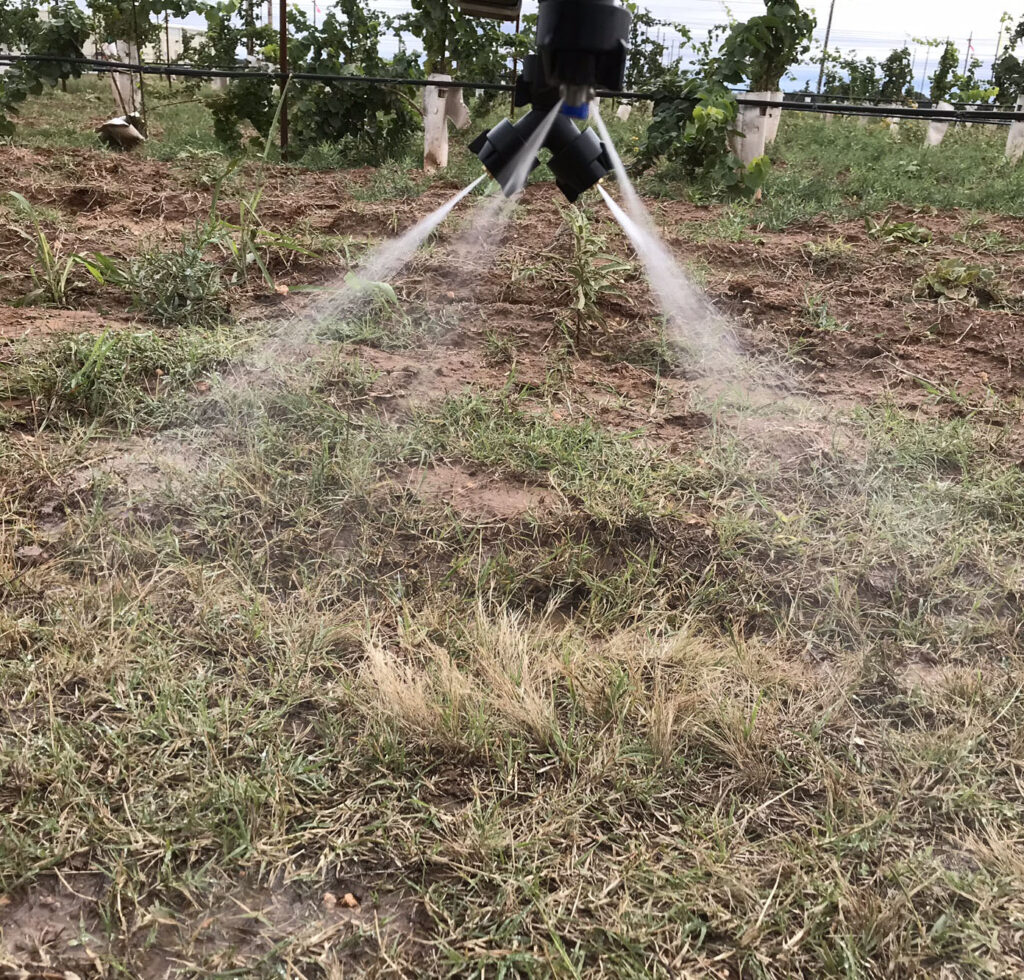
Image of double regular knozzels spraying down into vineyard

By: Kirk Williams, Lecturer-Texas Tech University

While there are many methods to control weeds, weed control with herbicides remains a viable option due to its lower cost versus other options such as mechanical cultivation.  When herbicide applications are done efficiently it can be a much faster process when compared to mechanical cultivation. 

  Application of herbicides through nozzles is important for correct herbicide distribution and dosage over the target.  The target could be existing weeds in the case of post emergent herbicides or the soil surface with pre-emergent herbicides or a combination of both existing weeds and the soil surface in the case of tank mixing post emergent and pre-emergent herbicides.  Coverage is critical for herbicides to work effectively.  Hydraulic spray nozzles create a wide range of droplet sizes.   These droplets are measured in microns with droplets from 200 to 400 microns considered the most appropriate size for herbicide applications.   Larger droplet sizes may bounce or roll off leaves while very fine droplets are more prone to drift.

  To provide satisfactory results, recommendations from Syngenta, one of the manufacturers of water sensitive cards, is to have 20 to 30 droplets per square centimeter for pre-emergent herbicides. For post emergent herbicide applications, it is recommended to have 30 to 40 droplets per square centimeter.   A square centimeter is about 1/6 of a square inch. 

  One way to increase and improve coverage in herbicide applications is to use a double nozzle body.  This allows two nozzles to occupy the same space as one nozzle.  The double nozzle body allows you to easily increase the volume of coverage no matter what kind of nozzle you using. This is especially true when you have to use a relatively large spray nozzle to apply higher volumes.  Larger sprayer nozzles tend to produce coarser droplets.  Splitting the required flow into two nozzles can produce an efficiency gain by decreasing the number of coarse droplets.  The double nozzle body also helps with increasing droplet coverage of target.  (See the double nozzle body set up in Image 1).

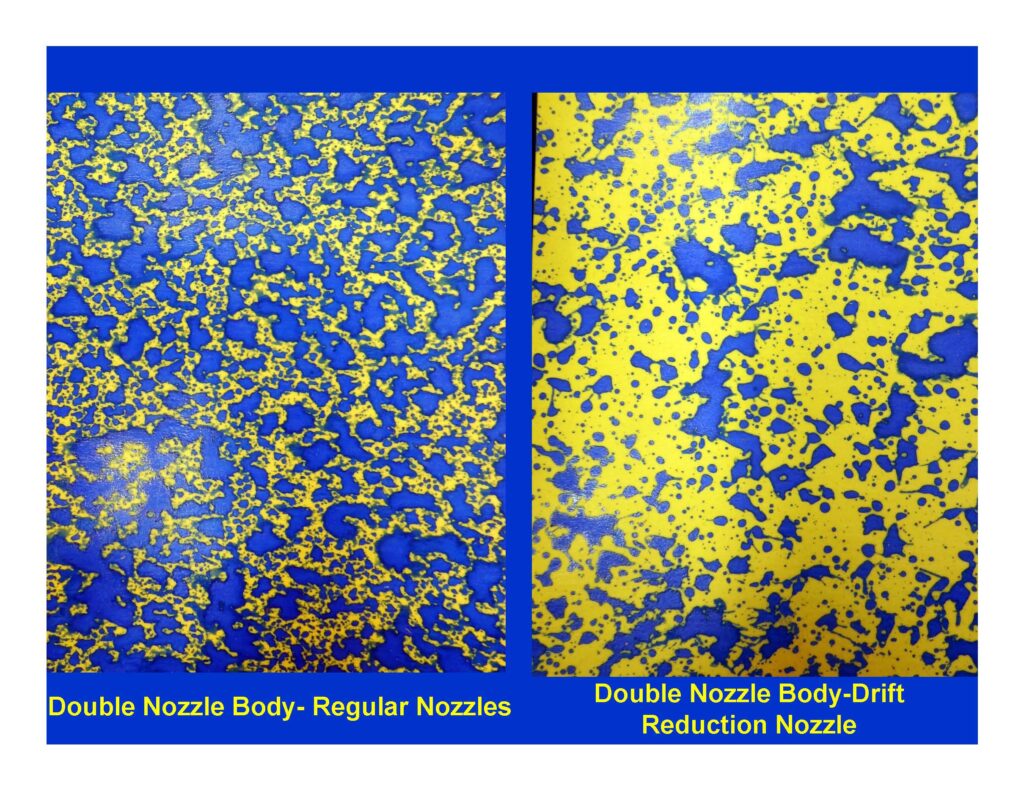
  It was found in a study with water sensitive cards that coverage was increased by 20% when double nozzle bodies were used when compared to single nozzle bodies.   The study used regular flat fan off center 03 nozzles, calibrated to deliver 47 gallons per treated acre and the water sensitive cards were placed on the berm underneath the grape vines.   While the double nozzle body had higher coverage the droplets per square centimeter went down due to the droplets running together versus the single nozzle body.  The single body nozzle had 43 droplets per square centimeter while the double body nozzle had 17 droplets per square centimeter but the droplets are much bigger.  (See the water sensitive cards in image 2).   While the droplets per square centimeter are out of the recommended range for droplets per square centimeter for herbicides with the double nozzle body the better coverage should result in similar or better weed control with both pre-emergent herbicides and post emergent herbicides. 

Regular single nozzle setup compared to double nozzle body regular nozzle

  Herbicide application technology has improved with a wider selection of nozzles available.  Adoption of these newer type of nozzles has been widely adopted in row crops but may be not as widely adopted for vineyard herbicide applications.  These newer type nozzles reduce drift but still deliver good weed control. 

  Air Induction nozzles are a newer type of nozzle that are available in a wide range of spray tips.  The air-induction nozzle is noted for producing large drops through the use of a venturi air aspirator. The venturi draws air into the nozzle through holes in the side of the nozzle and then the air is mixed with the solution to create larger spray droplets, which reduces drift potential.   These larger droplets are filled with air bubbles and explode on impact with the target surface and produce coverage that is similar to other nozzle types. 

  Many sustainable grape growing standards include drift management as a component of their plans.  The incorporation of air induction nozzles that reduce drift by reducing the number of fine, drift prone droplets could be a part of meeting the requirements of these standards.  Drift reduction is important during the growing season to reduce phytotoxicity due to herbicides.  When herbicide applications take place in the in dormant season, phytotoxicity to the grapevines is not an issue but with the wide spread adoption of cover crops, herbicide applications need to stay where they are intended to be, so they don’t impact the cover crops.     

  In a study, double nozzle bodies were equipped with air induction under banding nozzles (AIUB8503), calibrated to deliver 44 gallons per treated acre.  Water sensitive cards were placed on the berm underneath the grape vines.  This nozzle configuration delivered 56% coverage of the water sensitive cards and produced 26 droplets per square centimeter.  As you can see, in the water sensitive cards in (image 3) the droplets produced are large with few small droplets.  The droplets per square centimeter are in the recommended range for droplets per square centimeter for pre-emergent herbicides but outside of the recommended range for post emergent herbicides.  The coverage produced should result in similar or better weed control with both pre-emergent herbicides and post emergent herbicides when compared to the regular nozzle set up.  The air induction nozzles will also produce a minimum of drift prone fine droplets.  

Double nozzle body regular nozzles compared to double nozzle body drift reduction nozzle

  Adoption of double nozzles bodies into your herbicide application program will increase coverage for both pre-emergent and post emergent herbicides.   Switching to air induction nozzles is one way to make sure the herbicides that you are using stay where they are intended to.   

  In addition to coverage and nozzle selection, don’t forget about integrated weed management principles.  These principles include knowing and correctly identifying your weed problems so that appropriate herbicides can be chosen.  Controlling weeds when they are small when they are more susceptible to herbicides and easier to have better spray coverage.  Another integrated weed management principle is to keep annual weeds from going to seed which reduces the weed seed bank in the soil.   Other principles include rotating among herbicides with different modes or action or tank mixing herbicides with different modes of action together which helps manage weed population shifts as well as herbicide resistance.  Staying clean is easier than trying to clean up a mess, so pre-emergent herbicides may help to keep the vineyard berms clean.  

  Kirk Williams is a lecturer in Viticulture at Texas Tech University and teaches the Texas Tech Viticulture Certificate program.  He is also a commercial grape grower on the Texas High Plains.  He can be contacted at kirk.w.williams@ttu.edu

Moving Wine in the Cellar

row of wine tanks in winery

By: Tom Payette – Winemaking Consultant 

Transfers are a large part of the day to day operations in the cellar and on the crush pad; yet, few documents exist what should be considered when doing transfers.  Below are some ideas and tips to think of when transferring wine or juice at the winery.  It is assumed the pump, hoses and receiving vessel(s) are all appropriately clean for the endeavor at hand.

Venting

  Always vent both tanks and double check this operation is done.  Often I will not only remove the airlock but I will unlatch the lid and flip the threaded latch inward so the tank top rests on top of the handle.  This is just double assurance the tank I am transferring from and to is completely vented.

Assembling Your Hoses

  Always place the pump as close to the tank you are coming from with as little hose as reasonably needed to get the job done.  Do plan for being able to gently bend or curve the hose into the doorway in the event a racking is being done.  Plan enough hose length for other future transfer needs when feasible.  Also make sure to place the pump away from any water such as wash down areas or leaky faucets etc.  These pump motors are electric and they generally are not made to be soaked with water.

Taste

  Before you start the pump – taste the tank or barrels you are about to transfer or rack.  Confirm it is indeed the wine / product you are interested in moving.  Does it taste clean and what you expect?  If not – contact someone above you on the winemaking ladder to confirm the flavors etc.

Checking the Connections

  Always double check your connection to confirm the hoses run from the tank desired to the receiving vessel selected.  Are the connections secured?  Should you attach to the racking valve of the tank you are transferring from?

  Are the lines secure at the pump?  Is the bypass on the pump, if equipped, open or closed?  Is there enough capacity in the receiving tank and did you look inside both tanks when you were venting them?

Valve at the Pump

  For control I typically prefer to have a valve installed at the pump.  This allows one to turn off the pump and immediately confirm the stop of liquid flow through the pump and lines set up.  (Note: this is not done if transferring must.)

Pump Choice

  The pump choice is often related to the wine and the overall goal of the transfer.  If speed is needed – choose the fastest pump.  If gentleness is desired – use your most gentle pump.  A centrifugal pump can be very gentle but it may not be the best choice for a red wine “pump over”, etc.  Know what limits each pump has and generally how they operate etc.

Staying with Your Transfer

  Never leave your transfer.  This is not the time to walk off into another area and to get distracted.  A racking valve could inadvertently be left open or a door leak could be discovered.  If a phone call, or other distraction, should come in that has you leaving the area – stop the pump and close all valves to the tanks.

Main Goal

  Keep in mind the main goal of the transfer.  If the wine is a delicate wine – use the inert techniques you have at your disposal.  This could include gassing your lines, with carbon dioxide or your inert gas of choice, before pumping liquid.  Gassing your receiving tank, as well, can limit exposure to oxygen.   If the wine needs a touch of air – use techniques that may achieve that goal.  An example may be splashing into a macrobin, or other open vessel, to give some air.  Be careful here.

Oxidation Control (Inert Technique)

  Is oxidation a concern during this transfer?  If so – many winemakers will flush their hoses and receiving tank with an inert gas such as Nitrogen, Carbon dioxide or Argon.  This can be done by simply connecting the hoses to the pump, opening the bypass and flushing the inert gas from the receiving line all the way through until you are comfortable the inert gas has reached the far side of the  transfer connections.  Then attach the hose to the bottom valve of the receiving vessel.   Further protection can be gained by flushing out the tank with an inert gas as well.  [Many wineries now have the ability to make dry ice (carbon dioxide) on site and they will place dry ice in both vessels while the transfer is being done].  These processes can be used on juice transfers also – not just wine!

Air – introduction

  In some cases you may want some air introduced into the wine.  If that is the objective you do this by attaching to the racking valve of the receiving tank at the start of the transfer.  Splashing will occur, in the receiving tank, until the wine reaches that point, of course.  This is a small amount of air especially when working with a “tight red”.   Other more severe forms of air introduction can be achieved with splashing into a bin and transferring out into the receiving tank, splashing into the top of the receiving vessel or starting the transfer and throttling back the valve on the suction side of the hose (positive displacement pump only) while slightly cracking the hose connection to allow air to suck in.  [Please have an experienced winemaker present to justify how or if these processes should be done as described in this section].  One could also assemble a special “T”, with valves, for more precise control on the suction side of the pump.  This process may be hard on the pump and damage it if not done properly.

Sloppy Racking

  This is often a term one will use when the amount of solids that may come over into the receiving vessel is not that large of a concern.  Examples of this may be when racking off a white juice after cold settling.  We want to make sure we retain as much of the saleable volume as possible so we may elect to have small portions of solids come over into the receiving tank.  [This is less of a worry if we have a Lees Filter Press is on site]

  Another example may be when racking off bentonite.  Small amounts of the fluffy bentonite layer may be allowed to transfer over, again, to make sure we retain as much saleable volume as possible but not jeopardizing the heat/protein stability of the final wine in the receiving tank.  Don’t get carried away with this concept but don’t be wasteful either.  It’s a balance.

Listen

  I often relate to new winemakers in a manner that tell them your senses are incredible when working in a winery.  Your eyes are a large part of seeing that the transfer is happening as planned but your ears can also be a huge part of catching problems. 

  Always stay near by the tank and listen for falling liquids, pump noise changes etc.  Once wine or juice has filled past any possible orifices, and no leaks discovered, then one can more freely move around the cellar with periodic checks.  Do not completely leave the area and always “have an ear on the situation”.

Watch

  Many wineries have translucent hoses.  Watch the liquid as it moves through the lines.  Do you see air?  Why?  If the wine lines start to contract or expand – take note as to why.  Did someone close a valve or has some other physical function changes the stature of the hoses.  Hoses typically don’t move, without reason, so be aware visually to this indicator something is happening.

Chasing Your Liquid

  At the end of the liquid transfer you may wonder how to empty your lines.   If you have a bypass you can often hook up an inert gas and push the liquid all the way through.   If you don’t currently have that option you can attempt to “push” the juice or wine with chlorine free water.  Simply place the suction line in water, after the wine or juice has vacated enough internal line, and allow the water to run through the pump.   Look through the hose to understand when the water reaches the receiving tank and then turn the pump off and shut the tank valve.

Never Run Your Pump Dry

  In most cases we all agree not to run your pump dry.  The pump needs liquid in order to make sure heat is not created.  There are variable options to this statement so if unclear …. Never run your pump dry.  That is the safest bet.

Summary

  Transfers are a large part of moving your precious liquids around the winery.  Stay nearby, listen to the equipment while visually looking for leaks.  Also – know what your goals are.  This should not be a mindless transaction in the cellar and the more you think through your goals for each wine the more creative ways you can achieve them even during these everyday tasks.  This is part of the winemaking process.

Other Helpful Tips

  Recall no hoses should leak in the cellar.  The paths for these leaks are areas for bacteria to breed and grow.  Further understand a leaking hose on the discharge side of a transfer wastes wine; but a leaking hose on the suction side of a transfer will mostly introduce air and possibly bacteria.   Oouch.

  When starting a racking I like to attach all the hoses and then open the bypass on the pump (if equipped) without starting the pump.  I then open the valve on the tank to be transferred.  This allows the winemaker to track the liquid, see that all valves are open and working, look for initial leaks and confirm all is performing well before turning the pump on.  It is very gentle and should minimize air, oxygen or gases from being dissolved in the liquid.

  In general, winemakers typically transfer out of the racking valve of the tank being racked from and into the bottom valve of the receiving tank.  There are, or can be, exceptions to this rule.

  Take into consideration the temperature of the juice or wine. As a reminder cold liquids dissolve more gases into them than warmer liquids.  Therefore a colder wine / juice may dissolve more oxygen than a warmer liquid.  

  Always clean the tank you emptied right after it is empty.  It cleans up so much better and actually saves time in the long run. 

  A racking is typically a term used when the transfer is started from the racking valve and then finished while “pulling the liquid” through the side doorway of the tank.  One typically uses a flashlight to discern the solids layer while obtaining the clear liquid.

  A transfer is often a term when going from the bottom valve of one tank to the bottom valve of another.  Still being cognizant of solids at the bottom but understanding the wine / juice is generally “clean”.

  Be sure to record all transfers: recording the tank transferred from (varietal and vintage), the volume(s), the receiving tank, date and gains or losses.

  If racking barrels you should taste each one of them first.  It is not uncommon to find the last barreled filled previously is more “reduced” than the others due to more solids in that barrel.  If this proves to be the case I will either rack that barrel first, with most of the air becoming in contact with that volume, or treat it for the reduction and rack it first.  In any case this may slightly mitigate some of the reduction.  Plus – if one barrel is not what you expect – you want to identify that before you pump it out into a larger blend.

  Have fun and make sure your transfers are successful, with intention and objective and with as little liquid on the ground as possible.  You are “pumping money around I like to say”!

References: 

  Verbal discussion with Mr. Jacques Boissenot, Mr. Jacques Recht, Mr. Chris Johnson and Mr. Joachim Hollerith.

Update on Grapevine Plant Quarantine and Certification Programs

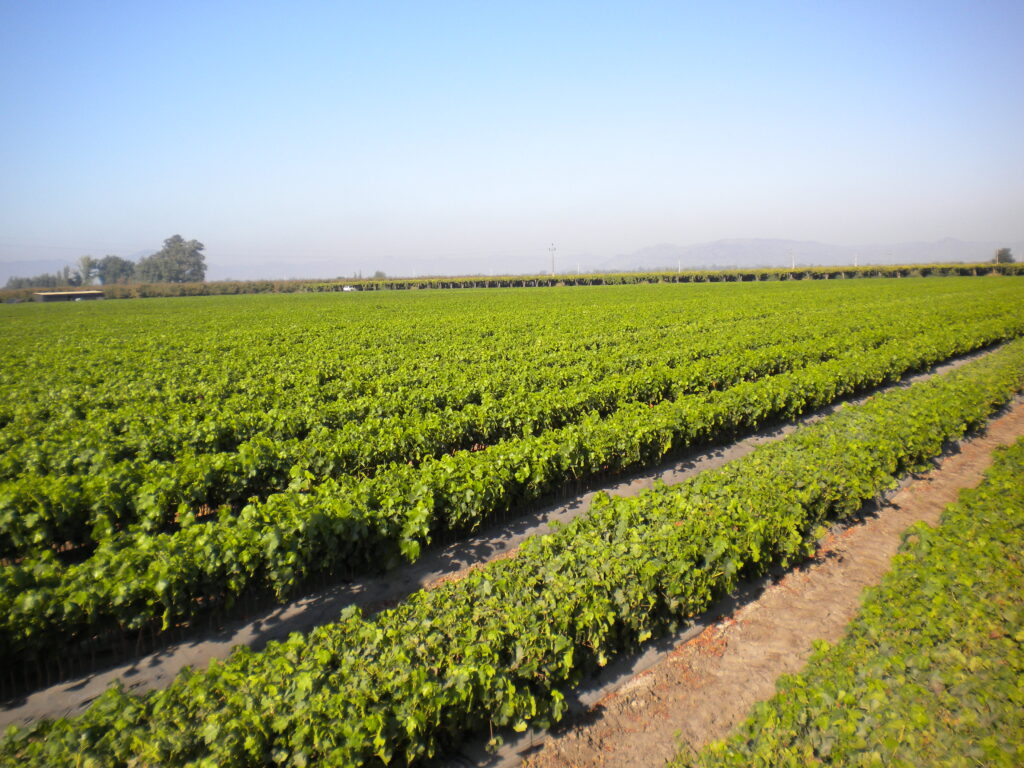
healthy nursery row of grapevines

By:  Judit Monis, Ph.D. – Vineyard and Plant Health Consultant

New methods are being applied for the testing of imported plants and the certified foundation mother blocks at the University of California at Davis that manages the foundation blocks for the California (CDFA) certification program.  After so many years of considering the biological indexing technique a gold standard, the methodology has been replaced with modern technology that is able to detect any virus in the propagation material.  Furthermore, due to the infection and spread of Grapevine red blotch virus (GRBV) in the former CDFA (Russell Ranch) certified foundation block, new measures are being applied to avoid that the problem occurs again. 

Plant Quarantine Programs

  Plant quarantine programs have been developed worldwide to reduce the risk of introducing foreign plant pests and/or pathogens not found in a particular state, country, or region.  My expertise is plant pathology and throughout my career I have specialized in the application and development of methods for the detection of bacteria, fungi, and viruses that cause diseases in vineyards and fruit orchards.  In spite of the current existence of plant quarantine programs, most grapevine pathogens with rare exceptions occur in all grape growing areas in the world.  The reason is that in most cases, quarantine programs were implemented after the introduction of the infected plant material.  In addition, modern techniques for the detection of these pathogens were not available at the time of plant introduction. In other words, the majority of grapevine pests and pathogens were moved unknowingly.  The advancement of science and the use of sophisticated detection methods for grapevine pathogens and isolation has helped keep certain viruses outside of Australia.  For example, Grapevine fanleaf (GFLV) has not been reported in Australia as of yet.  Presently, with the use of advanced methodologies, new pathogens continue to be discovered. As science progresses with the development of more refined technology (e.g., next generation sequencing also known as high throughput sequencing), it is expected that new (or unknown and established) pathogens will be discovered. In practice, most grapevine pathogens have originated at the centers of origin of Vitis species (a plant genus that includes both table, wine, and rootstock grapevine varieties) and moved to many grapevine growing areas of the world during plant introduction. 

  In the United States, the United States Department of Agriculture (USDA) Animal and Plant Inspection Services (APHIS) Plant Pest Quarantine (PPQ) unit regulates the introduction of plant material for planting from foreign countries.  However, the USDA does not have a centralized government plant quarantine center.  Instead, the APHIS PPQ  issues permits to specific clean plant centers with proper containment facilities and approved protocols to manage the quarantine of specific crops. For grapevines, two importation centers are available for introducing quarantined planting material: The Foundation Plant Services (FPS) at the UC at Davis and the Clean Plant Center at Cornell University in Geneva, New York.  

Grapevine Certification Programs

  Grapevine certification programs are needed to produce tested plant material that is free of important known pathogens.  These plants are then distributed to nurseries that propagate and sell these plants to growers.   In the United States, certification programs are voluntary and are managed by individual states.  I will describe the California certification program as many US grapevine growing regions purchase planting material from California nurseries. 

  The Grapevine California Registration and Certification (R&C) Program was first written into law in the 1980’s.   The Grapevine R&C Program is administered by the California Department of Agriculture (CDFA) and provides for the testing of source vines for grapevine viruses that cause important diseases. Registered sources and certified nursery stock are periodically inspected by the CDFA staff and are maintained by the participant nurseries.   Starting in 1996, I participated and provided input at the industry meetings that lead to the revision of the California Grapevine R&C program many years later.   In 2010 the Grapevine R&C program was revised to include testing of foundation mother vines for the presence of a comprehensive list of viruses.

  The California Grapevine R&C Program rules can be found in CDFA’s website:  https://www.cdfa.ca.gov/plant/pe/nsc/nursery/regcert.html

  With funding from the National Clean Plant Network, a new of foundation block named Russel Ranch was planted at the UC Davis in 2009.   The planting material (both scion and rootstock varieties) included in the new foundation block had to pass a rigorous testing program and have been propagated using the “apical micro-shoot tip culture” technique.   The apical micro-shoot tip culture process is a plant tissue culture technique that is used to eliminate pathogens from vegetative propagated plant material.  The testing program at UC Davis is known as Protocol 2010.  The maintenance and testing of the scion and rootstock mother blocks are performed by UC Davis FPS personnel.  Shortly after the update of the California Grapevine R&C Program, GRBV, a virus of significant importance for the vineyard industry, was discovered.  Consequently, the California Grapevine R&C Program was revised to include the testing of foundation and nursery increase blocks for the presence of GRBV.  Sadly, the Russell Ranch foundation block became progressively infected with GRBV.  The infection status was so high that FPS had to suspend the sale of plant material to nurseries. 

  The testing of the foundation mother plants includes a list of well characterized viruses, Xylella fastidiosa, and phytoplasmas using biological, serological, and molecular testing techniques (https://fps.ucdavis.edu/fgr2010.cfm).  The nursery increase blocks are inspected and tested by CDFA personnel with a reduced number of pathogens.  The updated Grapevine R&C added the testing for the detection of GRBV using the polymerase chain reaction (PCR) to vines in the foundation and nursery increase blocks.  Related to nursery certified plants, the rules are vague and state that certified plants may be tested (particularly if after inspection suspected symptoms are observed).  According to CDFA, the goal is to test a statistical sample with a 95% confidence level assuming a 1 % disease incidence.  It is disappointing that in spite of the importance of the decline and canker diseases caused by fungal pathogens (and how easily the pathogens can be transmitted by activities carried out at the nursery), the regulations do not include inspection or testing for fungal pathogens in foundation or increase blocks. 

  The use of certified material is expected to be less risky than planting field selections of unknown infection status.  However, it is always prudent to consult with me to assure that the planting material meets the expected cleanliness standards. An important piece of advice when working on the procurement of clean planting stock is to plan in advance.  Most nurseries in California collect cuttings for budwood as soon as the vines are dormant.  However, grafting activities are performed during the spring of the following year.  Planning with time will allow for inspection of the increase blocks early in the fall before a freeze.   Being familiar with the nursery’s operations and their staff is important.  Good communication will help with scheduling inspections and testing of the increase blocks from which bud wood and rootstock cuttings will be collected. 

Changes in the Testing and Management of UC Davis Grapevine Foundation Block and Introduce Quarantine Plant Material

  The FPS laboratory at UC Davis performed comparative studies between the traditional biological indexing technique and the high throughput sequencing (HTS) methodology.  To refresh my readers, the biological indexing technique or commonly known as woody indexing is an ancient method that relies on the grafting of grapevine (or other woody species) material onto an indicator host.  An indicator host, is a plant variety that is very susceptible to the disease we wish to detect.  For example, the indicator host for grapevine leafroll disease is  Cabernet Franc.  To perform the assay, buds from quarantine or foundation plants are grafted onto the indicator plants.  After a period of time (generally two years) the symptoms of the grafted plants are recorded. If the  buds of the grapevine plants that we wish to test for are infected with a virus that causes red leaf discoloration, and successfully transmits the virus to the indicator plant, it is concluded that the test vine is infected with a Grapevine leafroll associated virus (GLRaV). 

  However,  GRBV also causes red leaf symptoms in Cabernet Franc and other red grape varieties, therefore the test vines could be infected with GRBV.  In more simple words, the biological indexing technique is able to detect disease symptoms and not a particular pathogen that causes it. As long as there is a detection, there is no problem.  The problem occurs when a vine is infected but no symptoms are visible in the indicator plants.  In this case, the vines would be considered healthy and will spread a disease-causing agent.  After a series of experiments and discussions with regulators at USDA APHIS PPQ and CDFA, UC Davis FPS personnel have been able to implement the use of HTS instead of the woody indexing assay. This is a welcomed change I sincerely never expected to happen during my professional life! Another important needed change in the management of the UC Davis foundation plants is the construction of an insect-proof greenhouse that will host the CDFA certified mother vines.  The greenhouse is expected to be finished by the end of 2023.

Conclusions

  Diseases, pathogens, and/or their vectors do not know or respect the borders between blocks (at the nursery, foundation block, or your vineyard).  Even if the planting material came from a reputable certification program, paying attention to the surrounding vineyards as well as having knowledge of the potential presence of disease prior to planting is important.  The planning of a new vineyard is not trivial and requires specialized knowledge.  I am available to help look for suspicious symptoms (inspect scion and rootstock source blocks), evaluate the planting site, develop a testing plan based on science and statistics, and review nursery and vineyard disease testing history.  

  Judit Monis, Ph.D. provides specialized services to help growers, vineyard managers, and nursery personnel avoid the propagation and transmission of disease caused by bacteria, fungi, and viruses in the vineyard.   Judit (based in California) is fluent in Spanish and is available to consult in all wine grape growing regions of the word.  Please visit juditmonis.com for information or contact juditmonis@yahoo.com to request a consulting session at your vineyard.

Uncorking Accessibility

Ensuring Your Website Complies with the ADA

PICTURE OF KEYBOARD SHOWING ADA ICONS IN BLUE

 By: Vanessa Ing, Farella Braun + Martel

In today’s digital age, having an online presence is crucial for businesses, including wineries, breweries, and other beverage companies. Accordingly, it’s essential to ensure that your beverage website meets federal standards for accessibility to avoid lawsuits and fines. In this article, we will help beverage companies understand how to comply with federal law and implement accessible features on their websites.

Why is Web Accessibility Important?

  In 1990, Congress enacted the Americans with Disabilities Act (ADA). It prohibits businesses open to the public (otherwise known as “public accommodations”) from discriminating against people with disabilities in everyday activities. These everyday activities can include purchasing goods and services, or offering employment opportunities. 

  In March 2022, the U.S. Department of Justice issued web accessibility guidance, reiterating that ensuring web accessibility for people with disabilities is a priority for the Department. Relying on the ADA’s prohibition against discrimination and its mandate to provide equal access, Department of Justice emphasized that the ADA’s requirements apply to all the goods, services, privileges, or activities offered by public accommodations, including those offered on the web. The Department of Justice’s guidance was particularly timely given that many services moved online during the pandemic. 

  In its guidance, the Department of Justice explained that people with disabilities navigate the web in different ways: for example, those with visual impairments might require a screen reader that reads aloud text to the audience.  Those with auditory impairments might require closed-captioning software, while those with impaired motor skills might require voice recognition software.  A website, therefore, should be compatible with the full range of such software. 

Is Your Beverage Company a “Public Accommodation” Business?

  Public accommodations include businesses that sell goods and services, establishments serving food and drink, and places of recreation or public gathering.  Companies that sell drinks, wineries that offer a tasting room, or breweries that host events are all considered public accommodations.  Thus, those businesses’ websites must comply with the ADA by being accessible to people with disabilities. 

  It is an open question whether beverage companies without a physical location open to the public must still have ADA-compliant websites. Some jurisdictions, like the Ninth Circuit (which has jurisdiction over Alaska, Arizona, California, Hawaii, Idaho, Montana, Nevada, Oregon, and Washington), have tied the necessity of ADA-compliant websites to the existence of a brick-and-mortar location (Robles v. Domino’s Pizza, LLC). However, the Department of Justice, along with several federal circuit courts of appeals, has taken the position that even a public accommodation business without a physical location must have an ADA-compliant website. 

  Given the increased prevalence of online-only services open to the public, it is very likely that litigation over the next few years may resolve this open question.  In the meantime, it is wise for beverage companies to take preventative caution and ensure that their websites are accessible. 

What are some Website Accessibility Barriers?

  To ensure ADA compliance, beverage companies must be aware of common website accessibility barriers.  These include poor color contrast, lack of descriptive text on images and videos, mouse-only navigation, and more.  By addressing these barriers, beverage companies can enhance the user experience for people with disabilities.

  Six examples of website accessibility barriers highlighted in the DOJ’s accessibility guidance include:

Poor Color Contrast: Ensure sufficient color contrast between text and background to aid individuals with visual impairments or color blindness. Use color combinations that are easy to distinguish.

Use of Color Alone to Give Information:  Avoid using color alone to provide information.  Using color alone can be very disorienting for someone who is visually impaired or colorblind.  Someone who is colorblind might not be able to distinguish between shades of gray.  One solution might be to ensure that symbols conveying information are differently shaped.    

Lack of Descriptive Alternative Text for Images and Videos: Provide descriptive text (alt text) for images and videos, allowing screen readers to convey the information to visually impaired users. This makes your content more accessible and inclusive.

No Closed Captions on Videos: Include closed captions for videos to accommodate individuals with hearing impairments. Utilize manual or automatic captioning options and review the captions for accuracy.  Free options are available on the web.

Inaccessible Online Forms: Make online forms user-friendly for people with disabilities. Provide clear instructions before the form, ensure that a screen reader could recognize required fields and fields with special formatting, ensure keyboard-only navigation, use accessible labels for inputs, and display clear error messages.  Note that an image-based CAPTCHA is not a fully accessible way to secure your form; your CAPTCHA should offer users who are visually impaired an audio alternative.

Mouse-Only Navigation: Enable keyboard-only navigation on your website to assist individuals with motor skill impairments or those who cannot use a mouse or see a mouse pointer on the screen.  Make sure all interactive elements can be accessed using the tab, enter, spacebar, or arrow keys.  Use a “Skip to Main Content” link to ensure that users employing only a keyboard can easily navigate the website’s primary content. 

  To implement these features, beverage companies should discuss accessibility concerns upfront with the web developer.  Beverage companies should keep in mind that posting a phone number on a website to call for assistance, as commonly utilized by businesses, does not sufficiently provide equal access to the website and the services or goods provided.

Who can Sue Beverage Companies?

  Non-compliance with ADA standards can lead to potential lawsuits.  Although some courts have held that a nexus must exist between a private plaintiff’s disability and the web accessibility barrier claimed, a private plaintiff may easily surf the web for websites that are inaccessible.  A private plaintiff may then file a lawsuit in federal court without first notifying the business.  Further, liability under the ADA is strict, which means that the intent of the business to comply is immaterial.  Thus, it is prudent for beverage companies to proactively address accessibility issues to avoid potential legal troubles. 

  Private lawsuits under the ADA can result in injunctive relief (a court order to comply with the ADA) and attorney fees.  And in some states, like California, the state law version of the ADA may enable plaintiffs to demand monetary damages ($4,000 per violation of the ADA). 

  Government involvement, while less frequent, is possible in cases involving national retailers.  If the Department of Justice observes a pattern or practice of discrimination, the Department will attempt to negotiate a settlement, and may bring suit on behalf of the United States. At stake are fines of up to $75,000 for the first ADA violation, and up to $150,000 for each subsequent violation.

What are the Rules for Website Accessibility?

  Although the ADA itself does not spell out the rules for website accessibility, several sources provide detailed rules that can aid beverage companies in building accessible websites. 

  First, the ADA authorizes the Department of Justice to enforce the statute.  Accordingly, the Department develops and issues regulations explaining how businesses must comply.  Specifically, § 36.303 of the Electronic Code of Federal Regulations specifies that a public accommodation shall provide auxiliary aids and services when necessary to ensure effective communication with people with disabilities, and that a public accommodation should consult with people with disabilities whenever possible.  The Department also issues administrative guidance, such as its March 2022 guidance described above.  

  Second, Section 508 of the Rehabilitation Act of 1973, which requires federal agencies to make their electronic and information technology accessible to people with disabilities, provides detailed guidance concerning the display screen ratios, status indicators, audio signals, and other accessibility features. 

  Third, the Web Content Accessibility Guidelines 2.1 (WCAG 2.1), which were originally designed by a consortium of four universities, provide highly specific web accessibility guidelines grounded on the idea that information on the web must be perceivable, operable, understandable, and robust.  These guidelines are widely referenced in court cases and settlements with the Department of Justice, as the guidelines address numerous aspects of web accessibility and offer three different levels of conformance (A, AA, AAA). Beverage companies can consult the WCAG 2.1 guidelines (including a customizable quick reference guide, at https://www.w3.org/WAI/WCAG21/quickref/) to ensure their websites meet ADA compliance. 

Looking Ahead

  Web accessibility standards evolve over time, with updates being released periodically. Beverage companies should stay informed about changes and updates to ADA compliance regulations. For example, the WCAG 3.0 is scheduled for release in the latter half of 2023, further refining accessibility guidelines.

  In sum, by understanding and identifying web accessibility barriers, and implementing necessary accessibility features, beverage companies can enhance user experiences and minimize the risk of legal repercussions. Embracing web accessibility is not only legally required but economically prudent in the long run, as it enables beverage companies to cater to a broad and varied audience, and demonstrates a commitment to inclusivity in the digital realm.

  Vanessa Ing is a litigation associate with Farella Braun + Martel and can be reached at ving@fbm.com. Farella is a Northern California law firm representing corporate and private clients in sophisticated business and real estate transactions and complex commercial, civil and criminal litigation. The firm is headquartered in San Francisco with an office in the Napa Valley that is focused on the wine industry.