


Page 13 - GrapevineMarApr 2022
P. 13
In The Winery


               process, from the grape skins to the barrels. It can
               be challenging to control or eradicate because it
               grows into the barrel wood and becomes hidden.
               Brettanomyces seldom reveal themselves during
               the fermentation process but rather prefer to flour-
               ish during aging. Some winemakers claim that a
               low level of Brettanomyces can give wine desirable
               characteristics, but any more than that will ruin the
               whole batch.

                 In-barrel wine spoilage and short barrel life are
               problems facing the wine industry. Under the best
               conditions, wine barrels require a routine mainte-
               nance regimen to control taste- and aroma-fouling
               bacteria in affected barrels and keep them from
               taking over new, unaffected barrels.

                                 Steamericas:
                           Blending Science With                    a gallon of water per barrel in the entire sanitation
                             Eco-friendly Process                   process. Using dry steam is the quickest and most
                                                                    thorough way to sanitize a barrel, and it’s also a
                 “Winemakers should clean and sanitize their        popular method to swell or rehydrate wooden bar-
               barrels absolutely after every use,” said Yujin Yoo   rels for not only wineries but also breweries and
               Anderson, General Manager of Steamericas. “By        distilleries.”
               sanitizing with a dry steam process, you can simul-
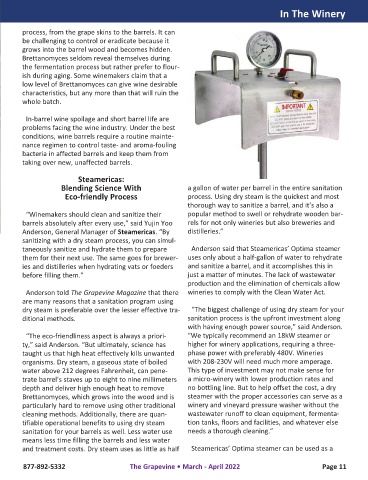
               taneously sanitize and hydrate them to prepare         Anderson said that Steamericas’ Optima steamer
               them for their next use. The same goes for brewer-   uses only about a half-gallon of water to rehydrate
               ies and distilleries when hydrating vats or foeders   and sanitize a barrel, and it accomplishes this in
               before filling them.”                                just a matter of minutes. The lack of wastewater
                                                                    production and the elimination of chemicals allow
                 Anderson told The Grapevine Magazine that there  wineries to comply with the Clean Water Act.
               are many reasons that a sanitation program using
               dry steam is preferable over the lesser effective tra-    “The biggest challenge of using dry steam for your
               ditional methods.                                    sanitation process is the upfront investment along
                                                                    with having enough power source,” said Anderson.
                 “The eco-friendliness aspect is always a priori-   “We typically recommend an 18kW steamer or
               ty,” said Anderson. “But ultimately, science has     higher for winery applications, requiring a three-
               taught us that high heat effectively kills unwanted   phase power with preferably 480V. Wineries
               organisms. Dry steam, a gaseous state of boiled      with 208-230V will need much more amperage.
               water above 212 degrees Fahrenheit, can pene-        This type of investment may not make sense for
               trate barrel’s staves up to eight to nine millimeters   a micro-winery with lower production rates and
               depth and deliver high enough heat to remove         no bottling line. But to help offset the cost, a dry
               Brettanomyces, which grows into the wood and is      steamer with the proper accessories can serve as a
               particularly hard to remove using other traditional   winery and vineyard pressure washer without the
               cleaning methods. Additionally, there are quan-      wastewater runoff to clean equipment, fermenta-
               tifiable operational benefits to using dry steam     tion tanks, floors and facilities, and whatever else
               sanitation for your barrels as well. Less water use   needs a thorough cleaning.”
               means less time filling the barrels and less water
               and treatment costs. Dry steam uses as little as half    Steamericas’ Optima steamer can be used as a

               877-892-5332                       The Grapevine • March - April 2022                            Page 11


          Grapevine Main Pages GV030422_Layout 1-1  copy.indd   11                                                  2/24/22   3:34 PM

