


Page 27 - Grapevine JanFeb 2021_REV
P. 27
Marketing


                 However, did this trend continue? Hubspot says                      Open Rates Fell
               no. The marketing juggernaut released a report at
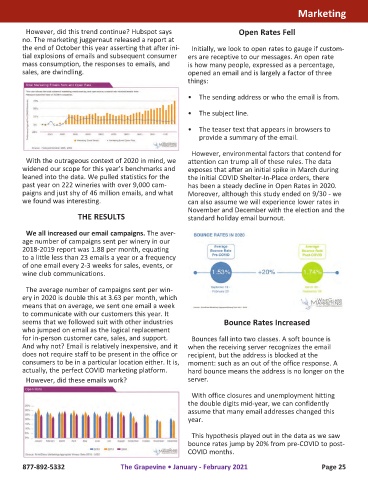
               the end of October this year asserting that after ini-    Initially, we look to open rates to gauge if custom-
               tial explosions of emails and subsequent consumer    ers are receptive to our messages. An open rate
               mass consumption, the responses to emails, and       is how many people, expressed as a percentage,
               sales, are dwindling.                                opened an email and is largely a factor of three
                                                                    things:

                                                                    •  The sending address or who the email is from.

                                                                    •  The subject line.

                                                                    •  The teaser text that appears in browsers to
                                                                        provide a summary of the email.

                                                                      However, environmental factors that contend for
                 With the outrageous context of 2020 in mind, we    attention can trump all of these rules. The data
               widened our scope for this year’s benchmarks and     exposes that after an initial spike in March during
               leaned into the data. We pulled statistics for the   the initial COVID Shelter-In-Place orders, there
               past year on 222 wineries with over 9,000 cam-       has been a steady decline in Open Rates in 2020.
               paigns and just shy of 46 million emails, and what   Moreover, although this study ended on 9/30 - we
               we found was interesting.                            can also assume we will experience lower rates in
                                                                    November and December with the election and the
                                 THE RESULTS                        standard holiday email burnout.

                 We all increased our email campaigns. The aver-
               age number of campaigns sent per winery in our
               2018-2019 report was 1.88 per month, equating
               to a little less than 23 emails a year or a frequency
               of one email every 2-3 weeks for sales, events, or
               wine club communications.


                 The average number of campaigns sent per win-
               ery in 2020 is double this at 3.63 per month, which
               means that on average, we sent one email a week
               to communicate with our customers this year. It
               seems that we followed suit with other industries                Bounce Rates Increased
               who jumped on email as the logical replacement
               for in-person customer care, sales, and support.       Bounces fall into two classes. A soft bounce is
               And why not? Email is relatively inexpensive, and it   when the receiving server recognizes the email
               does not require staff to be present in the office or   recipient, but the address is blocked at the
               consumers to be in a particular location either. It is,  moment: such as an out of the office response. A
               actually, the perfect COVID marketing platform.      hard bounce means the address is no longer on the
                 However, did these emails work?                    server.

                                                                      With office closures and unemployment hitting
                                                                    the double digits mid-year, we can confidently
                                                                    assume that many email addresses changed this
                                                                    year.

                                                                      This hypothesis played out in the data as we saw
                                                                    bounce rates jump by 20% from pre-COVID to post-
                                                                    COVID months.

               877-892-5332                    The Grapevine • January - February 2021                         Page 25


          Grapevine Main Pages G010221_Layout 1-1 .indd   25                                                        12/21/20   2:15 PM

