


Page 65 - Grapevine MayJune 2021_REV
P. 65
Around The Vineyard


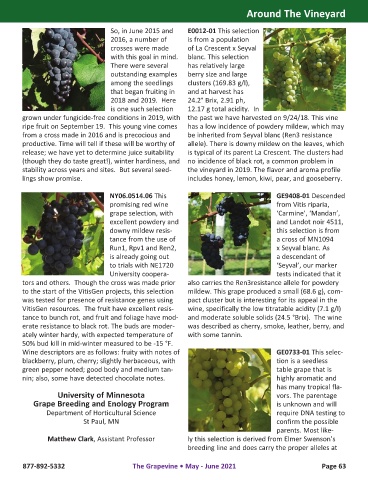
                                           So, in June 2015 and     E0012-01 This selection
                                           2016, a number of        is from a population
                                           crosses were made        of La Crescent x Seyval
                                           with this goal in mind.   blanc. This selection
                                           There were several       has relatively large
                                           outstanding examples     berry size and large
                                           among the seedlings      clusters (169.83 g/l),
                                           that began fruiting in   and at harvest has
                                           2018 and 2019.  Here     24.2° Brix, 2.91 ph,
                                           is one such selection    12.17 g total acidity.  In
               grown under fungicide-free conditions in 2019, with  the past we have harvested on 9/24/18. This vine
               ripe fruit on September 19.  This young vine comes   has a low incidence of powdery mildew, which may
               from a cross made in 2016 and is precocious and      be inherited from Seyval blanc (Ren3 resistance
               productive. Time will tell if these will be worthy of   allele). There is downy mildew on the leaves, which
               release; we have yet to determine juice suitability   is typical of its parent La Crescent. The clusters had
               (though they do taste great!), winter hardiness, and  no incidence of black rot, a common problem in
               stability across years and sites.  But several seed-  the vineyard in 2019. The flavor and aroma profile
               lings show promise.                                  includes honey, lemon, kiwi, pear, and gooseberry.


                                           NY06.0514.06 This                                     GE9408-01 Descended
                                           promising red wine                                    from Vitis riparia,
                                           grape selection, with                                 ‘Carmine’, ‘Mandan’,
                                           excellent powdery and                                 and Landot noir 4511,
                                           downy mildew resis-                                   this selection is from
                                           tance from the use of                                 a cross of MN1094
                                           Run1, Rpv1 and Ren2,                                  x Seyval blanc. As
                                           is already going out                                  a descendant of
                                           to trials with NE1720                                 ‘Seyval’, our marker
                                           University coopera-                                   tests indicated that it
               tors and others.  Though the cross was made prior    also carries the Ren3resistance allele for powdery
               to the start of the VitisGen projects, this selection   mildew. This grape produced a small (68.6 g), com-
               was tested for presence of resistance genes using    pact cluster but is interesting for its appeal in the
               VitisGen resources.  The fruit have excellent resis-  wine, specifically the low titratable acidity (7.1 g/l)
               tance to bunch rot, and fruit and foliage have mod-  and moderate soluble solids (24.5 °Brix).  The wine
               erate resistance to black rot. The buds are moder-   was described as cherry, smoke, leather, berry, and
               ately winter hardy, with expected temperature of     with some tannin.
               50% bud kill in mid-winter measured to be -15 °F.
               Wine descriptors are as follows: fruity with notes of                             GE0733-01 This selec-
               blackberry, plum, cherry; slightly herbaceous, with                               tion is a seedless
               green pepper noted; good body and medium tan-                                     table grape that is
               nin; also, some have detected chocolate notes.                                    highly aromatic and
                                                                                                 has many tropical fla-
                          University of Minnesota                                                vors. The parentage
                  Grape Breeding and Enology Program                                             is unknown and will
                       Department of Horticultural Science                                       require DNA testing to
                                   St Paul, MN                                                   confirm the possible
                                                                                                 parents. Most like-
                       Matthew Clark, Assistant Professor           ly this selection is derived from Elmer Swenson’s
                                                                    breeding line and does carry the proper alleles at


               877-892-5332                       The Grapevine • May - June 2021                               Page 63


          Grapevine Main Pages G030421_Layout 1-1 .indd   63                                                        5/10/21   3:09 PM

