


Page 64 - GrapevineMarApr 2022
P. 64
Around The Vineyard


               and the other team can catch and throw them            Not only should vineyards be taking close-up pho-
               slower than the other team. Eventually both teams    tos of leaves and grapes throughout the growing
               will get their balls to the other end of the soccer   season on specific plants, but microscope apps for
               field, but one team will get their balls there faster.   laptops are an indispensable tool for them also.
               Now think of the balls as chemical molecules.        Digging holes in one spot along a vine row through
                                                                    the years can show changes in soil compaction and
                 The people on the field are like the soil or rock   organic material.
               granules making up the ground below us. As the
               different chemicals move with the groundwater,         Another tool that the author used frequently for
               they released by the soil particles making up the    determining an estimate of soil organic matter was
               ground below us. These are chemical bonding sites    a simple small hand torch. The sample was dried,
               inside all the pores and crevices. For those that    weighed, burnt with the torch flame, and then
               are familiar with laboratory equipment such as gas   reweighed again. It was a surprisingly accurate
               or liquid chromatographs, this is also how these     method since a muffle oven was not available.
               instruments work and measure the chemicals in
               samples run through them.                              The soil, leaves and grapes are sent by the vine-
                                                                    yard for XRD analysis (X-ray Defraction), and this
                 Blocking the movement of water and chemical        analysis usually comes with bonus electron scan-
               compounds are immovable gas voids and water          ning microscope analysis, depending on the lab
               bubbles caught in the matrix of gas/air. This is a   used. It gives a comprehensive break down of the
               problem with well compacted vineyard soils after     constituents.
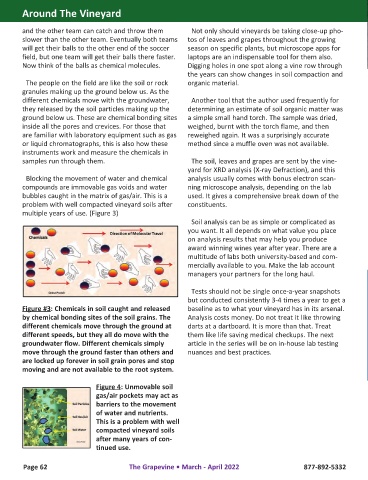
               multiple years of use. (Figure 3)
                                                                      Soil analysis can be as simple or complicated as
                                                                    you want. It all depends on what value you place
                                                                    on analysis results that may help you produce
                                                                    award winning wines year after year. There are a
                                                                    multitude of labs both university-based and com-
                                                                    mercially available to you. Make the lab account
                                                                    managers your partners for the long haul.


                                                                      Tests should not be single once-a-year snapshots
                                                                    but conducted consistently 3-4 times a year to get a
               Figure #3: Chemicals in soil caught and released     baseline as to what your vineyard has in its arsenal.
               by chemical bonding sites of the soil grains. The    Analysis costs money. Do not treat it like throwing
               different chemicals move through the ground at       darts at a dartboard. It is more than that. Treat
               different speeds, but they all do move with the      them like life saving medical checkups. The next
               groundwater flow. Different chemicals simply         article in the series will be on in-house lab testing
               move through the ground faster than others and       nuances and best practices.
               are locked up forever in soil grain pores and stop
               moving and are not available to the root system.

                                       Figure 4: Unmovable soil
                                       gas/air pockets may act as
                                       barriers to the movement
                                       of water and nutrients.
                                       This is a problem with well
                                       compacted vineyard soils
                                       after many years of con-
                                       tinued use.


               Page 62                           The Grapevine • March - April 2022                          877-892-5332


          Grapevine Main Pages GV030422_Layout 1-1  copy.indd   62                                                  2/24/22   3:34 PM

